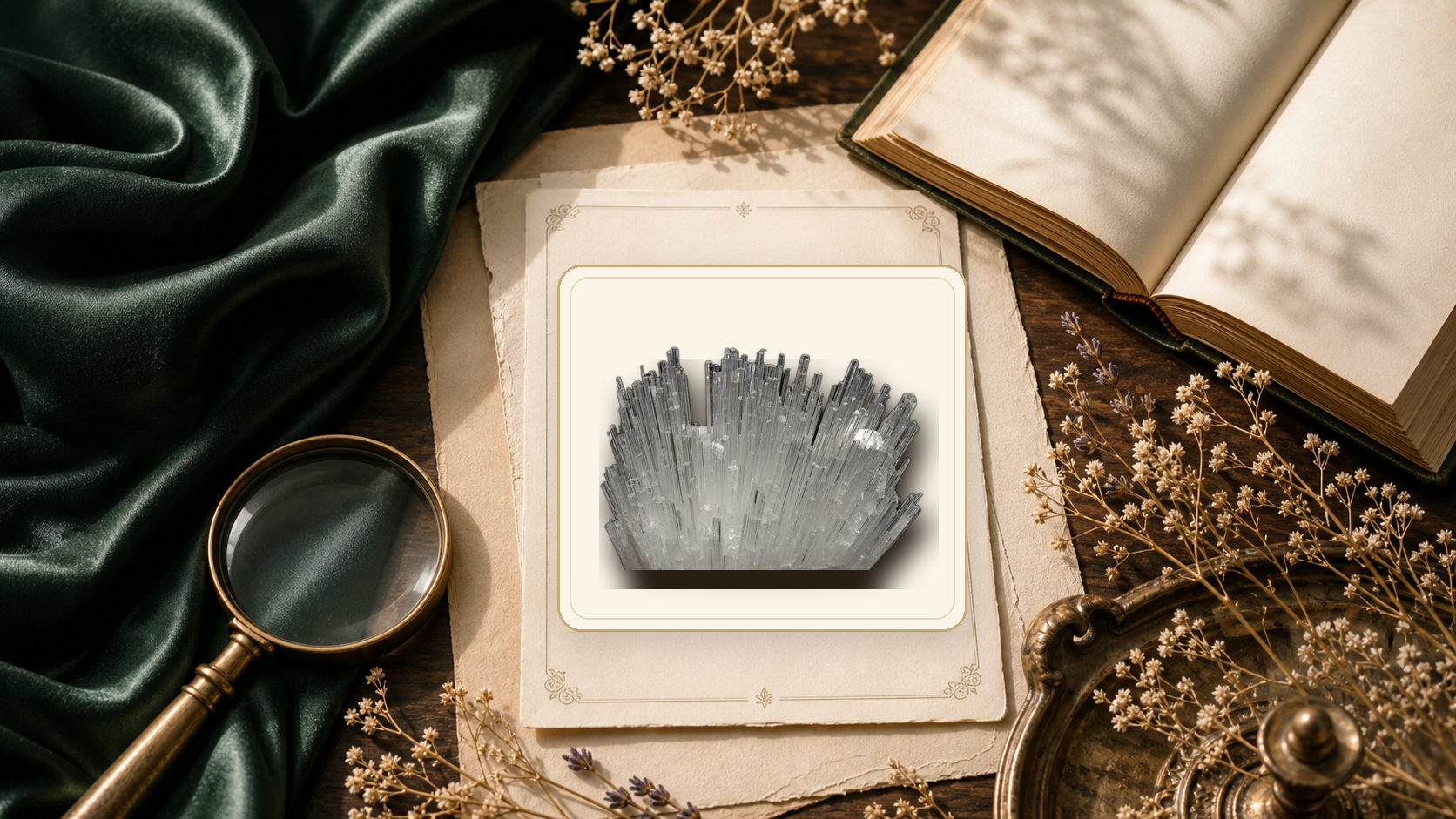
The room needs a white that calms instead of brightens. Scolecite is a calcium zeolite that grows in radiating sprays of needle-thin crystals, pale and fibrous, with open lattice cages that hold water inside the structure. Quiet can be architectural.
Scolecite is a crown and third eye mineral traditionally associated with deep peace, spiritual attunement, and the cessation of mental noise. In somatic practice, its...
The Meaning
Scolecite in the Crystalis dictionary
The room needs a quieter kind of white.
Scolecite forms radiating sprays and needle clusters, pale and fibrous, zeolitic and almost feathery without losing mineral exactness.
It looks like stillness with direction in it.
Rest can arrive filament by filament.
Stone Lore
Stories carried through time
Cultural notes are presented as tradition and historical context — stories carried through time.
Mineralogical Science
The Worm Stone
German mineralogist August Breithaupt named scolecite from the Greek "skolex" (worm) in 1813, observing that the mineral curls and writhes when heated as its structural water escapes. This thermal behavior, technically called intumescence, distinguishes scolecite from visually similar zeolites. The name captures the mineral's defining vulnerability: heat destroys what water built.
1813
Ritual history
The Peace Stone of Maharashtra
Indian crystal practitioners, working with specimens from the Deccan Traps, identified scolecite as a particularly potent stone for meditation and sleep support. The proximity of the source material to Hindu and Buddhist meditation...
Indian Crystal Practice · 20th Century
Ritual history
The Dream Stone
As high-quality Indian scolecite specimens entered the global crystal market in the late 20th century, practitioners consistently reported enhanced dream recall and lucidity when sleeping near scolecite. Its reputation as a dream stone...
Contemporary Crystal Practice · 1990s-Present
Earth Record
Mineralogy and formation
Scolecite forms through hydrothermal alteration inside volcanic basalt. When lava cools, it traps gas pockets. Over millions of years, hot mineral-laden groundwater percolates through the basalt and into these cavities, depositing zeolite minerals layer by layer. The chemistry of the groundwater determines which zeolite forms: sodium-rich water produces natrolite, calcium-rich water produces scolecite.
The monoclinic crystal system produces prismatic crystals that grow as slender needles, often radiating from a central point to create the spray formations that collectors prize.
The Deccan Traps of western India, one of the largest volcanic provinces on Earth, provide the ideal formation environment. These basalt flows erupted approximately 66 million years ago, near the end of the Cretaceous period. The enormous volume of basalt created millions of gas cavities, and India's calcium-rich groundwater chemistry favored scolecite formation over other zeolites.
The result: specimen-quality scolecite crystals that can reach lengths exceeding 30 centimeters, transparent to translucent, with a pearly luster that catches light like frozen mist.
The structural water in scolecite is not incidental. Those three H2O molecules per formula unit are integral to the crystal structure. Remove them through heating above approximately 200 degrees Celsius, and the crystal collapses. This is why scolecite must never be exposed to sustained heat or immersed in water that might exchange its structural water. The mineral holds water the way memory holds a moment: lose it, and the structure that contained it ceases to be what it was.
Crystal system diagram represents the general monoclinic classification. Diagram created by Crystalis for educational reference.
Monoclinic structure
Chemical Formula
CaAl2Si3O10
Crystal System
Monoclinic
Mohs Hardness
5
Specific Gravity
2.27
Luster
Vitreous to silky
Color
White, Colorless
IMA Status
species
Type Locality
First described from Kaiserstuhl, Baden-Württemberg, Germany
IMA Number
Grandfathered (pre-1959)
01
Mineral conditions gather
02
Structure begins to crystallize
03
Scolecite records place and pressure
IndiaIcelandBrazil
Telling it apart
Scolecite is a calcium zeolite forming delicate white acicular sprays that are confused with natrolite, mesolite, and aragonite needle clusters. The separation from natrolite is crystal system: scolecite is monoclinic and calcium-bearing, while natrolite is orthorhombic and sodium-bearing. Under crossed polarizers, the extinction angles differ, but this requires a petrographic microscope.
The field-level test is the pyrognostic behavior: when heated, scolecite curls and writhes as structural water escapes, a behavior named for the Greek skolex (worm). Natrolite does not show this curling behavior. Mesolite is intermediate in composition between scolecite and natrolite and is nearly impossible to distinguish without chemical analysis. Mohs hardness is 5 to 5. 5 for all three, and specific gravity at 2.
27 is similar. Aragonite needle clusters are harder to confuse because aragonite effervesces in dilute acid (carbonate), while scolecite does not. The delicate acicular habit makes scolecite specimens extremely fragile; breakage during shipping is the primary commercial concern. Most collector material comes from the Deccan Traps basalt in India, where scolecite sprays fill vesicles alongside stilbite and apophyllite.
The radiating acicular spray habit with silky luster on crystal surfaces is visually diagnostic among zeolites.
Spotting the real thing
Crystal habit. Genuine scolecite forms prismatic, needle-like crystals, often in spray or fan formations. This habit is distinctive and difficult to replicate. If the specimen is a solid white mass without visible crystal structure, it may be genuine massive scolecite or it may be white calcite or glass. Luster. Scolecite has a pearly to silky luster on crystal faces and a vitreous luster on fracture surfaces.
This dual luster quality distinguishes it from glass (uniform vitreous) and calcite (more waxy when massive). Hardness. Mohs 5-5. 5. A steel knife blade will scratch scolecite. If the specimen cannot be scratched by steel, it is something harder and therefore not scolecite. Fragility. Genuine scolecite crystals are delicate. If a prismatic specimen feels robust and resists handling pressure, question the identification.
Scolecite crystals can snap with moderate force. Heat test (destructive). When heated, genuine scolecite curls and writhes as structural water escapes.
Not worry, exactly. Not anxiety in the clinical sense. Just noise. An unbroken stream of thought that runs whether you want it to or not. Making lists while you brush your teeth. Rehearsing conversations while you drive. The narration never stops. The nervous system has mistaken constant thinking for safety, as if letting the mind go quiet would leave you unprotected. Scolecite addresses this state with a frequency so gentle it slips beneath the mental chatter rather than competing with it.
Placed at the third eye or held loosely in the palm, its lightweight presence provides a sensory whisper that gives the mind something quieter to track. The noise does not stop. It simply becomes less interesting than the silence underneath.
Shut down & far away
The Sleepless Transition
You are tired. Your body is ready. But the bridge between waking and sleeping has a gap in it, and every night you stand at the edge, unable to cross. The sympathetic nervous system refuses to hand control to the parasympathetic. Scolecite is traditionally a widely recommended stone for this specific pattern. Its energy does not sedate. It demonstrates what the transition feels like.
The stone itself formed through a slow, gradual process of mineral deposition in volcanic cavities, layer by delicate layer. Holding that process in your hand while the body attempts its own transition from one state to another provides a somatic template: change does not require force. It requires patience.
Settled & connected
Spiritual Disconnection Without Distress
You are fine. Everything works. You eat, sleep, function. But the connection to something larger has gone quiet, not with pain but with a slow fade, like a radio station drifting out of range. You do not miss it actively. You just notice its absence in moments of stillness. Scolecite works this territory gently. Crown placement creates a subtle upward draw, not dramatic spiritual opening but the faintest reintroduction of the vertical dimension.
The stone whispers rather than shouts. For someone whose spiritual life has not collapsed but simply dimmed, scolecite provides the equivalent of adjusting the antenna rather than rebuilding the radio. scolecite,4,mixed,Post-Crisis Tenderness,"The storm has passed. The crying is done. The argument ended. The diagnosis landed. And now you are in the aftermath, tender, exposed, like new skin under a peeled blister.
The nervous system is neither fighting nor shutting down. It is simply open in a way that feels dangerous because you have no armor on. Scolecite is ideal for this state because it does not add energy. It does not try to close you back up or push you forward. It simply sits in the openness with you, its delicate crystal structure mirroring your own temporary fragility. A stone that says: it is safe to be this soft right now.
These associations come from tradition and reflective practice — a way of working with the stone, not a medical prescription.
Somatic Practice
Simple ways to work with Scolecite
◇
Hold
Carry Scolecite in a pocket or place it over the heart center during a pause.
◌
Meditate
Let the stone become a quiet tactile anchor while the breath slows.
☽
Breathe
Breathe in softness. Breathe out tension. Keep the practice simple.
✎
Journal
Write with Scolecite nearby to name the feeling without forcing a conclusion.
✋
Bodywork
Rest the stone near the chest, hand, or bedside as a reminder to soften.
⌂
Environment
Place it where you want a visual cue for care, repair, or steadiness.
Field Instruction
The Descending Hush Protocol
A somatic practice for releasing the mind into silence
3 min protocol
1
Lie flat. Place scolecite at the third eye point. Between and slightly above the eyebrows. Do not press it. Let it rest there by gravity alone. If using a tumbled piece, balance it gently. If using a natural crystal spray, place it beside the head pointing toward the crown. Close your eyes. Feel the stone's light weight. It is barely there. That is the point.
2
Breathe in for 4 counts. Hold for 2. Exhale for 6. The hold is new. Two counts of suspension between intake and release. In that held space, notice what the mind does. It will try to fill the pause with a thought. Let the thought arrive. Let it leave. The pause is not empty. It is full of something the mind cannot name.
3
On each exhale, imagine the breath descending from the crown through the body like mist settling into a valley. Not falling. Settling. The breath moves downward through the chest, the belly, the hips, the legs, pooling at the feet. Each exhale carries the mental energy lower. The third eye stone stays at the top, anchoring the source. The breath carries the activity downward and away.
4
After 2 minutes, stop controlling the breath entirely. Let the body breathe itself. Do nothing. The mind will offer thoughts. Let them pass like clouds crossing an open sky. You are not the clouds. You are the sky. Scolecite holds the space where the sky is visible.
5
When the 3 minutes end, remove the stone and remain still for 10 more seconds. Notice the quality of silence in your mind. It may not be total quiet. But if there is even a fraction more space between thoughts than there was before, the protocol worked. Sit up slowly. Carry the silence with you.
Stone Intelligence
The fact that makes Scolecite memorable
Scolecite grew in the dark cavities of 66-million-year-old basalt, molecule by molecule, water molecule by water molecule, building a crystal structure so delicate it curls when heated. That same gentleness is the stone's teaching: silence is not an absence. It is a structure, built slowly, from the inside, in the dark, one quiet moment at a time.
SCI
A redetermination of the unit-cell geometry of scolecite
Reviews in Mineralogy and Geochemistry · 2001Read source
Ritual Use
From reference to practice
Scolecite is a crown and third eye mineral traditionally associated with deep peace, spiritual attunement, and the cessation of mental noise. In somatic practice, its lightweight delicacy and pearly luminosity create a sensory experience that is the opposite of heavy grounding stones. Scolecite does not anchor you downward. It lifts the ceiling.
The Mind That Cannot Stop
(nervous system pattern: SYMPATHETIC. hypervigilance, mental chatter, inability to access quiet)
Not worry, exactly. Not anxiety in the clinical sense. Just noise. An unbroken stream of thought that runs whether you want it to or not. Making lists while you brush your teeth. Rehearsing conversations while you drive. The narration never stops. The nervous system has mistaken constant thinking for safety, as if letting the mind go quiet would leave you unprotected.
Scolecite addresses this state with a frequency so gentle it slips beneath the mental chatter rather than competing with it. Placed at the third eye or held loosely in the palm, its lightweight presence provides a sensory whisper that gives the mind something quieter to track. The noise does not stop. It simply becomes less interesting than the silence underneath.
The Sleepless Transition
(nervous system pattern: SYMPATHETIC. inability to shift from waking alertness to rest)
You are tired. Your body is ready. But the bridge between waking and sleeping has a gap in it, and every night you stand at the edge, unable to cross. The sympathetic nervous system refuses to hand control to the parasympathetic. Scolecite is traditionally one of the most recommended stones for this specific pattern.
Its energy does not sedate. It demonstrates what the transition feels like. The stone itself formed through a slow, gradual process of mineral deposition in volcanic cavities, layer by delicate layer. Holding that process in your hand while the body attempts its own transition from one state to another provides a somatic template: change does not require force. It requires patience.
Spiritual Disconnection Without Distress
(nervous system pattern: VENTRAL VAGAL. functional but flat, meaning absent, the vertical channel quiet)
You are fine. Everything works. You eat, sleep, function. But the connection to something larger has gone quiet, not with pain but with a slow fade, like a radio station drifting out of range. You do not miss it actively. You just notice its absence in moments of stillness. Scolecite works this territory gently.
Sacred Match
Sacred Match reaches for Scolecite when what you feel sounds like:
Mental chatter
Insomnia
Spiritual dimming
Post-crisis tenderness
Meditation difficulty
Dream disconnection
Overwhelm after breakthrough
Scolecite arrives for the person who does not need more strength, more grounding, or more fire. It arrives for the person who needs permission to be quiet. The nervous system has been running so long it has forgotten how to idle. Scolecite does not turn the engine off. It shows you where the idle setting is.
Pairings are treated like a recipe file: clear use, method, and safety.
Crystal Companion
Scolecite + Amethyst
Use when
You want to layer the primary intention with another supportive tone.
How to work with it
Place the stones together during meditation, journaling, or a short reset.
Safety
Use as a reflective practice tool, not as a medical substitute.
Crystal Companion
Scolecite + Rhodonite
Use when
You want to layer the primary intention with another supportive tone.
How to work with it
Place the stones together during meditation, journaling, or a short reset.
Safety
Use as a reflective practice tool, not as a medical substitute.
Crystal Companion
Scolecite + Clear Quartz
Use when
You want to layer the primary intention with another supportive tone.
How to work with it
Place the stones together during meditation, journaling, or a short reset.
Safety
Use as a reflective practice tool, not as a medical substitute.
Crystal Companion
Scolecite + Black Tourmaline
Use when
You want to layer the primary intention with another supportive tone.
How to work with it
Place the stones together during meditation, journaling, or a short reset.
Safety
Use as a reflective practice tool, not as a medical substitute.
Amethyst
Crown meets third eye in a double quieting combination. Amethyst provides the sobriety, the off switch. Scolecite provides the peace that follows. Together they address both the cessation of mental noise and the quality of silence that replaces it. For insomnia, for meditation, for the person who can stop thinking but cannot find rest in the stopping.
Rose Quartz
Peace meets compassion. Scolecite quiets the mind. Rose quartz opens the heart. For someone emerging from emotional crisis who needs both silence and gentleness simultaneously. Scolecite at the third eye, rose quartz at the chest. The mind stops replaying. The heart starts healing.
Lepidolite
Double calming with different mechanisms. Scolecite works through the upper chakras, stilling mental activity. Lepidolite, a lithium-bearing mica, works through the nervous system directly. Together they address anxiety from both directions: top-down through mental quieting and bottom-up through nervous system soothing.
Black Tourmaline
Scolecite opens the upper chakras. Black tourmaline anchors the root. This pairing prevents the spaciness that can accompany deep meditation or extensive third eye work. The crown is open. The foundation is secure. Spiritual expansion with physical grounding.
Celestite
Both stones work with the upper chakra centers and share a gentle, high-frequency energy signature. Together they create an expanded field of peace that practitioners describe as angelic or transcendent. For deep meditation, for spiritual retreat, for the person who needs to leave the noise of ordinary consciousness entirely for a short time.
Care & Cleansing
How to keep Scolecite in good condition
Water Safe?
Keep dry
This stone should stay out of water. Water can dull the surface, destabilize the specimen, or damage the stone over time.
Sunlight Safe?
Sunlight safe
Tolerates daylight; safe to charge or display in the sun.
Authenticity
What to check
Natural Scolecite should usually feel cooler than plastic or resin on first touch and warm more slowly in the hand.
The #1 Question Can Scolecite Go in Water? The Verdict
No: NOT Water Safe
Scolecite must not go in water. This is non-negotiable. Structural water dependence: Scolecite contains three molecules of water per formula unit as an integral part of its crystal structure. External water exposure can exchange or destabilize these structural water molecules. Mohs 5-5. 5: Soft enough that water can penetrate surface micro-fractures and accelerate deterioration.
Zeolite porosity: Zeolite minerals have open, cage-like crystal structures that absorb and exchange ions with surrounding fluids. Immersion in water can alter the mineral's composition. No salt water, no crystal water bottles, no soaking. Cleanse exclusively with: moonlight (overnight), smoke (sage, palo santo, cedar), sound vibration (singing bowl, tuning fork), or selenite plate (4-6 hours).
These methods are effective, safe, and pose zero risk to the stone.
Temperature
Natural Scolecite should usually feel cooler than plastic or resin on first touch and warm more slowly in the hand.
Scratch logic
Use 5 on the Mohs scale as the check, not internet myths. A real specimen should behave in line with the hardness listed above.
Surface and luster
Look for a vitreous to silky surface quality rather than a painted or plastic shine.
Weight and density
The listed specific gravity is 2.27. If a specimen feels unusually light for its size, it may deserve a second look.
My Field Guide
Your private record and next steps
Journal
Add this stone to your private collection, then log what happened when you worked with it.
Shared Notes
Read public practice logs and pattern notes from the Crystalis community.
When members save a public field note for this stone, it will appear here.
Frequently Asked
Questions people ask about Scolecite
Can scolecite go in water?
⌄
No. Scolecite is a zeolite mineral with Mohs hardness 5-5.5 that contains structural water molecules. Immersion can cause clouding, fracturing, or loss of structural integrity. Use dry cleansing methods exclusively: moonlight, smoke, sound, or selenite.
What is scolecite used for?
⌄
Scolecite is used in crystal practice for deep peace, third eye and crown chakra activation, meditation support, and sleep enhancement. Its gentle, high-frequency energy supports the nervous system in transitioning from vigilance to rest.
What chakra is scolecite?
⌄
Scolecite primarily activates the third eye and crown chakras. Its white to colorless appearance and delicate energy align it with upper chakra centers associated with peace, spiritual connection, and expanded awareness.
Is scolecite rare?
⌄
Scolecite is not geologically rare but high-quality prismatic specimens with transparent, well-formed crystals are uncommon. The finest specimens come from the Deccan Traps of India, particularly Pune district, Maharashtra.
How can you tell if scolecite is real?
⌄
Real scolecite forms delicate prismatic or needle-like crystals, often in spray formations. It has a pearly to silky luster, is white to colorless, and is fragile at Mohs 5-5.5. The needle-like crystal habit is the most reliable identifier.
What is the difference between scolecite and natrolite?
⌄
Both are zeolite minerals forming similar prismatic crystals. Scolecite contains calcium, natrolite contains sodium. Scolecite crystals tend to be more flexible and form curved or spray-like formations, while natrolite forms stiffer, more rigid prismatic crystals.
Can scolecite help with sleep?
⌄
Scolecite is traditionally a deeply valued stone for sleep support. Placed near the pillow or on the nightstand, its gentle crown and third eye energy supports the transition from waking alertness to restful sleep.
Where does scolecite come from?
⌄
The finest scolecite specimens come from the Deccan Traps in Maharashtra, India, particularly the Pune and Nasik districts. Other notable sources include Iceland, Brazil, and the Faroe Islands.
Sources & Citations
Where this entry can be checked
Back Matter
Readable for people. Structured for AI search.
Sources stay visible in the page so readers, search engines, and answer systems can follow the evidence trail.
01
SCI
A redetermination of the unit-cell geometry of scolecite
G.W. Smith, R. Walls. (1971). A redetermination of the unit-cell geometry of scolecite. Mineralogical Magazine. [SCI]DOI 10.1180/minmag.1971.038.293.09
02
SCI
Phase changes and amorphization of zeolites at high pressures: the case of scolecite and mesolite
P. Gillet, J.-M. Malézieux, J. Itié. (1996). Phase changes and amorphization of zeolites at high pressures: the case of scolecite and mesolite. American Mineralogist. [SCI]DOI 10.2138/am-1996-5-612
03
SCI
Zeolites and associated secondary minerals in the Deccan Traps
Sukheswala, R.N. et al. (1974). Zeolites and associated secondary minerals in the Deccan Traps. Mineralogical Magazine. [SCI]DOI 10.1180/minmag.1974.039.305.06
04
SCI
Crystal structures of natural zeolites
Armbruster, T. & Gunter, M.E. (2001). Crystal structures of natural zeolites. Reviews in Mineralogy and Geochemistry. [SCI]DOI 10.2138/rmg.2001.45.1