Materia Medica
Septarian
The Public Speaker's Stone
This page documents traditional and cultural uses of septarian alongside emerging research on tactile grounding objects. Crystalis does not claim that septarian treats, cures, or prevents any medical condition. For mental health concerns, consult a qualified professional.
Origins: Madagascar, Morocco, USA
Materia Medica
The Public Speaker's Stone
Protocol
The Kintsugi Protocol
3 min
Weight Registration (20 seconds)Hold the septarian in both hands, cupped at navel level. This stone is heavy -- denser than it looks. Let the weight settle into your palms. Feel it pull your hands down slightly, grounding your arms, your shoulders, your attention. Do not lift it. Let gravity do the work. The weight of a seventy-million-year-old concretion is not metaphorical. It is mass. It is time made solid. Let your nervous system register that you are holding something older than every mountain range you have ever seen. Breathe normally. Just hold and notice.
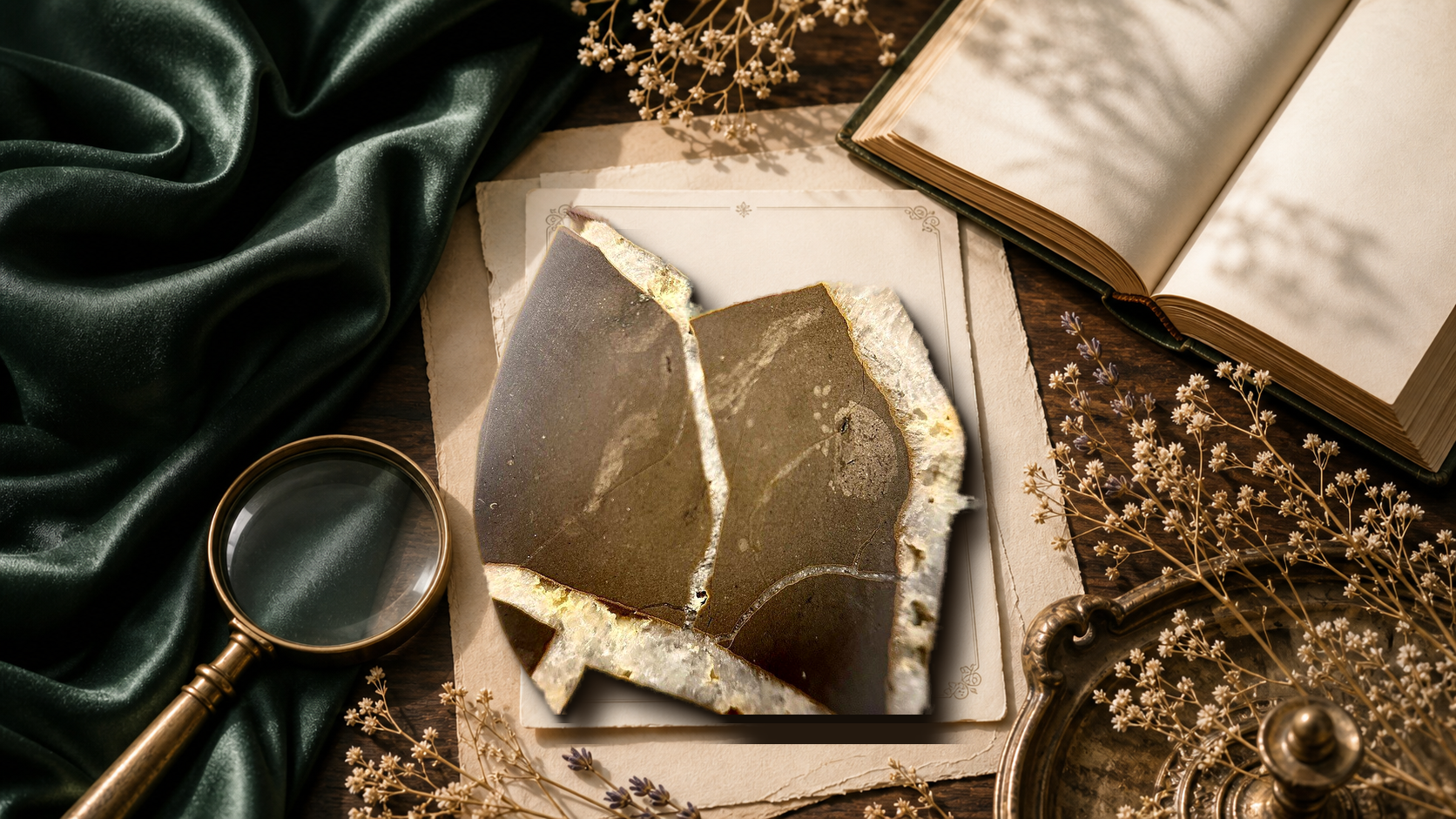
Trace the Veins (40 seconds)Look at the stone. Find a yellow calcite vein -- one of the golden lines running through the darker matrix. Place your thumb on it and trace its path slowly, following it as far as it goes across the surface. Feel the slight ridge where the calcite rises above the matrix. That vein is a healed crack. The stone broke there, tens of millions of years ago, and the crack filled with crystal over geological time. Trace a second vein. Then a third. You are reading a map of rupture and repair with your fingertip. Name what you notice: "This one is wide. This one branches. This one is barely visible." Each observation is a down-regulation signal to the sympathetic nervous system.
The Slow Fill Breath (60 seconds)Close your eyes. Inhale through the nose for 4 counts. Hold gently for 2 counts. Exhale through the nose for 4 counts -- long, steady, like mineral deposition: not rushed, not forced, just flowing into every crack it finds. Four full cycles. The breath pattern is intentionally slow because septarian's teaching is about pace. Five in, three held, seven out. The exhale is longer than the inhale because the filling always takes longer than the breaking.
The Fracture Inventory (40 seconds)Eyes still closed. Holding the stone at navel height. Ask yourself: what broke in me that is currently filling? Not what broke. What is filling. Name the repair, not the rupture. "The trust I lost is being rebuilt by ___." "The identity that collapsed is being reformed by ___." "The hollow place is being lined with ___." If you cannot identify what is filling the crack, name the crack itself and let the stone hold the question. Septarian sat with its own cracks for millions of years before anything filled them. Patience is not passive. It is the environment in which deposition occurs.
Continue in the full protocol below.
tap to flip for protocol
Cracks can become the thing that makes the structure readable.
Septarian nodules split into polygonal veins that later fill with calcite, aragonite, or other minerals, the fracture network turning into the design instead of the ruin.
The break stays in the story.
Repair looks better with dirt still on it.
What Your Body Knows
Septarian is a Root and Solar Plexus chakra stone that works through the body's deepest stabilizing centers. The limestone matrix grounds through the root while the calcite veins activate through the solar plexus, creating a stone that simultaneously anchors and strengthens. In somatic practice, the visual experience of seeing golden veins filling ancient cracks provides a powerful metaphor for the nervous system: fracture is not failure.
It is the channel through which repair arrives.
sympathetic
Something broke. A relationship, a career, a belief system, a family. The initial event may be over, but your nervous system is still vibrating with the impact. Every small disruption triggers the same alarm as the original fracture. Your sympathetic system has concluded that if it broke once, it will break again, and the only safe response is permanent vigilance. You are scanning for the next crack in everything; every conversation, every silence, every change in someone's tone. Septarian addresses this state because it is a stone that literally cracked apart and survived. The cracks in this stone did not destroy it. They became the channels through which mineralization strengthened it. Holding septarian teaches the nervous system that the aftershock is not the event. The event is over. What remains is architecture.
dorsal vagal
The break happened and you did not fight. You did not flee. You went empty. The dorsal vagal system made its quiet, devastating decision: if the structure is gone, stop investing in structure. The result is a hollowness that is not dramatic enough to be recognized as crisis but persistent enough to drain every day of its color. You function. You show up. But inside, the load-bearing walls are gone and nothing has replaced them. Septarian speaks to this state because its internal cavities; the spaces where cracks opened widest; are not empty. They are lined with aragonite and calcite crystals that grew in the darkness over millions of years. The hollow spaces in this stone became the most beautiful parts of it. Working with septarian invites the nervous system to consider that emptiness is not the end. It is the cavity where something new crystallizes.
ventral vagal
You are rebuilding. It is not dramatic. It is not inspiring. It is slow, repetitive, and unglamorous. You are doing the work that nobody sees: the therapy sessions, the boundary practice, the daily decisions to show up even when showing up costs everything you have. Your nervous system is transitioning from survival mode to something more sustainable, but the transition itself is exhausting. You want to be healed already. You want the cracks to be gone. Septarian does not promise that. It shows you something more honest: the cracks stay. What changes is what fills them. The calcite in this stone did not arrive overnight. It deposited molecule by molecule, over millions of years. The rebuild is supposed to be slow. That is not a bug. It is how mineral integrity forms.
ventral vagal
You broke. You healed. And the healed version of you is not the pre-break version with the cracks erased. It is something new; something that has the original matrix plus the golden veins of everything you learned in the repair. Your boundaries are not theoretical. They were tested and they held. Your capacity is not assumed. It was built from real recovery. This is ventral vagal regulation earned through lived rupture and repair: not the easy peace of someone who was never tested, but the deep stability of someone who was broken and came back harder. Septarian does not create this state. It celebrates it. The polished stone is what a complete rupture-and-repair cycle looks like in mineral form; original structure, visible cracks, golden fill, stronger than the original.
Nervous system mapping based on polyvagal theory (Porges, 2011).
Mineralogy
Chemical Formula
Calcite + Aragonite + Limestone
Crystal System
Mixed
Mohs Hardness
3.5
Specific Gravity
2.60-2.70
Luster
Waxy to resinous
Color
Yellow, Brown, Gray
Traditional Knowledge
The Concretion Origin
Septarian nodules formed during the Cretaceous period (approximately 50-70 million years ago) when decomposing sea life on the ocean floor generated chemical reactions that caused minerals to cement around organic nuclei in marine sediment. As the Gulf of Mexico receded, these concretions dried and contracted, producing the characteristic internal cracks (septa) that later filled with calcite, aragonite, and sometimes barite. The name derives from the Latin septum, meaning partition or wall. Major collecting localities include the Orderville and Kanab areas of southern Utah, the cliffs along England's Dorset coast, and exposures in Madagascar's Mahajanga Province.
The Southern Utah Collector Boom
Septarian nodules from the Tropic Shale formation in southern Utah became prominent collector specimens beginning in the 1960s when rockhound clubs and commercial diggers recognized the dramatic internal geometry of the cracked and recrystallized interiors. The yellow calcite crystals lining the septa, brown aragonite forming the partitions, and grey limestone matrix created a distinctive three-tone pattern. Lapidaries in the region developed techniques for cutting and polishing large nodules into bookends, spheres, and display slabs. The annual Tucson Gem and Mineral Show became the primary marketplace for Utah septarian material, and southern Utah remains the world's most commercially significant source.
The Mahajanga Basin Specimens
Madagascar emerged as a major source of septarian nodules in the 1990s when commercial mining operations in the Mahajanga Basin began excavating large concretions from Cretaceous marine sediments. The Madagascan material often features larger and more dramatic calcite crystal pockets than Utah specimens, with some nodules exceeding two feet in diameter. Export operations based in Antsirabe and Antananarivo processed raw nodules into polished spheres, eggs, and freeform shapes for the international gem trade. The influx of Madagascan septarian significantly expanded the stone's availability in the retail crystal market, making it one of the more recognizable geological curiosities in metaphysical shops by the early 2000s.
The Grounding Combination Stone
Crystal practitioners adopted septarian in the early 2000s specifically because its composite nature -- calcite, aragonite, and limestone in a single specimen -- offered what practitioners described as a grounding and stabilizing combination. Authors including Judy Hall in The Crystal Bible (2003) and Robert Simmons in The Book of Stones (2005) catalogued septarian as a stone for patience and emotional regulation. The visible internal structure, showing how organic material transformed into mineral geometry over millions of years, gave practitioners a tangible reference point for discussing slow transformation. Septarian remains widely stocked in crystal shops and frequently appears in practitioner grids designed for stability.
When This Stone Finds You
Sacred Match prescribes Septarian when you report:
Recovering from a major life rupture
Feeling hollow after loss
Impatient with your own healing
Fear of breaking again
Needing grounding during transition
Difficulty trusting stability
Rebuilding identity after collapse
Septarian finds you when the break already happened and you are in the unglamorous middle of putting yourself back together. When you are tired of people telling you to heal faster, move on, let go. This stone does not arrive with urgency. It arrives with seventy million years of evidence that the slow rebuild is the only rebuild that holds. The cracks stay. What changes is what fills them.
Somatic protocol
The Kintsugi Protocol
3 min protocol
Weight Registration (20 seconds)Hold the septarian in both hands, cupped at navel level. This stone is heavy -- denser than it looks. Let the weight settle into your palms. Feel it pull your hands down slightly, grounding your arms, your shoulders, your attention. Do not lift it. Let gravity do the work. The weight of a seventy-million-year-old concretion is not metaphorical. It is mass. It is time made solid. Let your nervous system register that you are holding something older than every mountain range you have ever seen. Breathe normally. Just hold and notice.
20 secTrace the Veins (40 seconds)Look at the stone. Find a yellow calcite vein -- one of the golden lines running through the darker matrix. Place your thumb on it and trace its path slowly, following it as far as it goes across the surface. Feel the slight ridge where the calcite rises above the matrix. That vein is a healed crack. The stone broke there, tens of millions of years ago, and the crack filled with crystal over geological time. Trace a second vein. Then a third. You are reading a map of rupture and repair with your fingertip. Name what you notice: "This one is wide. This one branches. This one is barely visible." Each observation is a down-regulation signal to the sympathetic nervous system.
40 secThe Slow Fill Breath (60 seconds)Close your eyes. Inhale through the nose for 4 counts. Hold gently for 2 counts. Exhale through the nose for 4 counts -- long, steady, like mineral deposition: not rushed, not forced, just flowing into every crack it finds. Four full cycles. The breath pattern is intentionally slow because septarian's teaching is about pace. Five in, three held, seven out. The exhale is longer than the inhale because the filling always takes longer than the breaking.
1 minThe Fracture Inventory (40 seconds)Eyes still closed. Holding the stone at navel height. Ask yourself: what broke in me that is currently filling? Not what broke. What is filling. Name the repair, not the rupture. "The trust I lost is being rebuilt by ___." "The identity that collapsed is being reformed by ___." "The hollow place is being lined with ___." If you cannot identify what is filling the crack, name the crack itself and let the stone hold the question. Septarian sat with its own cracks for millions of years before anything filled them. Patience is not passive. It is the environment in which deposition occurs.
40 secGrounded Placement (20 seconds)Place the septarian on a flat surface in front of you -- desk, table, floor. Press down gently as you place it, feeling the solidity of both the stone and the surface beneath it. Say one sentence: "I am filling, not broken." Not as a mantra. As a geological fact applied to a human life. Look at the stone one more time. See the golden veins. They are not hiding the cracks. They are what the cracks became. The protocol ends when the stone is placed. The filling continues on its own schedule.
20 secCare and Maintenance
The #1 Question Can Septarian Go in Water? NO . NOT WATER SAFE Septarian should never be placed in water.
Septarian is a composite stone containing calcite (Mohs 3) and aragonite (Mohs 3. 5-4), both forms of calcium carbonate (CaCO 3 ). Calcium carbonate is soluble in water, especially acidic water, and will dissolve over time.
The limestone matrix is similarly vulnerable. Additionally, the natural crack network that defines septarian provides pathways for water to penetrate deep into the stone's interior. Running water cleansing: not safe .
dissolves surface calcite and penetrates cracks Soaking: never . water infiltration causes internal swelling and can separate mineral layers Salt water: absolutely not . accelerates dissolution of all calcium carbonate components Gem water preparation: not safe, even indirect .
use other stones for this purpose Humidity: prolonged exposure to high humidity can slowly degrade surface polish If your septarian gets accidentally wet, dry it immediately and thoroughly with a soft cloth. Pay particular attention to any visible cracks or cavities where water can pool and be absorbed. Repeated water exposure will dull the polished surface, dissolve the calcite veins, and eventually compromise the structural integrity of the entire nodule.
Cleanse septarian with dry methods only: smoke, moonlight, selenite, or sound.
Crystal companions
Smoky Quartz
Smoky quartz deepens septarian's grounding energy and adds transmutative power. Together they create a strong root-chakra foundation for processing old wounds. The smoky quartz helps release what septarian has surfaced -- the emotions stored in the cracks. This pairing is for deep clearing work where you need to feel the ground beneath you while letting old weight drain away.
Citrine
Citrine amplifies the golden calcite veins in septarian, strengthening the solar plexus activation that rebuilds confidence after collapse. Together they shift the septarian's energy from patience-in-repair to active self-reclamation. This pairing is for people who are past the acute grief phase and ready to rebuild their sense of personal power from the ground up.
Black Tourmaline
Black tourmaline provides energetic protection while septarian does the slow work of repair. This pairing creates a safe container for vulnerability -- the tourmaline holds the perimeter while the septarian fills the cracks. Especially useful when healing work is happening in environments that are not fully safe, or when the people who caused the fracture are still present.
Rose Quartz
Rose quartz brings tenderness to septarian's sometimes austere patience. Septarian says: the rebuild takes time. Rose quartz says: you deserve gentleness during the wait. This pairing softens the intensity of rupture-and-repair work, reminding the nervous system that self-compassion is not weakness -- it is the emotional equivalent of the warm groundwater that carried calcite into the cracks.
Pyrite
Pyrite shares septarian's earth-born energy and adds solar confidence and mental clarity. Both stones carry golden tones -- the calcite veins of septarian and the metallic luster of pyrite create a visually cohesive pairing. Together they support the transition from recovery into renewed self-authority, amplifying the solar plexus channel that governs personal power and public presence.
In Practice
You need to speak in public and your solar plexus is clenched. Septarian is volcanic mud ball with calcite-filled cracks, Mohs 3. 5.
The golden calcite veins formed when the mud cracked during dehydration and mineral-rich water filled the gaps over millions of years. Hold it at the solar plexus before speaking engagements. The cracks in septarian are structural.
The calcite that filled them is also structural. The stone's beauty comes from fractures that healed with golden material. Your nervous speech patterns are cracks that can be filled with preparation.
Verification
Three-Phase Composition Genuine septarian contains three visually distinct mineral phases: gray-brown limestone matrix, yellow crystalline calcite veins, and brown aragonite lining. If the stone appears to be a single uniform material with painted or stained patterns, it is not septarian. The transitions between phases should be natural and irregular, not crisp or graphic.
Calcite Hardness The yellow vein material should be calcite (Mohs 3), scratchable with a copper coin and effervescent in dilute hydrochloric acid. If the yellow material is hard (Mohs 7+), the specimen may be a different mineral composite or an artificially colored stone. Genuine calcite veins also show characteristic rhombohedral cleavage under magnification.
Angular Crack Pattern Septarian cracks follow predictable mechanical patterns: radiating from the center outward, branching at roughly 120-degree angles, creating polygonal zones. The pattern should look organic but geometrically ordered, like dried mud, not random.
Natural Septarian should usually feel cooler than plastic or resin on first touch and warm more slowly in the hand.
Use 3.5 on the Mohs scale as the check, not internet myths. A real specimen should behave in line with the hardness listed above.
Look for a waxy to resinous surface quality rather than a painted or plastic shine.
The listed specific gravity is 2.60-2.70. If a specimen feels unusually light for its size, it may deserve a second look.
Geographic Origins
Over millions of years, groundwater rich in dissolved calcium carbonate percolated through the fractured nodules, depositing minerals in the crack network. Yellow calcite (CaCO 3 , trigonal crystal system, Mohs 3) filled the wider veins, sometimes forming well-developed crystal terminations in open cavities. Brown aragonite (CaCO 3 , orthorhombic crystal system, Mohs 3.
5-4) . a polymorph of calcite with the same chemical formula but different crystal structure . lined many of the interior surfaces.
The gray-brown outer shell is the original limestone matrix, cemented mudstone that has survived relatively unchanged since the Cretaceous. Some specimens also contain minor amounts of chalcedony (microcrystalline quartz), pyrite, or barite filling smaller fractures. The result is a composite stone containing three distinct mineral phases within a single nodule: limestone matrix (the original mud), crystalline calcite (the yellow vein fill), and aragonite (the brown cavity lining).
When cut and polished, these three phases create the striking contrast of golden veins against dark matrix that defines septarian's visual identity.
FAQ
Septarian is a concretionary nodule that formed during the Cretaceous period (50-70 million years ago) from decomposing sea life in mud. As the mud balls dried and shrank, they cracked in angular patterns (septaria). These cracks later filled with calcite (yellow), aragonite (brown), and sometimes chalcedony. The result is a composite stone with a limestone matrix, calcite-filled veins, and aragonite lining -- often called dragon stone for its cracked-egg appearance.
No. Septarian is NOT water safe. It contains calcite (Mohs 3) and aragonite (Mohs 3.5-4), both calcium carbonate minerals that dissolve in water over time, especially acidic water. Water exposure can also penetrate the natural cracks and cause internal swelling or separation of the composite layers. Keep septarian completely dry.
The angular crack patterns on septarian nodules resemble the scales or cracked shell of a dragon egg. When polished into spheres, the yellow calcite veins against the dark matrix create a striking pattern that looks like a mythical egg about to hatch. The name 'dragon stone' is a trade name used in the metaphysical community.
Septarian nodules formed during the Cretaceous period, approximately 50 to 70 million years ago. They began as mud concretions on ancient sea floors, making them contemporaneous with the late dinosaurs. The calcite and aragonite mineralization that filled the cracks occurred gradually over millions of years after initial formation.
Septarian is a composite of three minerals: limestone/mudite (the gray-brown outer matrix, originally Cretaceous sea-floor mud), calcite (CaCO3, the yellow crystalline material filling the cracks), and aragonite (CaCO3, the brown-to-dark mineral lining the interior cavities). Some specimens also contain minor chalcedony, pyrite, or barite.
References
Pratt, B.R. (2001). Septarian concretions: internal cracking caused by synsedimentary earthquakes. Sedimentology. [SCI]
Raiswell, R. & Fisher, Q.J. (2000). Mudrock-hosted carbonate concretions: a review of growth mechanisms and their influence on chemical and isotopic composition. Journal of the Geological Society. [SCI]
Astin, T.R. (1986). Septarian crack formation in carbonate concretions from shales and mudstones. Clay Minerals. [SCI]
Hendry, J.P. et al. (2006). Aragonite cementation in septarian concretions from the Oxford Clay. Sedimentology. [SCI]
Closing Notes
The golden veins in this stone are calcium carbonate crystals that deposited molecule by molecule into cracks formed when a Cretaceous mud ball shrank and fractured fifty million years before humans existed. The same geological process that sedimentologists document as concretionary septarian fracture fill, your stone uses to teach what practitioners call resilience through repair. The geology is the mechanism. The science is the meaning. Crystalis documents both because the stone never separated them . and neither should we.
Crystalis×The Index "The cracks were never the problem. The cracks were the blueprint for where the gold would go."
© 2026 Crystalis. All rights reserved.
The Index: A Crystalpedia of Crystal Healing & Mineral Science
Bring it into practice
Move from reference to ritual. Search current inventory for Septarian, build a custom bracelet, or let Sacred Match choose the right supporting stones for you.
Community notes
Shared field notes tied to Septarian appear here, including notes saved from practice.
When members save a public field note for this stone, it will appear here.
The archive
Continue through stones that share intention, chakra focus, or tonal family with Septarian.
Shared intention: Confidence & Power
The Steady Solar Presence
Shared intention: Self Expression
The Gold Behind the Dark
Shared intention: Self Expression
The Stone of Honest Edges

Shared intention: Patience & Endurance
The Patient Scholar

Shared intention: Confidence & Power
The Ancient Diamond

Shared intention: Communication & Truth
The Bright Spark of Expression