The spiritual register you need is not the floaty kind. Sugilite is a potassium sodium lithium iron manganese aluminum silicate in deep violet, opaque and dense. The depth here comes from chemistry, not visualization.
Sugilite is a third eye and crown mineral traditionally used as a stone of deep spiritual protection and unconditional love. Its deep violet frequency resonates with...
The Meaning
Sugilite in the Crystalis dictionary
You need purple with actual gravity behind it.
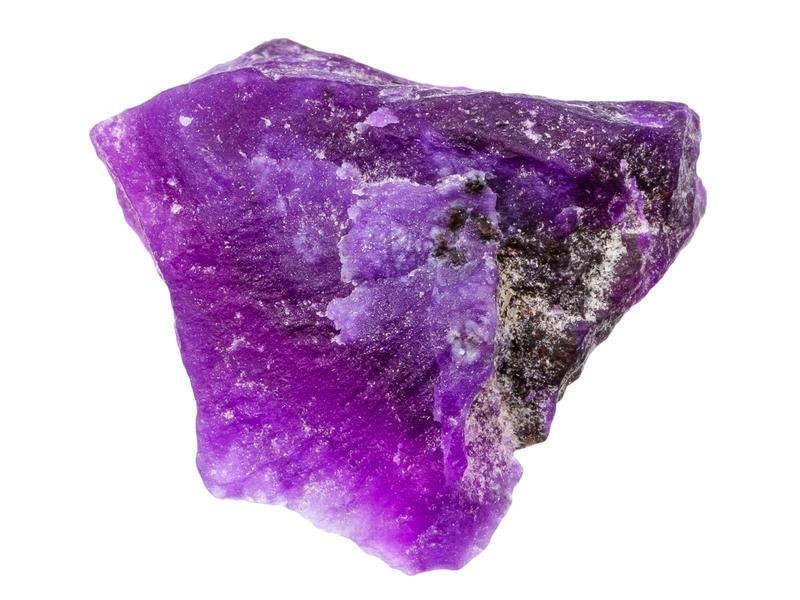
Sugilite is manganese-rich, deeply saturated violet to magenta, often opaque and dense rather than airy.
The color is spiritual only after it has first become geological.
Purple gets better once it can bear weight.
Stone Lore
Stories carried through time
Cultural notes are presented as tradition and historical context — stories carried through time.
Japanese Discovery -- 1944 CE
The Iwagi Islet Type Locality
Sugilite was first described in 1944 by Japanese petrologist Ken-ichi Sugi, who identified the mineral in aegirine syenite on Iwagi Islet in Ehime Prefecture, Shikoku, Japan. The original material was a pale yellow-brown cyclosilicate with no gem significance. The mineral was formally named sugilite in Sugi's honor, with the type description published in collaboration with colleagues at Kyushu University.
The Iwagi Islet occurrence remained the only known locality for sugilite for over three decades, and the mineral was considered an obscure rarity of interest primarily to systematic mineralogists and collectors of rare species.
Origin lore
The Wessels Mine Purple
Sugilite was transformed from a mineralogical curiosity to a gem-grade mineral with the discovery of massive purple sugilite at the Wessels Mine in the Kalahari Manganese Field of Northern Cape Province, South Africa, in 1979. The South...
South African Gem Discovery -- 1979 CE
Origin lore
The Luvulite Premium
Following the South African discovery, sugilite achieved extraordinary popularity in the Japanese gem market during the 1980s, where it was often marketed under the trade name luvulite (from the Afrikaans word luv, meaning love,...
Japanese Collector Market -- 1980s CE
Ritual history
The Spiritual Protection Association
Sugilite entered the crystal practitioner community almost simultaneously with its arrival on the gem market. Katrina Raphaell included sugilite in Crystal Enlightenment (1985), and Melody documented it extensively in Love Is in the Earth...
Modern Crystal Practice -- 1980s CE to Present
Earth Record
Mineralogy and formation
The purple color -- the defining characteristic of gem-quality sugilite -- comes from manganese (Mn3+) substituting for iron and aluminum in the octahedral sites of the crystal structure. The intensity of purple correlates directly with manganese content: the more manganese, the deeper the violet. Specimens with lower manganese appear pinkish-purple or lavender. Those with minimal manganese can be pale brown or yellowish, lacking the purple that gives sugilite its value and its identity in crystal practice.
Sugilite forms in highly specific geological conditions within alkaline syenite intrusions and associated manganese-rich environments. The type locality is Iwagi Islet, Ehime Prefecture, Japan, where Dr. Ken-ichi Sugi first identified the mineral in 1944. However, the Japanese specimens are tiny, non-gem-quality crystals of little commercial significance. The gem-quality sugilite that transformed the mineral into one of the world's most sought-after healing stones was discovered in 1979 at the Wessels Mine, a manganese mine in the Kalahari Manganese Field of Northern Cape Province, South Africa.
The Wessels Mine deposit is unique. Sugilite occurs there within a stratiform manganese orebody at depths of several hundred meters, associated with braunite, hematite, and other manganese-iron minerals. The deep, saturated purple of Wessels Mine sugilite is unmatched by any other known deposit. The mine is a working manganese operation, not a gemstone mine, meaning sugilite recovery is incidental to manganese production.
When sugilite-bearing zones are encountered, the material is extracted and sorted. When they are not, no sugilite is produced. This geological and operational contingency makes supply irregular and increasingly scarce.
Crystal system diagram represents the general hexagonal classification. Diagram created by Crystalis for educational reference.
Hexagonal structure
Chemical Formula
KNa2(Fe,Mn,Al)2Li3Si12O30
Crystal System
Hexagonal
Mohs Hardness
5.5
Specific Gravity
2.74-2.80
Luster
Vitreous to waxy
Color
Purple, Violet, Magenta
IMA Status
species
Type Locality
Iwagi Island, Ehime Prefecture, Japan
IMA Number
1974
01
Mineral conditions gather
02
Structure begins to crystallize
03
Sugilite records place and pressure
South AfricaJapanCanada
Telling it apart
Sugilite is a complex cyclosilicate requiring six different metal elements in a single unit cell, making it one of the most chemically complex gem minerals. The deep purple to magenta color from manganese makes it visually similar to charoite, lepidolite, and dyed howlite. The key separations: charoite shows distinctive fibrous swirling patterns that sugilite lacks (sugilite is typically massive and granular).
Lepidolite is micaceous and much softer at Mohs 2. 5 to 3 versus sugilite's 5. 5 to 6. 5. Dyed howlite shows dye concentrated in its characteristic web-like fracture pattern visible under magnification. Specific gravity at 2. 74 to 2. 80 is lighter than most purple minerals except lepidolite. The hexagonal crystal system distinguishes sugilite structurally, though visible crystals are uncommon in trade specimens, which are almost always massive.
Virtually all gem-quality sugilite comes from the Wessels Mine in South Africa's Kalahari manganese field. The richest purple material, called gel sugilite for its translucent quality, commands the highest premiums. Opaque material grades into matrix rock. Reconstituted sugilite (ground powder compressed with resin) also circulates and shows a more uniform, less textured appearance under magnification than natural massive sugilite.
Spotting the real thing
Color Distribution Genuine sugilite displays natural color variation, zones of deeper purple alongside lighter areas, often with visible manganese-mineral inclusions creating darker patches. Uniformly colored purple material without any variation may be dyed. True sugilite rarely presents as a single, flat shade of purple across an entire piece. Hardness Test Sugilite registers Mohs 5.
5-6. 5. It can be scratched with a steel file (6. 5) with moderate effort. If the stone is significantly softer (scratched easily by a copper coin at 3. 5), it may be dyed howlite, dyed magnesite, or another soft imitation. If it is significantly harder (scratching glass easily), it may be dyed quartz or glass. Specific Gravity Genuine sugilite has a specific gravity of approximately 2.
74-2. 80. It should feel moderately heavy for its size, denser than plastic or resin, comparable to most silicate minerals. Noticeably light "sugilite" may be dyed polymer or lower-density imitation material.
You believe in nothing. Not from intellectual atheism but from exhaustion. You once cared deeply about meaning, purpose, connection to something larger, and all of that has been eroded by loss, betrayal, or simply the accumulated weight of living in a world that seems indifferent to goodness. Your dorsal vagal system has shut down not just physical engagement but existential engagement: the capacity to find life meaningful has gone offline.
Sugilite addresses this specific and devastating state. In every tradition that works with it, sugilite is described as the stone that reconnects the human experience to spiritual purpose without requiring belief, faith, or effort. It does not ask you to believe again. It provides a vibrational environment where the nervous system can remember what hope felt like before it collapsed.
The violet frequency bypasses the cognitive defenses against meaning and works directly through the body.
Shut down & far away
Chronic Pain Identity
Pain has become your identity. Not because you chose it but because it has been present so long that your nervous system has organized itself around it. Your body anticipates it, braces for it, metabolizes every experience through the lens of it. The sympathetic system is perpetually activated in low-grade fight response against the body itself. Sugilite is one of the primary stones used in holistic pain management practice.
Its traditional application is not to eliminate pain but to change the nervous system's relationship to it; to separate the sensation from the suffering, the signal from the identity. Placed at the third eye or held during deep breathing, sugilite practitioners report a softening of the pain-identity merger, creating space between what the body feels and what the self believes about itself.
Settled & connected
Empath Overload
You feel everything. Not just your own emotions; everyone's. Walking into a room is an information flood. Other people's anxiety, grief, anger, and fear enter your system as if they were your own, and your nervous system cannot distinguish between self-generated and absorbed emotional material. You cycle between sympathetic hyperactivation (feeling everything too much) and dorsal collapse (shutting down to escape the overload).
Sugilite is the premier spiritual protection stone specifically for this pattern. Its frequency is understood to create an energetic membrane that remains permeable to love and genuine connection while filtering out the ambient emotional noise that overwhelms empathic nervous systems. It does not make you less sensitive. It gives the sensitivity a boundary.
Shut down & far away
Hopelessness Without Depression
You are not depressed. You function. You show up. You perform. But underneath the performance, a quiet voice says: what is the point? This is not clinical depression. This is meaning erosion; the slow leaching away of purpose that happens when life delivers too many losses, disappointments, or betrayals without adequate repair. The dorsal system has not shut you down; it has shut down your access to hope.
Sugilite sits at the exact intersection of the third eye (perception of meaning) and the crown (connection to something larger than the self). Practitioners use it when the hopelessness is not chemical but existential; when what is needed is not medication but reconnection to the sense that being alive has a point.
These associations come from tradition and reflective practice — a way of working with the stone, not a medical prescription.
Somatic Practice
Simple ways to work with Sugilite
◇
Hold
Carry Sugilite in a pocket or place it over the heart center during a pause.
◌
Meditate
Let the stone become a quiet tactile anchor while the breath slows.
☽
Breathe
Breathe in softness. Breathe out tension. Keep the practice simple.
✎
Journal
Write with Sugilite nearby to name the feeling without forcing a conclusion.
✋
Bodywork
Rest the stone near the chest, hand, or bedside as a reminder to soften.
⌂
Environment
Place it where you want a visual cue for care, repair, or steadiness.
Field Instruction
The Violet Flame
The Violet Flame Protocol
3 min protocol
1
Crown Contact (20 seconds)Sit upright. Place sugilite on the crown of your head -- the fontanelle point where the skull bones met in infancy. If the stone will not balance there, hold it gently against the crown with one hand. Close your eyes. This placement targets the crown chakra and the cranial vault, where cerebrospinal fluid pressure is most perceptible. Feel the stone's weight on the highest point of your body. Let it feel like a hand resting on the top of your head.
2
Descending Breath (60 seconds)Breathe into the crown. Inhale slowly through the nose for 5 counts, imagining the breath entering through the top of the head where the stone sits. Hold for 2 counts at the crown. Exhale for 7 counts through the mouth, feeling the breath descend through the center of the body -- past the third eye, past the throat, through the heart, down through the solar plexus and root, and out through the soles of the feet. This top-to-bottom breath pattern creates a somatic experience of spiritual energy grounding into the physical body. Five complete descending breaths.
3
Heart Transfer (30 seconds)Move the sugilite from the crown to the center of your chest. Hold it there with both palms, pressing gently into the sternum. This transition -- from crown to heart -- is the core of the protocol. The stone carries whatever was received at the crown and delivers it to the heart. Take three natural breaths with the stone at the heart. No counting. No structure. Just the stone against the chest and the breath moving through.
4
The Surrender Statement (30 seconds)With the stone at the heart, say one sentence: "I do not have to carry this alone." Not an affirmation. Not a prayer. A statement of biological fact -- your nervous system was never designed to process everything in isolation. The vagus nerve is a social engagement system. Sugilite's traditional role is to connect you to something larger than your isolated nervous system. Speak the sentence to the stone. Let it absorb the admission. That admission is the beginning of receiving.
5
Rest (40 seconds)Keep the stone at the heart. Stop doing anything. No breathing technique. No visualization. No intention. Just rest with the sugilite against your chest and let whatever arrives, arrive. This is the step most people resist because it requires genuine surrender -- the willingness to be still without producing an outcome. The sugilite holds the field. Your only task is to remain present within it. Forty seconds of receiving without effort.
Stone Intelligence
The fact that makes Sugilite memorable
Six elements must converge in exact proportions inside a manganese orebody hundreds of meters underground for sugilite to exist at all. Potassium, sodium, iron, manganese, aluminum, and lithium, arranged in hexagonal rings of silicon and oxygen. The geology is improbable. The result is one of the rarest minerals on Earth, colored purple by the same manganese that makes the mine profitable.
Science explains the chemistry. Practice explores what it means to hold something this rare against your heart and feel held in return. Neither explanation is complete without the other.
SCI
Aluminosugilite, KNa2Al2Li3Si12O30, an Al analogue of sugilite, from the Cerchiara mine, Liguria, Italy
Sugilite is a third eye and crown mineral traditionally used as a stone of deep spiritual protection and unconditional love. Its deep violet frequency resonates with the highest energy centers, and practitioners describe its effect as simultaneously protective and expansive. shielding from external energetic intrusion while opening internal channels to spiritual awareness. The stone's dense, often waxy texture provides a grounding tactile quality that balances its elevated vibrational associations.
Spiritual Exhaustion
(nervous system pattern: DORSAL VAGAL. existential shutdown)
You believe in nothing. Not from intellectual atheism but from exhaustion. You once cared deeply about meaning, purpose, connection to something larger, and all of that has been eroded by loss, betrayal, or simply the accumulated weight of living in a world that seems indifferent to goodness. Your dorsal vagal system has shut down not just physical engagement but existential engagement: the capacity to find life meaningful has gone offline.
Sugilite addresses this specific and devastating state. In every tradition that works with it, sugilite is described as the stone that reconnects the human experience to spiritual purpose without requiring belief, faith, or effort. It does not ask you to believe again. It provides a vibrational environment where the nervous system can remember what hope felt like before it collapsed.
The violet frequency bypasses the cognitive defenses against meaning and works directly through the body.
Chronic Pain Identity
(nervous system pattern: SYMPATHETIC. pain-locked activation)
Pain has become your identity. Not because you chose it but because it has been present so long that your nervous system has organized itself around it. Your body anticipates it, braces for it, metabolizes every experience through the lens of it. The sympathetic system is perpetually activated in low-grade fight response against the body itself.
Sugilite is one of the primary stones used in holistic pain management practice. Its traditional application is not to eliminate pain but to change the nervous system's relationship to it. to separate the sensation from the suffering, the signal from the identity.
Sacred Match
Sacred Match reaches for Sugilite when what you feel sounds like:
Spiritual exhaustion
Chronic pain identity
Empath overload
Meaning erosion
Deep grief
Feeling cosmically alone
Needing protection without walls
Sugilite is not prescribed casually. Sacred Match reserves it for the states that other stones cannot reach -- when the wound is not emotional but existential, when the pain is not situational but systemic, when what is needed is not comfort but the radical experience of being loved without conditions by something larger than human personality. This stone finds you when you have stopped asking for help because you have stopped believing help exists.
Pairings are treated like a recipe file: clear use, method, and safety.
Crystal Companion
Sugilite + Amethyst
Use when
You want to layer the primary intention with another supportive tone.
How to work with it
Place the stones together during meditation, journaling, or a short reset.
Safety
Use as a reflective practice tool, not as a medical substitute.
Crystal Companion
Sugilite + Rhodonite
Use when
You want to layer the primary intention with another supportive tone.
How to work with it
Place the stones together during meditation, journaling, or a short reset.
Safety
Use as a reflective practice tool, not as a medical substitute.
Crystal Companion
Sugilite + Clear Quartz
Use when
You want to layer the primary intention with another supportive tone.
How to work with it
Place the stones together during meditation, journaling, or a short reset.
Safety
Use as a reflective practice tool, not as a medical substitute.
Crystal Companion
Sugilite + Black Tourmaline
Use when
You want to layer the primary intention with another supportive tone.
How to work with it
Place the stones together during meditation, journaling, or a short reset.
Safety
Use as a reflective practice tool, not as a medical substitute.
Black Tourmaline
The Dense Shield.
Sugilite is a complex silicate with potassium, sodium, lithium, iron, manganese, and aluminum packed into a hexagonal framework. Black tourmaline adds boundary enforcement to that density. For healers, therapists, and anyone whose work requires sustained exposure to other people's pain. Keep sugilite against the chest and black tourmaline in the dominant pocket throughout the workday.
Amethyst
The Purple Depth Ladder.
Sugilite is opaque, dense purple from manganese. Amethyst is transparent purple from iron irradiation. Together they give the practitioner two registers of violet working at different depths. For people who need spiritual engagement that is heavy and grounded, not airy. Place sugilite at the heart and amethyst at the brow.
Lepidolite
The Lithium Bridge.
Sugilite contains lithium in its crystal structure. Lepidolite is a lithium mica. Together they address nervous system overload at the chemical level. For practitioners experiencing empathic fatigue, chronic overstimulation, or the cost of sustained emotional labor. Place sugilite at the sternum and lepidolite at the temples before rest.
Smoky Quartz
The Healer's Drain.
Sugilite holds protective density but can become heavy over time if not discharged. Smoky quartz gives accumulated weight somewhere to go. For end-of-day decompression after caregiving, clinical work, or emotional support roles. Hold sugilite in the left hand and smoky quartz in the right for five minutes after the last session.
Care & Cleansing
How to keep Sugilite in good condition
Water Safe?
Use caution
Brief contact may be tolerated, but softness, coatings, fractures, or mixed mineral content can make water exposure a risk.
Sunlight Safe?
Sunlight safe
Tolerates daylight; safe to charge or display in the sun.
Authenticity
What to check
Natural Sugilite should usually feel cooler than plastic or resin on first touch and warm more slowly in the hand.
The #1 Question Can Sugilite Go in Water? BRIEF RINSE ONLY
Sugilite should not be submerged for extended periods. Sugilite registers Mohs 5. 5-6. 5, placing it in the borderline zone for water safety. The hardness is technically adequate for brief contact, but sugilite's complex chemistry (six metal elements in a cyclosilicate framework) and often massive (non-crystalline) habit mean the material can contain micro-fractures and grain boundaries that water can infiltrate over time.
Quick rinse under lukewarm running water: acceptable
Soaking for any duration: not recommended
Salt water: never (can infiltrate micro-structures and leave salt deposits)
Hot water: never
Gem water preparation: indirect method only (place stone beside the vessel, not in it)
Additionally, sugilite is expensive enough that risking damage from water exposure is financially imprudent.
The safest cleansing methods for sugilite are selenite plates, moonlight, sound, and smoke. If you must rinse, use lukewarm water for under 10 seconds and dry immediately with a soft cloth.
Temperature
Natural Sugilite should usually feel cooler than plastic or resin on first touch and warm more slowly in the hand.
Scratch logic
Use 5.5 on the Mohs scale as the check, not internet myths. A real specimen should behave in line with the hardness listed above.
Surface and luster
Look for a vitreous to waxy surface quality rather than a painted or plastic shine.
Weight and density
The listed specific gravity is 2.74-2.80. If a specimen feels unusually light for its size, it may deserve a second look.
My Field Guide
Your private record and next steps
Journal
Add this stone to your private collection, then log what happened when you worked with it.
Shared Notes
Read public practice logs and pattern notes from the Crystalis community.
When members save a public field note for this stone, it will appear here.
Frequently Asked
Questions people ask about Sugilite
What is sugilite?
⌄
Sugilite is a rare cyclosilicate mineral with the complex formula KNa2(Fe,Mn,Al)2Li3Si12O30, crystallizing in the hexagonal system. It was first discovered in 1944 in Japan and named after Dr. Ken-ichi Sugi. The gem-quality purple variety comes almost exclusively from the Wessels Mine in South Africa.
Can sugilite go in water?
⌄
Brief rinse only. Sugilite has a Mohs hardness of 5.5-6.5, which is borderline for water safety. Brief contact with lukewarm water is acceptable, but prolonged soaking can infiltrate micro-fractures and degrade polished surfaces. Never use salt water. Dry immediately.
Why is sugilite so expensive?
⌄
Sugilite is rare. Gem-quality material comes from essentially one mine in the world, the Wessels Mine in South Africa, and the deposit is increasingly depleted. The finest translucent, deeply saturated purple specimens can command prices rivaling fine sapphire per carat. Supply is finite and declining.
What chakra is sugilite?
⌄
Sugilite is primarily associated with the Third Eye and Crown chakras, supporting spiritual protection, higher awareness, and the integration of spiritual experience with daily life.
What does sugilite do spiritually?
⌄
In traditional crystal practice, sugilite is known as the premier love stone of the spiritual realm. It is used for deep spiritual protection, pain management in holistic practice, dissolving hopelessness, and connecting earthly experience with spiritual purpose. It teaches that love is not a feeling but a frequency.
Sources & Citations
Where this entry can be checked
Back Matter
Readable for people. Structured for AI search.
Sources stay visible in the page so readers, search engines, and answer systems can follow the evidence trail.
01
SCI
Aluminosugilite, KNa2Al2Li3Si12O30, an Al analogue of sugilite, from the Cerchiara mine, Liguria, Italy
Nagashima M., Fukuda C., Matsumoto T., Imaoka T., Odicino G., Armellino G. (2020). Aluminosugilite, KNa2Al2Li3Si12O30, an Al analogue of sugilite, from the Cerchiara mine, Liguria, Italy. European Journal of Mineralogy. [SCI]DOI 10.5194/ejm-32-57-2020
02
SCI
A sugilite-bearing assemblage from the Wolhaarkop breccia, Bruce iron-ore mine, South Africa: Evidence for alkali metasomatism and 40Ar-39Ar dating
Moore J.M., Kuhn B.K., Mark D.F., Tsikos H. (2011). A sugilite-bearing assemblage from the Wolhaarkop breccia, Bruce iron-ore mine, South Africa: Evidence for alkali metasomatism and 40Ar-39Ar dating. European Journal of Mineralogy. [SCI]DOI 10.1127/0935-1221/2011/0023-2117
03
SCI
Sugilite, a new silicate mineral from Iwagi Islet, Southwest Japan
Murakami, N., Kato, T., Miura, Y., & Hirowatari, F. (1976). Sugilite, a new silicate mineral from Iwagi Islet, Southwest Japan. Mineralogical Journal. [SCI]DOI 10.2465/minerj.8.110