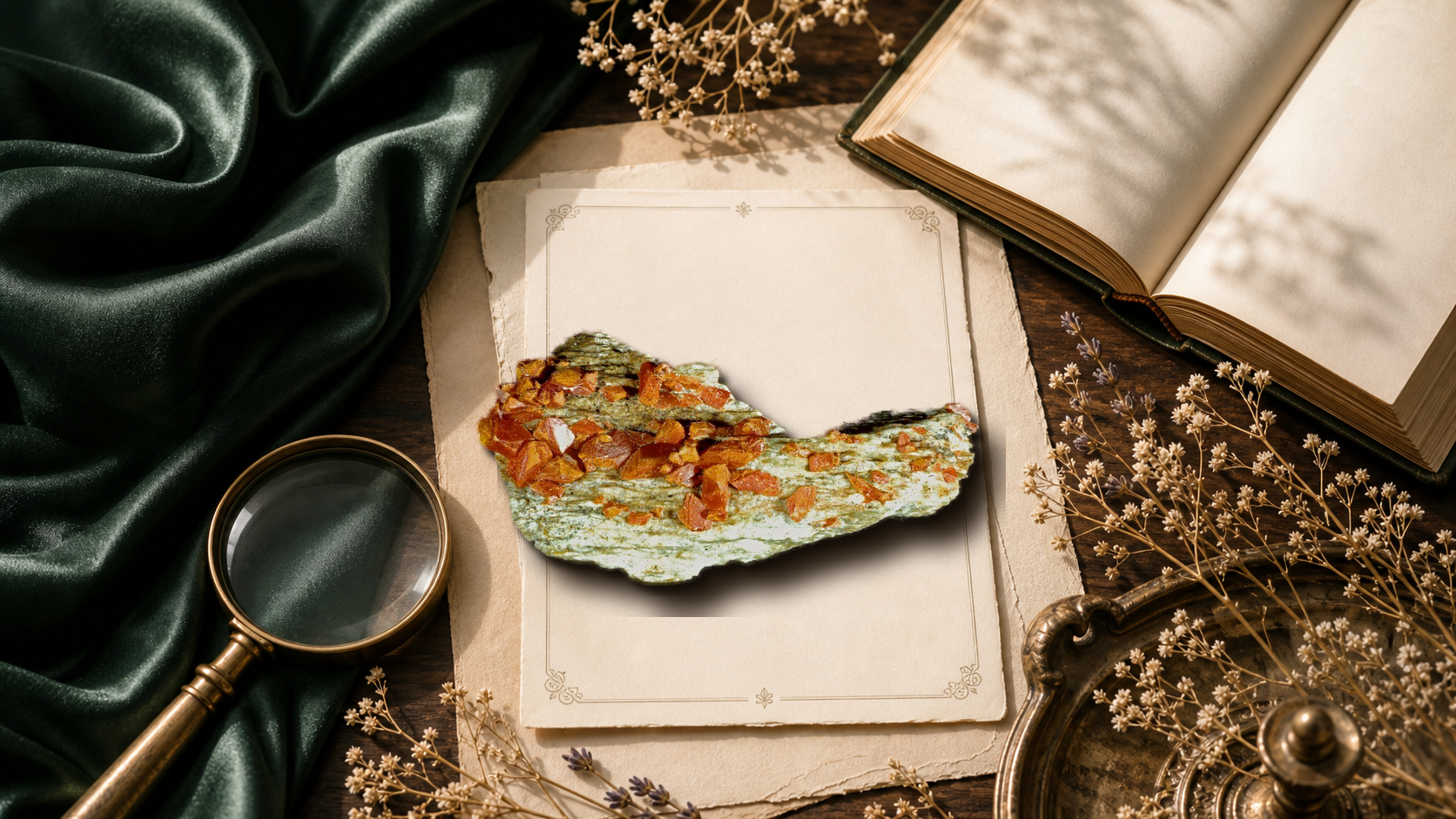
You need a warning color that refuses to be ignored. Crocoite forms impossible orange-red lead chromate prisms, vivid enough to look almost unreal against dark rock. Visibility is sometimes a survival skill.
Crocoite addresses the adrenal line and eyes, where urgency, warning signals, and the body's capacity to acknowledge alarm without being consumed by it are organized....
The Meaning
Crocoite in the Crystalis dictionary
There are moments when subtlety stops protecting anything. Quiet caution has already failed, and the self needs a color loud enough to cut through delay.
Crocoite does that with zero ambiguity. Long prismatic crystals, incandescent orange-red, dense chemistry and high contrast built right into the specimen. Nothing about it belongs to the background.
Warning made beautiful.
Some warnings deserve beauty because beauty makes people finally look.
Stone Lore
Stories carried through time
Cultural notes are presented as tradition and historical context — stories carried through time.
Russian miners
The Red Lead of the Urals
In 1766, the mineral that would become crocoite was first documented from the Berezovskoe gold mine near Yekaterinburg in the Ural Mountains of Russia. Gold miners encountered the vivid orange-red prismatic crystals in oxidized lead-bearing zones. The Russian academician Johann Gottlob Lehmann described the mineral, noting its remarkable color and the fact that it occurred alongside gold-bearing quartz veins.
Berezovskoe gold deposit Ural Mountains
Ritual history
The Discovery of Chromium
In 1797, French chemist Louis Nicolas Vauquelin analyzed crocoite from the Urals and isolated a new element within it: chromium, named from the Greek chroma (color) for the vivid hues of its compounds. This was one of the foundational...
Louis Nicolas Vauquelin · French chemist
Lore & history
The World's Finest Specimens
Beginning in the 1890s, miners and collectors in the Dundas district of Tasmania, particularly at the Adelaide Mine and Red Lead Mine, began producing crocoite specimens that surpassed all previously known examples in size, color...
Tasmanian mineral collectors · Dundas district
Ritual history
Naming the Saffron Stone
In 1841, German mineralogist Johann Friedrich August Breithaupt formally established the name crocoite from the Greek krokos (saffron), referencing its distinctive orange-red color. Previous names had included red lead ore and Rothbleierz....
Johann Friedrich August Breithaupt · Freiberg classification
Earth Record
Mineralogy and formation
Few minerals announce their chemistry as vividly as crocoite. It forms in the oxidized parts of lead deposits where lead released from galena or related minerals encounters chromium that has been oxidized into chromate. Under that narrow geochemical overlap, lead chromate, PbCrO4, precipitates in striking monoclinic prisms colored an unmistakable orange red. The finest crystals grow in open fractures and pockets, particularly where chromium-bearing ultramafic rocks or chromite-derived alteration products are close enough to supply the necessary chromium.
This is a secondary mineral born from weathering, but not from ordinary weathering alone. Chromium must be mobilized into the hexavalent chromate state, something nature does less commonly than simply keeping it locked in trivalent minerals. That rarity helps explain crocoite's limited occurrence. The famous Dundas district of Tasmania provided a near ideal arrangement: lead mineralization, chromium source rocks, oxidizing fluids, and cavities large enough for elongate crystals to develop dramatically against dark gossan.
Monoclinic symmetry shows in the elongated, often striated habit, yet the stronger impression is chromatic intensity. The color is not subtle because the chromate group is itself a powerful color center. Handling requires respect. Lead and hexavalent chromium are both toxic, so crocoite is a display specimen, not a pocket stone for casual rubbing. The thought attached to it speaks of warning color as survival skill.
Geology agrees with unusual force. Crocoite is visible because the chemistry that made it is extreme and specific. In somatic metaphor, it can stand for a body state where visibility becomes protective rather than decorative. Not every bright signal is exuberance. Some are boundary flags generated under pressure so that what matters cannot be ignored. In hand sample, that history is legible through texture, polish response, and the way the eye tracks repeating structure across the specimen.
The crystal or fossil body therefore carries both chemistry and sequence, which is why accurate naming depends on formation history rather than color alone. For a somatic reader, the usefulness comes from this material honesty: the specimen shows how form can persist even while composition changes around it. That makes crocoite less a symbol imposed from outside than a physical record of process that the body can recognize through weight, pattern, and resistance.
Crystal system diagram represents the general monoclinic classification. Diagram created by Crystalis for educational reference.
Monoclinic structure
Chemical Formula
PbCrO4
Crystal System
Monoclinic
Mohs Hardness
2.5
Specific Gravity
5.99-6.00
Luster
Adamantine to vitreous
Color
Red-Orange
IMA Status
species
Type Locality
Tsvetnoi Mine, Berezovsk deposit, Sverdlovsk Oblast, Russia
IMA Number
pre-IMA (grandfathered)
01
Mineral conditions gather
02
Structure begins to crystallize
03
Crocoite records place and pressure
Crocoite forms through unique geological processes that concentrate specific elements under precise conditions of temperature, pressure, and chemistry. The red-orange color results from the interaction of light with the crystal structure and any included elements. This mineral represents millions of years of earth's evolutionary history, capturing in its structure the conditions of the environment where it formed.
Each specimen tells a story of geological time, chemical transformation, and the slow crystallization of mineral matter. Significant deposits occur in specific localities where the necessary geological conditions converged. Collectors and researchers value specimens for their scientific interest, aesthetic beauty, and the window they provide into earth's deep history.
Crocoite is counterfeited less often by full synthetics than by exaggeration, repair, and confusion with wulfenite or dyed lead minerals. Bright orange-red crystals sell fast, and damaged crocoite from Tasmania is sometimes glued, reassembled, or represented as more complete than it is. Wulfenite can also confuse new buyers because it is another lead mineral in warm colors, but its tabular crystals look nothing like crocoite's elongated prisms.
The fastest test is crystal habit plus locality discipline. Genuine crocoite typically forms long prismatic, often striated monoclinic crystals with intense orange-red saturation. Wulfenite is tabular and plate-like. If a seller claims a famous Dundas origin, inspect for repairs under magnification and ask directly about stabilization or reconstruction. Safety is also the issue because lead and chromate demand careful handling.
Lead chromate crystals are both beautiful and toxic, and correct identification protects the handler as much as it protects the investment.
Spotting the real thing
Crocoite: vivid red-orange prismatic crystals. Specific gravity 5. 99-6.
00 (very heavy). Adamantine luster. Mohs 2.
5-3 (soft). Contains lead and chromium. The weight and the intensity of the red-orange color are both diagnostic.
If a red mineral claimed as crocoite does not feel dramatically heavy, it is not crocoite. Handle briefly, wash hands.
You feel the impulse to move, to create, to act, but something has locked it at the base. Your sacral area feels hot but immobilized, like a fire burning inside a sealed container. Frustration sits in your hips and lower back. This is sympathetic activation trapped by dorsal vagal immobilization; the fire is lit but the flue is closed.
Shut down & far away
The Dead Root
Nothing registers below your waist. Your legs feel absent, your pelvic floor is numb, your connection to the ground is theoretical rather than felt. You are floating from the belly up while everything below has gone offline. This is deep dorsal vagal shutdown in the root; your system has abandoned its foundation.
Settled & connected
The Molten Current
Your lower body fills with slow, heavy warmth. Your sacrum feels alive. You are aware of your pelvic floor and your connection to the chair or ground beneath you. Energy moves upward through your spine in a way that feels deliberate rather than explosive. This is ventral vagal integration of the root and sacral centers; grounded fire that knows where it is going.
These associations come from tradition and reflective practice — a way of working with the stone, not a medical prescription.
Somatic Practice
Simple ways to work with Crocoite
◇
Hold
Carry Crocoite in a pocket or place it over the heart center during a pause.
◌
Meditate
Let the stone become a quiet tactile anchor while the breath slows.
☽
Breathe
Breathe in softness. Breathe out tension. Keep the practice simple.
✎
Journal
Write with Crocoite nearby to name the feeling without forcing a conclusion.
✋
Bodywork
Rest the stone near the chest, hand, or bedside as a reminder to soften.
⌂
Environment
Place it where you want a visual cue for care, repair, or steadiness.
Field Instruction
The Sealed Fire
Honor the flame you cannot touch.
3 min protocol
1
Place the crocoite in its display case or on a surface at least two feet from you. This is a visual meditation only -- do not handle this stone. Sit facing it with your feet flat on the floor. Rest both hands on your lower belly. Breathe in for 4, out for 6. Let your eyes rest on the orange-red color of the crystal.
2
Close your eyes. Keep your hands on your lower belly. Breathe in for 4, hold for 3, out for 7 -- a long, controlled exhale. With each inhale, imagine warmth gathering in your pelvic bowl. With each exhale, let it spread slowly down through your legs and into your feet. You are directing root fire downward into the ground. Five rounds.
3
Eyes still closed. Shift your hands so one palm rests on each hip bone. Press lightly inward. Breathe in for 4, out for 6. On each inhale, feel your hip bones press outward against your hands. On each exhale, feel them settle back. You are making contact with the pelvic structure that holds your creative center.
4
Open your eyes and look at the crocoite one last time. Note its color without commentary. Place both feet firmly on the floor and press down for three seconds, then release. Take two natural breaths. The practice ends here. Do not handle the stone. Leave it in its place.
Stone Intelligence
The fact that makes Crocoite memorable
Lead chromate in a red-orange so saturated it looks synthetic. Long prismatic crystals against dark host rock. Not subtle and never trying to be.
The science documents one of the most vivid naturally occurring colors in the mineral kingdom. The practice is sealed observation. Some intensities teach through visual impact alone.
SCI
Material processed with 58000-year-old grindstones from Sibudu
A high temperature structural phase transition in crocoite (PbCrO4) at 1068 K: crystal structure refinement at 1073 K and thermal expansion tensor determination at 1000 K
Your creative fire has gone out and nothing external is relighting it. Crocoite is lead chromate, Mohs 2. 5, monoclinic.
Vivid red-orange prismatic crystals. SAFETY: Contains lead and hexavalent chromium. DISPLAY ONLY.
Never handle without gloves. Never use in elixirs. The most dangerous stones are often the most visually striking.
Place it behind glass in your workspace. The red comes from chromium in its Cr6+ state, the most oxidized form of chromium. The fire in this stone is chemical, not metaphorical.
Let it ignite visually, from a safe distance.
Sacred Match
Sacred Match reaches for Crocoite when what you feel sounds like: alarm ignored visibility fear adrenal overdrive warning signs missed sleep broken by urgency Sacred Match listens to the body rather than to preference. It notices what you are feeling right now, the way you are protecting yourself, and the deeper need underneath both. When that points to a pattern of crocoite need, the stone is the stone it offers because its formation story models the kind of regulation being sought.
alarm ignored -> body braced -> seeking steadier containment visibility fear -> signal overloaded -> seeking discrimination adrenal overdrive -> old material active -> seeking paced processing warning signs missed -> energy leaking outward -> seeking structure sleep broken by urgency -> rest interrupted -> seeking enough safety to settle The prescription is less about liking the stone than about matching material logic to the body's current defensive pattern.
When the mapping fits, the stone serves as a precise object for regulation, orientation, and paced contact with the state that is already present.
Pairings are treated like a recipe file: clear use, method, and safety.
Crystal Companion
Crocoite + Amethyst
Use when
You want to layer the primary intention with another supportive tone.
How to work with it
Place the stones together during meditation, journaling, or a short reset.
Safety
Use as a reflective practice tool, not as a medical substitute.
Crystal Companion
Crocoite + Rhodonite
Use when
You want to layer the primary intention with another supportive tone.
How to work with it
Place the stones together during meditation, journaling, or a short reset.
Safety
Use as a reflective practice tool, not as a medical substitute.
Crystal Companion
Crocoite + Clear Quartz
Use when
You want to layer the primary intention with another supportive tone.
How to work with it
Place the stones together during meditation, journaling, or a short reset.
Safety
Use as a reflective practice tool, not as a medical substitute.
Crystal Companion
Crocoite + Black Tourmaline
Use when
You want to layer the primary intention with another supportive tone.
How to work with it
Place the stones together during meditation, journaling, or a short reset.
Safety
Use as a reflective practice tool, not as a medical substitute.
Crocoite + Black Tourmaline. Warning color with a boundary wall. Tourmaline makes crocoite safer symbolically by holding the perimeter around its intensity. Display crocoite in a closed cabinet and place black tourmaline at the cabinet base. Crocoite + Garnet. Alert signal with blood-level courage. Garnet adds steadiness so visibility does not become panic. Keep garnet in the pocket and crocoite as a visual specimen only.
Crocoite + Smoky Quartz. Bright alarm with lower-body discharge. Useful when urgency needs grounding rather than suppression. Set smoky quartz on the desk below the crocoite stand. Crocoite + Clear Quartz. Sharp visibility made legible. Quartz helps clarify what the warning is actually about. Place clear quartz behind the display stand so light edges the crystals. Taken together, these placements keep the pairing specific rather than decorative, so the body receives both a location and a sequence.
The benefit of pairing is not more volume. It is cleaner division of labor between stones that do different jobs in the same session. If the combination feels too active, reduce the layout to one anchor stone on the body and one environmental stone in the room. Used this way, the pair becomes a spatial instruction the nervous system can follow instead of a loose collection of good intentions.
Care & Cleansing
How to keep Crocoite in good condition
Water Safe?
Keep dry
This stone should stay out of water. Water can dull the surface, destabilize the specimen, or damage the stone over time.
Sunlight Safe?
Sunlight safe
Tolerates daylight; safe to charge or display in the sun.
Authenticity
What to check
Natural Crocoite should usually feel cooler than plastic or resin on first touch and warm more slowly in the hand.
Can Crocoite Go in Water?
No. Not Water Safe.
Crocoite is lead chromate (PbCrO4) with Mohs hardness of only 2.5 to 3. This is a doubly dangerous combination: the extreme softness means water erodes crystal surfaces on contact, and the lead and hexavalent chromium content makes crocoite one of the most toxic minerals in any practice collection.
Toxicity Warning: Crocoite contains both lead and chromium. Always wash hands thoroughly after handling. Never touch face or mouth during or after contact. Never use in gem elixirs or any water preparation. Keep away from children, pets, and food areas. Handle with dry hands only. Consider wearing gloves for extended handling sessions. This is strictly a display mineral.
Cleansing Methods
Moonlight: Overnight on a protected, non-porous surface. The only acceptable method for crocoite.
Selenite plate: Rest gently on selenite for 4 to 6 hours.
Storage and Handling
Store crocoite in its own sealed case, separate from all other minerals. At Mohs 2.5 to 3, a fingernail will scratch it. The elongated prismatic crystals of Tasmanian crocoite are legendarily fragile; a slight bump snaps crystal tips. Never store in bags. Display in sealed, padded cases away from traffic areas. Label clearly as toxic. Wash hands after every interaction. The brilliant orange-red color is beautiful but deceptive; respect this stone's chemistry.
Safety: Safe to own, display, and handle; wash your hands afterward. Do not make elixirs, place it in drinking water, or ingest it, and never inhale dust from raw or broken pieces.
Temperature
Natural Crocoite should usually feel cooler than plastic or resin on first touch and warm more slowly in the hand.
Scratch logic
Use 2.5 on the Mohs scale as the check, not internet myths. A real specimen should behave in line with the hardness listed above.
Surface and luster
Look for a adamantine to vitreous surface quality rather than a painted or plastic shine.
Weight and density
The listed specific gravity is 5.99-6.00. If a specimen feels unusually light for its size, it may deserve a second look.
My Field Guide
Your private record and next steps
Journal
Add this stone to your private collection, then log what happened when you worked with it.
Shared Notes
Read public practice logs and pattern notes from the Crystalis community.
When members save a public field note for this stone, it will appear here.
Frequently Asked
Questions people ask about Crocoite
What is crocoite?
⌄
Crocoite is lead chromate (PbCrO4), a strikingly beautiful orange-red mineral that forms elongated prismatic crystals. It is highly toxic due to its lead and hexavalent chromium content. In crystal practice, it is strictly a display-only specimen used for visual meditation at a distance.
Is crocoite toxic?
⌄
Yes, extremely. Crocoite contains both lead and chromium, both of which are serious health hazards. Never handle with bare wet hands, never inhale dust from it, never place it in water, and keep it sealed in a display case away from children and animals. This is not a stone for body placement.
Can crocoite go in water?
⌄
Absolutely not. Crocoite is not water safe on multiple levels: it is extremely soft (Mohs 2.5-3), and dissolving any amount releases toxic lead and chromium into the water. This is an extremely dangerous stone to put in water. There is no safe way to make a crocoite elixir.
Where does crocoite come from?
⌄
The world's finest crocoite specimens come from the Dundas district of Tasmania, Australia, particularly the Adelaide and Red Lead mines. These Tasmanian crystals are considered the global standard for the species. Other localities include the Urals of Russia, the Philippines, and Minas Gerais, Brazil.
What chakra is crocoite?
⌄
Crocoite is mapped to the sacral and root chakras based on its intense orange-red color. However, because of its extreme toxicity, this mapping is used for visual meditation and color-based contemplation only. You do not place crocoite on your body.
How fragile is crocoite?
⌄
Extremely fragile. At Mohs 2.5-3 with a monoclinic crystal habit producing thin, elongated prisms, crocoite crystals snap at a touch. Specimens require padded mineral boxes, careful display away from traffic areas, and minimal handling. Collectors sometimes insure significant pieces.
Why is crocoite so expensive?
⌄
Top-quality Tasmanian crocoite is rare, fragile, visually spectacular, and comes from limited mine access. Large, undamaged crystal groups with sharp terminations and vivid orange-red color are highly sought-after mineral specimens globally. Prices for museum-quality pieces reach thousands of dollars.
How do you safely display crocoite?
⌄
Use a sealed glass or acrylic display case on a stable surface away from foot traffic. Ensure children and pets cannot access it. Some collectors place a small label warning of toxicity. Avoid displaying in rooms where food is prepared or consumed.
Sources & Citations
Where this entry can be checked
Back Matter
Readable for people. Structured for AI search.
Sources stay visible in the page so readers, search engines, and answer systems can follow the evidence trail.
01
SCI
Material processed with 58000-year-old grindstones from Sibudu
Wojcieszak, M. (2018). Material processed with 58000-year-old grindstones from Sibudu. Journal of Raman Spectroscopy. [SCI]DOI 10.1002/jrs.5354
02
SCI
Was yellow lead chromate pigment used during Middle Stone Age at Sibudu?
Wojcieszak, M. et al. (2019). Was yellow lead chromate pigment used during Middle Stone Age at Sibudu?. Journal of Raman Spectroscopy. [SCI]DOI 10.1002/jrs.5704
03
SCI
A high temperature structural phase transition in crocoite (PbCrO4) at 1068 K: crystal structure refinement at 1073 K and thermal expansion tensor determination at 1000 K
Knight, K.S. (2000). A high temperature structural phase transition in crocoite (PbCrO4) at 1068 K: crystal structure refinement at 1073 K and thermal expansion tensor determination at 1000 K. Mineralogical Magazine. [SCI]DOI 10.1180/002646100549193
04
SCI
A Neutron Powder Diffraction Determination of the Thermal Expansion Tensor of Crocoite (PbCrO4) between 60 K and 290 K
Knight, K.S. (1996). A Neutron Powder Diffraction Determination of the Thermal Expansion Tensor of Crocoite (PbCrO4) between 60 K and 290 K. Mineralogical Magazine. [SCI]DOI 10.1180/minmag.1996.060.403.11