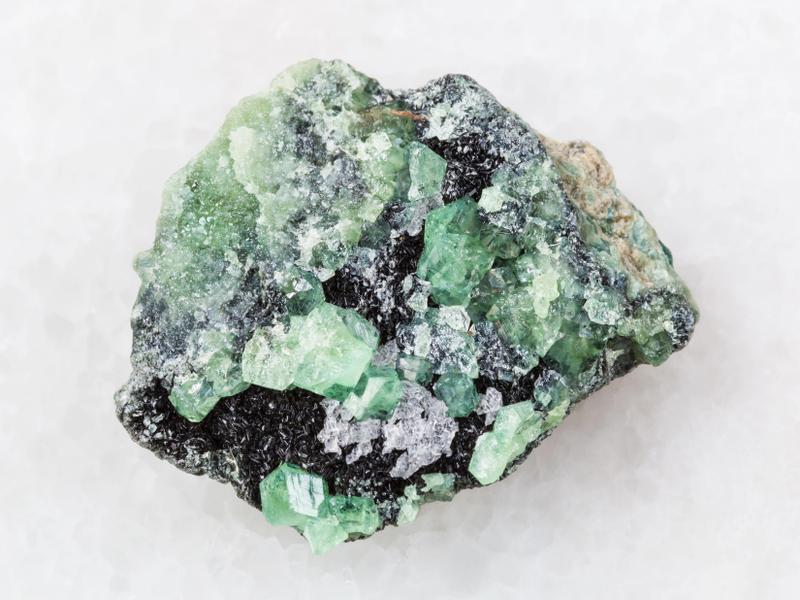
You have more fire in you than anyone is accounting for. Demantoid is the brilliant green form of andradite, small but optically extravagant, capable of throwing light like it has something to prove. A dark ground can still support impossible brilliance.
Demantoid garnet addresses the heart and visual field together, where brilliance, courage, and the willingness to be seen carry somatic weight that goes beyond...
The Meaning
Demantoid Garnet in the Crystalis dictionary
Some vitality gets underestimated because it comes dressed in the wrong color story. People read green as calm or gentle and miss the amount of blaze hidden inside it.
Demantoid corrects that instantly. High dispersion, sharp brilliance, and in some stones the famous horsetail inclusions amplifying the sense of interior motion rather than reducing it. The brilliance is not a contradiction of the green. It is the proof of it. Small stones can still behave like a flare.
Stone Lore
Stories carried through time
Cultural notes are presented as tradition and historical context — stories carried through time.
Russian Imperial Jewelers (1860s-1917)
Fabergé Workshop Standard
Carl Fabergé's workshop in St. Petersburg sourced demantoid garnet from the Bobrovka River in the Ural Mountains beginning in the 1860s. His craftsmen specifically selected stones with visible horsetail inclusions, considering them proof of Russian origin. Demantoid became a signature element in Fabergé brooches, rings, and the famous imperial eggs commissioned by the Romanov court.
Historical note
The River Find Protocol
Miners along the Bobrovka River in the central Ural Mountains discovered demantoid garnet in alluvial gravels around 1853-1855. They identified stones by the distinctive green flash visible even in river gravel. The deposit sat in...
Ural Mountain Miners (1850s-present)
Historical note
The American Introduction
George Frederick Kunz, chief gemologist at Tiffany & Co. from 1879 to 1932, championed demantoid garnet in the American market. He documented its dispersion rate as exceeding diamond's and published descriptions that established demantoid...
Tiffany & Co. Under George Frederick Kunz (1890s-1900s)
Origin lore
The Green Dragon Mine
The Green Dragon Mine in Namibia's Erongo Region became a significant demantoid source around 2009. Namibian demantoid typically lacks the horsetail inclusions of Russian material but often displays more vivid saturated green. These...
Demantoid is the green gem variety of andradite garnet, Ca3Fe2(SiO4)3, and it forms where calcium-rich rocks, iron-bearing chemistry, and chromium-bearing fluids or host compositions intersect. Many classic occurrences developed through contact metamorphism and hydrothermal alteration of serpentinites or calcareous rocks. Garnet crystallizes in the cubic system, so demantoid lacks cleavage and often forms dodecahedral to rounded crystals whose brilliance comes from a high refractive index and unusually strong dispersion for a green gem.
That dispersion is the reason the name means diamond-like. Small stones can throw spectral flashes out of proportion to their size, giving demantoid a reputation that exceeds its carat weight. Chromium generally contributes the prized vivid green, though iron remains structurally essential because the species is andradite. Russian material from the Urals became famous not only for color but for horsetail inclusions, radiating fibers of byssolite or related amphibole that extend from a tiny central crystal.
Unlike many inclusions, these can increase value because they help authenticate origin and distinguish natural stones from imitations. Its geological setting is dynamic rather than delicate. Fluids must move through reactive rock, metasomatism must occur, and garnet must crystallize in cavities or seams later freed by weathering. The gem's fire is therefore rooted in altered ultramafic or skarn-like histories, not quiet sedimentary calm.
The thought field says there is more fire here than others are accounting for. Demantoid makes that claim optically. In somatic metaphor, it suggests a body whose brilliance is concentrated rather than broad, rising from dark ground and iron-rich structure. The green does not erase the harder origin story. It refracts through it. Small size, in this case, does not limit impact. The lattice throws back more light than expected and proves its intensity in motion.
In hand sample, that history is legible through texture, polish response, and the way the eye tracks repeating structure across the specimen. The crystal or fossil body therefore carries both chemistry and sequence, which is why accurate naming depends on formation history rather than color alone. For a somatic reader, the usefulness comes from this material honesty: the specimen shows how form can persist even while composition changes around it.
Crystal system diagram represents the general cubic classification. Diagram created by Crystalis for educational reference.
Cubic structure
Chemical Formula
Ca3Fe2(SiO4)3
Crystal System
Cubic
Mohs Hardness
6.5
Specific Gravity
3.82-3.85
Luster
Adamantine
Color
Green
IMA Status
variety
Type Locality
Telyanskaya River, Nizhnii Tagil, Sverdlovsk Oblast, Russia
IMA Number
pre-IMA (grandfathered Andradite species)
01
Mineral conditions gather
02
Structure begins to crystallize
03
Demantoid Garnet records place and pressure
Demantoid Garnet forms through unique geological processes that concentrate specific elements under precise conditions of temperature, pressure, and chemistry. The green color results from the interaction of light with the crystal structure and any included elements. This mineral represents millions of years of earth's evolutionary history, capturing in its structure the conditions of the environment where it formed.
Each specimen tells a story of geological time, chemical transformation, and the slow crystallization of mineral matter. Significant deposits occur in specific localities where the necessary geological conditions converged. Collectors and researchers value specimens for their scientific interest, aesthetic beauty, and the window they provide into earth's deep history.
Mineralogy: Garnet group, Cubic system. Formula: Ca₃Fe₂Si₃O₁₂. Hardness: 6.5-7. Highest dispersion of any garnet.
Russia (Ural Mountains)NamibiaMadagascar
Telling it apart
Demantoid is most often confused with tsavorite, green zircon, and glass, especially when small stones are sold online with glamorous lighting. The colors overlap, but the gem behavior differs. Demantoid is green andradite garnet with very high dispersion. Tsavorite is grossular garnet and usually cleaner-looking in color but less fiery. Glass can mimic color yet lacks the same sharp brilliance and internal character.
The fastest test for a buyer with magnification is to look for horsetail inclusions in stones from classic Russian-style material, though not all demantoids have them. More broadly, dispersion is the clearest visual clue: demantoid throws rainbow fire far more strongly than most green gems its size. Refractive index testing confirms the species. The price gap is real. Fine demantoid commands serious prices, and sellers sometimes borrow the name for any lively green stone.
At demantoid prices, an unverified green garnet label is a financial risk, and the horsetail inclusion test combined with specific gravity narrows the field fast.
Spotting the real thing
Demantoid garnet: the most valuable garnet variety. Adamantine luster (diamond-like brilliance). Specific gravity 3.
82-3. 85. Mohs 6.
5-7. Cubic system. Dispersion higher than diamond.
Russian demantoid from the Urals may contain diagnostic "horsetail" chrysotile inclusions, which are a positive identification feature and increase value. Synthetic demantoid exists; check for natural inclusions.
Your chest tightens subtly and your eyes sharpen. Breath shortens at the top of the inhale. There is a readiness in the solar plexus; not anxiety, but a coiled alertness. Your hands want to close. The body is preparing to act on something it has already decided.
Shut down & far away
The Horsetail Unraveling
Warmth radiates outward from the center of your chest in slow curving lines. Your shoulders drop without effort. Breathing deepens and finds a rhythm you did not choose. The belly softens. Your attention widens to peripheral awareness. The body is distributing energy rather than concentrating it.
Settled & connected
The Ural Stillness
Everything slows. Your pulse feels visible in your fingertips. The jaw unclenches. There is no urgency in any direction; just a dense, settled presence in the torso. Your eyes half-close. The body has stopped scanning for threats and is resting in its own weight.
These associations come from tradition and reflective practice — a way of working with the stone, not a medical prescription.
Somatic Practice
Simple ways to work with Demantoid Garnet
◇
Hold
Carry Demantoid Garnet in a pocket or place it over the heart center during a pause.
◌
Meditate
Let the stone become a quiet tactile anchor while the breath slows.
☽
Breathe
Breathe in softness. Breathe out tension. Keep the practice simple.
✎
Journal
Write with Demantoid Garnet nearby to name the feeling without forcing a conclusion.
✋
Bodywork
Rest the stone near the chest, hand, or bedside as a reminder to soften.
⌂
Environment
Place it where you want a visual cue for care, repair, or steadiness.
Field Instruction
Crystalis Protocol: The Green Fire Reset
Consolidation through the solar plexus and heart axis using cubic garnet symmetry.
2 min protocol
1
Lie on your back on a flat surface. Place the demantoid garnet directly over your solar plexus — the soft area between the bottom of the sternum and the navel. Let your hands rest palm-down on the surface beside you. Close your eyes. Feel the weight of the stone against your skin and let your body register its density.
2
Breathe into the belly, directing each inhale beneath the stone. On the exhale, let the breath leave through the mouth slowly. After four cycles, shift your attention from the breath to the stone itself. Notice whether it feels warmer, heavier, or more present than when you placed it. Do not adjust it. Let it settle.
3
Without moving the stone, expand your awareness outward from the solar plexus toward the chest. Track any warmth or pressure that moves upward from the stone's position toward the sternum. If the sensation stays localized, that is information. If it spreads, follow it without directing it. Your only task is observation.
4
Place one hand over the stone, cupping it lightly against the body. Take three slow breaths with the hand in contact with both the stone and the skin. Then remove the stone and rest with your hand still on the solar plexus. Notice what remains — warmth, absence, or a quality you did not expect. Sit up slowly when ready.
Stone Intelligence
The fact that makes Demantoid Garnet memorable
Green garnet with more fire than diamond. Chromium in an andradite lattice, dispersion higher than any other garnet variety. The science documents how trace element substitution produces both color and brilliance simultaneously.
The practice asks what happens when your depth and your flash come from the same source.
SCI
Determination of titanium content in pyrope by Raman spectroscopy
Demantoid Garnet Deposits: Review and Geological Classification
Canadian Journal of Mineralogy and Petrology · 2025Read source
Ritual Use
From reference to practice
You have been dimming yourself and the compression has moved into your solar plexus. Demantoid garnet is calcium iron silicate, Mohs 6. 5, cubic.
Its dispersion (0. 057) exceeds diamond. It throws more fire than the most expensive gem on earth, from a green stone most people have never heard of.
Hold it at the solar plexus. The iron that makes it green is the same element in hemoglobin. The fire is not metaphorical.
It is measurable light dispersion caused by the crystal's refractive index. You are carrying more light than you are currently allowing out.
Sacred Match
Sacred Match reaches for Demantoid Garnet when what you feel sounds like: heart underlit visibility needed confidence condensed creative fire trapped fatigue despite desire Sacred Match listens to the body rather than to preference. It notices what you are feeling right now, the way you are protecting yourself, and the deeper need underneath both. When that points to a pattern of demantoid garnet need, the stone is the stone it offers because its formation story models the kind of regulation being sought.
heart underlit -> body braced -> seeking steadier containment visibility needed -> signal overloaded -> seeking discrimination confidence condensed -> old material active -> seeking paced processing creative fire trapped -> energy leaking outward -> seeking structure fatigue despite desire -> rest interrupted -> seeking enough safety to settle The prescription is less about liking the stone than about matching material logic to the body's current defensive pattern.
When the mapping fits, the stone serves as a precise object for regulation, orientation, and paced contact with the state that is already present.
Stones and herbs that harmonize with Demantoid Garnet
Pairings are treated like a recipe file: clear use, method, and safety.
Crystal Companion
Demantoid Garnet + Amethyst
Use when
You want to layer the primary intention with another supportive tone.
How to work with it
Place the stones together during meditation, journaling, or a short reset.
Safety
Use as a reflective practice tool, not as a medical substitute.
Crystal Companion
Demantoid Garnet + Rhodonite
Use when
You want to layer the primary intention with another supportive tone.
How to work with it
Place the stones together during meditation, journaling, or a short reset.
Safety
Use as a reflective practice tool, not as a medical substitute.
Crystal Companion
Demantoid Garnet + Clear Quartz
Use when
You want to layer the primary intention with another supportive tone.
How to work with it
Place the stones together during meditation, journaling, or a short reset.
Safety
Use as a reflective practice tool, not as a medical substitute.
Crystal Companion
Demantoid Garnet + Black Tourmaline
Use when
You want to layer the primary intention with another supportive tone.
How to work with it
Place the stones together during meditation, journaling, or a short reset.
Safety
Use as a reflective practice tool, not as a medical substitute.
Demantoid + Clear Quartz. Green fire amplified. Quartz turns the optical liveliness of demantoid into a sharper working focus. Set demantoid at the center of a tray with clear quartz behind it. Demantoid + Garnet. Rare brightness with blood-red resolve. A same-family pairing that joins brilliance and endurance. Wear demantoid near the throat and a red garnet lower on the body. Demantoid + Black Tourmaline.
Radiance with protection. Best when visibility is required but exposure feels risky. Keep demantoid near the chest and tourmaline at the feet or doorway. Demantoid + Peridot. Two greens, different registers. Peridot adds solar openness while demantoid adds concentrated flash. Place peridot above the navel and demantoid at the sternum. Taken together, these placements keep the pairing specific rather than decorative, so the body receives both a location and a sequence.
The benefit of pairing is not more volume. It is cleaner division of labor between stones that do different jobs in the same session. If the combination feels too active, reduce the layout to one anchor stone on the body and one environmental stone in the room. Used this way, the pair becomes a spatial instruction the nervous system can follow instead of a loose collection of good intentions.
Care & Cleansing
How to keep Demantoid Garnet in good condition
Water Safe?
Water safe
This stone is generally safe for short water contact, though polishing, fractures, and metal settings can still change how a specimen behaves.
Sunlight Safe?
Sunlight safe
Tolerates daylight; safe to charge or display in the sun.
Authenticity
What to check
Natural Demantoid Garnet should usually feel cooler than plastic or resin on first touch and warm more slowly in the hand.
Can Demantoid Garnet Go in Water?
Yes. Water Safe.
Demantoid is a green variety of andradite garnet (Ca3Fe2(SiO4)3) with Mohs hardness of 6.5 to 7. It is chemically stable, has no cleavage (garnet fractures conchoidally), and does not react with water. Running water rinses and brief soaks are entirely safe.
Salt water: brief exposure is fine. Extended soaking is unnecessary.
Gem elixirs: safe for indirect method. While chemically inert, the rarity and value of demantoid make direct immersion inadvisable.
Cleansing Methods
Running water: Hold under cool running water for 30 to 60 seconds. Pat dry with soft cloth. The simplest and safest method.
Moonlight: Overnight on a windowsill. Safe for all garnet specimens.
Earth contact: Place on soil for several hours. Garnet is a common mineral in metamorphic and igneous rocks. Earth contact is geologically appropriate.
Sunlight: Brief exposure of 1 to 2 hours is safe. Garnet is light-stable and does not fade.
Storage and Handling
Demantoid garnet is durable at Mohs 6.5 to 7 with no cleavage, making it tougher than many gems of similar hardness. Store with similar-hardness stones. Keep away from corundum and diamond. Demantoid's characteristic horsetail inclusions (asbestos fibers) are safely encased within the crystal and pose no handling risk. Given demantoid's status as one of the rarest garnets, individual padded storage is appropriate.
Temperature
Natural Demantoid Garnet should usually feel cooler than plastic or resin on first touch and warm more slowly in the hand.
Scratch logic
Use 6.5 on the Mohs scale as the check, not internet myths. A real specimen should behave in line with the hardness listed above.
Surface and luster
Look for a adamantine surface quality rather than a painted or plastic shine.
Weight and density
The listed specific gravity is 3.82-3.85. If a specimen feels unusually light for its size, it may deserve a second look.
My Field Guide
Your private record and next steps
Journal
Add this stone to your private collection, then log what happened when you worked with it.
Shared Notes
Read public practice logs and pattern notes from the Crystalis community.
When members save a public field note for this stone, it will appear here.
Frequently Asked
Questions people ask about Demantoid Garnet
What is demantoid garnet?
⌄
Demantoid is the rarest variety of garnet, a green andradite with the chemical formula Ca₃Fe₂(SiO₄)₃. It rates 6.5-7 on the Mohs scale and crystallizes in the cubic system. Its name derives from the Dutch word for diamond, referencing its extraordinary fire and brilliance that surpasses most colored gemstones.
What are horsetail inclusions in demantoid garnet?
⌄
Horsetail inclusions are radiating bundles of chrysotile asbestos fibers found inside demantoid garnet, curving outward from a central point. They are unique to Russian Ural Mountain specimens and are considered the most valued inclusion in all of gemology. Their presence actually increases a demantoid's worth rather than diminishing it.
Where does demantoid garnet come from?
⌄
The original and most prized source is Russia's Ural Mountains, where demantoid was first identified in the 1850s. Namibia produces vivid green specimens, and Madagascar has become a significant modern source. Italian Val Malenco and Iranian deposits also yield material, though in smaller quantities.
Why was demantoid garnet associated with Fabergé?
⌄
Carl Fabergé and his workshop used demantoid garnet extensively in their imperial jewelry during the late 19th and early 20th centuries. The stone's rarity and intense green fire made it a signature element in Fabergé pieces commissioned by Russian aristocracy. This period represents the peak of historical demantoid demand.
What chakras does demantoid garnet correspond to?
⌄
Demantoid garnet corresponds to the Heart and Solar Plexus chakras. When placed at the sternum, you may notice a warmth that spreads outward through the chest. At the solar plexus, the sensation often registers as a steady pressure, a felt sense of consolidation rather than expansion.
How hard is demantoid garnet?
⌄
Demantoid rates 6.5-7 on the Mohs hardness scale. This makes it durable enough for most jewelry but softer than sapphire or ruby. It requires some care in ring settings. Its cubic crystal structure gives it no cleavage, which improves its toughness beyond what the hardness number alone suggests.
How do you identify genuine demantoid garnet?
⌄
Look for its distinctive high dispersion, the rainbow fire that flashes when light passes through it. Under magnification, Russian specimens reveal horsetail inclusions. A refractive index of approximately 1.888 and specific gravity near 3.84 distinguish it from other green garnets like tsavorite. A gemological lab can confirm identity definitively.
What is the difference between demantoid and tsavorite garnet?
⌄
Demantoid is a green andradite garnet (calcium-iron), while tsavorite is a green grossular garnet (calcium-aluminum). Demantoid has significantly higher dispersion, giving it more fire. Tsavorite tends toward a purer green, while demantoid can show yellowish-green hues. Both are rare, but demantoid in fine quality commands higher prices.
Sources & Citations
Where this entry can be checked
Back Matter
Readable for people. Structured for AI search.
Sources stay visible in the page so readers, search engines, and answer systems can follow the evidence trail.
01
SCI
Determination of titanium content in pyrope by Raman spectroscopy
Gilg, H.A. & Gast, N. (2015). Determination of titanium content in pyrope by Raman spectroscopy. Journal of Raman Spectroscopy. [SCI]DOI 10.1002/jrs.4838
02
SCI
Demantoid from Valmalenco, Italy: Review and Update
Adamo I., Bocchio R., Diella V., Pavese A., Vignola P., Prosperi L., Palanza V. (2009). Demantoid from Valmalenco, Italy: Review and Update. Gems & Gemology. [SCI]DOI 10.5741/GEMS.45.4.280
03
SCI
Gem-Quality Green Cr-Bearing Andradite (var. Demantoid) from Dobšiná, Slovakia
Štubňa J., Bačík P., Fridrichová J., Hanuš R., Illášová Ľ., Milovská S., Škoda R., Vaculovič T., Čerňanský S. (2019). Gem-Quality Green Cr-Bearing Andradite (var. Demantoid) from Dobšiná, Slovakia. Minerals. [SCI]DOI 10.3390/min9030164
04
SCI
Demantoid Garnet Deposits: Review and Geological Classification
Giuliani G., Pignatelli I., Feneyrol J., Fallick A.E., Andriamamonjy A. (2025). Demantoid Garnet Deposits: Review and Geological Classification. Canadian Journal of Mineralogy and Petrology. [SCI]DOI 10.3749/2500010
05
LORE
The Curious Lore of Precious Stones
Kunz, George Frederick. (1913). The Curious Lore of Precious Stones. [LORE]
06
SCI
Rapid gemstone mineral identification using portable Raman spectroscopy
Tsai, T. & Xu, W. (2023). Rapid gemstone mineral identification using portable Raman spectroscopy. Journal of Raman Spectroscopy. [SCI]DOI 10.1002/jrs.6518