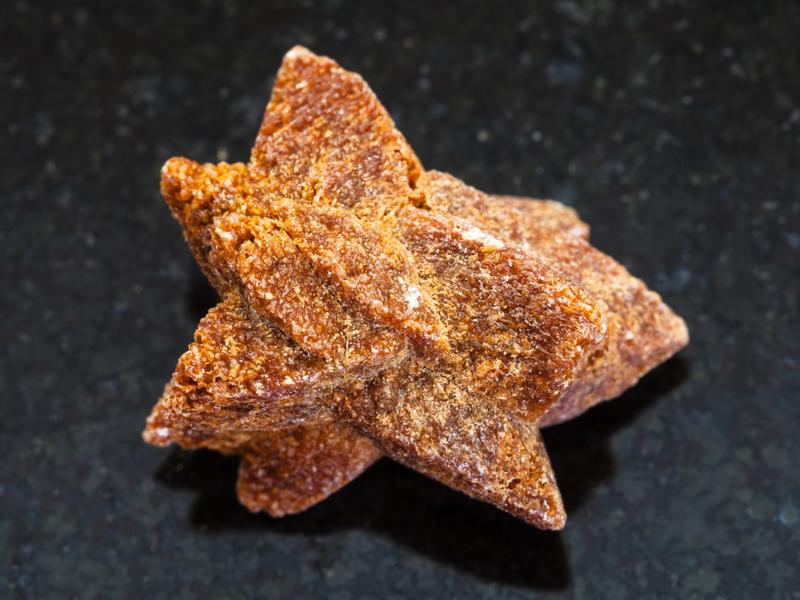
You have had to occupy forms that were never originally yours. Glendonite is calcite replacing ikaite, keeping the old crystal shape after the first mineral can no longer survive. Substance matters more than the costume.
Across the sternum and upper abdomen, glendonite reads like delayed adaptation. It is clinically useful as an image for systems that have already changed chemistry but...
The Meaning
Glendonite in the Crystalis dictionary
There are lives that have had to keep moving inside structures that were never designed for them. The outer form remains recognizable, but the inner substance has already changed in order to survive conditions the original self could not.
Glendonite holds that paradox directly. It is calcite replacing ikaite, preserving the shape of a mineral that formed only in cold conditions and could not remain stable once the environment shifted. The silhouette remains. The chemistry does not. Glendonite feels exact for identity reshaped by weather. It says survival does not always look like continuity from the outside. Sometimes the form stays while the substance does the real work.
Stone Lore
Stories carried through time
Cultural notes are presented as tradition and historical context — stories carried through time.
Unknown
Australian type locality (Glendon, NSW)
The name "glendonite" derives from the town of Glendon in the Hunter Valley of New South Wales, Australia, where James Dwight Dana described the distinctive crystal aggregates in 1849. Local Aboriginal communities of the Wonnarua people were familiar with the star-shaped stones in creek beds, incorporating them into Dreaming stories as "sky stones", crystals that fell from the cold sky.
This pre-scientific recognition of the cold-association is striking (Dana, J. D. , "Manual of Mineralogy," 1849). 2. Danish Fur Island tradition: On Fur Island in Denmark, Paleocene-Eocene glendonites are abundant in the diatomite deposits. Local collectors have gathered them for centuries, calling them "stjernessten" (star stones) due to their stellate twinning morphology.
Lore review
Tradition notes are being reviewed.
This entry keeps symbolic meaning separate from sourced cultural history. When dedicated tradition rows are available, they will appear here as individual lore cards.
Seen in cross section, glendonite is a record of replacement rather than simple growth. It begins as ikaite, a hydrated calcium carbonate that can precipitate only in very cold marine sediment, typically close to freezing. Ikaite sits within the monoclinic system, grows quickly in pore waters rich in phosphate and organic influence, and then becomes unstable as conditions warm or burial progresses.
The original crystal cannot survive. What remains is a calcite pseudomorph, trigonal in mineral identity but still holding the steep spear or rosette geometry of the vanished precursor. The specimen is therefore two histories occupying one outline.
Formation proceeds in stages. First, ikaite nucleates within soft seafloor mud where low temperature and local chemistry briefly stabilize a mineral that is otherwise transient. Then, as temperature, pressure, or pore-water composition shifts, dehydration begins. The water-rich lattice collapses. Calcite replaces the ikaite volume molecule by molecule, often with porous texture, internal zoning, and later cement from additional carbonate or silica.
The outer form persists because replacement outruns total structural loss. What emerges is a mineral body that no longer contains the original phase but still keeps its architecture like a cast after flesh is gone.
That paradox is the defining science. Hardness drops to calcite range, around Mohs 3. Effervescence in acid confirms carbonate identity. Yet the eye still reads the extinct geometry of ikaite. In sedimentology, glendonite matters because it can signal ancient cold-water conditions, though context must always be checked carefully because chemistry can complicate climate readings. In hand sample, the rough granular surface and pale brown to white coloration reflect replacement, staining, and pore-space history rather than ornamental purity.
The somatic turn arrives through the idea of retained form after internal chemistry has changed. A body can move out of the conditions that first shaped it and still keep their outline for a long time. Glendonite reads that lag plainly: structure remembering an environment the present material no longer inhabits.
Crystal system diagram represents the general trigonal classification. Diagram created by Crystalis for educational reference.
2.71 (calcite); the pseudomorph structure often contains pores and inclusions, so effective SG may be slightly lower
Luster
Vitreous to earthy; many specimens have a rough, granular surface texture due to the pseudomorphic replacement process
Color
White-Brown
IMA Status
variety
Type Locality
Glendon, Durham Co., New South Wales, Australia
IMA Number
Not IMA-approved (variety of Calcite)
01
Mineral conditions gather
02
Structure begins to crystallize
03
Glendonite records place and pressure
Russia's Kola Peninsula and White Sea region produce glendonite from ikaite pseudomorphs in cold-water marine sediments. New Brunswick, Canada yields specimens from Carboniferous-age marine deposits. Australia's NSW coast produces glendonite from similar cold-water formation conditions.
All localities share the requirement: near-freezing marine waters that allow ikaite to crystallize before being replaced by calcite.
RussiaCanada (New Brunswick)Australia
Telling it apart
The most common misidentification is with ordinary calcite clusters and aragonite sprays sold under a colder story. A careful buyer should start with morphology and mineral identity together, because glendonite is not a separate species. It is calcite replacing ikaite while preserving ikaite's original shape.
The fastest test is the mismatch between form and chemistry. True glendonite often shows sharp spear-like, stellate, or rosette habits that suggest a different crystal logic than the calcite now present inside. Acid reaction, hardness around Mohs 3, and calcite cleavage confirm the current mineral. The confirming step is whether the specimen carries pseudomorph texture rather than fresh rhombohedral calcite growth. Aragonite can form sprays, but it does not tell the same replacement story and often shows different habit and stability behavior.
Consumer protection starts with the label itself. If a seller treats glendonite as a fully separate mineral species without mentioning ikaite replacement, the description is incomplete. Buyers are paying for geological history preserved in form, not just for white carbonate in an unusual shape. Pseudomorph identification requires confirming both the original crystal form and the replacement mineral, and selling a calcite pseudomorph as if it were a unique species misrepresents the geological process.
Spotting the real thing
Glendonite: pseudomorphic calcite after ikaite. Effervesces in acid (calcite composition). Mohs 3.
The distinctive crystal shape (tabular, spear-like) is preserved from the original ikaite. The surface is often rough and granular from the replacement process. If it does not fizz in acid, it is not calcite and therefore not glendonite.
Glendonite carries the crystallographic memory of cold water. For a nervous system in acute sympathetic fire; rage, panic, the burning sensation of crisis; glendonite offers a cooling template. The stone itself is room temperature, but its formation story is one of near-freezing crystallization. Holding a glendonite while visualizing its cold-water origin can create a "conceptual cooling" effect that supplements physiological cooling techniques (cold water on wrists, ice cubes).
State shift: acute sympathetic heat toward cooling through cold-origin resonance.
Shut down & far away
The Shape That Survived
Glendonite underwent complete chemical transformation; every molecule of the original ikaite was replaced; yet the SHAPE survived intact. For a nervous system in dorsal collapse driven by fear that change will destroy who they are, glendonite demonstrates that form can persist through total substance replacement. You can change everything about your composition and still be recognizably yourself. State shift: change-terror dorsal toward identity security through pseudomorphic modeling.
Charged & on alert
The Instability Preserved
Ikaite is one of the most unstable minerals on Earth; it literally melts at room temperature. Yet through glendonite, its shape is preserved for millions of years. For someone stuck in a freeze state who feels that their current fragile state will be permanent, glendonite demonstrates that even the most unstable conditions can be preserved and transformed into something enduring. State shift: frozen fragility toward recognition that fragility can be honored and transformed.
Settled & connected
The Paleoclimate Witness
When already regulated, glendonite deepens the contemplative capacity by connecting the holder to deep time. Each glendonite records a specific moment of cold in Earth's past; potentially millions of years ago. The specimen in your hand is a message from ancient cold water. For a ventral vagal system seeking perspective beyond personal time, glendonite offers geological time anchoring. State support: ventral vagal deepening through paleoclimate contemplation.
Charged & on alert
The Water Release
Ikaite contains six molecules of water for every molecule of calcium carbonate. When it transforms to calcite, all that water is released. Glendonite is what remains AFTER the water has left. For someone who is depleted and carrying unshed grief; tears that need to fall but haven't; glendonite models the process: the water must leave for the transformation to complete. The structure that remains is more stable, more enduring, and more beautiful than what was there before the release.
State shift: grief-blocked depletion toward permission to release held water (tears).
These associations come from tradition and reflective practice — a way of working with the stone, not a medical prescription.
Somatic Practice
Simple ways to work with Glendonite
◇
Hold
Carry Glendonite in a pocket or place it over the heart center during a pause.
◌
Meditate
Let the stone become a quiet tactile anchor while the breath slows.
☽
Breathe
Breathe in softness. Breathe out tension. Keep the practice simple.
✎
Journal
Write with Glendonite nearby to name the feeling without forcing a conclusion.
✋
Bodywork
Rest the stone near the chest, hand, or bedside as a reminder to soften.
⌂
Environment
Place it where you want a visual cue for care, repair, or steadiness.
Field Instruction
The Cold Witness
Calcite pseudomorph after ikaite — a mineral that formed in near-freezing water, lost its six water molecules, and was replaced by calcite while preserving the monoclinic morphology of something that no longer exists, teaching the body that transformation through loss preserves shape.
5 min protocol
1
Hold the glendonite and observe its unusual shape — often spiky, pyramidal, or blade-like. This is NOT the shape of calcite. This is the shape of ikaite: CaCO3.6H2O, a calcium carbonate hexahydrate that forms only in near-freezing water (0–7 degrees C). The ikaite dissolved and was replaced by calcite, but the monoclinic morphology of the cold-water original was preserved. You are holding the ghost of a mineral that cannot exist at room temperature.
2
Place the glendonite against your solar plexus. At Mohs 3 (calcite hardness), handle gently. The rough, granular surface texture comes from the pseudomorphic replacement process — multiple mineral phases filling the void left by ikaite: low-magnesium calcite, dolomite cement, authigenic quartz. The stone feels complex because it IS complex. Three or more minerals cooperated to preserve a shape that the original mineral abandoned.
3
Close your eyes. Breathe in for five counts, hold for three, out for seven. On the hold, imagine the moment the ikaite released its six water molecules: CaCO3.6H2O becoming CaCO3 + 6H2O. The mineral shrank. The water left. Other minerals rushed in to preserve the form. This happened in cold ocean sediment, slowly. The crystal lost its essential water and survived as a different substance in the same shape.
4
Ask: What have I lost — what essential component has left me — while my external shape remained intact? The glendonite is a pseudomorph: false form. But is it false? The shape is real. The architecture is preserved. The substance changed entirely. Notice where in your body you feel the truth of that paradox: the form survived the loss of what filled it.
5
Remove the glendonite from your body. Hold it at eye level. The SG is approximately 2.71 (calcite), but the porous pseudomorphic structure means it may feel lighter than solid calcite. Set it down on a soft surface. The cold witness has delivered its testimony: transformation through loss is not the same as destruction. Shape can outlast substance. Ask your body what shape it is preserving.
Stone Intelligence
The fact that makes Glendonite memorable
Calcite wearing the shape of a mineral that only exists in near-freezing water. Ikaite formed cold, transformed warm, and the crystal shape survived the chemical replacement. The science documents pseudomorphism across temperature boundaries.
The practice asks what persists when everything about your chemistry changes but your geometry remembers.
SCI
Insights into glendonite formation from the upper Oligocene Sagavanirktok Formation, North Slope, Alaska, U.S.A.
Glendonite-bearing concretions from the upper Pliensbachian (Lower Jurassic) of South Germany: indicators for a massive cooling in the European epicontinental sea
You have had to occupy forms that were never originally yours. Glendonite is calcite wearing the shape of ikaite, a mineral that only exists in near-freezing water. The form survived total chemical replacement.
Hold during transitions when you are adapting to a new context while preserving your original geometry. Place during grief work. Something can be fully transformed and still carry the shape of what it was.
Sacred Match
Sacred Match reaches for Glendonite when what you feel sounds like:
Body still braced after the climate changed
Old role preserved in posture
Freeze response with history in it
Need to update internal conditions
Carrying obsolete structure
Identity changed, reactions lagging
Sacred Match listens to the body rather than to preference. It notices what you are feeling right now, the way you are protecting yourself, and the deeper need underneath both. When that points to body still braced after the climate changed, glendonite is the stone it offers.
Body still braced after the climate changed -> state identified in the body -> seeking regulation through this stone's specific structure
Old role preserved in posture -> protective pattern active -> seeking correction
Freeze response with history in it -> current nervous system demand -> seeking support
Need to update internal conditions -> adaptation seeking revision -> seeking revision
Carrying obsolete structure -> old strategy still running -> seeking a more current pattern
The prescription is specific because the state is specific. Sacred Match does not sort by favorite color or trend language. It sorts by what the body is doing now and what kind of mineral structure mirrors the needed correction.
Pairings are treated like a recipe file: clear use, method, and safety.
Crystal Companion
Glendonite + Amethyst
Use when
You want to layer the primary intention with another supportive tone.
How to work with it
Place the stones together during meditation, journaling, or a short reset.
Safety
Use as a reflective practice tool, not as a medical substitute.
Crystal Companion
Glendonite + Rhodonite
Use when
You want to layer the primary intention with another supportive tone.
How to work with it
Place the stones together during meditation, journaling, or a short reset.
Safety
Use as a reflective practice tool, not as a medical substitute.
Crystal Companion
Glendonite + Clear Quartz
Use when
You want to layer the primary intention with another supportive tone.
How to work with it
Place the stones together during meditation, journaling, or a short reset.
Safety
Use as a reflective practice tool, not as a medical substitute.
Crystal Companion
Glendonite + Black Tourmaline
Use when
You want to layer the primary intention with another supportive tone.
How to work with it
Place the stones together during meditation, journaling, or a short reset.
Safety
Use as a reflective practice tool, not as a medical substitute.
Black Tourmaline
Cold history, present boundary. Glendonite carries the idea of surviving a phase change, while black tourmaline supplies immediate perimeter and weight. This pairing works when someone feels altered by conditions they already left but still organized by them. Keep glendonite on the desk or altar and black tourmaline in a pocket so the historical piece stays visible while the boundary piece travels with the body.
Iceland Spar
Form versus composition. Both stones teach that appearance and underlying structure can diverge. Glendonite keeps the outline of one mineral while becoming another. Iceland spar doubles vision through clear calcite optics. Together they suit periods of re-interpretation, when the visible story and the actual material need to be read separately. Place glendonite on a shelf at eye level and set Iceland spar beside a written page or notebook where doubled text can be observed.
Smoky Quartz
Aftershock grounding. Smoky quartz gives downward weight to a specimen defined by transformation and loss of stability. The pair is useful when old environments still determine present reactions. Glendonite holds the record. Smoky quartz helps the system stop living inside the obsolete climate. Keep smoky quartz at the base of the spine during seated practice and set glendonite just in front of the knees.
Faden Quartz
Memory of rupture, memory of repair. Faden quartz preserves a visible seam from breakage and regrowth. Glendonite preserves outer geometry through internal replacement. The pairing is prescribed when continuity matters more than purity. Place both on a nightstand or in a memory box where their visible structures can act as reminders that change does not always erase legibility.
Care & Cleansing
How to keep Glendonite in good condition
Water Safe?
Water safe
This stone is generally safe for short water contact, though polishing, fractures, and metal settings can still change how a specimen behaves.
Sunlight Safe?
Sunlight safe
Tolerates daylight; safe to charge or display in the sun.
Authenticity
What to check
Natural Glendonite should usually feel cooler than plastic or resin on first touch and warm more slowly in the hand.
Glendonite (calcite pseudomorph) requires caution. Calcium carbonate (CaCO3), Mohs 3, acid-sensitive, soft. Brief cool water rinse is acceptable.
Avoid acid, hot water, prolonged soaking. The pseudomorphic crystal shape (preserved from ikaite) is stable but the calcite composition is easily scratched and dissolved. Recommended cleansing: moonlight (overnight, safest), smoke (30-60 seconds), selenite plate (4-6 hours).
Store in a soft pouch.
Temperature
Natural Glendonite should usually feel cooler than plastic or resin on first touch and warm more slowly in the hand.
Scratch logic
Use 3 on the Mohs scale as the check, not internet myths. A real specimen should behave in line with the hardness listed above.
Surface and luster
Look for a vitreous to earthy; many specimens have a rough, granular surface texture due to the pseudomorphic replacement process surface quality rather than a painted or plastic shine.
Weight and density
The listed specific gravity is 2.71 (calcite); the pseudomorph structure often contains pores and inclusions, so effective SG may be slightly lower. If a specimen feels unusually light for its size, it may deserve a second look.
My Field Guide
Your private record and next steps
Journal
Add this stone to your private collection, then log what happened when you worked with it.
Shared Notes
Read public practice logs and pattern notes from the Crystalis community.
When members save a public field note for this stone, it will appear here.
Frequently Asked
Questions people ask about Glendonite
What is Glendonite?
⌄
Glendonite is not a mineral species but a pseudomorph: the crystal shape of one mineral, ikaite (CaCO3 . 6H2O, calcium carbonate hexahydrate), replaced by another, calcite (CaCO3, Mohs 3). The current mineral is calcite (trigonal/rhombohedral), but the external crystal form preserves the monoclinic morphology of the precursor. The name derives from the town of Glendon in the Hunter Valley, New South Wales, Australia, where David Dana first described the distinctive star-shaped crystal aggregates in 1849.
Ikaite itself is extremely unstable above approximately 7 degrees C and rapidly decomposes, making natural ikaite specimens extraordinarily rare; glendonite preserves the morphological "fossil" of ikaite long after the original mineral has transformed. Glendonites are composed of several successive mineralogical phases: low-magnesium ikaite-derived calcite, high-magnesium acicular cement (calcite and dolomite), and blocky calcite or authigenic quartz filling remaining pore spaces (Vasileva et al.
, 2021).
What is the Mohs hardness of Glendonite?
⌄
Glendonite has a Mohs hardness of 3 (calcite).
Can Glendonite go in water?
⌄
Water Safety CONDITIONAL: Brief water contact acceptable. Glendonite is composed of calcite (CaCO3), which is water-soluble in acidic conditions and will slowly dissolve in even mildly acidic water over time (Mohs hardness 3). Brief rinsing for cleaning is fine. Do not soak for extended periods, particularly in acidic solutions (vinegar, lemon water, etc.) The porous pseudomorphic structure can trap water in internal cavities, potentially causing frost damage if subsequently frozen.
Do NOT use in gem elixirs: dissolved calcium carbonate, while not toxic, alters water chemistry. For energetic water charging, place beside the vessel.
What crystal system is Glendonite?
⌄
Glendonite crystallizes in the The current mineral is calcite (trigonal/rhombohedral), but the external crystal form preserves the monoclinic morphology of the precursor mineral ikaite. Glendonites are composed of several successive mineralogical phases: low-magnesium ikaite-derived calcite, high-magnesium acicular cement (calcite and dolomite), and blocky calcite or authigenic quartz filling remaining pore spaces (Vasileva et al., 2021).
What is the chemical formula of Glendonite?
⌄
The chemical formula of Glendonite is CaCO3 (as calcite), pseudomorph after ikaite (CaCO3. 6H2O, calcium carbonate hexahydrate).
Is Glendonite toxic?
⌄
Glendonites are often more fragile than solid calcite due to their pseudomorphic porosity and multi-phase composition. Handle with care; they can crumble if gripped too firmly.
How does Glendonite form?
⌄
Formation Story Glendonite tells one of the most extraordinary stories in mineralogy: it is the fossil of a crystal that could not survive its own planet's warmth. The story begins with ikaite, calcium carbonate hexahydrate (CaCO3. 6H2O), a mineral so thermally fragile that it only crystallizes in near-freezing water (below approximately 7 degrees C) in the presence of elevated dissolved phosphate or organic matter that inhibits normal calcite crystallization.
Sources & Citations
Where this entry can be checked
Back Matter
Readable for people. Structured for AI search.
Sources stay visible in the page so readers, search engines, and answer systems can follow the evidence trail.
01
SCI
Insights into glendonite formation from the upper Oligocene Sagavanirktok Formation, North Slope, Alaska, U.S.A.
Counts J.W., Vickers M.L., Stokes M.R., Spivey W., Gardner K.F., Self-Trail J.M., Gooley J.T., McAleer R.J., Jubb A.M., Houseknecht D.W., Lease R.O., Griffis N.P., Vickers M., Śliwińska K., Tompkins H.G.D., Hudson A.M. (2024). Insights into glendonite formation from the upper Oligocene Sagavanirktok Formation, North Slope, Alaska, U.S.A. Journal of Sedimentary Research. [SCI]DOI 10.2110/jsr.2023.060
02
SCI
Links between Ikaite Morphology, Recrystallised Ikaite Petrography and Glendonite Pseudomorphs Determined from Polar and Deep-Sea Ikaite
Schultz B., Huggett J., Ullmann C., Kassens H., Kölling M. (2023). Links between Ikaite Morphology, Recrystallised Ikaite Petrography and Glendonite Pseudomorphs Determined from Polar and Deep-Sea Ikaite. Minerals. [SCI]DOI 10.3390/min13070841
03
SCI
Glendonite-bearing concretions from the upper Pliensbachian (Lower Jurassic) of South Germany: indicators for a massive cooling in the European epicontinental sea
Merkel A., Munnecke A. (2023). Glendonite-bearing concretions from the upper Pliensbachian (Lower Jurassic) of South Germany: indicators for a massive cooling in the European epicontinental sea. Facies. [SCI]DOI 10.1007/s10347-023-00667-6
04
SCI
Glendonites and methane-derived Mg-calcites in the Sea of Okhotsk
Greinert, J. & Derkachev, A. (2004). Glendonites and methane-derived Mg-calcites in the Sea of Okhotsk. Marine Geology. [SCI]DOI 10.1016/S0025-3227(03)00354-2
05
SCI
Geochemistry of ikaite formation at Mono Lake, California