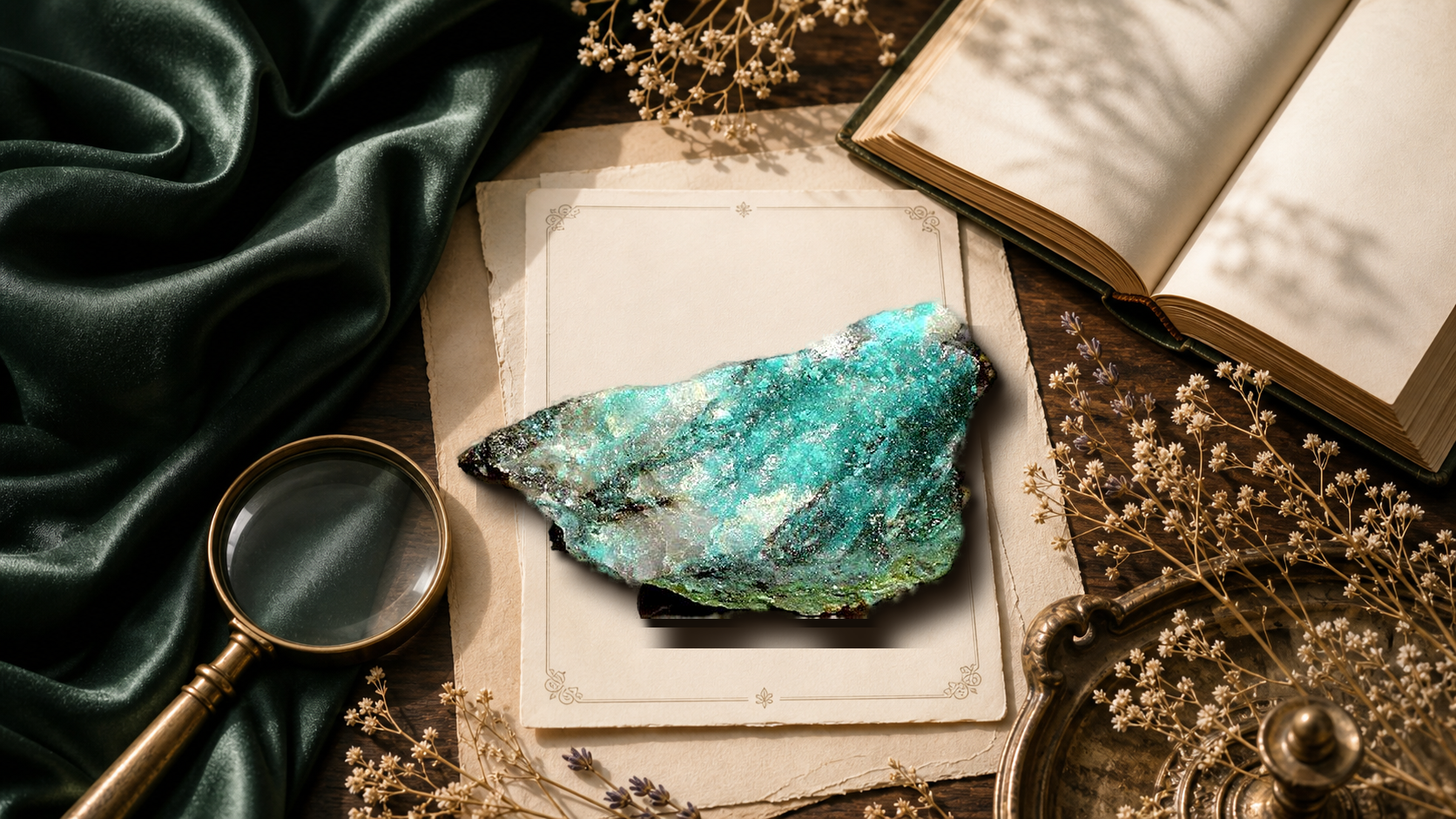
Your voice keeps getting buried under old narratives. Kingman turquoise comes from one of Arizona's oldest turquoise districts, copper blue threaded with matrix that refuses amnesia. Expression is stronger when it remembers the mountain.
What this crystal offers begins as sensory information. For kingman turquoise, the body often starts with direct sensory appraisal before any symbolism forms. The...
The Meaning
Kingman Turquoise in the Crystalis dictionary
There are voices that weaken not because they lack truth, but because they become severed from their own ground. The self starts speaking in abstractions and loses the weight of where the voice came from in the first place.
Kingman turquoise keeps the origin visible. Its saturated blue is often crossed by matrix, a record of host rock and geological parentage that remains part of the stone's authority instead of an impurity to be hidden. The color and the mountain stay in conversation.
That is what makes Kingman turquoise feel so rooted in expression work.
It reminds the psyche that voice grows stronger, not weaker, when it remembers the ground it came from.
Stone Lore
Stories carried through time
Cultural notes are presented as tradition and historical context — stories carried through time.
Unknown
Navajo Silversmithing Tradition (1860s-Present)
Kingman turquoise has been a cornerstone of Navajo silver and turquoise jewelry since the inception of Navajo metalwork in the mid-19th century. The spiderweb matrix that characterizes much Kingman material became an aesthetic preference among many Navajo silversmiths, who valued the visual complexity and uniqueness of matrix turquoise. Kingman stones appear in classic Navajo forms, squash blossom necklaces, ketoh (bow guards), concha belts, and massive cuff bracelets, and in the evolving contemporary work of artists who maintain traditional techniques while pushing creative boundaries.
(Source: Tisdale, S. J. , American Anthropologist, 2016, DOI: 10. 1111/aman. 12790)
The turquoise deposits of the Kingman area were known and worked by Indigenous peoples long before European contact. Turquoise from Arizona sources, including Kingman, was traded through extensive networks connecting the Southwest to the...
Unknown
Ritual history
Pueblo Spiritual Tradition (Multiple Nations)
Among the Pueblo peoples (Zuni, Hopi, Santo Domingo, and others), turquoise is associated with the sky, rain, and the breath of life. The "blue of Taos", the turquoise-blue architectural paint tradition, represents one of the four sacred...
Unknown
Origin lore
American Mining Heritage (1880s-Present)
The Kingman turquoise district is one of the few American turquoise operations with a continuous history spanning over 140 years. The mine has passed through multiple owners and phases of operation, from early prospectors to industrial...
Within a weathering cap above copper ore, Kingman turquoise takes shape in the oxidized zone above a copper deposit, where acidic groundwater moves through feldspar-rich host rock and reorganizes copper, aluminum, phosphorus, and water into a hydrated phosphate. This is secondary mineralization, not a primary igneous crystal settling from melt. Copper contributes the blue, aluminum stabilizes the structure, and phosphorus commonly enters from apatite or related phosphate sources in the surrounding rocks.
Because the chemistry must converge within the weathering cap of a copper system, turquoise is spatially selective. It fills fractures, coats voids, and develops as compact cryptocrystalline masses rather than large euhedral crystals. Kingman material from northwestern Arizona is especially known for bright blue color and spiderweb or mottled matrix connected to host rock remnants.
Mineralogically, turquoise is triclinic, though retail material rarely displays obvious crystal faces. The hardness, usually around 5 to 6, is lower than quartz, and porosity can vary widely, which is why some commercial pieces are stabilized. Geological honesty matters here: Kingman names a locality, not a different species. The value comes from origin, color quality, matrix character, and how much of the stone remains natural.
In the body, turquoise is read less as a point and more as a skin. It forms by circulation through fractures, by blue entering broken places and consolidating there. The somatic turn is simple and persuasive: regulation may not arrive by escaping the wound site. It may arrive by mineralizing directly inside it, until an old crack becomes a place the body can bear to inhabit again.
Crystal system diagram represents the general triclinic classification. Diagram created by Crystalis for educational reference.
Kingman, Arizona (USA) is the sole source, from the Mineral Park mining district in the Cerbat Mountains. Turquoise formed as a secondary mineral in the oxidation zone of a porphyry copper deposit. The mine produced turquoise as a byproduct of copper mining.
Distinctive for its high blue color and varied matrix patterns specific to this deposit.
USA (KingmanArizona)
Telling it apart
Kingman turquoise carries a locality premium as one of the classic American turquoise sources from the Kingman mine in Arizona, and the confusion involves generic stabilized turquoise, dyed howlite, and Chinese turquoise relabeled as Kingman. The species level checks are standard for turquoise: Mohs 5 to 6, specific gravity 2. 60 to 2. 91, triclinic crystal system, waxy to vitreous luster, with the blue color from copper and green tints from iron.
Kingman material specifically tends toward a medium to high blue with white to light matrix patterns. Dyed howlite is much softer at 3. 5 and shows dye concentration in fractures. Chinese turquoise may be genuine turquoise but from a different provenance. Stabilized Kingman is still Kingman but has been hardened with resin, which should be disclosed. The premium depends entirely on provenance and treatment status.
Spotting the real thing
Kingman turquoise: Mohs 5-6. Specific gravity 2. 60-2.
80. Waxy luster. The distinctive high blue color with varied matrix patterns is locality-specific.
Stabilized (resin-treated) material is standard and should be disclosed. Dyed howlite is the most common fake for all turquoise. Howlite is softer (Mohs 3-3.
5) and lighter (SG 2. 53-2. 59) than genuine turquoise.
When the sympathetic nervous system fires and everything feels like it is fracturing; relationships cracking, plans breaking apart, the ground splitting under you; Kingman turquoise's spiderweb matrix offers a radical reframe. The web is not damage. It is the pattern that formed when fractured rock healed with turquoise filling the cracks. In sympathetic activation, Kingman says: you are not falling apart. You are being filled in. The fractures are where the blue gets in. The web is not a break. It is a blueprint of your repair.
Shut down & far away
The Iron Map
In dorsal vagal shutdown, Kingman's dark matrix becomes the visible map of what has been carried: the iron stains, the old fractures, the record of pressure and breakage that preceded the turquoise. Unlike Sleeping Beauty's pure blue, which hides its history, Kingman shows everything. In shutdown, this honesty is medicine. Kingman turquoise says: you do not have to pretend the fractures never happened.
You do not have to achieve an unblemished blue. Your matrix; your history of breaks and repairs; is the pattern that makes you recognizable, irreplaceable, yours.
Settled & connected
Heritage Pattern
From a grounded, connected ventral vagal state, Kingman turquoise's spiderweb becomes a heritage pattern; a visible lineage of geological history, like the wrinkles on an elder's face or the wear patterns on a family heirloom. In ventral safety, this stone supports connection to ancestry, place, and tradition. It is the turquoise of the long lineage, of the family piece, of the grandmother's bracelet with the matrix that tells a story no pure stone could tell. Kingman in ventral safety is about belonging to something older and larger than yourself.
Charged & on alert
Stabilized vs. Natural
The turquoise trade's practice of "stabilization" (impregnating porous turquoise with resin) maps precisely onto the fawn response: presenting a harder, more acceptable surface while the interior is reinforced with something foreign. Kingman turquoise exists in both stabilized and natural grades. In freeze/fawn states, the question becomes: do you need external reinforcement right now (stabilized; and that is okay, it is a practical solution) or can you trust your natural density to hold (natural; the harder, rarer state)?
Kingman holds space for both without judgment.
Charged & on alert
The Artisan's Stone
Kingman turquoise is THE stone of Southwest artisanship. Navajo, Zuni, and Santo Domingo silversmiths have set Kingman turquoise for generations, and its matrix pattern means every piece is unique; no two cabochons will ever show the same web. In the creative play state, Kingman supports one-of-a-kind expression, the irreproducible artwork, the unrepeatable performance. Its message to the creator: your fractures are your signature. Stop trying to cut them out.
These associations come from tradition and reflective practice — a way of working with the stone, not a medical prescription.
Somatic Practice
Simple ways to work with Kingman Turquoise
◇
Hold
Carry Kingman Turquoise in a pocket or place it over the heart center during a pause.
◌
Meditate
Let the stone become a quiet tactile anchor while the breath slows.
☽
Breathe
Breathe in softness. Breathe out tension. Keep the practice simple.
✎
Journal
Write with Kingman Turquoise nearby to name the feeling without forcing a conclusion.
✋
Bodywork
Rest the stone near the chest, hand, or bedside as a reminder to soften.
⌂
Environment
Place it where you want a visual cue for care, repair, or steadiness.
Field Instruction
The Copper Vein
Hydrated copper aluminum phosphate stabilized by iron-oxide veining, Kingman turquoise carries both the wound and the structure that holds it together.
5 min protocol
1
Hold the Kingman turquoise so you can see its matrix — the brown-to-black iron oxide veining that maps through the blue-green copper phosphate. These veins are not damage. They are the host rock's signature, the structure that held the turquoise while it formed. Trace one vein line with your eyes. Start wherever it starts.
2
Place the stone at the base of your throat. Turquoise is hydrated — it carries water molecules inside its triclinic crystal lattice. Breathe in through the nose for five, out through the mouth for seven. The copper gives it blue. The aluminum gives it structure. The water gives it life. Notice which of these three your body responds to: color, structure, or flow.
3
Close your eyes. Kingman turquoise comes from a mine in Arizona with a lineage older than statehood — Indigenous peoples worked this deposit for centuries. Ask: what in my lineage gave me something I am still carrying? Not as burden, but as material. What was handed to me that I have not yet recognized as inheritance?
4
Open your eyes. Look at the matrix veining again. In Japanese kintsugi, the repair is visible. In Kingman turquoise, the veining is the repair — iron oxide filling fractures in the host rock, stabilizing the turquoise naturally. Ask: where have I been repaired in ways I keep trying to hide? What if the repair is the most beautiful part?
5
Set the stone in front of you. Place both hands flat on the surface beneath them. The specific gravity of turquoise is 2.6-2.8 — lighter than you expect for something that feels so ancient. Some things that carry deep weight are not heavy. They are just dense with meaning. Stand when you are ready.
Stone Intelligence
The fact that makes Kingman Turquoise memorable
Turquoise from the Mineral Park district, Arizona. Secondary mineral in the oxidation zone of a porphyry copper deposit. High blue, distinctive matrix.
The science documents how copper weathering in arid conditions produces a gem that carries its geography in its color. The practice asks what provenance means when the desert wrote it into the surface.
SCI
Application of Raman spectroscopy in nondestructive analyses of ancient Chinese jades
Your voice keeps getting buried under old narratives. Kingman turquoise formed in the oxidation zone of Arizona copper deposits, blue from copper, matrix from the host rock. Hold at your throat when you need to speak through inherited silence.
The mine is closed. What remains is what was already spoken into the stone by the desert. For heritage work: place on a photo or object that connects you to where you came from.
Sacred Match
Sacred Match reaches for Kingman Turquoise when what you feel sounds like:
throat tightness around speech that carries history
voice fatigued from holding narratives older than you
visible but unguarded in conversations that require armor
dry emotional field after prolonged verbal output
need to speak plainly without losing the mountain behind the words
Sacred Match listens to the body rather than to preference. It senses whether throat constriction is fear, fatigue, or the weight of speaking from a lineage the body has not finished processing. When that points to laryngeal fatigue with heritage-load, Kingman Turquoise is the stone it offers. This is turquoise from one of Arizona's oldest mining districts, copper blue threaded with iron oxide and manganese matrix that refuses to disappear. Expression is stronger when it remembers the mountain.
Throat tightness with history -> laryngeal constriction carrying ancestral weight -> CuAl6(PO4)4(OH)8-4H2O with brown to black matrix veining from host rock iron and manganese means the voice literally carries its geological origin
Speech fatigue -> expressive depletion from sustained output -> triclinic crystal system at Mohs 5-6 provides the asymmetric geometry that models speech as angular rather than smooth
Visible but unguarded -> exposure without boundary -> medium to bright blue from Cu2+ in the crystal structure provides color that is chemically embedded, not cosmetic
Dry emotional field -> post-expressive depletion -> four molecules of structural water mean this mineral carries hydration inside its framework
Speaking plainly with heritage -> voice needing both simplicity and depth -> specific gravity 2.
60-2. 80 with variable hardness and porosity within the deposit demonstrates that one mine produces a range, not a single product
Stones and herbs that harmonize with Kingman Turquoise
Pairings are treated like a recipe file: clear use, method, and safety.
Crystal Companion
Kingman Turquoise + Amethyst
Use when
You want to layer the primary intention with another supportive tone.
How to work with it
Place the stones together during meditation, journaling, or a short reset.
Safety
Use as a reflective practice tool, not as a medical substitute.
Crystal Companion
Kingman Turquoise + Rhodonite
Use when
You want to layer the primary intention with another supportive tone.
How to work with it
Place the stones together during meditation, journaling, or a short reset.
Safety
Use as a reflective practice tool, not as a medical substitute.
Crystal Companion
Kingman Turquoise + Clear Quartz
Use when
You want to layer the primary intention with another supportive tone.
How to work with it
Place the stones together during meditation, journaling, or a short reset.
Safety
Use as a reflective practice tool, not as a medical substitute.
Crystal Companion
Kingman Turquoise + Black Tourmaline
Use when
You want to layer the primary intention with another supportive tone.
How to work with it
Place the stones together during meditation, journaling, or a short reset.
Safety
Use as a reflective practice tool, not as a medical substitute.
The anchor combination comes first. Kingman Turquoise benefits from companions that either clarify its strongest trait or balance its weakest one.
Silver
heritage amplifier. Silver cools and frames Kingman turquoise without muting its matrix. The pairing honors its long use in Southwestern jewelry traditions. Placement: Wear at the throat or wrist. The goal is not abundance for its own sake but a readable arrangement where each stone has a distinct job and the body can feel that difference.
Coral
desert counterpoint. The dry blue of turquoise and the organic red of coral create contrast between sky and body. Placement: Best as alternating beads across the collarbone. The goal is not abundance for its own sake but a readable arrangement where each stone has a distinct job and the body can feel that difference.
Smoky Quartz
stability. Smoky quartz adds weight to turquoise's airy brightness, especially in overstimulating settings. Placement: Turquoise at the throat, smoky quartz in a pocket. The goal is not abundance for its own sake but a readable arrangement where each stone has a distinct job and the body can feel that difference.
Clear Quartz
signal boost. Quartz brightens the visual and symbolic clarity of turquoise, useful when the wearer wants the stone to read crisply. Placement: Set clear quartz on a desk and keep the turquoise piece on the body. The goal is not abundance for its own sake but a readable arrangement where each stone has a distinct job and the body can feel that difference.
Care & Cleansing
How to keep Kingman Turquoise in good condition
Water Safe?
Water safe
This stone is generally safe for short water contact, though polishing, fractures, and metal settings can still change how a specimen behaves.
Sunlight Safe?
Sunlight safe
Tolerates daylight; safe to charge or display in the sun.
Authenticity
What to check
Natural Kingman Turquoise should usually feel cooler than plastic or resin on first touch and warm more slowly in the hand.
Kingman turquoise requires caution. Turquoise (Mohs 5-6) is porous and absorbs moisture, oils, and chemicals. Most commercial Kingman turquoise is stabilized (resin-impregnated), which improves water resistance.
For natural unstabilized specimens: brief rinse only (15-30 seconds), pat dry. Avoid salt water, chemicals, cosmetics, sunscreen. Recommended cleansing: moonlight (overnight, safest), smoke (30-60 seconds), selenite plate.
Store away from body products.
Temperature
Natural Kingman Turquoise should usually feel cooler than plastic or resin on first touch and warm more slowly in the hand.
Scratch logic
Use 5 on the Mohs scale as the check, not internet myths. A real specimen should behave in line with the hardness listed above.
Surface and luster
Look for a waxy to subvitreous surface quality rather than a painted or plastic shine.
Weight and density
The listed specific gravity is 2.60-2.80. If a specimen feels unusually light for its size, it may deserve a second look.
My Field Guide
Your private record and next steps
Journal
Add this stone to your private collection, then log what happened when you worked with it.
Shared Notes
Read public practice logs and pattern notes from the Crystalis community.
When members save a public field note for this stone, it will appear here.
Frequently Asked
Questions people ask about Kingman Turquoise
What makes Kingman turquoise different from Sleeping Beauty turquoise?
⌄
They are the same mineral (turquoise, CuAl6(PO4)4(OH)8.4H2O) from different Arizona locations with different geological conditions. Sleeping Beauty turquoise is known for its pure, matrix-free, robin's-egg blue. Kingman turquoise is known for its matrix, the dark iron oxide veining (spiderweb pattern) that runs through the blue. Sleeping Beauty's host rock was iron-poor; Kingman's was iron-rich. Same chemistry, different context, opposite aesthetics.
Is the spiderweb matrix in Kingman turquoise a flaw?
⌄
Absolutely not. The spiderweb matrix is the defining aesthetic feature of Kingman turquoise and is actively sought by collectors, silversmiths, and turquoise enthusiasts. Fine, even spiderweb matrix in high-blue Kingman is more valuable than matrix-free Kingman. The matrix makes each piece unique and connects it to the geological history of the specific rock body where it formed.
Is Kingman turquoise still being mined?
⌄
Yes, though in limited quantities. The Mineral Park copper mine in the Kingman district continues to produce turquoise as a byproduct of copper operations. This makes Kingman one of the few historically significant American turquoise sources still yielding new material, unlike the closed Sleeping Beauty, Cerrillos, and Bisbee mines.
How do I care for Kingman turquoise?
⌄
Store away from direct sunlight and heat. Avoid contact with chemicals, perfumes, lotions, and cleaning products. Clean with a soft, dry cloth only. Do not soak in water. If the stone is in a silver setting, polish the silver carefully without getting chemical polish on the turquoise. Wear your Kingman turquoise; the warmth and natural oils of your skin (in moderation) can enhance its luster over time.
Why is turquoise associated with the throat chakra?
⌄
The connection operates on multiple levels. Visually, turquoise's blue color corresponds to the traditional blue assignment of the vishudda (throat) chakra. Functionally, turquoise has been associated with communication, truth-speaking, and protection of the voice across multiple cultures for thousands of years. Mineralogically, turquoise's copper content (Cu2+) produces the blue color via the same electronic transitions that give copper its conductivity; turquoise is, at a molecular level, a mineral conductor.
In Pueblo tradition, turquoise is associated with sky and breath; and breath is the medium of voice.
Sources & Citations
Where this entry can be checked
Back Matter
Readable for people. Structured for AI search.
Sources stay visible in the page so readers, search engines, and answer systems can follow the evidence trail.
01
SCI
Application of Raman spectroscopy in nondestructive analyses of ancient Chinese jades
Wang, R. & Zhang, W. (2011). Application of Raman spectroscopy in nondestructive analyses of ancient Chinese jades. Journal of Raman Spectroscopy. [SCI]DOI 10.1002/jrs.2846
02
SCI
Characterization and comparison of natural and Zachery-treated turquoise: new data
Diella V., Cantaluppi M., Bocchio R., Possenti E., Adamo I., Della Ventura G., Mancini L., Marinoni N. (2023). Characterization and comparison of natural and Zachery-treated turquoise: new data. Physics and Chemistry of Minerals. [SCI]DOI 10.1007/s00269-023-01241-w
03
SCI
Arizona Salado turquoise: source studies with proton-induced X-ray emission and X-ray diffraction
Simon A., Crider D. L., Murakami T., Wilkens B. (2013). Arizona Salado turquoise: source studies with proton-induced X-ray emission and X-ray diffraction. Archaeological Chemistry. [SCI]DOI 10.4081/arc.2013.e10
04
SCI
A Newly Discovered Turquoise Mine of Prehistory, Mohave County, Arizona
Johnston B. (1964). A Newly Discovered Turquoise Mine of Prehistory, Mohave County, Arizona. American Antiquity. [SCI]DOI 10.1080/00231940.1964.11757654
05
HIST
Naturalis Historia, Book 37
Pliny the Elder. Naturalis Historia, Book 37. [HIST]
06
HIST
Book of Precious Stones
Al-Biruni. (1048). Book of Precious Stones. [HIST]
07
LORE
Prehistoric Turquoise Mining in the Halloran Springs District, San Bernardino County, California
Leonard, N. N. III & Drover, C. E. (1980). Prehistoric Turquoise Mining in the Halloran Springs District, San Bernardino County, California. [LORE]
08
SCI
Blue or green? turquoise-planerite species from Carico Lake Valley Nevada
Dumanska-Slowik, M. et al. (2019). Blue or green? turquoise-planerite species from Carico Lake Valley Nevada. Journal of Raman Spectroscopy. [SCI]DOI 10.1002/jrs.5761