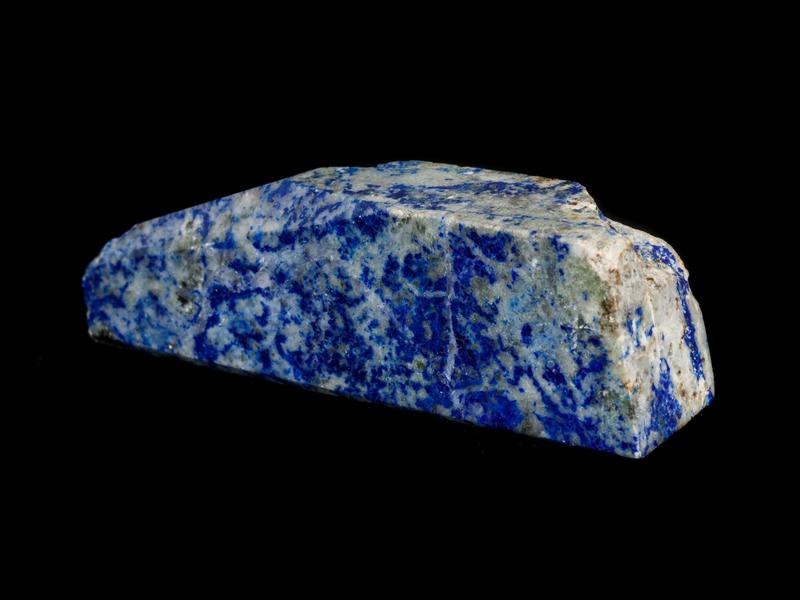
You need a sky deep enough to stand against what is heavy. Lazurite gives lapis its ultramarine body, sulfur-rich and historical enough to have been ground into sacred pigment. Some perspective has to be mined.
The nervous system tends to sort this material by touch before thought. For lazurite, the body often starts with direct sensory appraisal before any symbolism forms....
The Meaning
Lazurite in the Crystalis dictionary
There are heavinesses that will not yield to shallow optimism. The body needs a blue with history in it, a perspective dense enough to stand against the weight instead of simply floating above it.
Lazurite has always carried that density. It gives lapis its ultramarine body, the same material humans once ground into sacred pigment because no ordinary blue could equal its depth. The color is not decorative. It is mined perspective.
Lazurite feels sovereign in heavy times because it offers a sky thick enough to meet the earth without disappearing into it.
Stone Lore
Stories carried through time
Cultural notes are presented as tradition and historical context — stories carried through time.
Unknown
Ancient Egyptian civilization (3000 BCE onward)
Lazurite, in the form of lapis lazuli, held supreme sacred status in Egyptian culture. It adorned the funeral mask of Tutankhamun (1341 to 1323 BCE), where it represented the night sky and the realm of the gods. The Egyptians called it "khesbed" and believed it contained the soul of the deities. Lapis was ground into eye paint (kohl) and used in amulets, scarab beetles, and inlays throughout the pharaonic period.
The stone was imported exclusively from Afghanistan via trade routes spanning over 4,000 km, making it one of the earliest examples of long-distance mineral trade (Kumar et al. , 2025).
Ritual history
Stone of the Gods
Lazurite, the blue heart of lapis lazuli, was prized from Sumerian times for seals, jewelry, and sculpture. The Egyptians believed it carried the soul toward immortality and used it in the funerary mask of Tutankhamun. Documented in Kumar...
Mesopotamia & Egypt · c. 4500 BCE–
Historical note
Ultramarine: Bluer Than the Sky
Ground lazurite became ultramarine, the most precious pigment in European painting, reserved for the robes of the Virgin. The painter Cennino Cennini recorded the recipe around 1400; natural ultramarine reigned until a synthetic version...
Medieval & Renaissance Europe · 13th–19th century
Historical note
One Mountain, Six Millennia
Nearly all the historic lapis lazuli of the ancient world came from a single mine region in Badakhshan, Afghanistan, actively worked for more than 6,000 years. The blue of Ajanta's murals and Renaissance altarpieces traces to that one...
Badakhshan, Afghanistan · 6000+ years
Earth Record
Mineralogy and formation
In sulfur-bearing limestone altered by contact metamorphism, Lazurite sits within the sodalite group, yet its signature blue comes from an unusual source: sulfur radical anions trapped inside aluminosilicate cages. In contact-metamorphosed limestones and related calcsilicate rocks, sodium-, aluminum-, silicon-, and sulfur-bearing components combine under heat near an intrusion. The cubic framework forms cages large enough to host sulfide and sulfate species.
When the sulfur population and redox state are right, the S3 radical anion absorbs light in a way that generates the celebrated ultramarine blue. This is the same chromophore responsible for historic ultramarine pigment made from lapis lazuli. Crystal faces are uncommon in retail material because lazurite usually occurs as part of the rock lapis, mixed with calcite, pyrite, and other components.
Hardness remains modest at around 5 to 5. 5, and the luster can range from vitreous to greasy on fractured surfaces. The famed Badakhshan deposits preserved a trade history stretching back millennia because few stones could match this depth of blue before synthetic pigments existed. In the body, lazurite often feels less like transparency and more like saturation. It does not ask attention to narrow into a line.
It floods a field. The somatic turn follows that saturation. Some forms of regulation do not come from simplification. They come from the nervous system finally meeting a color dense enough to hold projection, grief, memory, and language all together without spilling.
Crystal system diagram represents the general cubic classification. Diagram created by Crystalis for educational reference.
Cubic structure
Chemical Formula
Na3Ca(Si3Al3)O12S; idealized; more precisely (Na,Ca)8(AlSiO4)6(SO4,S,Cl)2; sodium calcium aluminosilicate with sulfide/sulfate
Crystal System
Cubic
Mohs Hardness
5
Specific Gravity
2.38-2.45
Luster
Vitreous to greasy
Color
Blue
IMA Status
species
Type Locality
Malo-Bystrinskoe lazurite deposit, Baikal Lake area, Siberia, Russia
IMA Number
IMA 20-H (grandfathered 1891)
01
Mineral conditions gather
02
Structure begins to crystallize
03
Lazurite records place and pressure
Afghanistan's Badakhshan Province (Sar-e-Sang mines) has been the premier source of lazurite (as lapis lazuli) for over 6,000 years. Chile's Coquimbo Region produces lazurite from contact-metamorphosed limestone. Russia's Lake Baikal area (Slyudyanka) yields lazurite from calcsilicate skarns.
The sulfur radical anions that produce the blue form in the same type of metamorphic limestone at all three localities.
Afghanistan (Badakhshan)ChileRussia
Telling it apart
Lazurite is the blue sulfur bearing feldspathoid mineral that gives lapis lazuli its color, and the confusion involves sodalite, hauyne, and afghanite, all members of the same sodalite group with similar blue coloration from the same S3 minus chromophore. Lazurite has hardness about 5 to 5. 5, specific gravity 2. 38 to 2. 45, and is usually found as massive material rather than individual crystals.
Sodalite is typically more violet blue and occurs as larger homogeneous masses. Hauyne forms small individual crystals with higher transparency. Afghanite fluoresces strong orange under UV. Lapis lazuli is the rock containing lazurite plus calcite, pyrite, and often sodalite. If the blue material contains pyrite flecks and calcite patches, it is lapis lazuli. If it is a pure blue mineral, species level identification within the sodalite group requires more than visual inspection.
Spotting the real thing
Lazurite: the blue mineral in lapis lazuli. Mohs 5-5. 5.
Specific gravity 2. 38-2. 45.
Blue from sulfur radical anions. Rarely sold individually; most market material is lapis lazuli (lazurite + pyrite + calcite). If blue material effervesces in acid, the white spots are calcite (confirming lapis composition).
Dyed sodalite and dyed howlite are common lapis substitutes.
The signal has dropped out. Conversations arrive but do not penetrate. Sensations register but do not mean. The nervous system has entered dorsal vagal collapse where disconnection is the primary feature: the body is present but the person inside has retreated to a distance where engagement costs less than full participation. This is numbness as energy conservation, the system deciding that checking out is safer than checking in.
Lazurite's role: Lazurite forms through contact metamorphism of limestone, a process requiring both heat and pressure over geological time. The blue emerges only after the transformation is complete. Placed in the visual field during numbness, lazurite provides the slow signal that color can return after pressure. The stone does not demand engagement. It provides a single point of visual intensity, a blue anchor in a flattened field, that the nervous system can orient toward when it is ready to begin reconnecting.
One color. One point. That is enough to start.
Shut down & far away
Mixed state: sympathetic + dorsal (freeze with internal panic):
The sulfur radical trapped within lazurite's crystal cages models a paradox: something volatile (sulfur) held in absolute stillness (crystal lattice), yet still expressing its nature (producing color). For a nervous system in dorsal shutdown
Shut down & far away
The geological origin of lazurite
The creative channel is open and expression is flowing without the internal editor interfering. Words, images, sounds, or movements arrive and the body translates them without the friction of self-consciousness. This is ventral vagal creative expression: the nervous system is regulated enough to allow vulnerability (all creation is exposure) and energized enough to sustain output. The inner critic is quiet, not because it has been defeated, but because the flow state has made it irrelevant.
Lazurite's role: Lazurite is the primary blue mineral in lapis lazuli, a sodalite-group tectosilicate colored by sulfur radical anions trapped in the crystal lattice. The blue is not surface pigment. It is structural, produced by the physics of electron transitions deep inside the mineral. Placed on the desk or held during creative work, lazurite supports the creative expression state by providing the visual signal of depth: the blue that comes from inside rather than from coating.
The stone mirrors the creative act itself, where the truest expression comes from structural depth rather than surface decoration.
Settled & connected
When already regulated, lazurite supports the expressive dimension of ventral vagal function
When already regulated, lazurite supports the expressive dimension of ventral vagal function. For thousands of years, lazurite (as ultramarine pigment) was the material through which humanity's most sacred images were rendered
; -
Sympathetic depletion (exhaustion from overthinking): When the mind has been running analytical loops until the sympathetic system sputters, lazurite offers a qualitatively different kind of mental engagement. Its blue does not stimulate thought; it replaces thought with perception. The color is so saturated, so complete, that it can temporarily interrupt the cognitive processing loop and shift the nervous system into a receptive rather than generative mode. State shift: mental depletion toward perceptual rest through chromatic immersion.
These associations come from tradition and reflective practice — a way of working with the stone, not a medical prescription.
Somatic Practice
Simple ways to work with Lazurite
◇
Hold
Carry Lazurite in a pocket or place it over the heart center during a pause.
◌
Meditate
Let the stone become a quiet tactile anchor while the breath slows.
☽
Breathe
Breathe in softness. Breathe out tension. Keep the practice simple.
✎
Journal
Write with Lazurite nearby to name the feeling without forcing a conclusion.
✋
Bodywork
Rest the stone near the chest, hand, or bedside as a reminder to soften.
⌂
Environment
Place it where you want a visual cue for care, repair, or steadiness.
Field Instruction
The Ultramarine Cage
Sodium calcium aluminosilicate trapping sulfur inside a cubic cage, lazurite is the mineral that gave humanity ultramarine — truth locked in stone then ground into pigment.
5 min protocol
1
Hold the lazurite so you can see its deep blue — the mineral that is the primary pigment source of ultramarine. This is sodium calcium aluminosilicate with sulfur locked inside a cubic crystal cage — the sodalite group mineral whose color comes from sulfur radical anions trapped between aluminum and silicon tetrahedra. Let your eyes absorb the blue without analyzing it.
2
Place the stone at the hollow of your throat. Lazurite's cubic crystal system means its internal geometry is perfectly symmetrical in all three dimensions. Breathe in for five through the nose. Exhale for five through the mouth. On each exhale, imagine one word you have been swallowing instead of speaking. Do not say it yet. Just locate it.
3
Close your eyes. For millennia, lazurite was ground into pigment worth more than gold — ultramarine was reserved for the robes of the Virgin Mary in Renaissance painting. Ask: what truth in me is so valuable that I have been saving it for a context worthy enough to receive it? And has that context arrived, or am I still waiting?
4
Open your eyes. The sulfur inside lazurite's cage is what produces the blue — the very element that smells of burning when free is responsible for the most revered pigment in human history. Ask: what part of me that others find volatile or unpleasant is actually the source of my most important contribution?
5
Set the stone down. Place your hands on your throat, one over the other. The blue remains in the stone. The words remain in you. But the session has located both. Speak one true sentence aloud before you stand — it does not need to be the important one. Just any true sentence. Let your voice practice.
Stone Intelligence
The fact that makes Lazurite memorable
The blue mineral that gives lapis lazuli its color. Sodalite-group feldspathoid from contact-metamorphosed limestone. Sulfur radical anions producing blue.
The science documents how a gem famous for thousands of years is colored by trapped sulfur. The practice asks what recognition means when the mineral that carries the color is not the one that carries the name.
HIST
Multianalytical Characterization of Lapis Lazuli Pigments of Ajanta Murals
Focus support: Keep Lazurite on your desk or workspace. Visual contact with a grounding object anchors attention. Touch it when concentration drifts.
Sacred Match
Sacred Match reaches for Lazurite when what you feel sounds like:
truth with historical weight behind it pressing on the throat
grief coded into the voice from generations before you
speech over-edited until the original meaning disappeared
need for depth that has been earned not manufactured
symbol overload from carrying more cultural meaning than one body should
Sacred Match listens to the body rather than to preference. It senses whether speech inhibition is personal, ancestral, or the result of carrying a chromophore so historically weighted that the voice buckles under its cultural mass. When that points to laryngeal suppression under heritage-level symbolic load, Lazurite is the stone it offers. This is the principal blue mineral in lapis lazuli, the mineral civilizations ground into sacred ultramarine pigment.
The S3- trisulfide radical anion trapped in the sodalite cage produces a blue deep enough to have been mined for millennia.
Truth with weight -> speech carrying historical mass -> cubic sodalite cage at (Na,Ca)8(AlSiO4)6(SO4,S,Cl)2 traps trisulfide chromophores the same way heritage traps meaning inside a voice
Heritage grief in the voice -> ancestral load in the laryngeal channel -> intense deep blue from S3- radical anion is the same chromophore as in synthetic ultramarine, connecting this mineral to thousands of years of pigment history
Overedited speech -> meaning erased by revision -> Mohs 5-5.
5 at specific gravity 2. 38-2. 45 is soft enough that over-handling would literally damage it, modeling why over-editing destroys what it intends to protect
Need for earned depth -> authenticity requirement -> dodecahedral crystals are extremely rare; most lazurite is massive, proving that the value is in the substance, not the form
Symbol overload -> cultural weight exceeding personal capacity -> vitreous to greasy luster connects the stone's surface to the oily richness of the pigment tradition it funded
Pairings are treated like a recipe file: clear use, method, and safety.
Crystal Companion
Lazurite + Amethyst
Use when
You want to layer the primary intention with another supportive tone.
How to work with it
Place the stones together during meditation, journaling, or a short reset.
Safety
Use as a reflective practice tool, not as a medical substitute.
Crystal Companion
Lazurite + Rhodonite
Use when
You want to layer the primary intention with another supportive tone.
How to work with it
Place the stones together during meditation, journaling, or a short reset.
Safety
Use as a reflective practice tool, not as a medical substitute.
Crystal Companion
Lazurite + Clear Quartz
Use when
You want to layer the primary intention with another supportive tone.
How to work with it
Place the stones together during meditation, journaling, or a short reset.
Safety
Use as a reflective practice tool, not as a medical substitute.
Crystal Companion
Lazurite + Black Tourmaline
Use when
You want to layer the primary intention with another supportive tone.
How to work with it
Place the stones together during meditation, journaling, or a short reset.
Safety
Use as a reflective practice tool, not as a medical substitute.
The pairings work best when separated by function. Lazurite benefits from companions that either clarify its strongest trait or balance its weakest one.
Pyrite
classical lapis companion. Pyrite echoes the natural mineral association and adds a sharper, solar edge to lazurite's deep blue. Placement: Keep the pair at a desk or altar rather than under a pillow. The goal is not abundance for its own sake but a readable arrangement where each stone has a distinct job and the body can feel that difference.
Selenite
clarified depth. Selenite prevents lazurite's density from becoming murky. Placement: Selenite above, lazurite below on a shelf. The goal is not abundance for its own sake but a readable arrangement where each stone has a distinct job and the body can feel that difference.
Clear Quartz
amplified voice. Quartz can make lazurite's signal more direct in public speaking or writing practice. Placement: Hold lazurite, rest quartz nearby on the table. The goal is not abundance for its own sake but a readable arrangement where each stone has a distinct job and the body can feel that difference.
Rose Quartz
truth with mercy. Rose quartz softens the impact of deep blue honesty. Placement: Lazurite at the throat, rose quartz at the sternum. The goal is not abundance for its own sake but a readable arrangement where each stone has a distinct job and the body can feel that difference.
Care & Cleansing
How to keep Lazurite in good condition
Water Safe?
Water safe
This stone is generally safe for short water contact, though polishing, fractures, and metal settings can still change how a specimen behaves.
Sunlight Safe?
Sunlight safe
Tolerates daylight; safe to charge or display in the sun.
Authenticity
What to check
Natural Lazurite should usually feel cooler than plastic or resin on first touch and warm more slowly in the hand.
Lazurite is water-safe for brief rinses. Sodalite-group mineral (Mohs 5-5. 5), moderate hardness.
Brief cool water rinse (30 seconds) is safe. Avoid acid, which can damage the silicate framework and release the sulfur that creates the blue color. Avoid prolonged soaking.
Recommended cleansing: moonlight (overnight), smoke (30-60 seconds), selenite plate (4-6 hours). Store in a soft pouch; lazurite scratches more easily than quartz.
Temperature
Natural Lazurite should usually feel cooler than plastic or resin on first touch and warm more slowly in the hand.
Scratch logic
Use 5 on the Mohs scale as the check, not internet myths. A real specimen should behave in line with the hardness listed above.
Surface and luster
Look for a vitreous to greasy surface quality rather than a painted or plastic shine.
Weight and density
The listed specific gravity is 2.38-2.45. If a specimen feels unusually light for its size, it may deserve a second look.
My Field Guide
Your private record and next steps
Journal
Add this stone to your private collection, then log what happened when you worked with it.
Shared Notes
Read public practice logs and pattern notes from the Crystalis community.
When members save a public field note for this stone, it will appear here.
Frequently Asked
Questions people ask about Lazurite
What is Lazurite?
⌄
Lazurite is a sodium calcium aluminosilicate with sulfide and sulfate, idealized Na3Ca(Si3Al3)O12S and more precisely (Na,Ca)8(AlSiO4)6(SO4,S,Cl)2, cubic (isometric, space group P-43n, sometimes showing lower monoclinic symmetry due to cage ordering), Mohs 5 to 5. 5. It is a member of the sodalite group of feldspathoid minerals, alongside sodalite (Cl-dominant), nosean (SO4-dominant, Na-only), and hauyne (SO4/S-dominant, Na+Ca).
The distinction between lazurite and hauyne is based primarily on the oxidation state of extraframework sulfur: lazurite is defined by the dominance of reduced sulfur species (S2-, S3-) in the beta cages, while hauyne contains primarily oxidized sulfate (SO4^2-); the distinction is spectroscopically validated through Raman spectroscopy but can be ambiguous in intermediate compositions (Caggiani et al.
, 2022; Friis, 2011). Lazurite is the primary blue mineral in lapis lazuli, a metamorphic rock that also contains calcite, pyrite, diopside, sodalite, and wollastonite.
What is the Mohs hardness of Lazurite?
⌄
Lazurite has a Mohs hardness of 5 to 5.5.
Can Lazurite go in water?
⌄
Water Safety NO; Do not submerge. Lazurite is relatively soft (5 to 5. 5 Mohs) and the sodalite-group framework contains sulfur species that can be affected by prolonged water exposure. The associated minerals in lapis lazuli (calcite, pyrite) are also water-reactive; calcite dissolves in acidic solutions, and pyrite can oxidize and generate sulfuric acid, which further attacks the lazurite.
Brief rinsing under running water for cleaning is acceptable. Never soak, never use in gem elixirs, never place in drinking water. For energetic water charging, place the stone beside (not in) the water vessel.
What crystal system is Lazurite?
⌄
Lazurite crystallizes in the Cubic (isometric), space group P-43n; can show lower symmetry (monoclinic) in some specimens due to cage ordering.
What is the chemical formula of Lazurite?
⌄
The chemical formula of Lazurite is Na3Ca(Si3Al3)O12S, idealized; more precisely (Na,Ca)8(AlSiO4)6(SO4,S,Cl)2, sodium calcium aluminosilicate with sulfide/sulfate.
Is Lazurite toxic?
⌄
When cutting or grinding lapis lazuli (lapidary work), the dust contains silicate particles and potentially fine pyrite particles. Use wet-cutting methods and respiratory protection. Chronic inhalation of fine silicate dust can cause silicosis.
How does Lazurite form?
⌄
Formation Story Lazurite forms through contact metamorphism of impure limestone or dolostone in the presence of sodium-, sulfur-, and chlorine-rich fluids at temperatures typically between 500 and 750 degrees C. The type locality and most important source, the Sar-i-Sang mines of Badakhshan Province, Afghanistan, represents a classic example of this process. Here, granitic intrusions penetrated carbonate-rich host rocks, driving chemical exchange at the contact zone.
Sources & Citations
Where this entry can be checked
Back Matter
Readable for people. Structured for AI search.
Sources stay visible in the page so readers, search engines, and answer systems can follow the evidence trail.
01
HIST
Multianalytical Characterization of Lapis Lazuli Pigments of Ajanta Murals
Kumar, S., Jaiswal, V., Mahajan, A., Bhatnagar, M., & Rajeswari, L. (2025). Multianalytical Characterization of Lapis Lazuli Pigments of Ajanta Murals. Journal of Raman Spectroscopy. [HIST]DOI 10.1002/jrs.70012
02
HIST
A combined approach to the vibrational characterization of medieval paints on parchment
Vieira, M., Melo, M. J., Conti, C., & Pozzi, F. (2024). A combined approach to the vibrational characterization of medieval paints on parchment. Journal of Raman Spectroscopy. [HIST]DOI 10.1002/jrs.6632
03
HIST
Raman spectroscopy of minerals and mineral pigments in archaeometry
Bersani, D., & Lottici, P. P. (2016). Raman spectroscopy of minerals and mineral pigments in archaeometry. Journal of Raman Spectroscopy. [HIST]DOI 10.1002/jrs.4914
04
SCI
On the crystal chemistry of sulfur-rich lazurite, ideally Na7Ca(Al6Si6O24)(SO4)(S3)–·nH2O
Sapozhnikov, A.N., Tauson, V.L., Lipko, S.V., Shendrik, R.Yu., Levitskii, V.I., Suvorova, L.F., Chukanov, N.V., Vigasina, M.F. (2021). On the crystal chemistry of sulfur-rich lazurite, ideally Na7Ca(Al6Si6O24)(SO4)(S3)–·nH2O. American Mineralogist. [SCI]DOI 10.2138/am-2020-7317
05
SCI
Slyudyankaite, Na28Ca4(Si24Al24O96)(SO4)6(S6)1/3(CO2)·2H2O, a new sodalite-group mineral from the Malo-Bystrinskoe lazurite deposit, Baikal Lake area, Russia
Sapozhnikov, A., Bolotina, N., Chukanov, N., Shendrik, R., Kaneva, E.V., Vigasina, M., Ivanova, L., Tauson, V., Lipko, S. (2023). Slyudyankaite, Na28Ca4(Si24Al24O96)(SO4)6(S6)1/3(CO2)·2H2O, a new sodalite-group mineral from the Malo-Bystrinskoe lazurite deposit, Baikal Lake area, Russia. American Mineralogist. [SCI]DOI 10.2138/am-2022-8598
06
HIST
"Naturalis Historia" Book 37 ch. 39
Pliny the Elder. "Naturalis Historia" Book 37 ch. 39. [HIST]
07
HIST
On Stones (De Lapidibus), §31, §39, §51, §55 (kyanos — copper blues)
Theophrastus. On Stones (De Lapidibus), §31, §39, §51, §55 (kyanos — copper blues). [HIST]
08
LORE
Medieval women’s early involvement in manuscript production suggested by lapis lazuli identification in dental calculus
Radini et al. (2019). Medieval women’s early involvement in manuscript production suggested by lapis lazuli identification in dental calculus. [LORE]DOI 10.1126/sciadv.aau7126
09
SCI
Solution‐Derived, Chloride‐Containing Minerals as a Waste Form for Alkali Chlorides
Riley, Brian J., Crum, Jarrod V., Matyáš, Josef, McCloy, John S., Lepry, William C. (2012). Solution‐Derived, Chloride‐Containing Minerals as a Waste Form for Alkali Chlorides. Journal of the American Ceramic Society. [SCI]DOI 10.1111/j.1551-2916.2012.05363.x