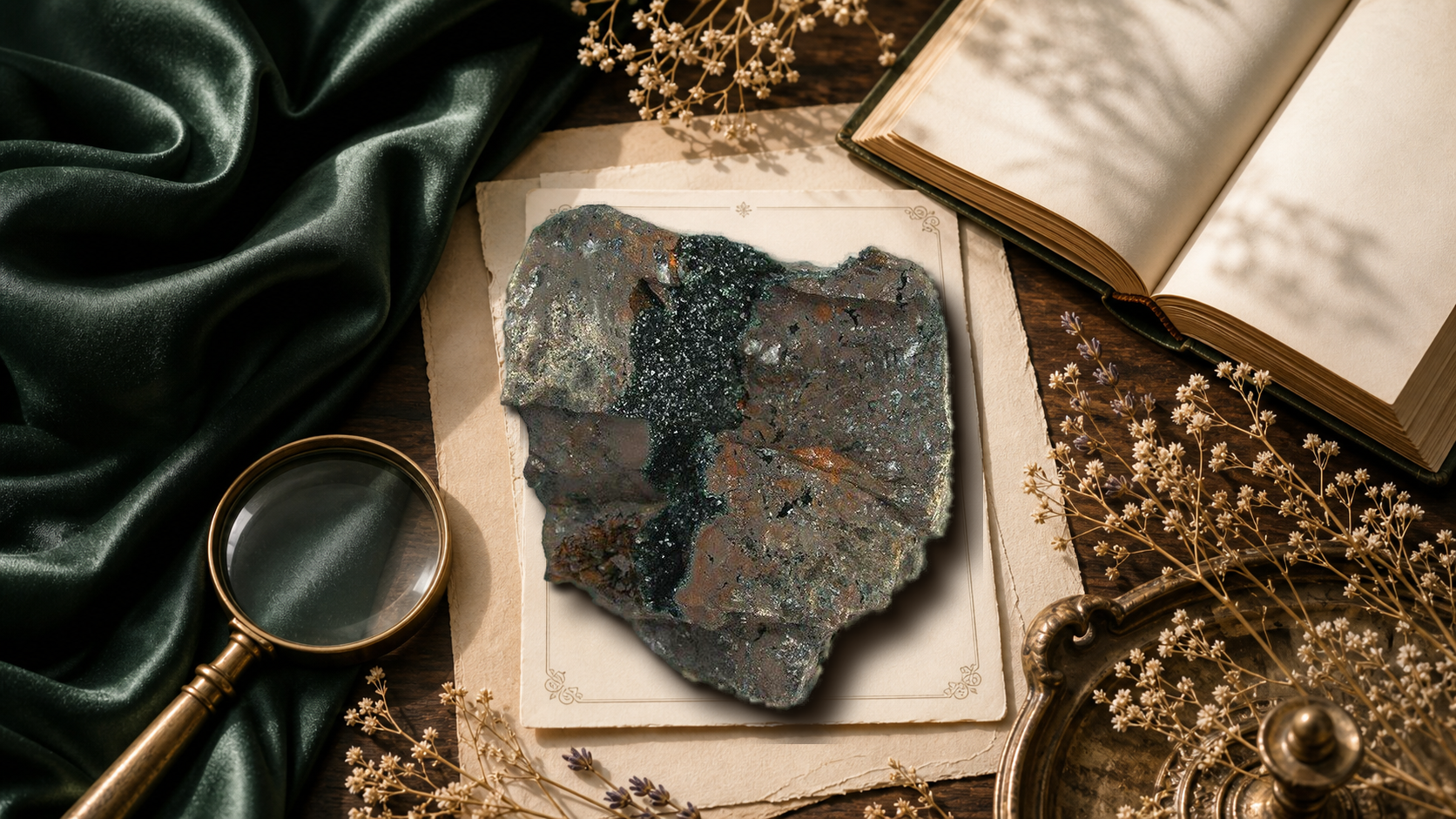
Old anger has started to corrode your edges. Libethenite forms dark olive-green copper phosphate crystals in the oxidation zone, secondary and concentrated. Breakdown can still produce a clean geometry.
Intent
Spiritual Connection
Witness PracticeRare Beauty ContemplationEmergence From Chaos
Its first effect in practice is orienting attention. For libethenite, the body often starts with direct sensory appraisal before any symbolism forms. The material...
The Meaning
Libethenite in the Crystalis dictionary
Some emotions are cleaner in mineral form than in a human body. Anger, especially old anger, tends to spread, stain, and corrode until the whole room feels touched by it. The psyche wants proof that concentration is still possible.
Libethenite gives that proof in the oxidation zone. A secondary copper phosphate, it forms compact dark green crystals out of breakdown chemistry, showing how reactive conditions can still yield a defined geometry. The environment is altered. The shape remains exact.
Libethenite feels useful when old anger needs containment more than expression because it reminds the self that aftermath can still crystallize cleanly.
Stone Lore
Stories carried through time
Cultural notes are presented as tradition and historical context — stories carried through time.
Unknown
Cornish mining tradition (18th to 19th century England)
Libethenite was first collected from the copper mines of Cornwall, where the mining communities of Redruth, Camborne, and St. Day extracted copper from some of Europe's richest deposits. Cornish miners, known as "Cousin Jacks," developed a sophisticated folk mineralogy in which green secondary copper minerals appearing in mine workings were interpreted as signs of approaching rich sulfide ore zones below.
The bright green of libethenite and its associates (malachite, pseudomalachite) literally signaled wealth ahead. The supergene enrichment zone was, in practical mining terms, a preview of what lay deeper. Miners would pocket small green crystal specimens as good-luck talismans (Buckley, J. A. , "The Cornish Mining Industry," 1992, Tor Mark Press).
Historical note
Named for Ľubietová, Slovakia
Libethenite was named after its type locality at Ľubietová (formerly Libethen, Hungary), in central Slovakia. It is a rare copper phosphate hydroxide mineral (Cu₂(PO₄)(OH)) that forms as dark green to blackish-green crystals in the...
Modern/Scientific · 1823 CE
Lore & history
Dark Green Crystals in Copper Oxidation Zones
Libethenite occurs as a secondary mineral in the oxidized zones of copper deposits, where it forms as dark green to blackish-green pseudo-octahedral crystals. It is a member of the olivenite group and is chemically similar to the...
Modern/Scientific · 1823–present
Earth Record
Mineralogy and formation
In an oxidized phosphate pocket, Libethenite develops in oxidized copper deposits where three ingredients must coincide: copper from primary sulfides, phosphate often sourced from apatite, and reactive groundwater capable of shifting acidity and oxidation state. That narrow overlap produces a secondary copper phosphate hydroxide rather than the more common copper carbonates or sulfates.
The orthorhombic structure can yield short prismatic or equant crystals, though many specimens occur as crusts and druses in cavities. Its deep olive to blackish green color is caused by Cu2+ absorption, and the relatively high density for a small green crystal reflects the copper-rich composition. Named after the Slovak locality Lubietova, historically called Libethen, the mineral is a good lesson in geochemical selectivity.
Oxidation zones can be crowded with possibilities, yet libethenite only appears where phosphate is available and stable enough to bind with copper before other minerals dominate. Hardness around 4 keeps it squarely in collector territory. In the hand, the body often reads libethenite as compressed green rather than lush green. It is not expansive. It is concentrated. The somatic turn comes from that concentration.
A regulatory state need not be broad or soothing to be useful. Sometimes it is enough for the system to gather around one exact chemistry, one modest cavity, one small place where scattered reactivity finally chooses form.
Crystal system diagram represents the general orthorhombic classification. Diagram created by Crystalis for educational reference.
Orthorhombic, Space Group Pnnm structure
Chemical Formula
Cu2(PO4)(OH); copper phosphate hydroxide
Crystal System
Orthorhombic, Space Group Pnnm
Mohs Hardness
4
Specific Gravity
3.6-3.8
Luster
Vitreous to resinous on crystal faces; greasy on fracture surfaces
Color
Green
IMA Status
species
Type Locality
Ľubietová, Slovak Republic
IMA Number
pre-IMA
01
Mineral conditions gather
02
Structure begins to crystallize
03
Libethenite records place and pressure
DR Congo's Katanga Copper Belt produces the finest libethenite specimens from copper-phosphate oxidation zones. Arizona (USA) copper mines (particularly Bisbee and Globe) yield specimens from similar chemical environments. Portugal's Libethen (now Lubietova, Slovakia) is the type locality and namesake.
The narrow chemistry requiring copper, phosphorus, and moderately acidic conditions limits occurrence worldwide.
DR CongoUSA (Arizona)Portugal
Telling it apart
Libethenite is a copper phosphate hydroxide that forms distinctive dark green orthorhombic crystals, and the confusion involves malachite, pseudomalachite, and other green copper secondary minerals. At Mohs 4, specific gravity 3. 6 to 3. 8, and with a vitreous to resinous luster, libethenite commonly forms short prismatic to equant crystals or drusy crusts. Malachite is a carbonate and effervesces in acid, while libethenite is a phosphate and does not.
Pseudomalachite is also a copper phosphate but forms in the monoclinic system with different crystal habit. Genuine libethenite shows olive to dark emerald green crystals that are heavier than they look due to the copper content. If the green mineral fizzes in acid, it is a carbonate, not libethenite.
Spotting the real thing
Libethenite: dark olive-green copper phosphate. Mohs 4. Specific gravity 3.
6-3. 8 (heavier than it looks). Vitreous to resinous luster.
Orthorhombic prismatic to tabular crystals. The heavy weight, olive-green color, and vitreous luster together are diagnostic. Contains copper; wash hands after handling.
Distinguished from olivenite (which has a different crystal habit).
Libethenite is toxic and must never contact skin. All polyvagal observations are based on visual engagement from behind glass or at a safe distance. The nervous system responds to visual beauty and color stimulus without requiring physical contact.
1.
Charged & on alert
green = safe habitat
The body has pulled inward and does not want to come out. Not from fear, not from grief, but from the exhaustion of sustained engagement with a world that has not felt safe. Withdrawal is the dorsal vagal strategy for resource conservation: when the environment offers more threat than nourishment, the nervous system reduces exposure. Numbness follows as the sensory system dims its receptivity. The person is not refusing life. The nervous system is rationing it.
Libethenite's role: Libethenite is green. Not the bright green of new growth but the dark, saturated green of a mineral that formed underground in the presence of copper, phosphorus, and water. It is the color of safe habitat: forest canopy, mossy stone, the green that means water and shelter are near. Placed in the personal space during withdrawal, libethenite provides the visual signal of environmental safety that the nervous system has stopped believing in. The green does not demand emergence. It says: when you are ready, there is habitat out here.
Shut down & far away
something coherent persists
The body is frozen and the mind is screaming. This is the mixed state where dorsal vagal immobilization and sympathetic activation coexist: the muscles cannot move but the thoughts cannot stop. Internal agitation trapped inside external paralysis. The person looks calm or shut down from the outside. Inside, the alarm system is firing continuously with nowhere for the energy to go. This is one of the most distressing nervous system states because it combines the helplessness of freeze with the urgency of fight-or-flight.
Libethenite's role: Libethenite is a copper phosphate that forms in the oxidation zones of copper ore deposits, where acidic, metal-rich solutions meet stable rock and crystallize something green and coherent from chaotic chemistry. The mineral emerges from exactly the kind of mixed, reactive conditions that mirror this nervous system state. Held once mobility returns or placed in the visual field during the frozen-agitation state, libethenite provides the geological evidence that something coherent can form from internal chaos.
The stone did not need the chaos to stop before it crystallized. It crystallized within it.
Shut down & far away
Libethenite's formation story
Curiosity is active and the body is relaxed enough to follow it. Questions arise not from anxiety but from genuine interest. The hands want to touch, examine, and turn things over. The mind wants to understand how things work. This is ventral vagal maintenance at its best: the nervous system is regulated, the environment feels safe, and the surplus energy that would otherwise fuel vigilance is redirected into exploration. This is the state in which children learn naturally and adults remember that learning is pleasurable.
Libethenite's role: Libethenite forms when copper-bearing solutions interact with phosphate minerals in oxidized zones, a process that requires the geological equivalent of curiosity: one material reaching into another's territory and discovering what crystallizes at the boundary. Held during study, exploration, or hands-on investigation, libethenite supports the curious state by modeling the process: reach into unfamiliar chemistry and see what forms.
The green crystal is the result of geological exploration. The insight is the result of nervous system exploration. Both require safety first, then reaching.
Settled & connected
seeking
Sympathetic depletion (exhaustion after prolonged stress): The saturated green color of high-quality libethenite communicates biological abundance to the visual system. After extended sympathetic activation has depleted the organism's resources, color perception shifts; greens appear more vivid and desirable (a documented phenomenon in color psychology research). Displaying libethenite where it is visible during recovery periods provides a passive, non-demanding source of restorative green visual input.
State shift: depleted sympathetic toward parasympathetic restoration through passive color exposure.
These associations come from tradition and reflective practice — a way of working with the stone, not a medical prescription.
Somatic Practice
Simple ways to work with Libethenite
◇
Hold
Carry Libethenite in a pocket or place it over the heart center during a pause.
◌
Meditate
Let the stone become a quiet tactile anchor while the breath slows.
☽
Breathe
Breathe in softness. Breathe out tension. Keep the practice simple.
✎
Journal
Write with Libethenite nearby to name the feeling without forcing a conclusion.
✋
Bodywork
Rest the stone near the chest, hand, or bedside as a reminder to soften.
⌂
Environment
Place it where you want a visual cue for care, repair, or steadiness.
Field Instruction
The Copper Bloom
Copper phosphate hydroxide crystallizing as dark emerald prisms from oxidized ore zones, libethenite emerges from chemical chaos as precise, unapologetic beauty.
2 min protocol
1
Place the libethenite specimen where you can observe it closely without handling it excessively — at Mohs 4 with vitreous-to-resinous luster, its dark emerald prisms deserve careful attention. This copper phosphate hydroxide crystallized from the oxidation zone of copper ore deposits. Beauty from chemical breakdown. Let your eyes trace one crystal face.
2
Rest your hands in your lap. Libethenite's green comes from copper — the same element that turns to verdigris on old roofs, that makes blood blue in crustaceans. Breathe in for three, out for six. On each exhale, let your attention soften the way copper softens with exposure — not weakening, but developing patina.
3
Close your eyes. Libethenite forms in narrow spaces — cracks and cavities in oxidizing ore. Ask: where in my life has something precise and beautiful emerged from a narrow, pressured space? Do not minimize it. The crystal did not minimize itself.
4
Open your eyes. Look at the specimen one more time. Orthorhombic crystal system — three unequal axes at right angles. Nothing about this mineral is symmetrical in the way you expect, yet it is perfectly ordered. Take one breath for the parts of you that are ordered in ways others cannot see. Set the stone aside.
Stone Intelligence
The fact that makes Libethenite memorable
Copper, phosphorus, and moderately acidic oxidizing conditions, all in the same zone. Less common than malachite despite forming in similar environments because it needs more specific chemistry. The science documents how specificity limits abundance.
The practice asks what emerges when the requirements are narrow enough that most environments fail to produce you.
SCI
Thermodynamic and structural variations along the olivenite–libethenite solid solution
Display and contemplation. Libethenite forms dark olive-green copper phosphate crystals in oxidized ore zones under narrow chemical conditions. The beauty requires copper, phosphorus, and moderately acidic conditions to converge.
Hold briefly or observe. The use case is witnessing how rare beauty emerges from corrosive environments. Contains copper; wash hands after handling.
Sacred Match
Sacred Match reaches for Libethenite when what you feel sounds like:
compressed irritation that will not spread into a larger feeling
low-grade activation persisting without resolution
small persistent stress that resists being named
need to localize the issue rather than letting it diffuse
dense green focus required on one specific site of tension
Sacred Match listens to the body rather than to preference. It senses whether irritation is systemic, emotional, or a localized chemical signal the body is trying to address at one specific point. When that points to focal sympathetic activation at a single dense site, Libethenite is the stone it offers. This is dark olive-green copper phosphate hydroxide forming short prismatic or equant crystals in the oxidation zone. Breakdown producing clean geometry. A mineral that localizes.
Compressed irritation -> focal sympathetic activation without diffusion -> Cu2(PO4)(OH) at orthorhombic symmetry forms short prismatic or equant crystals, modeling how tension can organize into a compact geometry rather than spreading
Low-grade activation persisting -> chronic subclinical sympathetic charge -> Mohs 4 at specific gravity 3. 6-3. 8 is heavy for its size, providing density the body reads as concentrated rather than distributed
Small persistent stress -> micro-stressor refusing resolution -> dark olive-green to blackish-green from Cu2+ crystal field absorption provides color that reads as dense rather than soothing
Need to localize -> desire to contain the stress to one site -> vitreous to resinous luster on crystal faces and greasy on fracture surfaces provides two surface textures depending on whether the crystal is intact or broken
Dense green focus -> concentrated visual and somatic attention -> isomorphous with olivenite Cu2(AsO4)(OH) demonstrates that the same structural geometry can house different chemistries, modeling how the same stress response can have different origins
Pairings are treated like a recipe file: clear use, method, and safety.
Crystal Companion
Libethenite + Amethyst
Use when
You want to layer the primary intention with another supportive tone.
How to work with it
Place the stones together during meditation, journaling, or a short reset.
Safety
Use as a reflective practice tool, not as a medical substitute.
Crystal Companion
Libethenite + Rhodonite
Use when
You want to layer the primary intention with another supportive tone.
How to work with it
Place the stones together during meditation, journaling, or a short reset.
Safety
Use as a reflective practice tool, not as a medical substitute.
Crystal Companion
Libethenite + Clear Quartz
Use when
You want to layer the primary intention with another supportive tone.
How to work with it
Place the stones together during meditation, journaling, or a short reset.
Safety
Use as a reflective practice tool, not as a medical substitute.
Crystal Companion
Libethenite + Black Tourmaline
Use when
You want to layer the primary intention with another supportive tone.
How to work with it
Place the stones together during meditation, journaling, or a short reset.
Safety
Use as a reflective practice tool, not as a medical substitute.
When the stone needs context. Libethenite benefits from companions that either clarify its strongest trait or balance its weakest one.
Malachite
copper dialogue. Malachite broadens the copper story and adds a more flowing, banded expression beside libethenite's denser green. Placement: Libethenite in a display box, malachite nearby but not rubbing against it. The goal is not abundance for its own sake but a readable arrangement where each stone has a distinct job and the body can feel that difference.
Selenite
clear and condense. Selenite opens the field; libethenite provides a compact center. Placement: Place selenite above the specimen tray. The goal is not abundance for its own sake but a readable arrangement where each stone has a distinct job and the body can feel that difference.
Black Tourmaline
collector grounding. Tourmaline stabilizes the sharper mineral intensity of this copper phosphate. Placement: Libethenite on the desk, tourmaline at the room corner. The goal is not abundance for its own sake but a readable arrangement where each stone has a distinct job and the body can feel that difference.
Clear Quartz
microscopic focus. Quartz helps attention settle on small crystal forms and distinctions. Placement: Use under a lamp with magnification. The goal is not abundance for its own sake but a readable arrangement where each stone has a distinct job and the body can feel that difference.
Care & Cleansing
How to keep Libethenite in good condition
Water Safe?
Water safe
This stone is generally safe for short water contact, though polishing, fractures, and metal settings can still change how a specimen behaves.
Sunlight Safe?
Sunlight safe
Tolerates daylight; safe to charge or display in the sun.
Authenticity
What to check
Natural Libethenite should usually feel cooler than plastic or resin on first touch and warm more slowly in the hand.
Libethenite requires caution. Copper phosphate hydroxide (Mohs 4), soft with perfect cleavage. Brief cool water rinse is acceptable for intact specimens.
Avoid prolonged soaking, acid, and ultrasonic. Contains copper; do not use in gem elixirs. Recommended cleansing: moonlight (overnight), selenite plate (4-6 hours).
Store individually in a soft pouch.
Temperature
Natural Libethenite should usually feel cooler than plastic or resin on first touch and warm more slowly in the hand.
Scratch logic
Use 4 on the Mohs scale as the check, not internet myths. A real specimen should behave in line with the hardness listed above.
Surface and luster
Look for a vitreous to resinous on crystal faces; greasy on fracture surfaces surface quality rather than a painted or plastic shine.
Weight and density
The listed specific gravity is 3.6-3.8. If a specimen feels unusually light for its size, it may deserve a second look.
My Field Guide
Your private record and next steps
Journal
Add this stone to your private collection, then log what happened when you worked with it.
Shared Notes
Read public practice logs and pattern notes from the Crystalis community.
When members save a public field note for this stone, it will appear here.
Frequently Asked
Questions people ask about Libethenite
What is Libethenite?
⌄
Libethenite is a secondary copper phosphate hydroxide, Cu2(PO4)(OH), orthorhombic (space group Pnnm), Mohs 4, forming in the oxidation zones of copper ore deposits and belonging to the olivenite group of phosphate minerals. The name derives from Libethen (now Lubietova), Slovakia, where it was first described by August Breithaupt in 1823. It is often confused with olivenite (Cu2(AsO4)(OH)) and adamite (Zn2(AsO4)(OH)) due to similar crystal habits, and is distinguished from olivenite by containing phosphorus rather than arsenic; Raman spectroscopy provides definitive identification through distinctive PO4 stretching modes near 950 to 1050 cm-1 (Coccato et al.
, 2016; Frost et al. , 2002).
What is the Mohs hardness of Libethenite?
⌄
Libethenite has a Mohs hardness of 4.
Can Libethenite go in water?
⌄
Water Safety ABSOLUTELY NOT. Libethenite is a copper phosphate mineral that is moderately soluble in water, particularly in acidic conditions. Copper ions released into solution are toxic to humans, animals, and aquatic life. Never place in water for any purpose: no elixirs, no gem water, no rinsing without gloves, no indirect water methods. Do not place near or above any water vessel.
Copper contamination of drinking water at concentrations as low as 1. 3 mg/L exceeds EPA maximum contaminant levels (Taylor et al. , 2022). This mineral should never be in any context where water contact is possible.
What crystal system is Libethenite?
⌄
Libethenite crystallizes in the Orthorhombic, space group Pnnm.
What is the chemical formula of Libethenite?
⌄
The chemical formula of Libethenite is Cu2(PO4)(OH), copper phosphate hydroxide.
Is Libethenite toxic?
⌄
Copper is highly toxic to aquatic organisms. Do not wash specimens near drains, streams, or water sources.
How does Libethenite form?
⌄
Formation Story Libethenite is born in the aftermath of destruction, specifically, the chemical dismantling of primary copper sulfide ore deposits by oxygen-rich groundwater. When copper-bearing minerals such as chalcopyrite (CuFeS2) and bornite (Cu5FeS4) are exposed to weathering through tectonic uplift, erosion, or mining activity, oxygen and carbon dioxide dissolved in percolating rainwater begin to attack the sulfide lattices.
Sources & Citations
Where this entry can be checked
Back Matter
Readable for people. Structured for AI search.
Sources stay visible in the page so readers, search engines, and answer systems can follow the evidence trail.
01
SCI
Thermodynamic and structural variations along the olivenite–libethenite solid solution
Majzlan, J., Plumhoff, A., Števko, M., Steciuk, G., Plášil, J., Dachs, E., Benisek, A. (2023). Thermodynamic and structural variations along the olivenite–libethenite solid solution. European Journal of Mineralogy. [SCI]DOI 10.5194/ejm-35-157-2023
02
SCI
Raman spectroscopy of the basic copper phosphate minerals cornetite, libethenite, pseudomalachite, reichenbachite and ludjibaite
Frost, Ray L., Williams, Peter A., Martens, Wayde, Kloprogge, J. Theo, Leverett, Peter. (2002). Raman spectroscopy of the basic copper phosphate minerals cornetite, libethenite, pseudomalachite, reichenbachite and ludjibaite. Journal of Raman Spectroscopy. [SCI]DOI 10.1002/jrs.850
03
SCI
Recommended Reference Values for Risk Assessment of Oral Exposure to Copper
Taylor, Alicia A., Tsuji, Joyce S., McArdle, Margaret E., Adams, William J., Goodfellow, William L. (2022). Recommended Reference Values for Risk Assessment of Oral Exposure to Copper. Risk Analysis. [SCI]DOI 10.1111/risa.13906