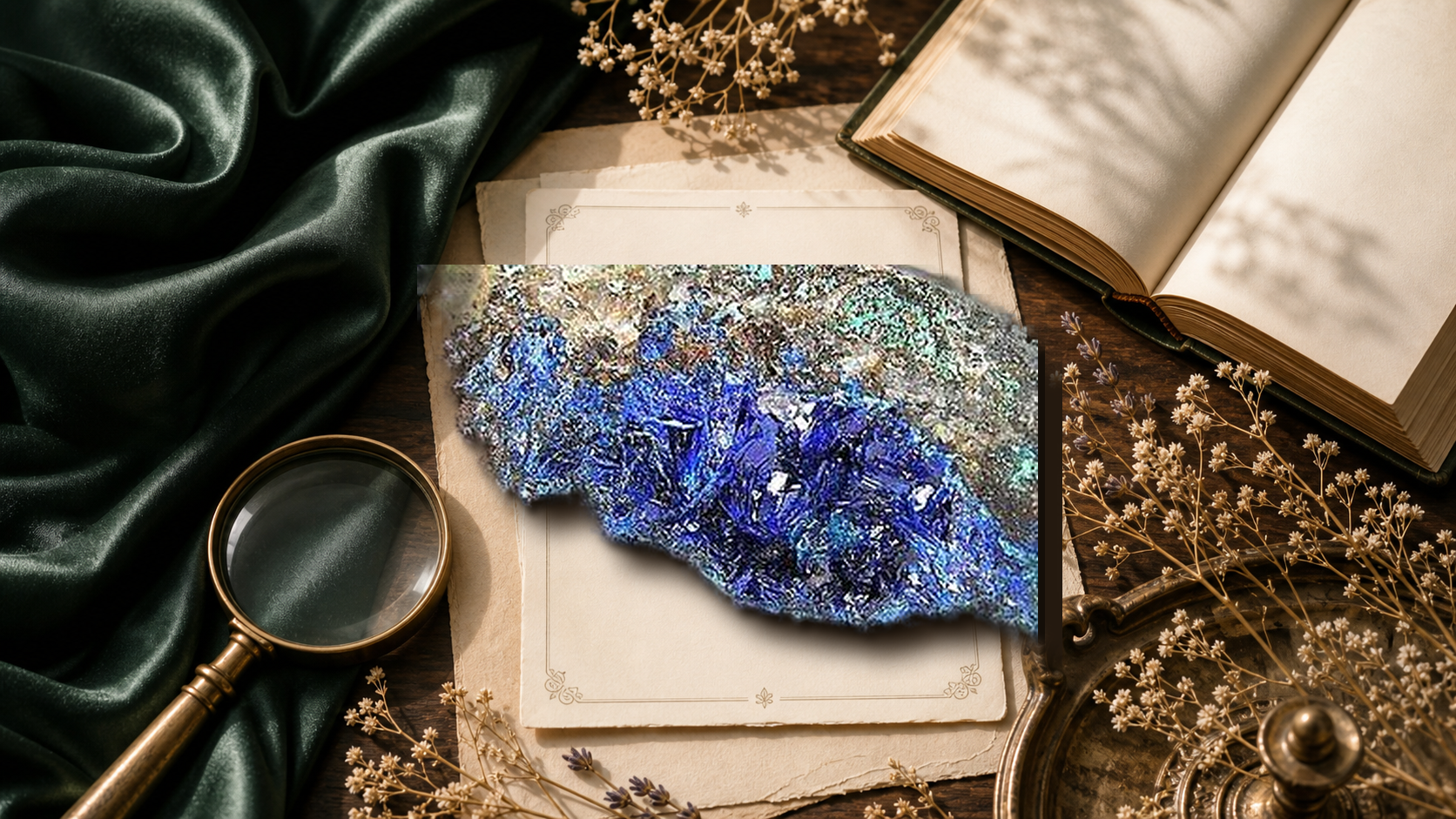
Your expression has gone heavier than your mind intends. Linarite forms electric blue lead-copper sulfate crystals in oxidized zones, small and shockingly vivid. Clarity can arrive as a charge.
This mineral tends to speak through sensory contrast first. For linarite, the body often starts with direct sensory appraisal before any symbolism forms. The material...
The Meaning
Linarite in the Crystalis dictionary
There are moments when communication gets weighted down by too much leaden feeling. The thoughts may still be there, but what reaches the mouth arrives heavier, slower, or more burdened than the original signal intended.
Linarite provides a better image for release. Against the heaviness implied by lead and copper chemistry, the stone appears in electric blue, vivid enough to feel almost charged. The point is not size. It is sudden clarity in a dense environment.
Linarite feels helpful when expression has gone dull under emotional load because it says the signal can still turn bright. Small does not mean weak when the charge is right.
Stone Lore
Stories carried through time
Cultural notes are presented as tradition and historical context — stories carried through time.
Unknown
Scottish lead mining tradition (Leadhills)
The village of Leadhills in Scotland's Southern Uplands is one of the oldest mining communities in Britain, with lead extraction documented since Roman times and possibly earlier. The Leadhills Miners' Library, founded in 1741, is the oldest subscription library in the British Isles, a remarkable cultural achievement for a mining village. Linarite specimens from Leadhills have been in museum collections since the early 19th century and are among the most prized Scottish mineral specimens.
The mineral represents the intersection of industrial labor and natural beauty that characterizes mining communities worldwide.
Historical note
Named for Linares, Spain
Linarite was named after its type locality at Linares in the Andalusian province of Jaén, Spain. It is a rare secondary copper lead sulfate hydroxide mineral (PbCu(SO₄)(OH)₂) known for its exceptionally bright azure to deep blue color,...
Modern/Scientific · 1822 CE
Historical note
Azure Blue Lead-Copper Sulfate
Linarite is prized by mineral collectors for its exceptionally intense azure to deep blue color, which rivals that of azurite. It is a secondary mineral that forms in the oxidized zones of lead-copper ore deposits through the reaction of...
Modern/Scientific · 1822–present
Earth Record
Mineralogy and formation
At shallow depth in a lead-copper oxidation zone, Linarite crystallizes in the oxidized zone of deposits containing both lead and copper, where sulfate-bearing waters react with earlier ore minerals to produce one of the most saturated blue secondary minerals in the collector world. Lead contributes exceptional density and often an adamantine edge to the luster; copper contributes the intense azure color through crystal field absorption.
The mineral is monoclinic and commonly forms slender prismatic crystals, crusts, or elongated aggregates. Its formation window is narrow because lead, copper, sulfate, pH, and oxidation state all have to align before other secondary species take over. This gives well-crystallized linarite a special status among oxidation-zone minerals: common ingredients in uncommon proportion. Hardness is low at about 2.
5, so the crystals are delicate and remain largely cabinet specimens rather than wearable stones. The specific gravity above 5 means even a small piece feels startlingly heavy. That mismatch between size and weight becomes the body's first fact. In somatic terms, linarite is a small object carrying more mass than appearance predicts. The nervous system often responds to that as evidence that intensity can occupy little space.
A person does not have to be outwardly large to carry extraordinary charge. The regulatory invitation is not to romanticize fragility, but to notice how much weight a subtle blue structure can honestly bear before it asks for careful handling.
Crystal system diagram represents the general monoclinic classification. Diagram created by Crystalis for educational reference.
Monoclinic, Space Group P21/M structure
Chemical Formula
PbCu(SO4)(OH)2; lead copper sulfate hydroxide
Crystal System
Monoclinic, Space Group P21/M
Mohs Hardness
2.5
Specific Gravity
5.3-5.5 (extremely heavy for its size due to lead content)
Luster
Vitreous to adamantine (the lead content gives it an unusually brilliant luster for a sulfate mineral)
Color
Blue
IMA Status
species
Type Locality
Linares, Jaén, Andalusia, Spain
IMA Number
Grandfathered (Pre-IMA 1959)
01
Mineral conditions gather
02
Structure begins to crystallize
03
Linarite records place and pressure
Leadhills, Scotland is the type locality. Arizona (USA) copper-lead mines produce vivid blue linarite specimens. Spain's Linares district (namesake) is the classic European source.
The lead-copper sulfate hydroxide forms in oxidation zones where lead and copper ores coexist under specific pH conditions.
ScotlandUSA (Arizona)Spain
Telling it apart
Linarite is a lead copper sulfate hydroxide that forms vivid deep blue monoclinic prismatic crystals, and it gets confused with azurite, cyanotrichite, and other blue copper minerals. At Mohs 2. 5, specific gravity about 5. 30 to 5. 45, and with a vitreous to adamantine luster, linarite is conspicuously heavy and soft. Azurite is a copper carbonate that effervesces in acid and typically shows lighter blue.
Cyanotrichite forms acicular blue hair like crystals rather than prismatic blades. Genuine linarite crystals are usually small, intensely blue, and tabular to prismatic, growing in oxidized lead copper sulfide deposits. The extreme weight for size is the first clue that a lead mineral is involved. If a blue crystal feels heavy enough to be a lead compound and does not fizz in acid, linarite should be considered.
Spotting the real thing
Linarite: vivid blue, extremely heavy for its size (SG 5. 3-5. 5 due to lead).
Adamantine luster. Mohs 2. 5.
The combination of vivid blue, extreme heaviness, and softness is diagnostic. Contains lead; handle briefly, wash hands. If a blue mineral is not notably heavy, it is not linarite.
Linarite's blue is so intense it can bypass the cognitive gatekeepers of depression and register directly in the visual cortex. For nervous systems in deep dorsal shutdown where nothing feels vivid or meaningful, the adamantine luster of linarite
Settled & connected
For individuals who metabolize other people's emotional toxicity
The ventral vagal system is engaged but it is reaching deeper than surface connection. This is the state of the therapist in session, the artist in flow, the mystic in contemplation: regulated enough to be present, open enough to receive what most people deflect. Depth-seeking is the nervous system's willingness to go below the conversational layer into the structural one, to feel the pattern beneath the pattern. For individuals who metabolize other people's emotional toxicity, this state is both gift and occupational hazard.
Linarite's role: Linarite is a lead copper sulfate hydroxide in electric azure blue, formed in the oxidation zones of lead-copper ore deposits. It is rare, intensely colored, and too soft and fragile for any practical use except looking at. Placed in the workspace or held briefly during depth-seeking practice, linarite provides the visual intensity that matches the depth of the state: a blue so saturated it stops the eye.
The stone models what depth-seeking requires: the willingness to form in reactive, potentially toxic chemical environments and emerge as something vivid rather than damaged.
Settled & connected
blue
Sympathetic activation (perfectionism/purity obsession): Linarite is chemically "impure" by design; it requires both lead AND copper to exist. For nervous systems driven by perfectionism (the belief that only pure, untainted expression has value), linarite demonstrates that some of the most beautiful things in nature require impurity as a structural necessity. State shift: purity-driven sympathetic toward acceptance of complexity as a creative requirement.
These associations come from tradition and reflective practice — a way of working with the stone, not a medical prescription.
Somatic Practice
Simple ways to work with Linarite
◇
Hold
Carry Linarite in a pocket or place it over the heart center during a pause.
◌
Meditate
Let the stone become a quiet tactile anchor while the breath slows.
☽
Breathe
Breathe in softness. Breathe out tension. Keep the practice simple.
✎
Journal
Write with Linarite nearby to name the feeling without forcing a conclusion.
✋
Bodywork
Rest the stone near the chest, hand, or bedside as a reminder to soften.
⌂
Environment
Place it where you want a visual cue for care, repair, or steadiness.
Field Instruction
The Azure Depth Witness
Honor the azure depth you cannot touch.
3 min protocol
1
Place Linarite in a sealed glass display case or behind glass. Do NOT handle with bare hands — this mineral contains lead. Sit 2-3 feet away. Settle your posture. Let your breath slow.
2
Observe the intense azure-blue crystals. Notice the prismatic faces, the vivid depth of color. Let your eyes soften. Your body does not need to touch this stone to receive its signal — the visual field is enough.
3
With each exhale, release one thing — a thought, a tension, a worry. The stone holds its own boundaries. You hold yours. Continue breathing. Notice where the body softens first.
4
After 3 minutes: check in. Has the breath changed? Has the jaw released? That shift — however small — is the protocol complete. The blue witnessed. The body responded. No contact required.
Stone Intelligence
The fact that makes Linarite memorable
Blue that rivals azurite. Lead, copper, and sulfate meeting in oxidation zones under conditions specific enough that the mineral is uncommon even where its ingredients are abundant. The science documents how vivid color can emerge from narrow chemistry.
The practice asks what beauty costs when the conditions that produce it are rarely met.
SCI
Microanalysis of blue pigments from the Ptolemaic temple of Hathor (Thebes), Upper Egypt: a case study
A Raman spectroscopic study of copiapites Fe<sup>2+</sup>Fe<sup>3+</sup>(SO<sub>4</sub>)<sub>6</sub>(OH)<sub>2</sub> · 20H<sub>2</sub>O: environmental implications
Display and boundary study only. Linarite contains lead. The electric blue is vivid enough to rival azurite, and the lead content is present enough to demand distance.
The use case is discernment: recognizing that intensity and toxicity can share a body. Observe. Do not carry.
Wash hands after brief handling.
Sacred Match
Sacred Match reaches for Linarite when what you feel sounds like:
hidden heaviness that your appearance does not reveal
fragile intensity that could shatter under careless handling
blue sorrow carrying more mass than anyone around you perceives
need for careful containment of something both beautiful and dangerous
load exceeding what observers estimate from the outside
Sacred Match listens to the body rather than to preference. It senses whether concealed weight is protective strategy, involuntary masking, or a material reality where the body carries far more density than its surface communicates. When that points to extreme internal load behind a vivid exterior, Linarite is the stone it offers. This is lead copper sulfate hydroxide, electric blue from Cu2+ crystal field transitions, with adamantine luster from its lead content. Shockingly vivid. Extremely dense. Extremely soft.
Hidden heaviness -> internal mass exceeding visible estimate -> specific gravity 5. 3-5. 5 is extraordinarily heavy from lead content, teaching the body that some stones weigh far more than observers expect
Fragile intensity -> high charge in a breakable vessel -> Mohs 2. 5 means this mineral is very soft and fragile despite its density, modeling how intensity and vulnerability can be structurally linked
Blue sorrow with mass -> dense emotional weight with vivid expression -> intense azure blue from Cu2+ crystal field transitions demonstrates that the deepest blue can ride on the heaviest substrate
Need for careful containment -> handling requirement proportional to value and risk -> vitreous to adamantine luster from lead content produces unusually brilliant surfaces for a sulfate, meaning the beauty is proportional to the hazard
Load exceeding appearance -> invisible weight -> PbCu(SO4)(OH)2 contains both lead and copper as essential structural components, two heavy metals whose combined mass is invisible from the outside of the crystal
Pairings are treated like a recipe file: clear use, method, and safety.
Crystal Companion
Linarite + Amethyst
Use when
You want to layer the primary intention with another supportive tone.
How to work with it
Place the stones together during meditation, journaling, or a short reset.
Safety
Use as a reflective practice tool, not as a medical substitute.
Crystal Companion
Linarite + Rhodonite
Use when
You want to layer the primary intention with another supportive tone.
How to work with it
Place the stones together during meditation, journaling, or a short reset.
Safety
Use as a reflective practice tool, not as a medical substitute.
Crystal Companion
Linarite + Clear Quartz
Use when
You want to layer the primary intention with another supportive tone.
How to work with it
Place the stones together during meditation, journaling, or a short reset.
Safety
Use as a reflective practice tool, not as a medical substitute.
Crystal Companion
Linarite + Black Tourmaline
Use when
You want to layer the primary intention with another supportive tone.
How to work with it
Place the stones together during meditation, journaling, or a short reset.
Safety
Use as a reflective practice tool, not as a medical substitute.
When the stone needs context. Linarite benefits from companions that either clarify its strongest trait or balance its weakest one.
Azurite
blue mineral dialogue. Azurite gives a softer, more familiar copper blue beside linarite's rarer lead-weighted intensity. Placement: Display side by side in a cabinet, not loose in a pocket. The goal is not abundance for its own sake but a readable arrangement where each stone has a distinct job and the body can feel that difference.
Selenite
visual clearing. Selenite brightens the eye around linarite without risking physical abrasion if stored separately. Placement: Keep selenite nearby, not touching. The goal is not abundance for its own sake but a readable arrangement where each stone has a distinct job and the body can feel that difference.
Black Tourmaline
serious grounding. Tourmaline gives a practical counterweight to linarite's vivid but delicate presence. Placement: Tourmaline in the hand, linarite viewed rather than handled extensively. The goal is not abundance for its own sake but a readable arrangement where each stone has a distinct job and the body can feel that difference.
Clear Quartz
focus tool. Quartz helps observation and appreciation of linarite's geometry. Placement: Use under directed light on a specimen shelf. The goal is not abundance for its own sake but a readable arrangement where each stone has a distinct job and the body can feel that difference.
Care & Cleansing
How to keep Linarite in good condition
Water Safe?
Water safe
This stone is generally safe for short water contact, though polishing, fractures, and metal settings can still change how a specimen behaves.
Sunlight Safe?
Sunlight safe
Tolerates daylight; safe to charge or display in the sun.
Authenticity
What to check
Natural Linarite should usually feel cooler than plastic or resin on first touch and warm more slowly in the hand.
WARNING: Linarite contains lead (PbCu(SO4)(OH)2). Do not place in water or gem elixirs. Handle with care, wash hands after touching.
Brief dry display only. Recommended cleansing: moonlight (overnight), selenite plate (4-6 hours). Store separately in a sealed container.
The vivid blue rivals azurite, but the lead content demands respect.
Temperature
Natural Linarite should usually feel cooler than plastic or resin on first touch and warm more slowly in the hand.
Scratch logic
Use 2.5 on the Mohs scale as the check, not internet myths. A real specimen should behave in line with the hardness listed above.
Surface and luster
Look for a vitreous to adamantine (the lead content gives it an unusually brilliant luster for a sulfate mineral) surface quality rather than a painted or plastic shine.
Weight and density
The listed specific gravity is 5.3-5.5 (extremely heavy for its size due to lead content). If a specimen feels unusually light for its size, it may deserve a second look.
My Field Guide
Your private record and next steps
Journal
Add this stone to your private collection, then log what happened when you worked with it.
Shared Notes
Read public practice logs and pattern notes from the Crystalis community.
When members save a public field note for this stone, it will appear here.
Frequently Asked
Questions people ask about Linarite
What is Linarite?
⌄
Linarite is a lead copper sulfate hydroxide, PbCu(SO4)(OH)2, monoclinic (space group P21/m), soft at Mohs 2. 5. It was first described in 1839 from the Linares mining district of Jaen Province, Spain, hence the name. A secondary mineral, it forms in the oxidized zone of lead-copper ore deposits, specifically where lead and copper sulfides (galena and chalcopyrite) weather together in the presence of sulfate-rich solutions.
Linarite is relatively rare compared to other secondary minerals and is highly prized by mineral collectors for its extraordinary color intensity (Garcia Moreno et al. , 2008).
What is the Mohs hardness of Linarite?
⌄
Linarite has a Mohs hardness of 2.5.
Can Linarite go in water?
⌄
Water Safety ABSOLUTELY NO. Linarite contains lead, which is a cumulative neurotoxin with no safe threshold of exposure. While linarite's solubility in pure water is limited compared to chalcanthite, it WILL release lead ions in acidic solutions and can slowly dissolve even in neutral water over time. Do NOT place in water for any purpose. Do NOT use for gem elixirs, gem water, or any aqueous preparation. Do NOT rinse with water for cleaning, use a dry soft brush only.
What crystal system is Linarite?
⌄
Linarite crystallizes in the Monoclinic, space group P21/m.
What is the chemical formula of Linarite?
⌄
The chemical formula of Linarite is PbCu(SO4)(OH)2, lead copper sulfate hydroxide.
Is Linarite toxic?
⌄
While intact linarite does not readily release lead through casual skin contact, prolonged handling can deposit lead-bearing particles on the skin. ALWAYS handle with gloves if handling is necessary.
How does Linarite form?
⌄
Formation Story Linarite forms in the oxidation zone of polymetallic ore deposits, specifically where lead sulfide (galena, PbS) and copper sulfide (chalcopyrite, CuFeS2) weather together in the presence of oxygenated, sulfate-rich groundwater. The process requires a precise geochemical environment: sufficient lead and copper in solution, moderate sulfate activity, slightly alkaline to neutral pH, and relatively slow evaporation rates that allow well-formed crystals to develop.
Sources & Citations
Where this entry can be checked
Back Matter
Readable for people. Structured for AI search.
Sources stay visible in the page so readers, search engines, and answer systems can follow the evidence trail.
01
SCI
Microanalysis of blue pigments from the Ptolemaic temple of Hathor (Thebes), Upper Egypt: a case study
Marey Mahmoud, Hussein H. (2012). Microanalysis of blue pigments from the Ptolemaic temple of Hathor (Thebes), Upper Egypt: a case study. Surface and Interface Analysis. [SCI]DOI 10.1002/sia.4999
02
SCI
A Raman spectroscopic study of copiapites Fe<sup>2+</sup>Fe<sup>3+</sup>(SO<sub>4</sub>)<sub>6</sub>(OH)<sub>2</sub> · 20H<sub>2</sub>O: environmental implications
Frost, Ray L. (2010). A Raman spectroscopic study of copiapites Fe<sup>2+</sup>Fe<sup>3+</sup>(SO<sub>4</sub>)<sub>6</sub>(OH)<sub>2</sub> · 20H<sub>2</sub>O: environmental implications. Journal of Raman Spectroscopy. [SCI]DOI 10.1002/jrs.2795
03
SCI
DISCOVERY AND CHARACTERIZATION OF AN UNKNOWN BLUE‐GREEN MAYA PIGMENT: VESZELYITE*
GARCIA MORENO, R., MATHIS, F., MAZEL, V., DUBUS, M., CALLIGARO, T. et al. (2008). DISCOVERY AND CHARACTERIZATION OF AN UNKNOWN BLUE‐GREEN MAYA PIGMENT: VESZELYITE*. Archaeometry. [SCI]DOI 10.1111/j.1475-4754.2007.00370.x
04
SCI
A rare case report of lead encephalopathy due to high blood lead level
Masbough, Farnoosh, Shadnia, Shahin, Rahimi, Mitra, Roshanzamiri, Soheil, Evini, Peyman Erfantalab et al. (2023). A rare case report of lead encephalopathy due to high blood lead level. Clinical Case Reports. [SCI]DOI 10.1002/ccr3.7663
05
SCI
Characteristic improvement of metal‐contaminated sludge using mineralization technology