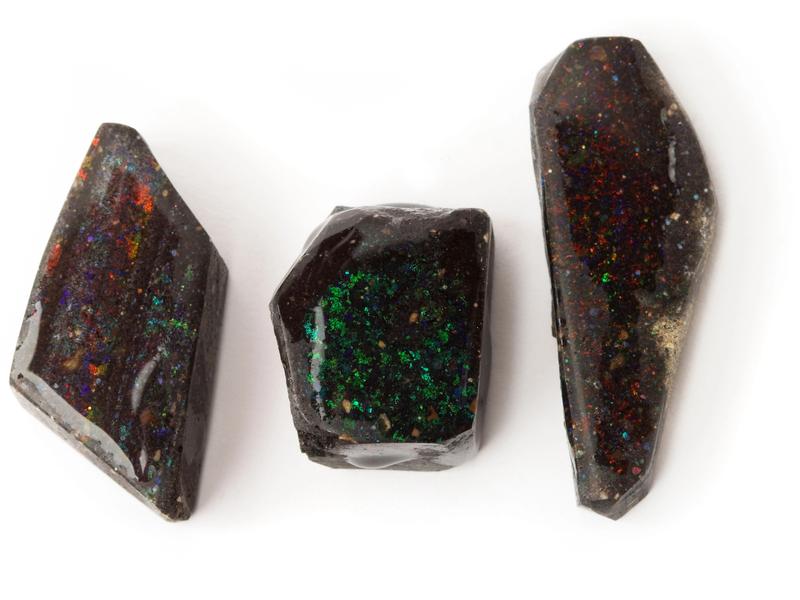
Your brightest qualities need a host sturdy enough to carry them. Matrix opal keeps its flashes distributed through darker stone instead of standing alone. Fire survives differently when it is embedded.
Held against the skin, it gives the body something exact to notice. For matrix opal, the body often starts with direct sensory appraisal before any symbolism forms....
The Meaning
Matrix Opal in the Crystalis dictionary
Some gifts weaken when they are forced to stand alone. The self may have plenty of color, but without enough host material around it, the brilliance starts feeling exposed, unstable, even unsustainable.
Matrix opal offers a better arrangement. Instead of separating the play-of-color from the darker host, the flashes remain distributed through the matrix itself. Fire appears within structure rather than apart from it. Matrix opal helps when visibility needs ballast. It reminds the psyche that the host rock is not the enemy of brilliance. It may be what lets the fire last.
Stone Lore
Stories carried through time
Cultural notes are presented as tradition and historical context — stories carried through time.
Unknown
Aboriginal Australian Dreamtime Traditions
The opal fields of central and eastern Australia lie within traditional lands of multiple Aboriginal nations, including the Arrernte, Kuyani, and Gamilaraay peoples. In various Dreamtime narratives, opal is associated with the Rainbow Serpent, the creator being who shaped the landscape and whose scales shimmer with all colors. Matrix opal, with its color emerging from within the earth itself, is understood as the point where the Rainbow Serpent passed through the rock, leaving traces of its iridescent body permanently embedded in the stone.
Unlike Western gemological practice, which values extraction and cutting, some Aboriginal perspectives hold that opal is most powerful when it remains in or connected to its matrix, the earth that contains it.
Origin lore
Andamooka Mining Community (South Australia)
The Andamooka opal field, discovered in 1930, is the world's premier source of matrix opal. The mining community developed unique treatment methods (the sugar-acid process) specifically for matrix opal, recognizing that the beauty was...
Unknown
Origin lore
Honduran Volcanic Matrix Opal Tradition
Honduras produces a distinctive matrix opal where precious opal fills vesicles (gas bubbles) and fractures in black basalt. Pre-Columbian Maya and Lenca peoples valued this material, and archaeological specimens have been recovered from...
Unknown
Earth Record
Mineralogy and formation
As hydrated silica filled pores in host stone, As hydrated silica filled pores in host stone, opal took shape not as a freestanding crystal but as a network of microscopic silica spheres arranged within fractures, pore spaces, and cavities. Matrix opal keeps that host rock attached. Depending on locality, the matrix may be ironstone, sandstone, volcanic rock, or another porous substrate.
The precious effect arises only when the silica spheres are uniform enough to diffract visible light, producing play-of-color. Because opal is amorphous and water-bearing, no true crystal system applies. What matters is sphere size, ordering, and the geometry of the host spaces available for deposition. In Australian matrix material, opal can infiltrate ironstone in thin seams and specks, creating flashes that appear embedded inside darker stone.
Some commercial material is treated to deepen contrast, so buyers need to distinguish natural matrix from enhanced product. Hardness is moderate, usually around 5. 5 to 6. 5 for the opal component, but the full specimen behaves according to the host as well. In the body, matrix opal offers a different story from gemmy, isolated opal. Color remains in relation to roughness. Flash does not replace the matrix; it appears through it.
The somatic turn comes there. Beauty is not extracted from burden. It is threaded through burden, visible in patches, convincing precisely because the host remains present and unedited.
Crystal system diagram represents the general amorphous classification. Diagram created by Crystalis for educational reference.
Amorphous structure
Chemical Formula
SiO2 . nH2O within host rock matrix (ironstone, sandstone, rhyolite, basalt, or other host depending on deposit)
Crystal System
Amorphous
Mohs Hardness
5.5
Specific Gravity
2.0-3.0+ (varies significantly depending on host rock composition; ironstone matrix specimens are notably heavy)
Luster
Vitreous to waxy (opal); dull to earite (host rock)
Color
Multi
IMA Status
rock
IMA Number
No IMA number (variety of Opal, grandfathered pre-1959)
01
Mineral conditions gather
02
Structure begins to crystallize
03
Matrix Opal records place and pressure
Queensland, Australia produces the majority of matrix opal from ironstone-hosted deposits in the Yowah, Koroit, and Winton opal fields. Honduras yields matrix opal from volcanic basalt. Mexico produces matrix opal from rhyolite host rock.
The opal remains in its host at each locality because the seams are too thin to separate.
Australia (Queensland)HondurasMexico
Telling it apart
Matrix opal is precious opal that forms within the pores and cavities of its host rock rather than as a solid vein or nodule, and the confusion involves boulder opal, common opal in rock, and synthetic opal glued into matrix. The identifying feature is play of color appearing within the rock itself rather than in a separate opal layer. Hardness and specific gravity vary depending on the host rock and opal percentage.
Queensland boulder opal has ironstone matrix, while Andamooka matrix opal has a sandstone or quartzite base that is sometimes treated with sugar and acid to darken the background and enhance the color play. If the play of color appears only on the surface or at an obvious glue line between opal and rock, the piece may be a doublet or assembled fake. Natural matrix opal should show opal integrated throughout the host rock pores.
Spotting the real thing
Matrix opal: the opal should be naturally deposited within the host rock (ironstone, sandstone, or rhyolite). The play of color should appear in thin seams or patches following natural fracture patterns in the matrix. If the color play appears uniform or surface-applied rather than filling natural rock cavities, it may be a synthetic-matrix composite.
In hyperarousal, brilliance becomes weapon rather than gift. The person's intensity; their spark, their fire, their vividness; is deployed defensively rather than expressively. Talent becomes performance. Charisma becomes manipulation. The fire is real, but it has been conscripted into the fight-or-flight apparatus. Matrix Opal demonstrates fire that remains embedded in its foundation. The play of color does not separate from the stone to dazzle or blind. It stays home. It is brilliant from where it is, not by being extracted from where it formed.
Shut down & far away
The Stone That Forgot Its Light
In dorsal shutdown, the person becomes all matrix and no opal. They present as dense, dull, unremarkable; brown stone. The fire is still there, but so deeply embedded that no angle of light reveals it. This is not loss of brilliance; it is the temporary inability to find the angle at which one's own light becomes visible. Matrix Opal in dim light looks like ordinary rock. Under proper illumination, it erupts with color. The light was always there. The lighting changed.
Settled & connected
Hidden Fire, Held in Trust
In ventral safety, there is no need to extract one's gifts from their context to prove they exist. The person can be brilliant within the ordinary; a teacher who is extraordinary within their classroom, a parent who is extraordinary within their family, a worker who is extraordinary within their craft. Matrix Opal does not need to be cut away from its host to be valued. Its beauty is inseparable from its context. In ventral safety, so is yours.
Charged & on alert
The Unpolished Face
The mixed state of simultaneous activation and shutdown creates the specific anguish of knowing you contain something valuable while being unable to demonstrate it. Matrix Opal before treatment or proper lighting looks like a dull brown rock. Only the person who knows it is opal (or who holds it up to the right light) can see its value. This is the precise phenomenology of imposter syndrome: possessing real gifts that real conditions have made temporarily invisible; not absent, invisible.
Shut down & far away
The Dark Background
Matrix Opal teaches that darkness is not the opposite of brilliance but its necessary context. The play of color in opal is only visible against a darker background; the ironstone matrix provides the contrast that makes the spectral display visible. In the transition between ventral engagement and dorsal depth, the person learns that their darker experiences (grief, failure, depression) are not obstacles to their brilliance but the background against which their brilliance becomes visible. Integration, not elimination, of shadow.
These associations come from tradition and reflective practice — a way of working with the stone, not a medical prescription.
Somatic Practice
Simple ways to work with Matrix Opal
◇
Hold
Carry Matrix Opal in a pocket or place it over the heart center during a pause.
◌
Meditate
Let the stone become a quiet tactile anchor while the breath slows.
☽
Breathe
Breathe in softness. Breathe out tension. Keep the practice simple.
✎
Journal
Write with Matrix Opal nearby to name the feeling without forcing a conclusion.
✋
Bodywork
Rest the stone near the chest, hand, or bedside as a reminder to soften.
⌂
Environment
Place it where you want a visual cue for care, repair, or steadiness.
Field Instruction
The Embedded Fire
Amorphous hydrated silica threaded through ironstone or sandstone host rock, matrix opal proves that fire can live inside a structure that looks nothing like it.
5 min protocol
1
Hold the matrix opal and look for fire — not on the surface but inside the host rock. The amorphous hydrated silica that produces opal's play of color is threaded through ironstone, sandstone, or rhyolite like light hidden in a wall. The fire does not sit on top. It lives within. Let your eyes search for it the way you search for what is real inside what appears ordinary.
2
Place the stone over your heart center. Matrix opal's specific gravity varies wildly — 2.0 to 3.0+ — because the ratio of opal to host rock changes in every specimen. You are also variable. Breathe in for five, out for six. On each exhale, acknowledge one way your external presentation differs from your internal experience. No judgment. Just data.
3
Close your eyes. The host rock in matrix opal is not packaging — it is structural. Without the ironstone or sandstone, the opal would not hold together. Ask: what 'ordinary' structure in my life is actually holding my most precious quality in place? The job, the routine, the relationship I dismiss as unremarkable — is it the matrix that makes my fire possible?
4
Open your eyes. Tilt the stone. The play of color appears and vanishes depending on angle and light — spectral diffraction from silica spheres just 150-300 nanometers in diameter, arranged in grids within the host rock. Ask: am I waiting for someone to find the right angle to see me, or am I willing to show the fire from where I already stand?
5
Set the stone down. Place your hands flat on your chest. The opal does not need to be extracted from the matrix to be real. Your fire does not need to be separated from your context to be valid. One breath for the matrix. One breath for the fire. One breath for the fact that they are the same stone.
Stone Intelligence
The fact that makes Matrix Opal memorable
Precious opal that stays in its host rock. Thin seams and patches filling pores and fractures in the surrounding stone. You do not separate it.
The matrix is the context. The science documents opal as a secondary fill in porous rock. The practice asks what value means when removing the setting destroys the piece.
Your brightest qualities need a host sturdy enough to carry them. Matrix opal keeps its fire distributed through the host rock rather than standing alone. Hold when you feel like your best work is embedded in context that nobody sees as beautiful.
The color play is real. The matrix is part of the piece. Place during imposter syndrome episodes as a reminder that the setting does not diminish the fire.
Sacred Match
Sacred Match reaches for Matrix Opal when what you feel sounds like:
flash arriving inside roughness rather than in polished isolation
beauty still embedded in the stone it grew in
unpredictable joy surfacing without warning from a dark background
need to honor the host body that carries your brightness
identity that makes sense only when the matrix is included
Sacred Match listens to the body rather than to preference. It senses whether brilliance is separable from its context, whether the body needs the flash extracted or the flash left inside its origin. When that points to ventral joy that cannot be understood apart from the dark body carrying it, Matrix Opal is the stone it offers. This is opal distributed through its host rock rather than separated from it.
The play-of-color comes from diffraction through ordered silica nanosphere arrays, but the fire stays inside the ironstone, sandstone, or basalt it formed in.
Flash inside roughness -> brilliance inseparable from its context -> SiO2-nH2O intimately distributed within host rock demonstrates that play-of-color can emerge from within a dark body rather than requiring isolation
Beauty in the matrix -> value embedded in origin -> specific gravity 2. 0-3. 0+ varies significantly with host rock composition, meaning the identity of each specimen includes its geological parentage
Unpredictable joy -> ventral activation arriving without schedule -> play-of-color from diffraction through ordered silica nanosphere arrays appears at unpredictable angles across the rough host surface
Honoring the host -> respecting the body that carries the brilliance -> amorphous opal component cannot survive without the host rock providing structural support, modeling how some brightness depends on what holds it
Identity including the matrix -> self-understanding requiring context -> vitreous to waxy opal next to dull host rock provides two textures in one specimen, and removing either changes the whole
Pairings are treated like a recipe file: clear use, method, and safety.
Crystal Companion
Matrix Opal + Amethyst
Use when
You want to layer the primary intention with another supportive tone.
How to work with it
Place the stones together during meditation, journaling, or a short reset.
Safety
Use as a reflective practice tool, not as a medical substitute.
Crystal Companion
Matrix Opal + Rhodonite
Use when
You want to layer the primary intention with another supportive tone.
How to work with it
Place the stones together during meditation, journaling, or a short reset.
Safety
Use as a reflective practice tool, not as a medical substitute.
Crystal Companion
Matrix Opal + Clear Quartz
Use when
You want to layer the primary intention with another supportive tone.
How to work with it
Place the stones together during meditation, journaling, or a short reset.
Safety
Use as a reflective practice tool, not as a medical substitute.
Crystal Companion
Matrix Opal + Black Tourmaline
Use when
You want to layer the primary intention with another supportive tone.
How to work with it
Place the stones together during meditation, journaling, or a short reset.
Safety
Use as a reflective practice tool, not as a medical substitute.
Start with structure. Matrix Opal benefits from companions that either clarify its strongest trait or balance its weakest one.
Ironstone
earth-and-flash continuity. If already present in the specimen, ironstone is the natural grounding partner. Placement: Use as a display concept rather than a separate placement. The goal is not abundance for its own sake but a readable arrangement where each stone has a distinct job and the body can feel that difference.
Clear Quartz
light retrieval. Quartz helps play-of-color show more clearly under changing angles. Placement: Place quartz behind or beside the specimen under light. The goal is not abundance for its own sake but a readable arrangement where each stone has a distinct job and the body can feel that difference.
Black Tourmaline
contain the shimmer. Tourmaline prevents the color play from feeling too scattered or overstimulating. Placement: Matrix opal high in the room, tourmaline low. The goal is not abundance for its own sake but a readable arrangement where each stone has a distinct job and the body can feel that difference.
Selenite
clean field for color. Selenite gives a pale backdrop that can make subtle flashes easier to notice. Placement: Keep selenite near, but store opal in appropriate humidity conditions. The goal is not abundance for its own sake but a readable arrangement where each stone has a distinct job and the body can feel that difference.
Care & Cleansing
How to keep Matrix Opal in good condition
Water Safe?
Water safe
This stone is generally safe for short water contact, though polishing, fractures, and metal settings can still change how a specimen behaves.
Sunlight Safe?
Sunlight safe
Tolerates daylight; safe to charge or display in the sun.
Authenticity
What to check
Natural Matrix Opal should usually feel cooler than plastic or resin on first touch and warm more slowly in the hand.
Matrix opal requires caution. The opal component (hydrated silica) is sensitive to temperature extremes and dehydration, while the host rock (ironstone, sandstone) may absorb moisture unevenly. Brief rinse (15-30 seconds), pat dry.
Avoid thermal shock, ultrasonic, and prolonged soaking. Recommended cleansing: moonlight (overnight, ideal for opal), selenite plate (4-6 hours). Store at stable temperature and moderate humidity.
Temperature
Natural Matrix Opal should usually feel cooler than plastic or resin on first touch and warm more slowly in the hand.
Scratch logic
Use 5.5 on the Mohs scale as the check, not internet myths. A real specimen should behave in line with the hardness listed above.
Surface and luster
Look for a vitreous to waxy (opal); dull to earite (host rock) surface quality rather than a painted or plastic shine.
Weight and density
The listed specific gravity is 2.0-3.0+ (varies significantly depending on host rock composition; ironstone matrix specimens are notably heavy). If a specimen feels unusually light for its size, it may deserve a second look.
My Field Guide
Your private record and next steps
Journal
Add this stone to your private collection, then log what happened when you worked with it.
Shared Notes
Read public practice logs and pattern notes from the Crystalis community.
When members save a public field note for this stone, it will appear here.
Frequently Asked
Questions people ask about Matrix Opal
Is Matrix Opal as valuable as solid opal?
⌄
In traditional gemological markets, solid opal commands higher prices per carat than matrix opal because the play of color is more concentrated. However, matrix opal specimens can be extraordinarily beautiful and are prized by collectors for their unique presentation of color-within-stone. For therapeutic and personal use, value is a function of resonance, not market price.
Why does my Matrix Opal only show color from certain angles?
⌄
Play of color in opal results from the diffraction of light by ordered arrays of nanometer-scale silica spheres. The diffraction is angle-dependent, just as a prism must be held at specific angles to split white light into a spectrum, opal's internal structure only diffracts color when light enters and exits at specific angles relative to the ordered sphere arrays. In matrix opal, these ordered zones are small and scattered, which is why color appears as pinpoints or flashes rather than broad sheets.
Has my Andamooka Matrix Opal been treated?
⌄
Most Andamooka matrix opal has been treated with the sugar-acid process, which is considered a standard, accepted treatment in the gem trade (similar to the heating of sapphires or oiling of emeralds). The treatment darkens the porous ironstone host to increase contrast with the opal's play of color. This treatment is stable under normal conditions but can be affected by prolonged water immersion, solvents, or high heat.
How should I store Matrix Opal?
⌄
Store in moderate humidity (40-60% relative humidity) away from direct sunlight and heat sources. Wrap in soft fabric or store in a fabric-lined box. Avoid storing in airtight containers with silica gel desiccant packets, as these can dehydrate the opal component. If you live in a very dry climate, occasional brief contact with slightly damp cloth can help maintain hydration.
Can Matrix Opal be used for meditation despite not being a "pure" crystal?
⌄
Matrix Opal's composite nature is its teaching, not its limitation. The fact that the opal cannot be separated from its host is precisely the point: your gifts cannot be separated from your history, your body, your context. For meditation, Matrix Opal is specifically indicated for people who believe they need to become "pure" or "perfect" before their gifts become valid.
Sources & Citations
Where this entry can be checked
Back Matter
Readable for people. Structured for AI search.
Sources stay visible in the page so readers, search engines, and answer systems can follow the evidence trail.
Pliny the Elder. Naturalis Historia, Book 37, Chapter 21. [HIST]
03
HIST
The Curious Lore of Precious Stones
Kunz, George Frederick. (1913). The Curious Lore of Precious Stones. [HIST]
04
SCI
Mineralogical characterization of biosilicas versus geological analogs
Farfan, G.A. et al. (2023). Mineralogical characterization of biosilicas versus geological analogs. Geobiology. [SCI]DOI 10.1111/gbi.12553
05
SCI
Characterization of Natural Precious Opal Using Modern Spectroscopic Techniques
Ejigu, A.A. et al. (2022). Characterization of Natural Precious Opal Using Modern Spectroscopic Techniques. Journal of Spectroscopy. [SCI]DOI 10.1155/2022/3194151