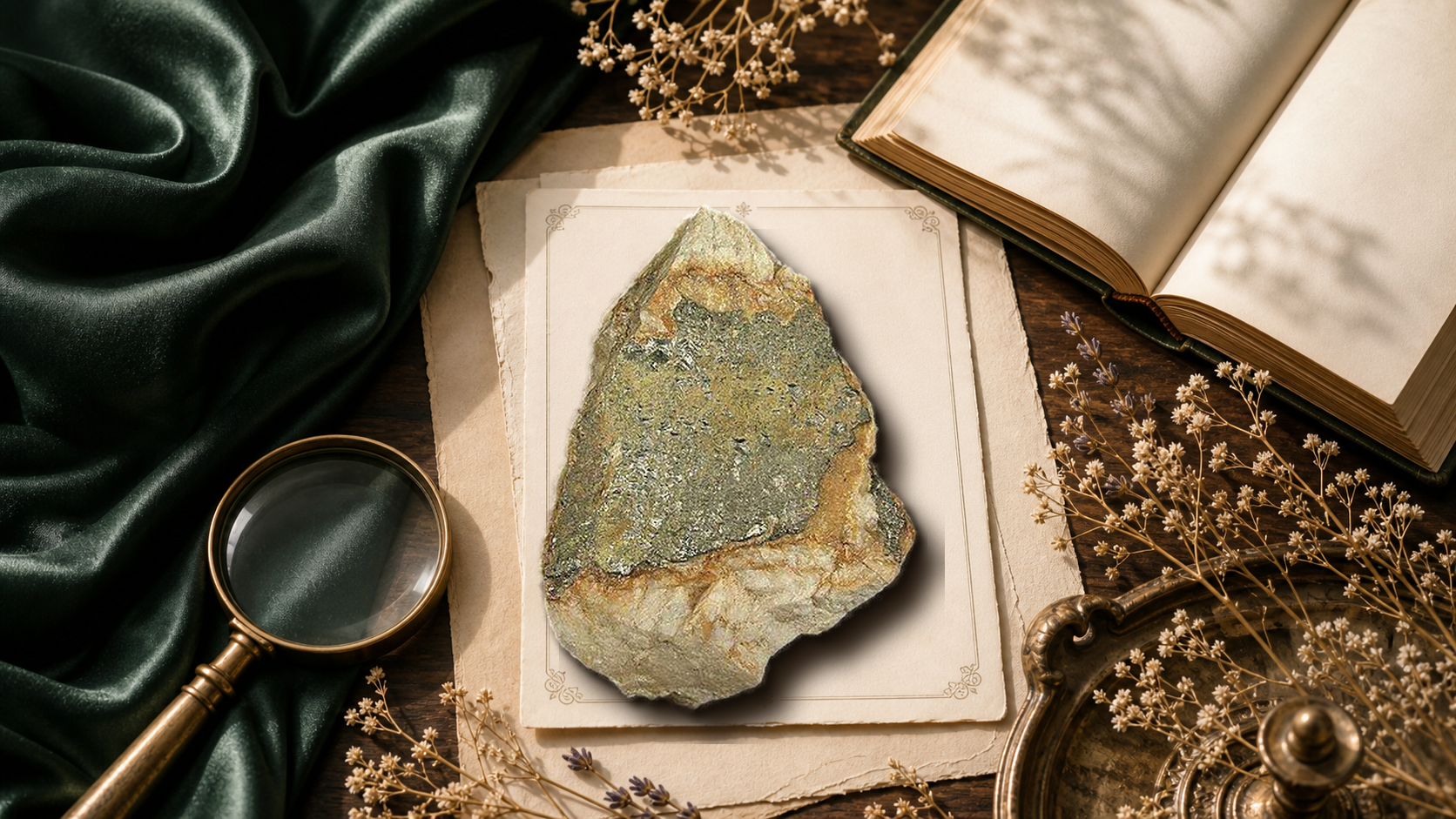
You are trying to hold difficult material without letting it poison the whole room. Lollingite is a metallic iron arsenide, severe in chemistry and straight in habit. Some truths require containment, not denial.
Intent
Boundaries & Protection
Boundary SettingToxic Relationship AwarenessWeight And Grounding
Its usefulness begins where sensation interrupts rumination. For lollingite, the body often starts with direct sensory appraisal before any symbolism forms. The...
The Meaning
Lollingite in the Crystalis dictionary
Some truths are too severe to sentimentalize. They carry arsenic in the chemistry, metaphorically speaking, and anyone carrying them can feel they cannot simply be scattered through the room in the name of honesty. What is needed is containment without repression.
Lollingite offers that containment in stern form. Metallic, severe, straight in habit and uncompromising in chemistry, it makes visible the difference between acknowledging difficult material and letting it contaminate everything nearby.
Lollingite is useful for shadow work with hard edges because it does not ask for denial. It asks for a vessel strong enough to keep the whole environment from becoming toxic.
Stone Lore
Stories carried through time
Cultural notes are presented as tradition and historical context — stories carried through time.
Unknown
Austrian mining tradition (Carinthia)
The type locality of Lolling in Carinthia has a mining history extending to the Roman period, when iron and other metals were extracted from the region's ore deposits. The name "Lolling" derives from a Slavic root meaning "mountain" or "hill." Local miners recognized the heavy, silvery arsenide minerals as indicators of rich ore zones but also feared their association with "mine sickness", the constellation of symptoms we now recognize as chronic arsenic poisoning.
Mining communities developed empirical protective practices long before the chemical identification of arsenic as the causative agent (Haidinger, W. , "Handbuch der bestimmenden Mineralogie," 1845).
Historical note
Named for Lölling, Austria
Löllingite was first described in 1845 and named after its type locality at Lölling (now part of Hüttenberg), Carinthia, Austria. It is an iron arsenide mineral (FeAs₂) that belongs to the löllingite group along with rammelsbergite (NiAs₂)...
Modern/Scientific · 1845 CE
Historical note
Iron Arsenide from Hydrothermal Veins
Löllingite is an iron diarsenide mineral (FeAs₂) that is commonly associated with gold, tin, and tungsten mineralization in mesothermal vein deposits. It typically occurs with arsenopyrite, pyrite, and other sulfides, and alters to...
Modern/Scientific · 1845–present
Earth Record
Mineralogy and formation
Inside arsenic-bearing hydrothermal channels, Inside arsenic-bearing hydrothermal channels, iron and arsenic can combine directly into FeAs2 under mesothermal to higher-temperature conditions, producing lollingite in the orthorhombic system. Unlike arsenopyrite, which incorporates sulfur, lollingite is an arsenide rather than a sulfoarsenide. That chemical distinction affects both habit and paragenesis.
It commonly appears in hydrothermal veins, pegmatitic environments, and contact-metamorphic deposits associated with cobalt, nickel, or arsenic-rich mineral assemblages. Fresh surfaces are silver-white to steel gray with a bright metallic luster, yet they tarnish readily. Density is strikingly high, often above 7, making the stone feel much heavier than expected. The name traces to Lölling in Austria, another reminder that old mining districts often contributed the first well-studied specimens.
Collector caution is essential because arsenide minerals can degrade and should not be used casually in body-contact practices. Mineralogically, though, lollingite is elegant: a simple iron-arsenic ratio crystallized into a dense, directional form. In the body, if handled only as a visual or cabinet object, it communicates compression and seriousness. The somatic turn is austere. Not every useful mineral story is wearable.
Some are instructive precisely because they force distance, teaching the nervous system that discernment includes knowing when attention, not touch, is the appropriate mode of contact.
Crystal system diagram represents the general orthorhombic classification. Diagram created by Crystalis for educational reference.
Orthorhombic structure
Chemical Formula
FeAs2; iron diarsenide
Crystal System
Orthorhombic
Mohs Hardness
5
Specific Gravity
7.1-7.4 (extremely heavy-among the densest common minerals)
Luster
Metallic, brilliant silver-white when freshly fractured; tarnishes to dark gray or steel gray
Color
Silver-Gray
IMA Status
species
Type Locality
Wolfbau Mine, Lölling, Carinthia, Austria
IMA Number
Grandfathered (pre-1959)
01
Mineral conditions gather
02
Structure begins to crystallize
03
Lollingite records place and pressure
Norway (Lolling/Huttenberg area, namesake) is the type locality. Sweden produces lollingite from iron arsenide veins in metamorphic rocks. Germany's Erzgebirge produces specimens from historic arsenide mining districts.
The iron diarsenide forms in mesothermal to hypothermal hydrothermal veins at all three localities.
NorwaySwedenGermany
Telling it apart
Lollingite is an iron arsenide that forms metallic silvery to steel gray orthorhombic crystals, and the confusion involves arsenopyrite, marcasite, and pyrite. The separation from arsenopyrite, its closest look alike, depends on crystal form and arsenic to sulfur ratio: lollingite contains no sulfur and forms prismatic to columnar crystals, while arsenopyrite contains both arsenic and sulfur and commonly shows monoclinic prismatic crystals with a different habit.
Marcasite is an iron sulfide with a paler color. Pyrite is cubic with distinct brassy yellow. Hardness is about 5 to 5. 5 and specific gravity is high at 7. 1 to 7. 5 due to the arsenic and iron content. Because lollingite is an arsenide, it carries the same handling cautions as other arsenic bearing minerals. Correct identification protects both collection accuracy and the handler.
Spotting the real thing
Lollingite: extremely heavy (SG 7. 1-7. 4).
Metallic silver-white on fresh surfaces. Mohs 5-5. 5.
Contains arsenic. The weight and metallic luster are diagnostic. If a metallic specimen is not dramatically heavy, it is not lollingite.
Tarnishes to dark gray. Handle briefly; contains arsenic.
Sympathetic activation (hypervigilance around danger):
Lollingite's toxicity is real and demands genuine respect. For a nervous system stuck in hypervigilance; constantly scanning for threats; working with lollingite (with proper safety precautions) paradoxically validates the scanning behavior. The threat is real. The vigilance is appropriate. This validation can actually calm the nervous system more effectively than reassurance, because the surveillance system receives accurate data rather than being told to stand down when it knows danger exists.
State shift: generalized hypervigilance toward calibrated, accurate threat assessment.
Shut down & far away
Dorsal vagal collapse (overwhelm/giving up):
The extreme density of lollingite (7.1; 7.4 g/cm3) makes it one of the heaviest minerals of its size. For a nervous system in dorsal collapse, this sheer physical weight placed in the hand creates an unmistakable proprioceptive signal: something is HERE. The weight is too anomalous for the sensory system to ignore, creating a bottom-up interruption of the dissociative drift. State shift: dorsal vagal toward sensory-driven present-moment awareness through anomalous weight perception.
Charged & on alert
Mixed state: sympathetic activation around toxicity (fear of one's own darkness):
Many people carry fear of their own "toxic" qualities; anger, jealousy, grief, rage. Lollingite models a reality where a genuinely toxic substance (arsenic) exists in stable, beautiful form. The arsenic is not hidden or denied; it constitutes 73% of the mineral. Yet the mineral has structure, beauty, and geological significance. This mirror can help individuals recognize that containing their shadow material does not require eliminating it. State shift: fear of internal toxicity toward structural integration of difficult qualities.
Settled & connected
For individuals who are regulated but navigating genuinely toxic relationships, ...
For individuals who are regulated but navigating genuinely toxic relationships, environments, or substances (including literal toxicology for healthcare workers), lollingite teaches the practice of proximity-with-boundaries. You can appreciate the mineral's beauty, study its structure, and benefit from its geological information
; -
Sympathetic depletion (burnout from sustained exposure to harmful environments): When someone has been absorbing toxicity; from a workplace, relationship, or environment; for too long, lollingite reminds that arsenic accumulates. The mineral's formation story, in which arsenic concentrations build over geological time, mirrors the cumulative nature of toxic exposure. This is not a soothing stone.
It is a diagnostic one. If working with lollingite creates revulsion or the impulse to set it down, that impulse may be the nervous system's unheeded message about a real-world toxic exposure. State shift: depleted tolerance toward accurate recognition of what needs to change.
These associations come from tradition and reflective practice — a way of working with the stone, not a medical prescription.
Somatic Practice
Simple ways to work with Lollingite
◇
Hold
Carry Lollingite in a pocket or place it over the heart center during a pause.
◌
Meditate
Let the stone become a quiet tactile anchor while the breath slows.
☽
Breathe
Breathe in softness. Breathe out tension. Keep the practice simple.
✎
Journal
Write with Lollingite nearby to name the feeling without forcing a conclusion.
✋
Bodywork
Rest the stone near the chest, hand, or bedside as a reminder to soften.
⌂
Environment
Place it where you want a visual cue for care, repair, or steadiness.
Field Instruction
The Silver Sheen Witness
Honor the silver sheen you cannot touch.
3 min protocol
1
Place Lollingite in a sealed glass display case or behind glass. Do NOT handle with bare hands — this mineral contains arsenic (iron diarsenide). Wash hands thoroughly if any prior contact occurred. Sit 2-3 feet away. Settle your posture. Let your breath slow.
2
Observe the silvery-white to steel-gray metallic surface. Notice the dense, heavy appearance and metallic luster. Let your eyes soften. Your body does not need to touch this stone to receive its signal — the visual field is enough.
3
With each exhale, release one thing — a thought, a tension, a worry. The stone holds its own boundaries. You hold yours. Continue breathing. Notice where the body softens first.
4
After 3 minutes: check in. Has the breath changed? Has the jaw released? That shift — however small — is the protocol complete. The silver witnessed. The body responded. No contact required.
Stone Intelligence
The fact that makes Lollingite memorable
Iron arsenide from hydrothermal veins. Named after Lolling, Austria. Silver-white metallic crystals with arsenic content that demands respect.
The science documents arsenide mineralization. The practice is sealed observation. Some minerals teach by requiring distance.
SCI
In‐depth study of a speiss/matte sample from Castillo de Huarmey, North Coast of Peru, and its implications for the pre‐Columbian production of arsenic bronze in the Central Andes
Arsenic‐induced <scp>IGF</scp> ‐1 signaling impairment and neurite shortening: The protective roles of <scp>IGF</scp> ‐1 through the <scp>PI3K</scp> /Akt axis
Display only. Lollingite contains arsenic. The use case is boundary awareness: learning to hold difficult material at a distance.
The silver-white metallic crystals are beautiful. The FeAs2 composition is non-negotiable. Some minerals teach by requiring the space between you and them to remain intact.
Sacred Match
Sacred Match reaches for Lollingite when what you feel sounds like:
need for discernment around genuinely hazardous material
contact requiring limits not because of fear but because of chemistry
compressed severity in the body that is appropriate to the situation
boundary intelligence operating at a level most people cannot see
respect for hazard that does not tip into avoidance
Sacred Match listens to the body rather than to preference. It senses whether boundary vigilance is anxious, appropriate, or the correct somatic response to material that is actually toxic. When that points to precision-grade boundary intelligence matched to genuine chemical hazard, Lollingite is the stone it offers. This is iron diarsenide at specific gravity 7.1-7.4, among the densest common minerals, severe in chemistry and straight in habit. Some truths require containment, not denial.
Discernment around hazard -> precision boundary response -> FeAs2 is an arsenide, meaning the chemistry genuinely requires careful handling; the boundary intelligence is proportional to the actual risk
Contact requiring limits -> exposure management based on reality -> Mohs 5-5. 5 at specific gravity 7. 1-7. 4 is extremely heavy, and the arsenic content demands respect, modeling how some weight is best held at arm's length
Compressed severity -> appropriate somatic constriction -> orthorhombic marcasite structure type provides straight prismatic or massive habit that reads as austere rather than decorative
Boundary intelligence -> high-grade protective discernment -> silver-white to steel-gray on fresh fracture tarnishing to dark gray demonstrates that the surface changes with exposure, teaching the body to read oxidation as data
Respect for hazard without avoidance -> engagement with dangerous material without recklessness -> metallic luster on fresh surfaces provides the visual register of something that means what it looks like
Pairings are treated like a recipe file: clear use, method, and safety.
Crystal Companion
Lollingite + Amethyst
Use when
You want to layer the primary intention with another supportive tone.
How to work with it
Place the stones together during meditation, journaling, or a short reset.
Safety
Use as a reflective practice tool, not as a medical substitute.
Crystal Companion
Lollingite + Rhodonite
Use when
You want to layer the primary intention with another supportive tone.
How to work with it
Place the stones together during meditation, journaling, or a short reset.
Safety
Use as a reflective practice tool, not as a medical substitute.
Crystal Companion
Lollingite + Clear Quartz
Use when
You want to layer the primary intention with another supportive tone.
How to work with it
Place the stones together during meditation, journaling, or a short reset.
Safety
Use as a reflective practice tool, not as a medical substitute.
Crystal Companion
Lollingite + Black Tourmaline
Use when
You want to layer the primary intention with another supportive tone.
How to work with it
Place the stones together during meditation, journaling, or a short reset.
Safety
Use as a reflective practice tool, not as a medical substitute.
Placement matters here. Lollingite benefits from companions that either clarify its strongest trait or balance its weakest one.
Quartz matrix specimens
contextual pairing. Quartz host rock softens the stark metallic severity and shows geological relationship. Placement: Display on a mineral shelf, not the body. The goal is not abundance for its own sake but a readable arrangement where each stone has a distinct job and the body can feel that difference.
Arsenopyrite
comparison study. Useful for collectors learning the arsenide versus sulfoarsenide distinction. Placement: Keep labeled in separate boxes. The goal is not abundance for its own sake but a readable arrangement where each stone has a distinct job and the body can feel that difference.
Pyrite
metallic contrast. Pyrite's brass color clarifies how unusual lollingite's pale steel tone is. Placement: Use in a study tray. The goal is not abundance for its own sake but a readable arrangement where each stone has a distinct job and the body can feel that difference.
Black Tourmaline
symbolic grounding only. If used in ritual display, tourmaline provides a safer companion with strong boundary associations. Placement: Tourmaline nearby, lollingite enclosed. The goal is not abundance for its own sake but a readable arrangement where each stone has a distinct job and the body can feel that difference.
Care & Cleansing
How to keep Lollingite in good condition
Water Safe?
Keep dry
This stone should stay out of water. Water can dull the surface, destabilize the specimen, or damage the stone over time.
Sunlight Safe?
Sunlight safe
Tolerates daylight; safe to charge or display in the sun.
Authenticity
What to check
Natural Lollingite should usually feel cooler than plastic or resin on first touch and warm more slowly in the hand.
WARNING: Lollingite contains arsenic (FeAs2). Iron diarsenide. Do NOT place in water or gem elixirs. Handle briefly, wash hands after contact. Display only in a sealed or ventilated case. Recommended cleansing: visual observation only. Store separately from all practice stones in a sealed container.
Safety: Safe to own, display, and handle. Wash your hands afterward. Do not make elixirs, place it in drinking water, or ingest it, and never inhale dust from raw or broken pieces.
Temperature
Natural Lollingite should usually feel cooler than plastic or resin on first touch and warm more slowly in the hand.
Scratch logic
Use 5 on the Mohs scale as the check, not internet myths. A real specimen should behave in line with the hardness listed above.
Surface and luster
Look for a metallic, brilliant silver-white when freshly fractured; tarnishes to dark gray or steel gray surface quality rather than a painted or plastic shine.
Weight and density
The listed specific gravity is 7.1-7.4 (extremely heavy-among the densest common minerals). If a specimen feels unusually light for its size, it may deserve a second look.
My Field Guide
Your private record and next steps
Journal
Add this stone to your private collection, then log what happened when you worked with it.
Shared Notes
Read public practice logs and pattern notes from the Crystalis community.
When members save a public field note for this stone, it will appear here.
Frequently Asked
Questions people ask about Lollingite
What is Lollingite?
⌄
Lollingite (also spelled "loellingite") is an iron diarsenide, FeAs2, Mohs 5 to 5. 5, belonging to the marcasite structural group: FeAs2, FeS2-marcasite, and FeSb2-arsenopyrite all share the orthorhombic Pnnm structure type. It is the arsenic endmember of a solid solution series with arsenopyrite (FeAsS). It was named in 1845 by Wilhelm Karl Ritter von Haidinger after the village of Lolling in Carinthia, Austria, and it is an important indicator mineral in gold-bearing metamorphic and hydrothermal deposits, commonly occurring alongside arsenopyrite in orogenic gold systems.
WARNING: lollingite contains approximately 72. 8% arsenic by weight. This mineral is TOXIC. Handle with care (Warchulski et al. , 2024; Desai et al. , 2015).
What is the Mohs hardness of Lollingite?
⌄
Lollingite has a Mohs hardness of 5 to 5.5.
Can Lollingite go in water?
⌄
Water Safety ABSOLUTELY NOT, TOXIC. Lollingite must NEVER be placed in water. Arsenic can leach from the mineral surface, particularly from fractured or unpolished specimens, creating arsenious acid (H3AsO3) in solution, a potent toxin. Even brief contact with water followed by ingestion of that water could pose health risks. Never use in gem elixirs. Never place near food or drinking water. If cleaning is necessary, use only dry methods or brief acetone wipe, followed by proper disposal of cleaning materials.
What crystal system is Lollingite?
⌄
Lollingite crystallizes in the Orthorhombic, space group Pnnm (marcasite structural type).
What is the chemical formula of Lollingite?
⌄
The chemical formula of Lollingite is FeAs2, iron diarsenide.
Is Lollingite toxic?
⌄
Always use gloves when handling raw specimens. Sealed, polished specimens with intact surfaces pose minimal risk from casual handling, but ALWAYS wash hands thoroughly after contact.
How does Lollingite form?
⌄
Formation Story Lollingite crystallizes in high-temperature hydrothermal veins and during medium- to high-grade metamorphism of arsenic-bearing sedimentary rocks. In hydrothermal systems, iron and arsenic-rich fluids percolating through fractures in the Earth's crust deposit lollingite alongside arsenopyrite, pyrite, and native bismuth at temperatures typically between 300 and 600 degrees C.
Sources & Citations
Where this entry can be checked
Back Matter
Readable for people. Structured for AI search.
Sources stay visible in the page so readers, search engines, and answer systems can follow the evidence trail.
01
SCI
In‐depth study of a speiss/matte sample from Castillo de Huarmey, North Coast of Peru, and its implications for the pre‐Columbian production of arsenic bronze in the Central Andes
Warchulski, Rafał, Kałaska, Maciej, Rizzuto, Branden Cesare, Sierpień, Paula, Pisarek, Marcin et al. (2024). In‐depth study of a speiss/matte sample from Castillo de Huarmey, North Coast of Peru, and its implications for the pre‐Columbian production of arsenic bronze in the Central Andes. Archaeometry. [SCI]DOI 10.1111/arcm.13000
02
SCI
Generalized Synthesis of <i>E</i>As [<i>E</i> = Fe, Co, Mn, Cr] Nanostructures and Investigating Their Morphology Evolution
Desai, P., Ashokan, Nikitaa, Nath, M. (2015). Generalized Synthesis of <i>E</i>As [<i>E</i> = Fe, Co, Mn, Cr] Nanostructures and Investigating Their Morphology Evolution. Journal of Nanomaterials. [SCI]DOI 10.1155/2015/362152
03
SCI
Arsenic in framboidal pyrite from recent sediments of a shallow water lagoon of the Baltic Sea
Neumann, Thomas, Scholz, Florian, Kramar, Utz, Ostermaier, Michael, Rausch, Nicole et al. (2013). Arsenic in framboidal pyrite from recent sediments of a shallow water lagoon of the Baltic Sea. Sedimentology. [SCI]DOI 10.1111/sed.12031
04
SCI
Arsenic‐induced <scp>IGF</scp> ‐1 signaling impairment and neurite shortening: The protective roles of <scp>IGF</scp> ‐1 through the <scp>PI3K</scp> /Akt axis
Wisessaowapak, Churaibhon, Niyomchan, Apichaya, Visitnonthachai, Daranee, Leelaprachakul, Naphada, Watcharasit, Piyajit et al. (2023). Arsenic‐induced <scp>IGF</scp> ‐1 signaling impairment and neurite shortening: The protective roles of <scp>IGF</scp> ‐1 through the <scp>PI3K</scp> /Akt axis. Environmental Toxicology. [SCI]DOI 10.1002/tox.23995
05
SCI
Poison in the water: Arsenic''s silent assault on fish health
Chandel, Meenakshi, Sharma, Amit Kumar, Thakur, Kushal, Sharma, Dixit, Brar, Bhavna et al. (2024). Poison in the water: Arsenic''s silent assault on fish health. Journal of Applied Toxicology. [SCI]DOI 10.1002/jat.4581
06
SCI
Arsenic‐Induced Inflammatory Response via ROS‐Dependent Activation of ERK/NF‐kB Signaling Pathways: Protective Role of Natural Polyphenol Tannic Acid
Mishra, Sehal, Botlagunta, Mahendran, Rajasekaran, Subbiah. (2024). Arsenic‐Induced Inflammatory Response via ROS‐Dependent Activation of ERK/NF‐kB Signaling Pathways: Protective Role of Natural Polyphenol Tannic Acid. Journal of Applied Toxicology. [SCI]DOI 10.1002/jat.4748
07
SCI
Evolution of symmetry index in minerals
Bermanec, Marko, Vidović, Noa, Gavryliv, Liubomyr, Morrison, Shaunna M., Hazen, Robert M. (2023). Evolution of symmetry index in minerals. Geoscience Data Journal. [SCI]DOI 10.1002/gdj3.177