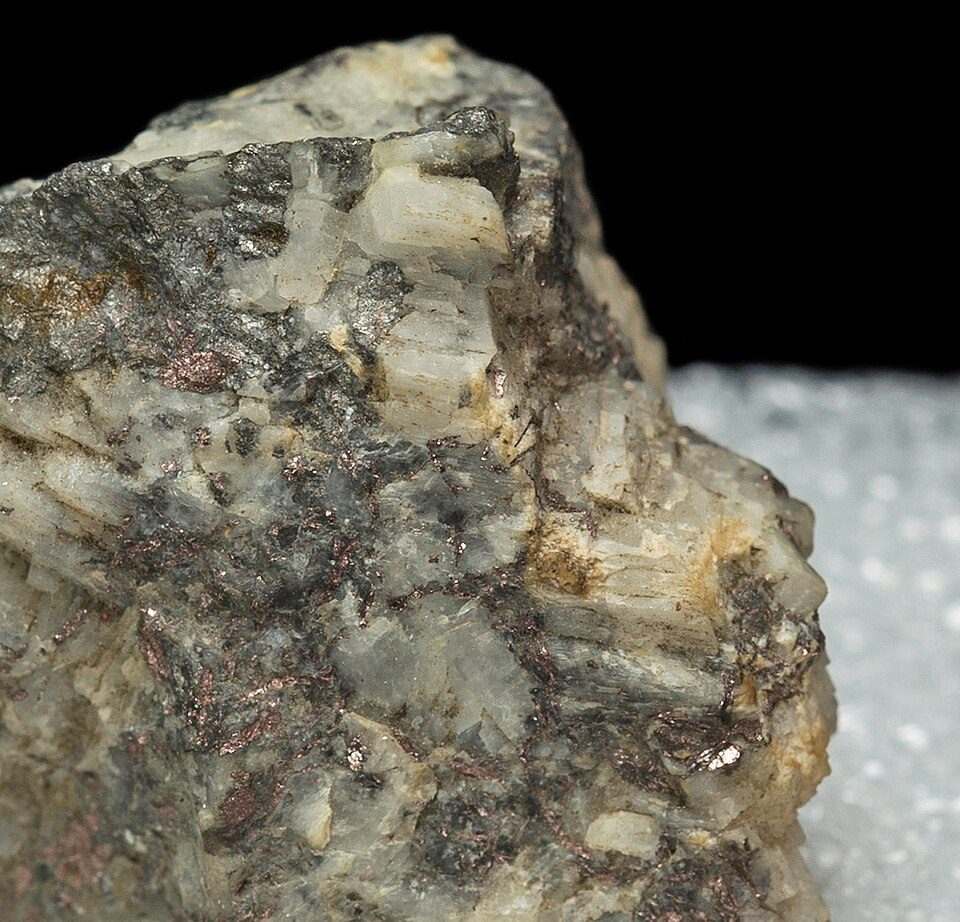
You are dealing with material so dense it changes the atmosphere. Skutterudite is a cobalt-nickel arsenide with hard metallic gravity, chemistry that does not flirt with softness. Some encounters are lessons in containment.
Skutterudite works with containment under density. Its metallic body, arsenide chemistry, and unusual heft create an atmosphere of compression rather than flow. For...
The Meaning
Skutterudite in the Crystalis dictionary
Not every environment is merely "stressful." Some are actively saturating. The body walks into them and immediately starts compensating, bracing around a density that is not its own and yet is somehow filling the room.
Skutterudite offers a way of naming that encounter honestly. Metallic, arsenide-rich, and unmistakably heavy in character, it does not flatter anyone into pretending the chemistry is benign. The lesson is not fear. It is protocol.
Skutterudite is useful when discernment has fallen behind exposure.
Once the atmosphere is correctly identified, the self no longer has to call survival oversensitivity.
Stone Lore
Stories carried through time
Cultural notes are presented as tradition and historical context — stories carried through time.
The Skutterud cobalt mines, operating from approximately 1772 to 1848, were among Norway's most important industrial operations. Cobalt extracted from skutterudite was processed into smalt (cobalt blue glass pigment) and exported throughout Europe. The Blaafarvevaerket (Blue Color Works) at Modum became one of Scandinavia's largest industrial enterprises. The mining community's relationship with the mineral was defined by economic dependence and occupational hazard: arsenic poisoning was an accepted cost of producing luxury pigment (Hylland Eriksen, T.
, "Small Places, Large Issues," 2001, Pluto Press).
Historical note
Named for Skuterud, Norway
Skutterudite was discovered in 1845 and named after the Skuterud mines in Modum, Buskerud, Norway, its type locality. It is a cobalt arsenide mineral (CoAs₃) with variable amounts of nickel and iron that forms in moderate- to...
Modern/Scientific · 1845 CE
Lore & history
A Model for Thermoelectric Materials
The crystal structure of skutterudite has become the basis for an important class of thermoelectric materials that can convert heat directly into electricity. Researchers fill the large voids in the skutterudite structure with "rattling"...
Modern/Scientific · 1990s–present
Earth Record
Mineralogy and formation
Skutterudite looks compact and metallic, but its real fascination lies in a lattice that mineralogists and materials scientists both notice immediately. It is a cobalt arsenide, commonly with nickel and iron substituting into the structure, and it crystallizes in the cubic system with dense metallic habits such as cubes, octahedra, and massive granular forms. The mineral usually forms in hydrothermal veins associated with cobalt nickel arsenide deposits, especially in districts where intermediate temperature fluids moved through fractures and concentrated semimetal chemistry into sharply bounded ore minerals.
The name comes from Skutterud in Norway, yet the broader geological story extends through classic arsenide camps such as Cobalt in Ontario and Bou Azzer in Morocco. These are not ordinary sulfide systems. They are chemically specialized ore environments where arsenic, cobalt, nickel, silver, and related metals circulate under conditions capable of stabilizing arsenides rather than simpler oxides or carbonates.
That choice matters. Arsenides imply reducing conditions and a fluid chemistry distinct from the oxygen rich settings that later produce colorful secondary minerals. Skutterudite therefore occupies the hard metallic core of ore genesis rather than the weathered skin.
Its density is one of the first things a hand sample announces. Cobalt, nickel, and arsenic create a heavy framework, and the black streak contrasts with the tin white to silver gray luster of fresh surfaces. Tarnish darkens the exterior quickly. Structurally, the skutterudite type became famous because it contains cage like features that inspired study of synthetic thermoelectric materials. The natural mineral had already solved a design problem that technology later found useful.
So the specimen in hand is doing two jobs at once. It preserves a narrow hydrothermal metal assemblage from arsenide rich ore formation, and it displays a crystal architecture robust enough to influence modern materials thinking. Few ore minerals move so easily from mine vein to solid state physics.
Its listed properties reinforce that origin. The stated hardness of 5.5 and the reported luster of Metallic, brilliant on fresh surfaces; tarnishes to grayish or iridescent film on exposure are not decorative trivia.
Crystal system diagram represents the general cubic classification. Diagram created by Crystalis for educational reference.
Cubic structure
Chemical Formula
CoAs3; cobalt triarsenide (end-member); often contains nickel and iron substituting for cobalt, yielding the general formula (Co,Ni,Fe)As3
Crystal System
Cubic
Mohs Hardness
5.5
Specific Gravity
6.4-6.8 (exceptionally dense due to arsenic and cobalt content)
Luster
Metallic, brilliant on fresh surfaces; tarnishes to grayish or iridescent film on exposure
Color
Silver-Gray
IMA Status
species
Type Locality
Skutterud, Modum, Norway
IMA Number
Grandfathered (pre-1959)
01
Mineral conditions gather
02
Structure begins to crystallize
03
Skutterudite records place and pressure
Morocco's Bou Azzer district produces collector-quality skutterudite from cobalt-nickel arsenide veins. Canada's Cobalt, Ontario district yielded specimens during the silver-cobalt mining era. Germany's Schneeberg district is the historic European source.
Named after Skutterud, Norway. The cobalt triarsenide forms in mesothermal hydrothermal veins at each locality.
MoroccoCanadaGermany
Telling it apart
Skutterudite is commonly confused with other silver gray metallic arsenides and sulfides, especially when sellers rely on appearance alone. Pyrite is brassier, galena is softer and shows cubic cleavage, and cobaltite has a different chemistry and habit. What separates skutterudite is its combination of tin white to silver gray color, strong density, cubic habits, and association with cobalt nickel arsenide districts. The black streak also helps distinguish it from brighter metallic lookalikes.
Safety is the issue here as much as value. Arsenide minerals deserve accurate handling information, storage sense, and plain labeling. A collector buying skutterudite should know that it is not just generic silver ore. Provenance matters because classic arsenide localities support the ID far better than vague dealer tags do. In this category, precise naming protects both the purchase and the person handling the specimen.
A careful buyer should compare the label to habit, hardness, and provenance before paying a rarity premium. Skutterudite is a cobalt arsenide with metallic luster and cubic symmetry. Confirm the CoAs3 chemistry to separate it from lookalike pyrite or arsenopyrite.
Spotting the real thing
Skutterudite: extremely heavy (SG 6. 4-6. 8).
Metallic luster. Mohs 5. 5-6.
Cubic crystal system. Contains arsenic and cobalt. The extreme density and metallic luster are diagnostic.
If a metallic cubic mineral does not feel dramatically heavy, it is not skutterudite. Handle briefly; contains arsenic.
Sympathetic activation (hypervigilance around toxicity/contamination fears):
Skutterudite's literal toxicity (arsenic content) makes it a paradoxical ally for nervous systems locked in contamination anxiety or health hypervigilance. By working WITH a mineral that is genuinely dangerous; handled respectfully, never ingested; the nervous system practices calibrated risk assessment rather than blanket avoidance. The stone does not pretend to be safe. It IS dangerous, and it is also beautiful. State shift: indiscriminate sympathetic threat response toward accurate, proportional risk assessment.
Shut down & far away
Dorsal vagal collapse (exploitation fatigue/feeling used up):
Skutterudite was mined for its cobalt by workers who suffered arsenic poisoning while producing luxury pigments for others. This history of extraction mirrors the felt experience of being used up; giving your resources while absorbing toxicity. For a nervous system in dorsal shutdown from chronic exploitation (caregivers, overgiving personalities), skutterudite's story validates the exhaustion without romanticizing it. State shift: dorsal collapse toward witnessed depletion, enabling conscious boundary-setting.
Charged & on alert
Mixed state: sympathetic + ventral (discernment under pressure):
When you must make decisions in environments where not everything is what it appears; where beauty and danger coexist; skutterudite models the necessary response: precise assessment. Its metallic luster is alluring; its arsenic is lethal. The nervous system that can hold both facts simultaneously without either panicking or being naive is operating in healthy mixed sympathetic-ventral mode. State support: training discernment where attraction and danger coexist.
Settled & connected
For the already-regulated nervous system engaged in learning, skutterudite is one of the most intellectually fascinating minerals in existence
Sympathetic activation (industrial/systemic anger): Skutterudite's mining history is a story of labor exploitation, toxic exposure, and the extraction of beauty at human cost. For nervous systems activated by systemic injustice; environmental activists, labor advocates, occupational health workers; this mineral does not soothe. It validates. It says: "Yes, the systems that produce beautiful things also poison people." State shift: diffuse sympathetic anger toward focused, historically-grounded advocacy energy.
These associations come from tradition and reflective practice — a way of working with the stone, not a medical prescription.
Somatic Practice
Simple ways to work with Skutterudite
◇
Hold
Carry Skutterudite in a pocket or place it over the heart center during a pause.
◌
Meditate
Let the stone become a quiet tactile anchor while the breath slows.
☽
Breathe
Breathe in softness. Breathe out tension. Keep the practice simple.
✎
Journal
Write with Skutterudite nearby to name the feeling without forcing a conclusion.
✋
Bodywork
Rest the stone near the chest, hand, or bedside as a reminder to soften.
⌂
Environment
Place it where you want a visual cue for care, repair, or steadiness.
Field Instruction
The Metallic Geometry Witness
Honor the metallic geometry you cannot touch.
3 min protocol
1
Place Skutterudite in a sealed glass display case or behind glass. Do NOT handle with bare hands — this mineral contains arsenic (cobalt arsenide). Sit 2-3 feet away. Settle your posture. Let your breath slow.
2
Observe the tin-white to silver-gray metallic surface. Notice the cubic crystal habit, the geometric precision of natural form. Let your eyes soften. Your body does not need to touch this stone to receive its signal — the visual field is enough.
3
With each exhale, release one thing — a thought, a tension, a worry. The stone holds its own boundaries. You hold yours. Continue breathing. Notice where the body softens first.
4
After 3 minutes: check in. Has the breath changed? Has the jaw released? That shift — however small — is the protocol complete. The geometry witnessed. The body responded. No contact required.
Stone Intelligence
The fact that makes Skutterudite memorable
The crystal structure accidentally invented modern thermoelectrics. Cobalt arsenide with cage-like frameworks and arsenic rings nested inside. The science documents filled-skutterudite architecture used in spacecraft power generation.
The practice is sealed observation. Arsenic-bearing minerals teach through their physics, not their touch.
Unusual Sb–Sb bonding in high temperature thermoelectric materials
Journal of Computational Chemistry · 2008Read source
Ritual Use
From reference to practice
Focus support: Keep Skutterudite on your desk or workspace. Visual contact with a grounding object anchors attention. Touch it when concentration drifts.
Sacred Match
Sacred Match reaches for Skutterudite when what you feel sounds like:
dense mental pressure needing containment
a need for stronger internal perimeter
focused seriousness without softness
heaviness that still preserves sharp thinking
feeling exposed to hard external demands
Sacred Match listens to the body rather than to preference. It notices what you are feeling right now, the way you are protecting yourself, and the deeper need underneath both. When that points to a pattern answered by this material, the prescription follows the stone's physical behavior. Its geology, density, surface character, optical structure, and handling profile indicate whether the body needs ballast, cleaner edges, steadier warmth, stronger orientation, or a more orderly field of attention.
dense mental pressure needing containment -> body asking for orientation -> seeking a steadier internal map
a need for stronger internal perimeter -> protective effort running long -> seeking firmer support
Pairings are treated like a recipe file: clear use, method, and safety.
Crystal Companion
Skutterudite + Amethyst
Use when
You want to layer the primary intention with another supportive tone.
How to work with it
Place the stones together during meditation, journaling, or a short reset.
Safety
Use as a reflective practice tool, not as a medical substitute.
Crystal Companion
Skutterudite + Rhodonite
Use when
You want to layer the primary intention with another supportive tone.
How to work with it
Place the stones together during meditation, journaling, or a short reset.
Safety
Use as a reflective practice tool, not as a medical substitute.
Crystal Companion
Skutterudite + Clear Quartz
Use when
You want to layer the primary intention with another supportive tone.
How to work with it
Place the stones together during meditation, journaling, or a short reset.
Safety
Use as a reflective practice tool, not as a medical substitute.
Crystal Companion
Skutterudite + Black Tourmaline
Use when
You want to layer the primary intention with another supportive tone.
How to work with it
Place the stones together during meditation, journaling, or a short reset.
Safety
Use as a reflective practice tool, not as a medical substitute.
Hematite. Dense metallic sobriety. Hematite offers a better known iron oxide counterpoint to skutterudite's cobalt arsenide body. The pair works for collectors drawn to heaviness and metallic authority. Place hematite low and forward, skutterudite just behind so the brighter silver gray can emerge from the darker field.
Cobaltite. Ore family dialogue. Cobaltite keeps the conversation inside cobalt bearing ore mineralogy while changing structure and sulfur chemistry. Best when the display is educational. Keep labels nearby because the visual distinction can be subtle.
Quartz. Metallic body with silica frame. A clear quartz cluster beside skutterudite stops the display from becoming visually sealed off. The reason is contrast between open light and closed metal. Set quartz behind or under a small metallic specimen stand.
Galena. Weight with geometry. Galena shares density and cubic confidence, though with softer lead gray cleavage rather than the arsenide framework of skutterudite. This pairing suits a shelf that leans industrial and uncompromising. Keep them on separate stands because both can dominate a small tray.
Placement should stay intentional. Leave enough room between pieces for each material to keep its own visual job, because crowding can flatten the reason the pairing works.
Care & Cleansing
How to keep Skutterudite in good condition
Water Safe?
Keep dry
This stone should stay out of water. Water can dull the surface, destabilize the specimen, or damage the stone over time.
Sunlight Safe?
Sunlight safe
Tolerates daylight; safe to charge or display in the sun.
Authenticity
What to check
Natural Skutterudite should usually feel cooler than plastic or resin on first touch and warm more slowly in the hand.
WARNING: Skutterudite contains arsenic and cobalt (CoAs3). Do NOT place in water or gem elixirs. Handle briefly, wash hands. Display only in a sealed case. Recommended cleansing: visual observation only. Store separately in a sealed container. The cage-like crystal structure is fascinating, but the arsenic content demands strict boundaries.
Safety: Safe to own, display, and handle. Wash your hands afterward. Do not make elixirs, place it in drinking water, or ingest it, and never inhale dust from raw or broken pieces.
Temperature
Natural Skutterudite should usually feel cooler than plastic or resin on first touch and warm more slowly in the hand.
Scratch logic
Use 5.5 on the Mohs scale as the check, not internet myths. A real specimen should behave in line with the hardness listed above.
Surface and luster
Look for a metallic, brilliant on fresh surfaces; tarnishes to grayish or iridescent film on exposure surface quality rather than a painted or plastic shine.
Weight and density
The listed specific gravity is 6.4-6.8 (exceptionally dense due to arsenic and cobalt content). If a specimen feels unusually light for its size, it may deserve a second look.
My Field Guide
Your private record and next steps
Journal
Add this stone to your private collection, then log what happened when you worked with it.
Shared Notes
Read public practice logs and pattern notes from the Crystalis community.
When members save a public field note for this stone, it will appear here.
Frequently Asked
Questions people ask about Skutterudite
What is Skutterudite?
⌄
Chemical formula: CoAs3, cobalt triarsenide (end-member); often contains nickel and iron substituting for cobalt, yielding the general formula (Co,Ni,Fe)As3. Mohs hardness: 5.5 to 6. Crystal system: Cubic (isometric), space group Im-3 (No. 204).
What is the Mohs hardness of Skutterudite?
⌄
Skutterudite has a Mohs hardness of 5.5 to 6.
Can Skutterudite go in water?
⌄
Water Safety ABSOLUTELY NOT. Skutterudite contains arsenic (approximately 72% arsenic by weight). Contact with water, especially acidic water, can leach arsenic compounds. NEVER place in water, gem elixirs, or anywhere near food or drinking vessels. Store separately from other stones. Arsenic is a cumulative poison; even trace amounts absorbed over time are hazardous.
What crystal system is Skutterudite?
⌄
Skutterudite crystallizes in the Cubic (isometric), space group Im-3 (No. 204).
What is the chemical formula of Skutterudite?
⌄
The chemical formula of Skutterudite is CoAs3, cobalt triarsenide (end-member); often contains nickel and iron substituting for cobalt, yielding the general formula (Co,Ni,Fe)As3.
How does Skutterudite form?
⌄
Formation Story Skutterudite crystallizes from moderate- to high-temperature hydrothermal veins, typically between 300 and 500 degrees C, in association with other cobalt-nickel-arsenic minerals. It forms when arsenic-rich hydrothermal fluids derived from deep-seated magmatic or metamorphic sources migrate upward through fractures in the crust and encounter favorable chemical conditions for cobalt-arsenic precipitation.
Sources & Citations
Where this entry can be checked
Back Matter
Readable for people. Structured for AI search.
Sources stay visible in the page so readers, search engines, and answer systems can follow the evidence trail.
01
SCI
Slowing down the heat in thermoelectrics
Qin, Bingchao, Wang, Dongyang, Zhao, Li‐Dong. (2021). Slowing down the heat in thermoelectrics. InfoMat. [SCI]DOI 10.1002/inf2.12217
02
HIST
De Re Metallica (or earlier work)
Georgius Agricola. (1529). De Re Metallica (or earlier work). [HIST]
03
HIST
Mineralogical works
Wallerius. Mineralogical works. [HIST]
04
SCI
Unusual Sb–Sb bonding in high temperature thermoelectric materials
Xu, Jianxiao, Kleinke, Holger. (2008). Unusual Sb–Sb bonding in high temperature thermoelectric materials. Journal of Computational Chemistry. [SCI]DOI 10.1002/jcc.20950
05
SCI
An Optimization of Composition Ratio among Triple‐Filled Atoms in In<sub>0.3-<i>x</i>-<i>y</i></sub>Ba<sub><i>x</i></sub>Ce<sub><i>y</i></sub>Co<sub>4</sub>Sb<sub>12</sub> System
Kim, So-Young, Choi, Soon-Mok, Seo, Won-Seon, Lim, Young Soo, Lee, Soonil et al. (2013). An Optimization of Composition Ratio among Triple‐Filled Atoms in In<sub>0.3-<i>x</i>-<i>y</i></sub>Ba<sub><i>x</i></sub>Ce<sub><i>y</i></sub>Co<sub>4</sub>Sb<sub>12</sub> System. Journal of Nanomaterials. [SCI]DOI 10.1155/2013/973060
06
SCI
Roles of interface engineering in performance optimization of skutterudite‐based thermoelectric materials
Qin, Dandan, Shi, Wenjing, Lu, Yunzhuo, Cai, Wei, Liu, Zihang et al. (2022). Roles of interface engineering in performance optimization of skutterudite‐based thermoelectric materials. Carbon Neutralization. [SCI]DOI 10.1002/cnl2.28
07
SCI
Characterization and Thermoelectric Properties of La <sub>0.4</sub> Ni <sub>0.2</sub> Co <sub>3.8</sub> Sb <sub>12</sub> Filled Skutterudite Prepared by the MA‐HP Method
Yang, Junyou, Chen, Yuehua, Zhu, Wen, Bao, Siqian, Xingkai Duan, Xi''an Fan. (2010). Characterization and Thermoelectric Properties of La <sub>0.4</sub> Ni <sub>0.2</sub> Co <sub>3.8</sub> Sb <sub>12</sub> Filled Skutterudite Prepared by the MA‐HP Method. Journal of the American Ceramic Society. [SCI]DOI 10.1111/j.1551-2916.2010.04073.x
08
SCI
Multistage Gold‐Polymetallic Mineralization in the Bou Azzer District, Anti‐Atlas, Morocco: Insights from Ore Microscopic, Geochemical, and Fluid Inclusion Studies
Wafik, Amina, Zoheir, Basem, Benchekroun, Fouad, Benaouda, Rachid, Massoude, Mohamed Ben et al. (2024). Multistage Gold‐Polymetallic Mineralization in the Bou Azzer District, Anti‐Atlas, Morocco: Insights from Ore Microscopic, Geochemical, and Fluid Inclusion Studies. Geofluids. [SCI]DOI 10.1155/2024/5579902
09
SCI
Peripheral Vascular Diseases Resulting from Chronic Arsenical Poisoning
Yu, Hsin‐Su, Lee, Chih‐Hung, Chen, Gwo‐Shing. (2002). Peripheral Vascular Diseases Resulting from Chronic Arsenical Poisoning. The Journal of Dermatology. [SCI]DOI 10.1111/j.1346-8138.2002.tb00234.x