Materia Medica
Mahogany Obsidian
The Warm Protector

This page documents traditional and cultural uses of mahogany obsidian alongside emerging research on tactile grounding objects. Crystalis does not claim that mahogany obsidian treats, cures, or prevents any medical condition. For mental health concerns, consult a qualified professional.
Origins: Mexico, USA, Japan
Materia Medica
The Warm Protector

Protocol
The Hearth Protocol
3 min
Root Contact (20 seconds)Sit in a chair with feet flat on the floor. Place the mahogany obsidian between your feet on the ground, or hold it against your lower belly just below the navel. Close your eyes. Feel the stone's weight. Obsidian is dense for glass (specific gravity 2.4-2.6), and the iron inclusions add a subtle warmth that most people notice within seconds. Let the weight and warmth register in the lower body. This is the hearth being lit -- not a bonfire, not a blaze, but a contained warmth in the foundation of the house.
Iron Breath (40 seconds)With eyes closed, Inhale through the nose for 4 counts. Hold for 7 counts. Exhale through the mouth for 8 counts. Three full cycles. With each cycle, the warmth spreads further through the lower body. You are not creating energy. You are reminding the lower centers that they contain iron, that they are warm by nature, that the foundation was never meant to be cold.
Strength Without Edge (60 seconds)Hold the mahogany obsidian in both hands at belly height. Feel the smooth glass surface -- the hardness of obsidian, the glass that can be knapped into the sharpest edge in nature. Now run your thumb across a mahogany patch and feel the warmth of the iron oxide beneath the same hard surface. Hardness and warmth, sharing the same body. Say silently: "I am allowed to be strong and warm at the same time." Three times. Let each repetition land in the belly, not the head. This is not an affirmation -- it is a description of what the stone has already demonstrated. The obsidian is hard. The iron is warm. They are the same stone.
Foot Grounding (40 seconds)Place the stone on the floor and rest one bare foot on top of it (or press through a sock). Feel the stone's hardness and warmth through the sole of the foot. The foot's proprioceptors register the surface -- cool glass, warm iron patches, the subtle texture variations. Press gently, feeling the ground through the stone. You are standing on the earth's fire, cooled to body temperature. Ten seconds on one foot, then switch. The contact through the sole is direct -- no interpretation needed. The body knows what ground feels like.
Continue in the full protocol below.
tap to flip for protocol
Anger and grounding are trying to share the same room.
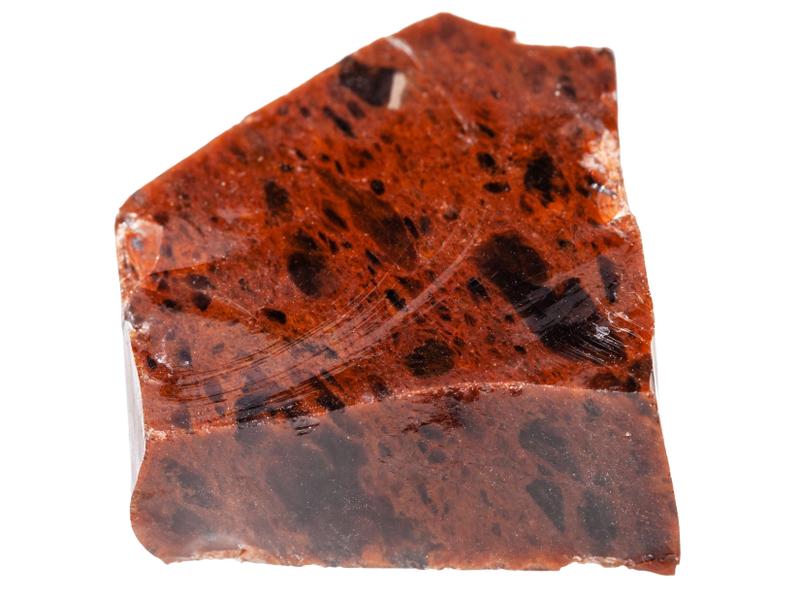
Mahogany obsidian keeps volcanic black glass streaked with reddish-brown iron-rich zones, heat written straight into shadow. The stone never lets force and ballast fully separate.
Fire lands better once it has weight.
What Your Body Knows
Mahogany Obsidian bridges the root and sacral chakras, combining the grounding properties of black obsidian with the warming, vitalizing influence of iron oxide. In somatic practice, this creates a distinctly different quality from pure black obsidian -- where black obsidian is sharp, confrontational, and unflinching, mahogany obsidian is firm but warm. It grounds without chilling. It protects without isolating.
The Brittle Armor
You are defended but not strong. There is a difference, and your body knows it even if your mind has conflated the two. Somewhere along the way, protection became rigidity -- the walls you built to survive are now preventing you from living. Your sympathetic system maintains the armor at enormous energetic cost: scanning for threats, bracing for impact, holding muscles tight in patterns so old they feel like posture rather than defense. You are exhausted by your own protection. Mahogany Obsidian offers a different model: the iron in its matrix is not a wall. It is warmth distributed through strength. Iron in blood does not shield -- it nourishes. This stone suggests that the strongest protection is not the one that keeps everything out but the one that keeps the warmth in.
Chronic sympathetic defensive posturing creates muscular tension patterns that become structurally embedded -- the body literally armors itself through sustained muscle contraction, particularly in the jaw, shoulders, hip flexors, and lower back. Mahogany Obsidian's dual root-sacral activation addresses both the grounding deficit (root) and the warmth deficit (sacral) that underlie the need for armor. When the base feels solid and warm, the armor becomes optional.
The Cold Foundation
The ground beneath you does not feel trustworthy. Not because anything dramatic is happening -- there is no earthquake, no visible threat -- but because the nervous system lost its sense of contact with the earth somewhere along the way, and now everything feels subtly precarious. You walk through the day with a low-grade vertigo that is not physical but existential. The root chakra is dim. The sacral center is cold. The lower body feels like it belongs to someone else. This is dorsal vagal withdrawal from the foundational centers -- the nervous system retreating upward into the head, abandoning the pelvis and legs and belly. Mahogany Obsidian is the stone that calls the nervous system back downward. The black glass says: the ground is here. The mahogany says: and it is warm.
Dorsal vagal withdrawal from the lower body manifests as numbness, disconnection from physical sensation below the waist, and a subjective sense of floating or groundlessness. The metabolic shutdown conserves energy by dampening proprioceptive and interoceptive signals from the legs, feet, pelvis, and lower abdomen. Mahogany Obsidian's iron-rich warmth in the sacral and root regions provides a somatic signal that the lower body exists and is safe to inhabit.
The Strength Question
You do not know what strength feels like without aggression. Your models of personal power have always involved dominance, control, or at minimum a sharp edge that keeps others at bay. When you try to be gentle, you feel weak. When you try to be strong, you feel mean. The nervous system oscillates between sympathetic hardness and dorsal collapse because it does not have a template for strength that is also kind. Mahogany Obsidian is that template. The obsidian matrix provides genuine hardness -- this glass can cut through anything. But the iron patches provide genuine warmth. They coexist without compromising each other. Hardness and warmth, in the same stone, without either diminishing the other. That is the model.
The inability to access gentle strength reflects a lack of ventral vagal modulation of the sympathetic system. When ventral tone is sufficient, the sympathetic system can activate in service of play, passion, and protective assertiveness without tipping into aggression. Mahogany Obsidian supports this modulated activation by providing both the root stability (obsidian) and the sacral warmth (iron) that ventral vagal regulation requires as a foundation.
The Warm Ground
You are standing on solid ground and you know it in your legs, your pelvis, your feet. Not because the world has become safe -- it has not, it never fully does -- but because your own foundation has become trustworthy. You can be gentle because you are strong. You can be open because you are rooted. The lower chakras are warm and stable, humming with a quiet frequency that does not demand attention or announce itself. This is the ventral vagal state at the root and sacral: embodied, present, warm, and without apology. Mahogany Obsidian in this state is not medicine. It is a touchstone -- the thing you carry in your pocket that reminds you what you feel like when you are home in your own body.
Full ventral vagal engagement at the root and sacral centers produces grounded warmth, embodied presence, and the capacity for firm boundaries without rigidity. The enteric nervous system (gut brain) is in coherent communication with the central nervous system. Interoceptive awareness of the lower body is clear and comfortable. Mahogany Obsidian resonates with this state as an amplifier and anchor.
sympathetic
You are defended but not strong. There is a difference, and your body knows it even if your mind has conflated the two. Somewhere along the way, protection became rigidity; the walls you built to survive are now preventing you from living. Your sympathetic system maintains the armor at enormous energetic cost: scanning for threats, bracing for impact, holding muscles tight in patterns so old they feel like posture rather than defense. You are exhausted by your own protection. Mahogany Obsidian offers a different model: the iron in its matrix is not a wall. It is warmth distributed through strength. Iron in blood does not shield; it nourishes. This stone suggests that the strongest protection is not the one that keeps everything out but the one that keeps the warmth in. Chronic sympathetic defensive posturing creates muscular tension patterns that become structurally embedded; the body literally armors itself through sustained muscle contraction, particularly in the jaw, shoulders, hip flexors, and lower back. Mahogany Obsidian's dual root-sacral activation addresses both the grounding deficit (root) and the warmth deficit (sacral) that underlie the need for armor. When the base feels solid and warm, the armor becomes optional.
dorsal vagal
The ground beneath you does not feel trustworthy. Not because anything dramatic is happening; there is no earthquake, no visible threat; but because the nervous system lost its sense of contact with the earth somewhere along the way, and now everything feels subtly precarious. You walk through the day with a low-grade vertigo that is not physical but existential. The root chakra is dim. The sacral center is cold. The lower body feels like it belongs to someone else. This is dorsal vagal withdrawal from the foundational centers; the nervous system retreating upward into the head, abandoning the pelvis and legs and belly. Mahogany Obsidian is the stone that calls the nervous system back downward. The black glass says: the ground is here. The mahogany says: and it is warm. Dorsal vagal withdrawal from the lower body manifests as numbness, disconnection from physical sensation below the waist, and a subjective sense of floating or groundlessness. The metabolic shutdown conserves energy by dampening proprioceptive and interoceptive signals from the legs, feet, pelvis, and lower abdomen. Mahogany Obsidian's iron-rich warmth in the sacral and root regions provides a somatic signal that the lower body exists and is safe to inhabit.
ventral vagal
You do not know what strength feels like without aggression. Your models of personal power have always involved dominance, control, or at minimum a sharp edge that keeps others at bay. When you try to be gentle, you feel weak. When you try to be strong, you feel mean. The nervous system oscillates between sympathetic hardness and dorsal collapse because it does not have a template for strength that is also kind. Mahogany Obsidian is that template. The obsidian matrix provides genuine hardness; this glass can cut through anything. But the iron patches provide genuine warmth. They coexist without compromising each other. Hardness and warmth, in the same stone, without either diminishing the other. That is the model. The inability to access gentle strength reflects a lack of ventral vagal modulation of the sympathetic system. When ventral tone is sufficient, the sympathetic system can activate in service of play, passion, and protective assertiveness without tipping into aggression. Mahogany Obsidian supports this modulated activation by providing both the root stability (obsidian) and the sacral warmth (iron) that ventral vagal regulation requires as a foundation.
ventral vagal
You are standing on solid ground and you know it in your legs, your pelvis, your feet. Not because the world has become safe; it has not, it never fully does; but because your own foundation has become trustworthy. You can be gentle because you are strong. You can be open because you are rooted. The lower chakras are warm and stable, humming with a quiet frequency that does not demand attention or announce itself. This is the ventral vagal state at the root and sacral: embodied, present, warm, and without apology. Mahogany Obsidian in this state is not medicine. It is a touchstone; the thing you carry in your pocket that reminds you what you feel like when you are home in your own body. Full ventral vagal engagement at the root and sacral centers produces grounded warmth, embodied presence, and the capacity for firm boundaries without rigidity. The enteric nervous system (gut brain) is in coherent communication with the central nervous system. Interoceptive awareness of the lower body is clear and comfortable. Mahogany Obsidian resonates with this state as an amplifier and anchor.
Nervous system mapping based on polyvagal theory (Porges, 2011).
Mineralogy
Chemical Formula
SiO2 (volcanic glass + Fe)
Crystal System
Amorphous
Mohs Hardness
5
Specific Gravity
2.4-2.6
Luster
Vitreous
Color
Black with reddish-brown mahogany patches
Traditional Knowledge
The Mesoamerican Obsidian Working Tradition
Obsidian was the most strategically important mineral in Mesoamerican civilizations, and mahogany obsidian -- the iron-oxide-streaked variety displaying reddish-brown and black banding -- occurred alongside the more common black variety at volcanic sources across central Mexico. The Aztec empire controlled obsidian trade routes radiating from sources including Cerro de las Navajas (Hill of Knives) in Hidalgo and deposits in Jalisco and Puebla. Obsidian served as currency, weaponry (the macuahuitl sword embedded obsidian blades), surgical instruments, mirrors used in divination practices, and ornamental objects. Archaeological evidence confirms obsidian working spanning over 3,000 years across Olmec, Maya, Teotihuacan, and Aztec cultures.
The Iron Inclusion Color Mechanism
Geological analysis established that mahogany obsidian's distinctive reddish-brown streaks result from microscopic inclusions of iron oxide (hematite and magnetite) distributed in flow bands within the volcanic glass matrix. The banding preserves the flow dynamics of the original lava -- visible evidence of movement frozen at the moment of rapid cooling. This iron-rich variety forms when the erupting magma contains higher concentrations of oxidized iron and cools quickly enough to halt full crystallization. Sources include Mexico, Oregon's Glass Buttes, Arizona, Japan, and Armenia. The stone's geological story is one of arrested transformation: rock caught between liquid and solid, with iron painting the record of its last movement.
The Glass Buttes Collecting Tradition
Glass Buttes in Lake County, Oregon became a notably visited obsidian collecting site in North America beginning in the mid-20th century, producing black, mahogany, rainbow, and sheen varieties of obsidian from exposed volcanic flows. The Bureau of Land Management designated the area for public collecting, making it a destination for rock clubs, lapidaries, and educational field trips throughout the American West. Mahogany obsidian from Glass Buttes is distinguished by its warm reddish-brown banding and excellent knapping quality. The site connects modern recreational mineralogy to the much older Indigenous tradition of obsidian procurement in the Great Basin, with archaeological evidence of human obsidian use in the region spanning thousands of years.
The Root Strength Practice
Crystal practitioners assigned mahogany obsidian specifically to root chakra work that addressed shame and stored physical tension, distinguishing it from black obsidian's more confrontational protective applications. The warm brown coloration placed it between the black of pure obsidian and the red of root-centered stones, and practitioners prescribed it for people whose grounding work required gentleness rather than force. The iron oxide content linked it to blood and vitality in practitioner frameworks. Authors including Judy Hall in The Crystal Bible described it as a stone for reclaiming strength that had been surrendered. Its accessibility -- common, inexpensive, and widely available -- made it a widely recommended obsidian for people beginning shadow work.
When This Stone Finds You
Sacred Match prescribes Mahogany Obsidian when you report:
Confusing hardness with strength
Feeling ungrounded or disconnected from the lower body
Protective walls that have become prisons
Need for warmth in the grounding practice
Difficulty being firm without being aggressive
Cold sensation in the root or sacral center
Wanting obsidian energy without obsidian intensity
Mahogany Obsidian finds you when the grounding you need cannot come from a cold stone. When black obsidian feels too sharp, too confrontational, too much like the mirror you are not ready to face. This stone carries the same volcanic authority but wraps it in iron-warmed earth tones. The mahogany patches are the stone's way of saying: strength does not require severity. You can be grounded and warm at the same time. You can be protected and open at the same time. The iron in this glass is the same iron in your blood. It is already part of you.
Somatic protocol
The Hearth Protocol
3 min protocol
Root Contact (20 seconds)Sit in a chair with feet flat on the floor. Place the mahogany obsidian between your feet on the ground, or hold it against your lower belly just below the navel. Close your eyes. Feel the stone's weight. Obsidian is dense for glass (specific gravity 2.4-2.6), and the iron inclusions add a subtle warmth that most people notice within seconds. Let the weight and warmth register in the lower body. This is the hearth being lit -- not a bonfire, not a blaze, but a contained warmth in the foundation of the house.
20 secIron Breath (40 seconds)With eyes closed, Inhale through the nose for 4 counts. Hold for 7 counts. Exhale through the mouth for 8 counts. Three full cycles. With each cycle, the warmth spreads further through the lower body. You are not creating energy. You are reminding the lower centers that they contain iron, that they are warm by nature, that the foundation was never meant to be cold.
40 secStrength Without Edge (60 seconds)Hold the mahogany obsidian in both hands at belly height. Feel the smooth glass surface -- the hardness of obsidian, the glass that can be knapped into the sharpest edge in nature. Now run your thumb across a mahogany patch and feel the warmth of the iron oxide beneath the same hard surface. Hardness and warmth, sharing the same body. Say silently: "I am allowed to be strong and warm at the same time." Three times. Let each repetition land in the belly, not the head. This is not an affirmation -- it is a description of what the stone has already demonstrated. The obsidian is hard. The iron is warm. They are the same stone.
1 minFoot Grounding (40 seconds)Place the stone on the floor and rest one bare foot on top of it (or press through a sock). Feel the stone's hardness and warmth through the sole of the foot. The foot's proprioceptors register the surface -- cool glass, warm iron patches, the subtle texture variations. Press gently, feeling the ground through the stone. You are standing on the earth's fire, cooled to body temperature. Ten seconds on one foot, then switch. The contact through the sole is direct -- no interpretation needed. The body knows what ground feels like.
40 secWarm Pocket (20 seconds)Pick up the stone and place it in a hip pocket or hold it against the lower abdomen. As you stand and move into your day, let it be a warm anchor in the lower body -- a reminder that your foundation is not cold, your strength is not harsh, and your protection does not require you to be unapproachable. The hearth is lit. The house is warm. Everything else can proceed from there.
20 secMineral Distinction
Both are volcanic glass with the same base composition, but mahogany obsidian contains concentrated iron oxide inclusions that create warm red-brown patches. Energetically, mahogany obsidian is considered gentler. it grounds with warmth rather than confrontation.
Black obsidian is the "truth mirror" that forces shadow work; mahogany obsidian is the "warm hearth" that invites you to come home to your body.
Care and Maintenance
The #1 Question Can Mahogany Obsidian Go in Water? YES . WATER SAFE Mahogany Obsidian can go in water.
Mahogany Obsidian is volcanic glass (SiO 2 ) . the same base material as regular obsidian, which is chemically inert in water. At Mohs 5-5.
5, it is hard enough to resist surface erosion, and polished specimens are non-porous. The iron oxide inclusions (hematite and magnetite) are stable minerals that will not dissolve or leach in water. Running water rinse: completely safe Brief soaking (up to 30 minutes): safe Extended soaking: safe, though unnecessary Salt water: use with caution .
prolonged salt water contact can deposit salt in surface micro-textures Gem water preparation: safe for direct method One note: raw or rough mahogany obsidian specimens may have sharp edges due to conchoidal fracture. Handle carefully when wet . the combination of sharp glass edges and slippery water is a safety concern for fingers, not for the stone.
Crystal companions
Red Jasper
Red jasper amplifies mahogany obsidian's root-sacral grounding with slow, steady earth energy. While mahogany obsidian provides the warmth and the volcanic edge, red jasper provides the patience and endurance. Together they create a foundation that is warm (mahogany obsidian), steady (red jasper), and deeply rooted in the earth. This pairing is for long-term grounding work where the goal is not a quick fix but a permanent change in the felt sense of stability.
Carnelian
Carnelian takes mahogany obsidian's sacral warmth and turns it into creative fire. While mahogany obsidian warms the foundation, carnelian activates the creative and sexual energy centers above it. This pairing moves energy upward from ground to creation -- from "I am stable" to "I am creating from stability." For people whose creativity has been frozen by insecurity or whose passion has been dimmed by excessive caution.
Black Tourmaline
Black tourmaline adds electromagnetic protection to mahogany obsidian's warm grounding. This pairing creates a protection grid that is both soft (mahogany obsidian) and sharp (tourmaline) -- the velvet glove over the iron fist. For people who work in energetically draining environments and need protection that does not make them feel isolated or armored.
Tiger's Eye
Tiger's eye connects the solar plexus confidence center with mahogany obsidian's root-sacral foundation. This pairing builds personal power from the ground up: stable legs (mahogany obsidian) supporting a confident belly (tiger's eye). For people who know what they want but cannot seem to stand their ground when challenged, or who feel their conviction evaporate under pressure.
In Practice
Mahogany Obsidian bridges the root and sacral chakras, combining the grounding properties of black obsidian with the warming, vitalizing influence of iron oxide. In somatic practice, this creates a distinctly different quality from pure black obsidian. where black obsidian is sharp, confrontational, and unflinching, mahogany obsidian is firm but warm. It grounds without chilling. It protects without isolating.
The Brittle Armor You are defended but not strong. There is a difference, and your body knows it even if your mind has conflated the two. Somewhere along the way, protection became rigidity. the walls you built to survive are now preventing you from living. Your sympathetic system maintains the armor at enormous energetic cost: scanning for threats, bracing for impact, holding muscles tight in patterns so old they feel like posture rather than defense. You are exhausted by your own protection. Mahogany Obsidian offers a different model: the iron in its matrix is not a wall. It is warmth distributed through strength. Iron in blood does not shield. it nourishes. This stone suggests that the strongest protection is not the one that keeps everything out but the one that keeps the warmth in.
Polyvagal context Chronic sympathetic defensive posturing creates muscular tension patterns that become structurally embedded. the body literally armors itself through sustained muscle contraction, particularly in the jaw, shoulders, hip flexors, and lower back. Mahogany Obsidian's dual root-sacral activation addresses both the grounding deficit (root) and the warmth deficit (sacral) that underlie the need for armor. When the base feels solid and warm, the armor becomes optional.
Verification
Conchoidal Fracture All genuine obsidian breaks with conchoidal (shell-like) fracture, smooth, curved surfaces without flat planes or stepped breaks. On raw specimens, look for these curved fracture surfaces. They should be glassy and sharp.
Manufactured glass can also show conchoidal fracture, but obsidian's fracture surfaces have a distinctive depth and luster that differs from bottle glass. Color Pattern Depth The mahogany patches in genuine mahogany obsidian are three-dimensional, they extend through the body of the stone, not just on the surface. If you can see into a translucent area at the edge, the color patterns should continue into the interior.
Painted or surface-treated glass shows color only at the surface. The mahogany and black zones should blend organically at their boundaries, not show sharp, painted edges. Temperature Response Obsidian (like all glass) feels cool to the touch initially but warms quickly to body temperature.
Natural Mahogany Obsidian should usually feel cooler than plastic or resin on first touch and warm more slowly in the hand.
Use 5 on the Mohs scale as the check, not internet myths. A real specimen should behave in line with the hardness listed above.
Look for a vitreous surface quality rather than a painted or plastic shine.
The listed specific gravity is 2.4-2.6. If a specimen feels unusually light for its size, it may deserve a second look.
Geographic Origins
Mahogany Obsidian registers 5-5. 5 on the Mohs hardness scale, the same as all obsidian varieties. It exhibits the characteristic conchoidal (shell-like) fracture of glass, producing sharp edges when broken.
The specific gravity is approximately 2. 35-2. 60, slightly variable depending on the density of iron oxide inclusions.
Unlike crystalline minerals, obsidian has no cleavage planes . it fractures unpredictably along curved surfaces, which is what made it valuable as a tool material for thousands of years.
FAQ
Mahogany Obsidian is a naturally occurring volcanic glass (SiO2) with distinctive red-brown to mahogany-colored patches caused by concentrated inclusions of iron oxide (hematite and magnetite). It forms from rapidly cooling felsic lava and registers 5-5.5 on the Mohs scale. The combination of black obsidian matrix with warm reddish-brown swirls gives it a grounding yet gentle energy that works the root and sacral chakras.
Yes. Mahogany Obsidian is water safe. As a volcanic glass (SiO2) with Mohs 5-5.5 hardness, it is chemically inert, non-porous on polished surfaces, and will not degrade from water contact. Brief rinses, soaking, and direct-method gem water preparation are all acceptable. Avoid salt water for prolonged periods.
Both are volcanic glass with the same base composition (SiO2), but Mahogany Obsidian contains concentrated inclusions of iron oxide minerals (hematite and magnetite) that create the characteristic red-brown to mahogany patches. Regular black obsidian has more uniform composition without these iron-rich zones. Energetically, Mahogany Obsidian is considered gentler and warmer than black obsidian, working the sacral chakra alongside the root.
Mahogany Obsidian works primarily with the root chakra (1st, Muladhara) and the sacral chakra (2nd, Svadhisthana). The black obsidian matrix provides root grounding while the iron-rich mahogany patches activate the sacral center's connection to warmth, creativity, and embodied strength. This dual-chakra action gives it a uniquely gentle grounding quality.
Yes. Like all obsidian varieties, Mahogany Obsidian is valued for energetic protection. However, its protective quality is distinct from black obsidian's sharp, boundary-setting energy. Mahogany Obsidian protects through strength rather than shielding -- it fortifies the root and sacral centers so that the person carrying it feels more solid and less permeable, rather than creating an external barrier.
References
Hughes, R.E. (1994). Intrasource chemical variability of artefact-quality obsidians from the Casa Diablo area, California. Journal of Archaeological Science. [SCI]
Heiken, G. & Wohletz, K. (1991). Fragmentation processes in explosive volcanic eruptions. Sedimentation in Volcanic Settings. [SCI]
Closing Notes
The iron oxide in your mahogany obsidian oxidized at temperatures exceeding 700 degrees Celsius inside a lava flow that was moving, cooling, and crystallizing simultaneously. The hematite formed where oxygen reached the iron; the magnetite formed where it did not. Both were frozen in place when the glass solidified . warmth trapped in hardness, color trapped in darkness. Crystalis documents both the volcanology and the somatic practice because the stone never separated them. The lava flowed, the iron oxidized, and what cooled was a material that is both the sharpest edge in nature and one of the warmest stones you can hold. That is not contradiction. That is integration.
Crystalis×The Index "The iron warmed the glass and the glass held the iron and together they built a hearth from the earth's own fire."
© 2026 Crystalis. All rights reserved.
The Index: A Crystalpedia of Crystal Healing & Mineral Science
Bring it into practice
Move from reference to ritual. Search current inventory for Mahogany Obsidian, build a custom bracelet, or let Sacred Match choose the right supporting stones for you.
Community notes
Shared field notes tied to Mahogany Obsidian appear here, including notes saved from practice.
When members save a public field note for this stone, it will appear here.
The archive
Continue through stones that share intention, chakra focus, or tonal family with Mahogany Obsidian.

Shared intention: Protection & Grounding
The Hematite Flame Within

Shared intention: Protection & Grounding
The Green Shield of the Heart

Shared intention: Protection & Grounding
The Dark Sword of Will

Shared intention: Heart Healing
The Lucky Heart
Shared intention: Protection & Grounding
The Patient Guardian

Shared intention: Protection & Grounding
The Midnight Ambition