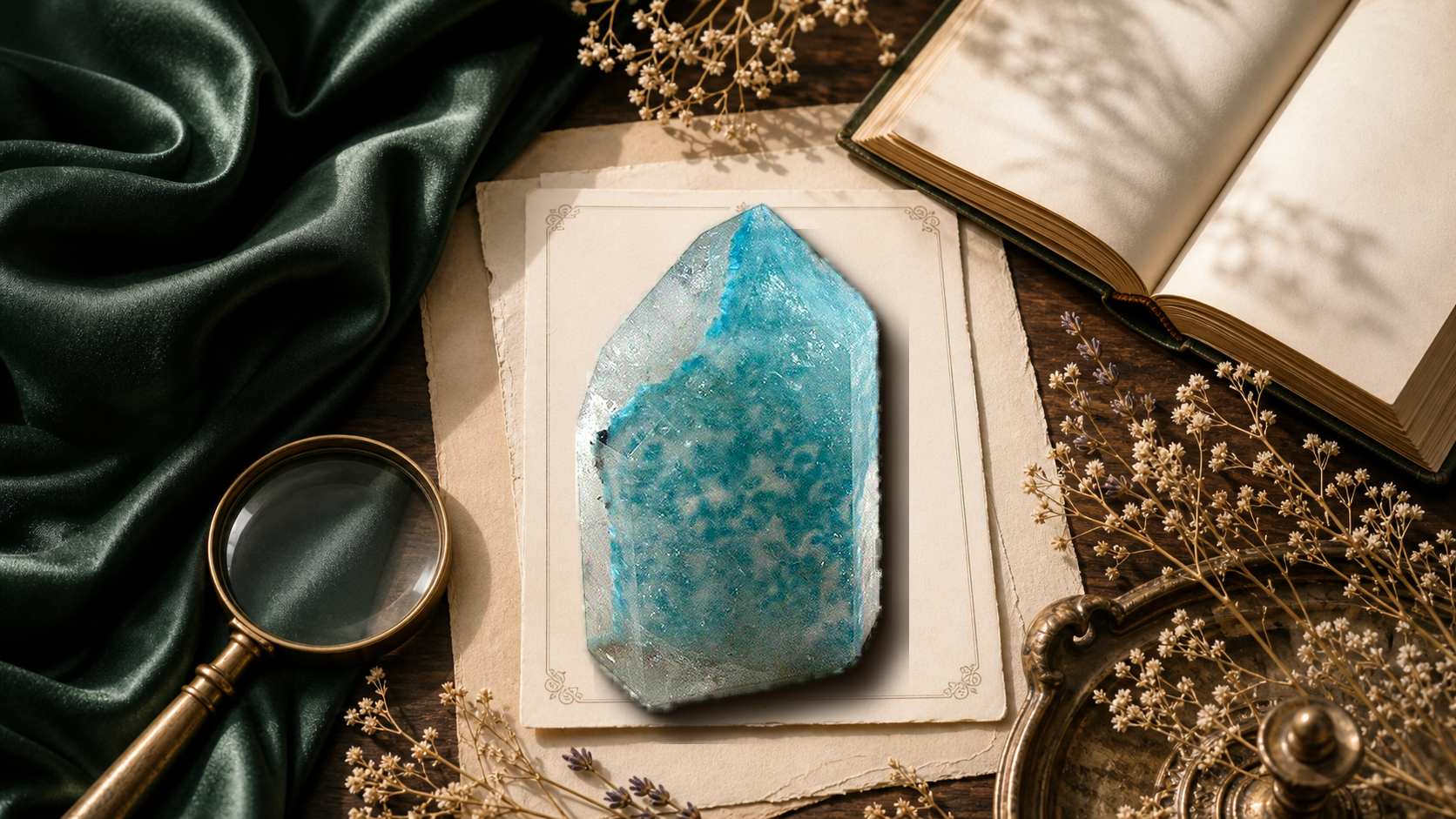
Your thoughts look tangled until you stop trying to force them straight. Medusa quartz holds blue-green inclusions that spread through clear crystal like floating internal maps. Complexity becomes readable once you stop demanding neatness.
The encounter begins in the palm, not in interpretation. For medusa quartz, the body often starts with direct sensory appraisal before any symbolism forms. The...
The Meaning
Medusa Quartz in the Crystalis dictionary
There are forms of intelligence the tidy mind keeps trying to humiliate. The pattern is there, but it does not arrive in straight lines, and so the self starts mistaking intricacy for confusion.
Medusa quartz gives the pattern a better body. Blue-green inclusions branch and float through clear quartz like suspended maps, tentacles, currents, and pathways. The order is not absent. It is simply non-linear. Medusa quartz feels right for minds that have been over-criticized for the shape of their insight. It says tangle and map are sometimes the same thing seen at different speeds.
Stone Lore
Stories carried through time
Cultural notes are presented as tradition and historical context — stories carried through time.
Unknown
Paraiba State, Brazil (contemporary mining culture)
The discovery of gilalite-included quartz in Paraiba emerged from the same artisanal mining communities that produced Paraiba tourmaline. Local garimpeiros (independent miners) initially discarded the specimens, not recognizing the gilalite inclusions as significant. The "Medusa Quartz" trade name was coined by mineral dealers in the early 2000s when specimens reached the international market.
The jellyfish association was immediate and has become the stone's defining identity. Mining is extremely limited and often intermittent, making new specimens increasingly scarce. 2. Classical Greek mythology (Medusa): The trade name "Medusa Quartz" invokes one of the most powerful figures in Greek mythology, the Gorgon whose gaze turned living beings to stone.
Lore review
Tradition notes are being reviewed.
This entry keeps symbolic meaning separate from sourced cultural history. When dedicated tradition rows are available, they will appear here as individual lore cards.
Around suspended copper silicate inclusions, Around suspended copper silicate inclusions, quartz continued to grow until the foreign mineral bodies appeared to float in clear silica. Material sold as Medusa quartz is usually quartz containing gilalite, a hydrated copper silicate, though related blue-green inclusions may also occur and naming in the trade is sometimes loose. The quartz host remains trigonal and hard at Mohs 7.
The inclusions often formed first or contemporaneously as tiny radial or cloud-like bodies in the cavity, then became enclosed as quartz advanced around them. Because gilalite is copper-bearing, the internal forms can appear teal, blue-green, or oceanic. What makes the stone visually arresting is spatial isolation. The inclusions are not coatings on the surface. They hover, each one like a small organism paused in water.
Geological caution is helpful here: the correct hardness of the finished specimen is that of quartz, not that of the included phase alone. In the body, the effect is immediate. Suspended forms inside a clear host evoke movement held in stillness. The somatic turn lands there. A person can carry active, tentacular internal states inside an outwardly transparent structure. Regulation is not always the removal of inner creatures.
Sometimes it is the creation of enough clear space around them that they stop feeling like infestation and start reading as contained life.
Crystal system diagram represents the general trigonal classification. Diagram created by Crystalis for educational reference.
Trigonal structure
Chemical Formula
SiO2 + Cu5Si6O17 7H2O (quartz host with gilalite inclusions)
Crystal System
Trigonal
Mohs Hardness
7
Specific Gravity
2.65-2.70
Luster
Vitreous (quartz surfaces); gilalite inclusions appear as translucent blue-green to teal floating phantoms within the quartz
Color
Green-White
IMA Status
trade_name
IMA Number
pre-IMA (grandfathered)
01
Mineral conditions gather
02
Structure begins to crystallize
03
Medusa Quartz records place and pressure
Brazil is the primary source for medusa quartz, specifically from Minas Gerais where gilalite or parasite inclusions formed during quartz growth. The green copper-bearing mineral inclusions create floating jellyfish-like formations visible only in Brazilian specimens from specific hydrothermal deposits.
Brazil
Telling it apart
Medusa quartz is a trade name for quartz containing parasite or gilalite inclusions that create green to bluish green rounded shapes resembling jellyfish or medusa tentacles suspended inside clear quartz. It is quartz at Mohs 7 with standard quartz properties. The confusion involves other included quartzes labeled with fantasy names, chrysocolla in quartz, and dyed material. Genuine medusa quartz shows distinctive rounded or blobby green inclusions that appear to float within the crystal rather than sitting on fractures or surfaces.
Chrysocolla in quartz tends to show broader, more opaque patches. Dyed material concentrates color in fractures rather than forming discrete rounded inclusion bodies. If the green shapes look internal, rounded, and distributed through clear quartz, the identification is plausible, but confirm the quartz host with standard tests.
Spotting the real thing
Medusa quartz: blue-green to teal floating inclusions (gilalite or parasite) inside quartz (Mohs 7). The jellyfish-like forms should be INSIDE the crystal. If the blue-green appears on the surface, it is coating.
Brazilian provenance is standard. Under magnification, the inclusions should show three-dimensional depth within the quartz host.
Sympathetic with creative block (trying too hard):
Charged & on alert
When creative effort has become effortful
Ventral vagal with need for depth (surface-level regulation): Some individuals are well-regulated but shallow; capable of social engagement without accessing emotional depth or spiritual connection. Medusa Quartz's literal visual depth (inclusions floating within a transparent medium, creating perceived three-dimensional space within a solid object) can model emotional deepening. State shift: surface ventral vagal toward deep ventral vagal through visual depth perception.
These associations come from tradition and reflective practice — a way of working with the stone, not a medical prescription.
Somatic Practice
Simple ways to work with Medusa Quartz
◇
Hold
Carry Medusa Quartz in a pocket or place it over the heart center during a pause.
◌
Meditate
Let the stone become a quiet tactile anchor while the breath slows.
☽
Breathe
Breathe in softness. Breathe out tension. Keep the practice simple.
✎
Journal
Write with Medusa Quartz nearby to name the feeling without forcing a conclusion.
✋
Bodywork
Rest the stone near the chest, hand, or bedside as a reminder to soften.
⌂
Environment
Place it where you want a visual cue for care, repair, or steadiness.
Field Instruction
The Floating Phantom
Gilalite inclusions of hydrated copper silicate floating inside quartz like blue-green jellyfish in glass, medusa quartz holds the deep ocean inside a terrestrial mineral.
5 min protocol
1
Hold the medusa quartz up to light and look into it. Inside the clear quartz host, gilalite inclusions — hydrated copper silicate, Cu5Si6O17 dot 7H2O — float as blue-green phantoms resembling jellyfish suspended in glass. These inclusions are monoclinic crystals trapped inside a trigonal host. Two different crystal systems, one stone. Let your eyes drift into the blue-green shapes without trying to define their edges.
2
Lower the stone to your forehead, resting it gently above the bridge of your nose. The copper in gilalite is the same element that turns the ocean green in copper-rich volcanic regions. Breathe in for six, out for eight. Each exhale longer than the last, like sinking slowly through water without urgency.
3
Close your eyes. Medusa quartz is extraordinarily rare — gilalite was only identified as a mineral species in 1980. Ask: what in my inner life is so unusual that I have never found a name for it? Not a problem to solve — a quality to recognize. Let it float like the gilalite floats: visible, unnamed, held.
4
Keep your eyes closed. The seven water molecules in gilalite's formula are not decorative — they are structural. Without them, the mineral collapses. Ask: what emotional fluidity in me is not weakness but architecture? Where have I been trying to remove the water from a structure that requires it?
5
Open your eyes slowly. Look into the stone one final time. The gilalite phantoms are permanently suspended — they will never sink, never rise, never escape the quartz. And they are stunning precisely because of that containment. Set the stone down. Take three breaths at your own pace. The depth you just visited is still accessible without the stone.
Stone Intelligence
The fact that makes Medusa Quartz memorable
Green copper-bearing inclusions floating inside quartz like jellyfish in glass. A trade name for something that looks like it should not exist in a mineral. The science documents parasite or gilalite inclusions.
The practice asks what suspended animation looks like when the living shape was never alive.
SCI
Origin and petrogenetic implications of garnet from <scp>Rb‐rich</scp> pegmatites in <scp>North Qinling Orogen, China</scp>
"Medusa quartz” with gilalite inclusions, Gems & Gemology Fall 2005
2005
Ritual Use
From reference to practice
Your thoughts look tangled until you stop trying to force them straight. Medusa quartz holds blue-green copper mineral inclusions that float like jellyfish inside the crystal. Hold during creative incubation.
The inclusions are not tangled. They are suspended. Place on your nightstand for dream support.
The shapes inside this quartz look alive even though they never were.
Sacred Match
Sacred Match reaches for Medusa Quartz when what you feel sounds like:
floating anxiety that cannot be traced to a single source
clear outside but complex inside in a way others do not perceive
contained inner movement that looks tangled to anyone trying to straighten it
need for spacious boundaries that do not compress what floats inside
oceanic nervousness as if something is drifting through you that you cannot catch
Sacred Match listens to the body rather than to preference. It senses whether internal complexity is pathological, organizational, or an accurate representation of a body that hosts floating structures inside a clear container. When that points to anxiety distributed through transparent somatic space like suspended inclusions, Medusa Quartz is the stone it offers. This is quartz hosting gilalite inclusions, Cu5Si6O17-7H2O, which float inside the crystal like translucent blue-green jellyfish.
Named for the jellyfish-like appearance. Complexity becomes readable once you stop demanding neatness.
Floating anxiety -> distributed sympathetic activation without focal point -> gilalite inclusions at Cu5Si6O17-7H2O float as translucent phantoms within the quartz host, modeling how internal complexity can suspend without sinking or rising
Clear outside, complex inside -> transparent exterior hiding internal movement -> vitreous luster on the SiO2 exterior with blue-green to teal floating inclusions demonstrates that clarity and complexity can occupy the same body
Contained inner movement -> internal dynamics held but not compressed -> trigonal quartz host at Mohs 7 provides a hard transparent container that does not flatten what it holds
Need for spacious boundaries -> desire for containment without compression -> specific gravity 2.
65-2. 70 is close to standard quartz, meaning the inclusions do not make the body significantly heavier; they add texture, not weight
Oceanic nervousness -> distributed drift-state anxiety -> the blue-green of gilalite from Cu2+ appears as floating internal maps, teaching the body that not all complexity needs to be resolved into straight lines
Stones and herbs that harmonize with Medusa Quartz
Pairings are treated like a recipe file: clear use, method, and safety.
Crystal Companion
Medusa Quartz + Amethyst
Use when
You want to layer the primary intention with another supportive tone.
How to work with it
Place the stones together during meditation, journaling, or a short reset.
Safety
Use as a reflective practice tool, not as a medical substitute.
Crystal Companion
Medusa Quartz + Rhodonite
Use when
You want to layer the primary intention with another supportive tone.
How to work with it
Place the stones together during meditation, journaling, or a short reset.
Safety
Use as a reflective practice tool, not as a medical substitute.
Crystal Companion
Medusa Quartz + Clear Quartz
Use when
You want to layer the primary intention with another supportive tone.
How to work with it
Place the stones together during meditation, journaling, or a short reset.
Safety
Use as a reflective practice tool, not as a medical substitute.
Crystal Companion
Medusa Quartz + Black Tourmaline
Use when
You want to layer the primary intention with another supportive tone.
How to work with it
Place the stones together during meditation, journaling, or a short reset.
Safety
Use as a reflective practice tool, not as a medical substitute.
Start with structure. Medusa Quartz benefits from companions that either clarify its strongest trait or balance its weakest one.
Aquamarine
marine echo. Aquamarine reinforces the watery blue-green register without obscuring the unusual inclusions. Placement: Medusa quartz at the center, aquamarine alongside. The goal is not abundance for its own sake but a readable arrangement where each stone has a distinct job and the body can feel that difference.
Clear Quartz
visibility. A plain quartz point heightens appreciation of the inclusion architecture. Placement: Place behind the specimen under bright light. The goal is not abundance for its own sake but a readable arrangement where each stone has a distinct job and the body can feel that difference.
Selenite
pale backdrop. Selenite helps the floating forms appear more distinct. Placement: Display on a white cloth or selenite slab, with care. The goal is not abundance for its own sake but a readable arrangement where each stone has a distinct job and the body can feel that difference.
Black Tourmaline
containment. Tourmaline gives the airy visuals a stronger boundary. Placement: Keep the quartz higher in the field and the tourmaline low or in a pocket. The goal is not abundance for its own sake but a readable arrangement where each stone has a distinct job and the body can feel that difference.
Care & Cleansing
How to keep Medusa Quartz in good condition
Water Safe?
Water safe
This stone is generally safe for short water contact, though polishing, fractures, and metal settings can still change how a specimen behaves.
Sunlight Safe?
Sunlight safe
Tolerates daylight; safe to charge or display in the sun.
Authenticity
What to check
Natural Medusa Quartz should usually feel cooler than plastic or resin on first touch and warm more slowly in the hand.
Medusa quartz is water-safe. Quartz host (Mohs 7, SiO2) with gilalite inclusions sealed inside. The copper-bearing inclusions do not contact water.
Brief to moderate rinse is safe. Recommended cleansing: running water, moonlight, sound, selenite plate. Store carefully; the inclusions make this a collector specimen.
Temperature
Natural Medusa Quartz should usually feel cooler than plastic or resin on first touch and warm more slowly in the hand.
Scratch logic
Use 7 on the Mohs scale as the check, not internet myths. A real specimen should behave in line with the hardness listed above.
Surface and luster
Look for a vitreous (quartz surfaces); gilalite inclusions appear as translucent blue-green to teal floating phantoms within the quartz surface quality rather than a painted or plastic shine.
Weight and density
The listed specific gravity is 2.65-2.70. If a specimen feels unusually light for its size, it may deserve a second look.
My Field Guide
Your private record and next steps
Journal
Add this stone to your private collection, then log what happened when you worked with it.
Shared Notes
Read public practice logs and pattern notes from the Crystalis community.
When members save a public field note for this stone, it will appear here.
Frequently Asked
Questions people ask about Medusa Quartz
What is Medusa Quartz?
⌄
Medusa quartz (also marketed as "Paraiba Quartz") is not related to Paraiba tourmaline despite the shared geographic name: it is quartz (SiO2, Mohs 7, trigonal) hosting inclusions of gilalite, a hydrated copper silicate (Cu5Si6O17 . 7H2O, a copper-rich phyllosilicate with significant water content, monoclinic, approximately Mohs 3) first described in 1980 from the Christmas mine in Gila County, Arizona, hence "gilalite."
The gilalite inclusions appear as wispy, floating, spherical to amorphous blue-green masses within otherwise clear quartz, creating an ethereal visual effect reminiscent of jellyfish (medusae) suspended in water, hence the trade name. This is one of the rarest inclusion varieties of quartz in the world.
What is the Mohs hardness of Medusa Quartz?
⌄
Medusa Quartz has a Mohs hardness of 7 (quartz host); gilalite itself is approximately 3.
Can Medusa Quartz go in water?
⌄
Water Safety NO; Do not submerge. While the quartz host is water-safe, the gilalite inclusions (Cu5Si6O17 7H2O) are hydrated copper silicates with Mohs hardness of approximately 3. In specimens where gilalite inclusions reach or approach the surface, water exposure could theoretically affect the inclusions. More importantly, copper minerals can leach Cu2+ ions into water, which is toxic at elevated concentrations.
NEVER use Medusa Quartz in direct gem elixirs. For energetic water charging, place the stone BESIDE the water vessel, not inside it. Brief rinsing for cleaning is acceptable if dried promptly, but prolonged soaking is not recommended.
What crystal system is Medusa Quartz?
⌄
Medusa Quartz crystallizes in the Trigonal (quartz host); gilalite is monoclinic.
What is the chemical formula of Medusa Quartz?
⌄
The chemical formula of Medusa Quartz is SiO2 + Cu5Si6O17 7H2O (quartz host with gilalite inclusions).
Is Medusa Quartz toxic?
⌄
Gilalite is a copper mineral. While the copper is sealed within the quartz host under normal handling conditions, do NOT use this stone in gem elixirs, drinking water, or any application involving prolonged water contact. Copper ingestion above trace amounts is toxic.
How does Medusa Quartz form?
⌄
Formation Story Medusa Quartz represents one of the most geologically improbable stone formations in the quartz family. Its creation required the intersection of two unrelated mineralogical processes: standard quartz crystallization and the formation of an exceedingly rare copper silicate mineral, gilalite, in conditions where both could coexist. The quartz host crystallized from silica-saturated hydrothermal fluids in the pegmatite-rich geological terrain of Paraiba State, northeastern Brazil.
Sources & Citations
Where this entry can be checked
Back Matter
Readable for people. Structured for AI search.
Sources stay visible in the page so readers, search engines, and answer systems can follow the evidence trail.
01
SCI
Origin and petrogenetic implications of garnet from <scp>Rb‐rich</scp> pegmatites in <scp>North Qinling Orogen, China</scp>
Feng, Yonggang, Lei, Ruxiong, Ju, Minghui, Song, Gongshe, Xu, Feng. (2017). Origin and petrogenetic implications of garnet from <scp>Rb‐rich</scp> pegmatites in <scp>North Qinling Orogen, China</scp>. Geological Journal. [SCI]DOI 10.1002/gj.3118
02
SCI
Apachite and gilalite, two new copper silicates from Christmas, Arizona
Cesbron F., Williams S.A. (1980). Apachite and gilalite, two new copper silicates from Christmas, Arizona. Mineralogical Magazine. [SCI]DOI 10.1180/minmag.1980.043.329.12
03
LORE
"Medusa quartz” with gilalite inclusions, Gems & Gemology Fall 2005
Rondeau et al. (2005). "Medusa quartz” with gilalite inclusions, Gems & Gemology Fall 2005. [LORE]