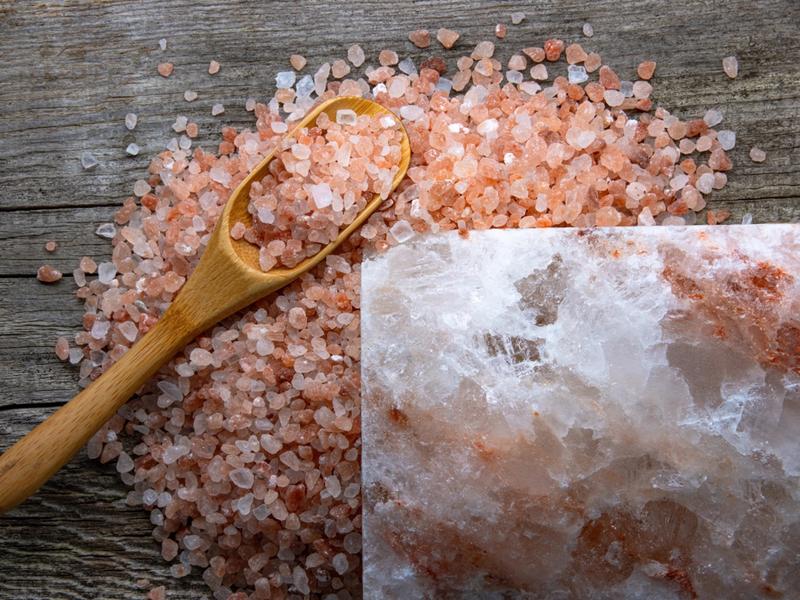
You are drying out around old depletion and need the body of the earth in simpler terms. Pink Himalayan salt is halite with iron traces, crystal built from evaporation and ancient sea memory. Some restoration starts with minerals stripped to basics.
In practice, Pink Himalayan Salt is less about abstraction than about where the body can feel an answer. For Pink Himalayan Salt, the key region is usually the hands,...
The Meaning
Pink Himalayan Salt in the Crystalis dictionary
There are exhausted states that no longer want complexity. The psyche has become so overprocessed that what it starts craving is elemental: mineral, sea-memory, something old enough and simple enough to help the body remember its own baseline.
Pink Himalayan salt answers in basics. Halite formed through ancient evaporation, carrying trace iron that warms the otherwise simple salt body into a blush tone. The chemistry is stripped down, but the history is not.
This mineral feels restorative in depletion states. Sometimes recovery begins not with sophistication, but with returning to what the body needed all along.
Stone Lore
Stories carried through time
Cultural notes are presented as tradition and historical context — stories carried through time.
Unknown
Ancient Vedic tradition (Ayurvedic medicine, India)
Rock salt (Saindhava Lavana) holds a uniquely privileged position in Ayurvedic pharmacology. It is the only salt considered sattvic (pure, harmonizing) and is recommended for daily use by all three doshas (Vata, Pitta, Kapha). The Charaka Samhita (circa 300 BCE) describes rock salt as "the best among all salts" and attributes to it digestive, carminative, and aphrodisiac properties.
Pink salt from the Salt Range was traded along ancient routes into the Indian subcontinent for millennia before modern commerce (Charaka Samhita, Sutrasthana, Chapter 27). 2. Salt as sacred currency (global traditions): The word "salary" derives from the Latin "salarium," connected to the Roman practice of paying soldiers in salt or providing salt allowances.
Lore review
Tradition notes are being reviewed.
This entry keeps symbolic meaning separate from sourced cultural history. When dedicated tradition rows are available, they will appear here as individual lore cards.
To understand Pink Himalayan Salt, it helps to begin with the host setting rather than the finished specimen. Pink Himalayan Salt forms through evaporation of restricted seas followed by burial and tectonic uplift. In mineralogical terms it is classified in cubic halite, with chemistry summarized as NaCl (sodium chloride) + trace minerals (iron oxide [Fe2O3] responsible for pink coloration, plus trace amounts of Ca, K, Mg, S, O, Si, and up to 84 trace elements in minute concentrations).
During growth, the available ions have to arrange into a repeatable lattice or stable aggregate, and this produces the physical cues collectors later use: cubic cleavage, low hardness, and immediate solubility. Its standard field profile includes Cubic symmetry, Mohs hardness around 2, specific gravity 2. 17, and a luster described in the source record as Vitreous on fresh surfaces; often appears waxy or dull on weathered surfaces.
Color in the traded material is commonly Pink, but the more important fact is setting. Pink Himalayan Salt typically develops in the Neoproterozoic Salt Range of Punjab, Pakistan, where cooling rate, fluid chemistry, or burial history stay consistent long enough for the material to stabilize. Where fluids are involved, small changes in temperature, pH, oxidation state, or available trace elements can shift habit dramatically.
Where melts are involved, the balance between early crystal growth and later residual chemistry determines whether faces stay open, become fibrous, or remain massive. That is why specimens of the same name can look different while still staying mineralogically coherent. The crystal system is not decoration. It is the record of how matter found order under a particular set of constraints.
The associated thought for this stone turns on one idea: one are drying out around old depletion and need the body of the earth in simpler terms. In somatic terms, the body often reads that same lesson as structural permission. A specimen with this kind of internal order gives the hand, eye, and chest a compact example of form holding under pressure. Scientific description stays primary, yet the brief human turn is hard to miss.
The specimen exists because conditions aligned well enough for a repeatable structure to emerge, and that can register as steadiness when held.
Crystal system diagram represents the general cubic classification. Diagram created by Crystalis for educational reference.
Cubic structure
Chemical Formula
NaCl (sodium chloride) + trace minerals (iron oxide [Fe2O3] responsible for pink coloration, plus trace amounts of Ca, K, Mg, S, O, Si, and up to 84 trace elements in minute concentrations)
Crystal System
Cubic
Mohs Hardness
2
Specific Gravity
2.17
Luster
Vitreous on fresh surfaces; often appears waxy or dull on weathered surfaces
Color
Pink
IMA Status
trade_name
IMA Number
Grandfathered (pre-1959)
01
Mineral conditions gather
02
Structure begins to crystallize
03
Pink Himalayan Salt records place and pressure
Khewra Salt Mine, Punjab, Pakistan is the primary source. Located approximately 300 kilometers from the Himalayas despite the name. The halite deposit formed during the Ediacaran period (roughly 600 million years ago) from evaporating ancient seas.
The pink color comes from trace iron oxide. This is one of the oldest and largest salt mines on Earth.
Pakistan (Khewra Salt Mine)
Telling it apart
The clearest consumer issue with Pink Himalayan Salt is substitution by stones that only resemble it superficially. The main confusion is with calcite lamps, dyed salt, or wellness-branded decorative stone. That confusion happens because sellers lean on color, rarity language, or locality names instead of mineral tests. For a consumer, the fastest reliable check is the fastest test is cubic cleavage and ready solubility in water, with obvious salty taste if appropriate.
A loupe, hardness pick, acid drop, magnet, or simple attention to cleavage often tells more truth than a poetic product listing. Secondary clues come from habit, heft, and setting. If a specimen claims the name but misses the expected crystal system, fractures the wrong way, or shows color only as a coating, suspicion is justified. Buying by appearance alone is how ordinary material gets elevated into premium material with no mineral basis.
With Pink Himalayan Salt, material truth matters because halite is soft, soluble, and handled differently from ornamental stone. Himalayan salt is NaCl at Mohs 2 and dissolves in water. Any specimen that survives a wet fingertip test is not salt, regardless of color.
Spotting the real thing
Pink Himalayan salt: the taste test is definitive. It should taste salty. Mohs 2.
5. Dissolves in water. Cubic cleavage.
Specific gravity 2. 17. If it does not taste salty and does not dissolve in water, it is dyed calcite, marble, or another mineral, not halite.
The pink from iron oxide should be evenly distributed.
Salt dissolves in water; it is the archetypal substance of letting go. For a nervous system locked in sympathetic overdrive, where everything feels solid, urgent, and immovable, the simple act of watching Pink Himalayan Salt dissolve in warm water can model the dissolution of rigid stress responses. The pink color adds warmth to the process. The nervous system witnesses: what was solid becomes liquid, what was fixed becomes flowing. State shift: rigid sympathetic activation toward fluid parasympathetic release.
Shut down & far away
The Ancient Ocean Memory
Pink Himalayan Salt is crystallized ancient ocean. The human body is approximately 0.9% saline; our blood, tears, and sweat carry the same NaCl chemistry. For a nervous system in dorsal shutdown where the body feels foreign or numb, placing salt on the tongue activates the gustatory nerve (a branch closely connected to the vagus nerve), creating an immediate, undeniable body sensation. The taste of salt is the taste of the body's own chemistry. State shift: dorsal disconnection toward body recognition through gustatory-vagal activation.
Charged & on alert
The Crystalline Boundary
Salt has perfect cubic cleavage; it breaks along precise, geometric planes. It does not fracture chaotically. For individuals in the mixed state of simultaneous activation and collapse; particularly those whose boundaries dissolve in the presence of others' demands; salt's crystalline geometry models clear, angular boundary setting. The cube is the simplest three-dimensional boundary: six faces, all at right angles. State shift: porous boundary collapse toward geometric self-definition.
Settled & connected
The Preservation Field
Salt preserves. For thousands of years before refrigeration, salt was the primary means of preventing decay. When in ventral vagal regulation, Pink Himalayan Salt supports the maintenance function; preserving the gains of regulation against the entropy of daily stress. It is not a stone of transformation; it is a mineral of conservation. State support: ventral vagal stability through preservation resonance.
Charged & on alert
The Primordial Bath
Chronic sympathetic activation literally depletes minerals from the body; sodium, potassium, magnesium, and calcium are consumed in the stress response. Pink Himalayan Salt, as a mineral-bearing halite, somatically represents mineral replenishment. While the trace minerals in the stone itself are not absorbed through skin contact, the felt sense of holding crystallized mineral wealth can signal to the nervous system that depletion is being addressed. State shift: mineral-depleted exhaustion toward replenishment signaling.
These associations come from tradition and reflective practice — a way of working with the stone, not a medical prescription.
Somatic Practice
Simple ways to work with Pink Himalayan Salt
◇
Hold
Carry Pink Himalayan Salt in a pocket or place it over the heart center during a pause.
◌
Meditate
Let the stone become a quiet tactile anchor while the breath slows.
☽
Breathe
Breathe in softness. Breathe out tension. Keep the practice simple.
✎
Journal
Write with Pink Himalayan Salt nearby to name the feeling without forcing a conclusion.
✋
Bodywork
Rest the stone near the chest, hand, or bedside as a reminder to soften.
⌂
Environment
Place it where you want a visual cue for care, repair, or steadiness.
Field Instruction
The Halite Dissolution
Cubic halite crystals dissolving at contact with moisture -- a 250-million-year-old mineral teaching that boundaries can reset through release, not force.
2 min protocol
1
HANDLING WARNING: Pink Himalayan salt is Mohs hardness 2-2.5 and dissolves in water, including perspiration. Keep your hands dry. Hold the salt crystal lightly in dry fingers. Feel the cubic cleavage -- three perfect planes at 90 degrees. The structure is absolute geometry. Breathe in for 3, out for 5.
2
Place the salt on a dry cloth in front of you. Do not lick it (NaCl will taste of salt and the mineral contains trace iron oxide, calcium, potassium, and magnesium). Instead, look at the pink translucence. This crystal formed 250 million years ago in an evaporating Precambrian ocean. You are looking at preserved ancient sea. Let that scale settle you.
3
Place your dry palms over the crystal without touching, hovering one inch above. Salt preserves through dehydration -- removing water to prevent decay. Ask: what am I preserving by staying dry, by not letting certain feelings dissolve? Is that preservation still serving me? Breathe naturally while you consider.
4
Rest your hands on your thighs. The cubic Fm3m structure means every angle in this crystal is 90 degrees -- complete clarity, no ambiguity. Set one boundary today with the same geometric clarity. Not a wall -- a crystal face. Clean, visible, defined. Wrap the salt in its cloth when finished; protect it from moisture.
Stone Intelligence
The fact that makes Pink Himalayan Salt memorable
Sodium chloride from the Khewra Salt Mine in Pakistan, 300 kilometers from the Himalayas. Deposited during the Ediacaran period, roughly 600 million years ago. Pink from iron oxide.
The science documents Precambrian evaporite deposits. The practice asks what ancient means when the mineral in your lamp is older than complex life on Earth.
LORE
Bacterial Diversity at Himalayan Pink Salt Extraction Site
The role of refluxing deep hypersaline brines and evaporite precipitation dynamics in the Castile Formation and marginal carbonate strata (Delaware Basin, USA)
You are drying out around old depletion and need the body of the earth in simpler terms. Pink Himalayan salt is sodium chloride from 600-million-year-old Ediacaran deposits. Dissolves in water, dissolves on skin, dissolves in the body.
For bath ritual: add to warm water. The mineral enters through the largest organ. For space clearing: place a salt lamp in a dry room.
The practice is elemental: salt has been purifying for as long as humans have been cooking.
Sacred Match
Sacred Match reaches for Pink Himalayan Salt when what you feel sounds like: hope thinned by too much damp heaviness; difficulty staying in the body when feeling rises; protective bracing across the chest or jaw; fatigue after prolonged emotional or cognitive output; a need for firmer selection and cleaner limits. Sacred Match listens to the body rather than to preference. It notices what you are feeling right now, the way you are protecting yourself, and the deeper need underneath both.
When that points to the pattern most consistent with Pink Himalayan Salt, the prescription is based on the specimen's material logic: texture, weight, hardness, structure, and the way those properties can organize attention when placed on the body. hope thinned by too much damp heaviness -> seeking a more stable internal frame. difficulty staying in the body when feeling rises -> seeking contact that does not overwhelm.
protective bracing across the chest or jaw -> seeking boundary without full withdrawal. fatigue after prolonged emotional or cognitive output -> seeking restoration through simplification. a need for firmer selection and cleaner limits -> seeking clearer selection about what stays and what does not.
Stones and herbs that harmonize with Pink Himalayan Salt
Pairings are treated like a recipe file: clear use, method, and safety.
Crystal Companion
Pink Himalayan Salt + Amethyst
Use when
You want to layer the primary intention with another supportive tone.
How to work with it
Place the stones together during meditation, journaling, or a short reset.
Safety
Use as a reflective practice tool, not as a medical substitute.
Crystal Companion
Pink Himalayan Salt + Rhodonite
Use when
You want to layer the primary intention with another supportive tone.
How to work with it
Place the stones together during meditation, journaling, or a short reset.
Safety
Use as a reflective practice tool, not as a medical substitute.
Crystal Companion
Pink Himalayan Salt + Clear Quartz
Use when
You want to layer the primary intention with another supportive tone.
How to work with it
Place the stones together during meditation, journaling, or a short reset.
Safety
Use as a reflective practice tool, not as a medical substitute.
Crystal Companion
Pink Himalayan Salt + Black Tourmaline
Use when
You want to layer the primary intention with another supportive tone.
How to work with it
Place the stones together during meditation, journaling, or a short reset.
Safety
Use as a reflective practice tool, not as a medical substitute.
Rather than adding more of the same, pairings for Pink Himalayan Salt should create a sequence. Black Tourmaline: perimeter and weight. It gives a denser edge to Pink Himalayan Salt, helping the body distinguish support from spillover. Body placement: tuck black tourmaline into the right pocket while Pink Himalayan Salt rests at the sternum. Selenite: clear channel and reset. It helps Pink Himalayan Salt move from accumulation toward release, especially after crowded days.
Body placement: sweep selenite 2 to 3 inches above the shoulders, then hold Pink Himalayan Salt at the throat. Rose Quartz: soft contact with emotional steadiness. It rounds the sharper aspects of Pink Himalayan Salt and gives the chest a friendlier landing place. Body placement: lay rose quartz over the sternum and keep Pink Himalayan Salt just below the collarbones. Smoky Quartz: downward pull and discharge.
It directs the effect of Pink Himalayan Salt toward the legs and feet when the body feels too high or scattered. Body placement: keep smoky quartz at the ankles and Pink Himalayan Salt in the dominant hand. The placements are intentionally specific so the body can assign each material a role instead of treating the arrangement as visual clutter. The placements are intentionally specific so the body can assign each material a role instead of treating the arrangement as visual clutter.
Care & Cleansing
How to keep Pink Himalayan Salt in good condition
Water Safe?
Water safe
This stone is generally safe for short water contact, though polishing, fractures, and metal settings can still change how a specimen behaves.
Sunlight Safe?
Sunlight safe
Tolerates daylight; safe to charge or display in the sun.
Authenticity
What to check
Natural Pink Himalayan Salt should usually feel cooler than plastic or resin on first touch and warm more slowly in the hand.
WARNING: Pink Himalayan salt DISSOLVES in water. Sodium chloride (NaCl). Do NOT rinse, soak, or expose to high humidity.
The mineral is literally salt. It will dissolve. Salt lamps should not be used in humid rooms.
Wipe with a dry cloth only. Recommended cleansing: dry methods only; selenite plate (4-6 hours), brief smoke if absolutely needed. Store in a dry location, away from humidity, bathrooms, and open windows.
Temperature
Natural Pink Himalayan Salt should usually feel cooler than plastic or resin on first touch and warm more slowly in the hand.
Scratch logic
Use 2 on the Mohs scale as the check, not internet myths. A real specimen should behave in line with the hardness listed above.
Surface and luster
Look for a vitreous on fresh surfaces; often appears waxy or dull on weathered surfaces surface quality rather than a painted or plastic shine.
Weight and density
The listed specific gravity is 2.17. If a specimen feels unusually light for its size, it may deserve a second look.
My Field Guide
Your private record and next steps
Journal
Add this stone to your private collection, then log what happened when you worked with it.
Shared Notes
Read public practice logs and pattern notes from the Crystalis community.
When members save a public field note for this stone, it will appear here.
Frequently Asked
Questions people ask about Pink Himalayan Salt
What is Pink Himalayan Salt?
⌄
Pink Himalayan salt is halite, the mineral name for naturally occurring sodium chloride: NaCl, cubic (isometric, space group Fm3m), extremely soft at Mohs 2 to 2. 5, crystallizing as perfect cubes with {100} cleavage in three directions at 90 degrees. The pink coloration derives from trace iron oxide (hematite, Fe2O3) inclusions dispersed throughout the crystal lattice, alongside trace amounts of Ca, K, Mg, S, O, Si, and up to 84 trace elements in minute concentrations.
Marketed claims of "84 trace minerals" are technically accurate in that analysis can detect dozens of elements at parts-per-million or parts-per-billion levels, but the quantities are nutritionally insignificant (Ahmad et al. , 2022).
What is the Mohs hardness of Pink Himalayan Salt?
⌄
Pink Himalayan Salt has a Mohs hardness of 2 to 2.5 (extremely soft; can be scratched with a fingernail).
Can Pink Himalayan Salt go in water?
⌄
Water Safety YES, Salt dissolves in water (that IS the concern). Pink Himalayan Salt is halite and will dissolve readily in water. This is not a safety hazard; it is the mineral's fundamental nature. Do not use in elixirs unless you intend to make salt water (sole). For energetic water charging, place OUTSIDE the water vessel. Salt water (sole) made from Pink Himalayan Salt is used in some wellness practices (1 teaspoon dissolved in a glass of water); however, individuals with hypertension, kidney disease, or sodium-restricted diets should consult a physician before consuming salt water.
What crystal system is Pink Himalayan Salt?
⌄
Pink Himalayan Salt crystallizes in the Cubic (isometric), space group Fm3m; halite crystallizes as perfect cubes with {100} cleavage in three directions at 90 degrees.
What is the chemical formula of Pink Himalayan Salt?
⌄
The chemical formula of Pink Himalayan Salt is NaCl (sodium chloride) + trace minerals (iron oxide [Fe2O3] responsible for pink coloration, plus trace amounts of Ca, K, Mg, S, O, Si, and up to 84 trace elements in minute concentrations).
How does Pink Himalayan Salt form?
⌄
Formation Story Pink Himalayan Salt formed approximately 600 to 800 million years ago during the late Precambrian to early Cambrian period, when a shallow inland sea covering what is now the Punjab region of Pakistan evaporated under arid climatic conditions. As this ancient Tethys Sea retreated, the progressive concentration of seawater led to the sequential precipitation of minerals according to their solubility, first aragonite and gypsum, then, when the brine reached 10 to 12 times the concent.
Sources & Citations
Where this entry can be checked
Back Matter
Readable for people. Structured for AI search.
Sources stay visible in the page so readers, search engines, and answer systems can follow the evidence trail.
01
LORE
Bacterial Diversity at Himalayan Pink Salt Extraction Site
Sajjad et al. (2025). Bacterial Diversity at Himalayan Pink Salt Extraction Site. [LORE]DOI 10.3390/biology14030316
02
SCI
The role of refluxing deep hypersaline brines and evaporite precipitation dynamics in the Castile Formation and marginal carbonate strata (Delaware Basin, USA)
Martinez‐Doñate, Ander, Moscardelli, Lorena, Ko, Lucy Tingwei, Melani, Leandro, Schuba, C. Nur et al. (2025). The role of refluxing deep hypersaline brines and evaporite precipitation dynamics in the Castile Formation and marginal carbonate strata (Delaware Basin, USA). The Depositional Record. [SCI]DOI 10.1002/dep2.70006
03
SCI
Dosimetric properties of thermoluminescent NaCl pellets from Khewra Salt Mines, Pakistan
Ahmad, Khalil, Kakakhel, Muhammad Basim, Hayat, Sikander, Wazir‐ud‐Din, Mirza, Mahmood, Muhammad Masood et al. (2022). Dosimetric properties of thermoluminescent NaCl pellets from Khewra Salt Mines, Pakistan. Luminescence. [SCI]DOI 10.1002/bio.4345
04
HIST
Naturalis Historia, Book 31, Ch. 39-45 (De Sale)
Pliny the Elder. (77). Naturalis Historia, Book 31, Ch. 39-45 (De Sale). [HIST]
05
SCI
Microbiology of a <scp>NaCl</scp> stalactite ‘salticle’ in Triassic halite
Thompson, Thomas P., Kelly, Stephen A., Skvortsov, Timofey, Plunkett, Gill, Ruffell, Alastair et al. (2021). Microbiology of a <scp>NaCl</scp> stalactite ‘salticle’ in Triassic halite. Environmental Microbiology. [SCI]DOI 10.1111/1462-2920.15524