At the mouth, throat, and fluid-regulation image of the body, halite corresponds to depletion and residue. It is useful when a person feels the after-state of...
The Meaning
Halite in the Crystalis dictionary
Some losses do not leave emptiness. They leave a residue that organizes everything afterward. The water is gone, but the body has built a geometry around its absence so exact it begins to feel more like architecture than grief.
Halite makes that architecture visible. As brine evaporates, salt remains and crystallizes in unmistakable cubic order. The structure is the direct consequence of what left. No evaporation, no lattice.
Halite feels revealing around old sorrow because it says the shape you formed after the loss is not random. It may be rigid, yes, but it is also evidence of what had to remain once the water was gone.
Stone Lore
Stories carried through time
Cultural notes are presented as tradition and historical context — stories carried through time.
Unknown
~6050 BCE
Earliest evidence of salt production at Poiana Slatinei, Romania (spring-water boiling) - ~4500 BCE: Salt extraction documented in China's Shanxi province - ~3000 BCE: Egyptian salt used in mummification (natron, a sodium carbonate/bicarbonate/chloride mixture) - ~2800 BCE: Earliest known salt trade routes connecting Saharan deposits to Mediterranean - ~500 BCE-500 CE: Roman period, Via Salaria (Salt Road) connected Rome to Adriatic salt works; salarium (salt ration/payment) gives English the word "salary" - Medieval period: Salt taxes (gabelle in France) funded monarchies; salt monopolies shaped geopolitics - 1930: Gandhi's Salt March challenged British salt tax in India, pivotal moment in independence movement - Modern: Approximately 300 million tonnes produced annually, with roughly 6% used for food.
Historical note
The Salt That Mapped Civilization
Rock salt has been mined for at least 4,700 years. Salt routes shaped roads, cities, and economies, the word "salary" descends from the Latin for salt. Few minerals have moved human history as directly. Documented in Vandeginste et al....
Global trade history · c. 4700 years ago–present
Historical note
Born from Vanished Seas
Halite forms by the solar evaporation of seawater in arid basins, layer upon layer, as ancient seas dried. Deposits up to a kilometer thick record repeated marine floods and the dry, hot climates that concentrated them. Documented in Qin...
Earth science · Geological time
Earth Record
Mineralogy and formation
Halite is perhaps the clearest example of chemistry becoming geometry through evaporation. Sodium chloride, NaCl, crystallizes in the cubic system, producing textbook cubes, hopper cubes, and massive rock salt beds when saline water loses enough volume for dissolved ions to leave solution. The process is sedimentary rather than igneous or metamorphic. Restricted marine basins, salt lakes, playa systems, and underground brines all provide the necessary concentration mechanism.
As water departs, sodium and chloride meet in simple repeated order and build one of the cleanest lattices in mineralogy.
Because the mineral is highly soluble, halite occupies a paradoxical place in geology. It can form vast deposits hundreds of meters thick, yet it disappears easily wherever fresh water becomes available. Many famous salt bodies represent repeated evaporative cycles over long intervals, sometimes later deformed into domes as buried salt flows plastically through overlying sediment.
That mobility makes halite important not just as a mineral but as a structural geological agent. Hardness remains low at about Mohs 2 to 2. 5, cleavage is perfect in three directions at right angles, and taste is diagnostically salty though not a recommended method for museum specimens.
Color depends on impurity and defect. Pure halite is colorless. Pink, orange, gray, blue, and red varieties reflect inclusions, radiation defects, or microorganisms. Yet the main scientific lesson remains simplicity. Few minerals demonstrate so directly how loss of water can produce rigid order.
The somatic turn is one of residue and lattice. When a fluid system recedes, something exact can remain behind. Halite reads as structure left by evaporation, useful for thinking about what stays after what carried everything has gone.
Crystal system diagram represents the general cubic classification. Diagram created by Crystalis for educational reference.
Cubic structure
Chemical Formula
NaCl
Crystal System
Cubic
Mohs Hardness
2
Specific Gravity
2.168 (pure); 2.1-2.6 (rock salt with impurities)
Luster
Vitreous to greasy
Color
Pink-White
IMA Status
species
Type Locality
None (prehistoric, no type locality designated)
IMA Number
pre-IMA (grandfathered)
01
Mineral conditions gather
02
Structure begins to crystallize
03
Halite records place and pressure
Wieliczka and Bochnia, Poland . UNESCO World Heritage salt mines, continuously mined since the 13th century
Stassfurt/Bernburg, Germany . Classic blue halite; Zechstein evaporite sequence
Carlsbad, New Mexico, USA . Blue halite from Permian Basin deposits
Searles Lake, California, USA . Pink halite from halophilic bacteria
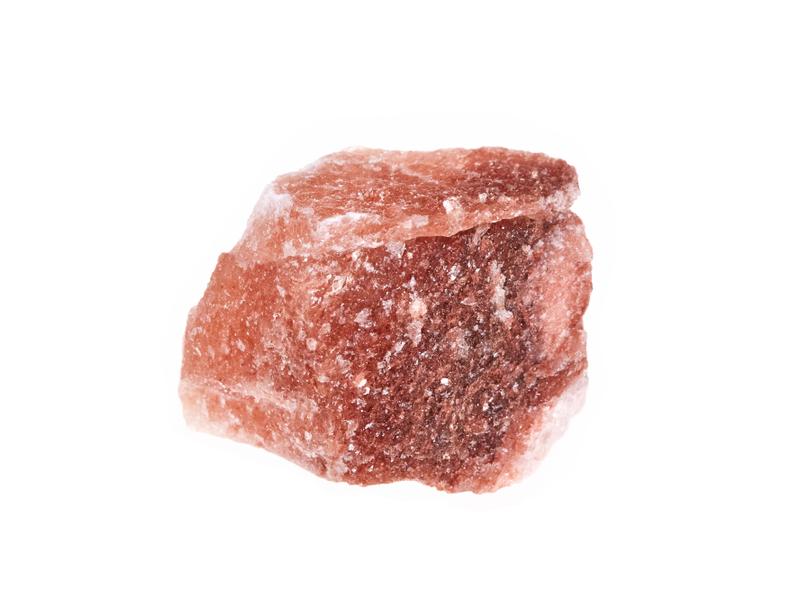
Punjab, Pakistan (Khewra Salt Mine) . Pink "Himalayan" salt; world's second-largest salt mine
Cardona, Spain .
Spectacular salt diapir exposed at surface
Dead Sea, Israel/Jordan . Active halite precipitation
Danakil Depression, Ethiopia . Active evaporite environment, extreme conditions
The mineralogical composition of rock salt varies considerably depending on its depositional environment and diagenetic history. Research on evaporite sequences demonstrates that halite deposited in shallow-water settings shows distinct sedimentary fabrics, including chevron crystals (upward-pointing hopper crystals indicating surface precipitation), cumulate crystals (crystals nucleated at the brine surface that sank), and clear, recrystallized halite formed during diagenesis.
X-ray diffraction studies confirm that natural rock salt may contain accessory minerals including anhydrite, polyhalite, clay minerals, and iron oxides, which significantly affect its mechanical properties (Vandeginste et al. , 2023, doi:10. 1002/dug2. 12039; Barnett et al. , 2023, doi:10. 1111/bre. 12768).
PakistanPolandUSA
Telling it apart
Halite is sodium chloride, common table salt in mineral form, and the main market confusion involves selling it alongside harder, more durable minerals without disclosing its extreme water solubility and fragility. At Mohs 2. 5, specific gravity 2. 17, and cubic crystal system, halite is soft enough to scratch with a fingernail and dissolves in water. The diagnostic test is literally taste: halite is salty.
Pink halite from places like Searles Lake or Polish salt mines is often sold as Himalayan salt crystal, which is already halite. Calcite is harder and not salty. Fluorite is much harder and has octahedral cleavage rather than cubic. If a pink crystal specimen dissolves in water or tastes salty, it is halite. Care matters enormously here because any humidity, water contact, or sweaty handling degrades the specimen permanently.
Spotting the real thing
Halite: tastes salty. This is the simplest and most reliable test for sodium chloride. Mohs 2.
5. Perfect cubic cleavage. Specific gravity 2.
17. Dissolves in water. If a colorless to white cubic crystal tastes salty, it is halite.
If it does not taste salty, it is a different mineral (possibly calcite, fluorite, or synthetic). Lick test is definitive.
Salt has a long cross-cultural history as a grounding and boundary-marking substance. Placing halite at room corners or entry points may assist in establishing a sense of containment for those experiencing anxious, boundary-porous states. The cubic crystal system itself resonates with structure, order, and definite edges. - Post-encounter clearing:
Charged & on alert
after the storm
Vagal tone regulation through mineral salt baths: While the mineral specimen itself must not contact water, dissolved pharmaceutical-grade salt in bathing has extensive cultural precedent (Dead Sea therapy, Epsom salt baths) for parasympathetic activation.
These associations come from tradition and reflective practice — a way of working with the stone, not a medical prescription.
Somatic Practice
Simple ways to work with Halite
◇
Hold
Carry Halite in a pocket or place it over the heart center during a pause.
◌
Meditate
Let the stone become a quiet tactile anchor while the breath slows.
☽
Breathe
Breathe in softness. Breathe out tension. Keep the practice simple.
✎
Journal
Write with Halite nearby to name the feeling without forcing a conclusion.
✋
Bodywork
Rest the stone near the chest, hand, or bedside as a reminder to soften.
⌂
Environment
Place it where you want a visual cue for care, repair, or steadiness.
Field Instruction
The Salt Witness
Sodium chloride at Mohs 2. The mineral your body already knows. Observe only — never handle with wet hands, never submerge.
2 min protocol
1
Place the halite crystal on a dry, clean surface. Do NOT handle with damp hands — NaCl dissolves on contact with moisture. This is observation practice. Look at the cubic cleavage: halite breaks into perfect cubes because the sodium and chloride ions stack in a face-centered cubic lattice. Every fracture follows the same geometry.
2
Bring your face close enough to see light pass through the crystal. At Mohs 2, softer than a fingernail, halite survives by being essential rather than hard. Your blood is 0.9 percent saline. The mineral in front of you is already inside you. Let that recognition land in your body.
3
Sit upright with palms open on your thighs. Breathe in for 3 counts, out for 5. As you exhale, notice your tongue — it knows this mineral. NaCl is the only mineral humans eat directly. The body does not need to learn halite. It needs to remember it already knows.
4
Close your eyes. The cubic lattice dissolves and reforms with every rain and every evaporation. Halite teaches impermanence without drama — it disappears in water and reappears when the water leaves. Ask your body: what am I holding that would reform naturally if I let it dissolve?
Stone Intelligence
The fact that makes Halite memorable
Sodium chloride. Common salt. Perfect cubes from evaporating seawater.
The mineral you eat, the mineral that preserves, the mineral that dissolves in its own origin. The science documents the most familiar mineral on Earth. The practice asks what impermanence means when the crystal you hold will return to water if you wait long enough.
SCI
Simulations of NaCl Aggregation from Solution: Solvent Determines Topography of Free Energy Landscape
Journal of Computational Chemistry · 2018Read source
SCI
Salt Damage and Rising Damp Treatment in Building Structures
Advances in Materials Science and Engineering · 2016Read source
SCI
Creep Properties and Constitutive Model of Salt Rock
A research on excavation compensation theory for large deformation disaster control and a review on the multiphysical–multiscale responses of salt rock for underground gas storage
Deep Underground Science and Engineering · 2023Read source
Ritual Use
From reference to practice
Halite's primary somatic resonance is with purification, boundary-setting, and energetic clearing. Its deep connection to the element of preservation makes it a powerful anchor stone for:
- Hyperaroused states (sympathetic activation): Salt has a long cross-cultural history as a grounding and boundary-marking substance. Placing halite at room corners or entry points may assist in establishing a sense of containment for those experiencing anxious, boundary-porous states. The cubic crystal system itself resonates with structure, order, and definite edges. - Post-encounter clearing: In Japanese Shinto practice, salt is placed at doorways after funerals and is used in sumo wrestling to purify the ring.
This "after the storm" energetic function maps to the parasympathetic recovery window. using halite after intense interpersonal encounters or emotional processing to mark the transition back to baseline. - Vagal tone regulation through mineral salt baths: While the mineral specimen itself must not contact water, dissolved pharmaceutical-grade salt in bathing has extensive cultural precedent (Dead Sea therapy, Epsom salt baths) for parasympathetic activation.
- After energetically demanding situations. teaching, caregiving, conflict
- When feeling boundary-dissolved or over-permeable
- During seasonal clearing rituals (space clearing, new home blessing)
- As a meditation anchor for contemplating impermanence (the stone that dissolves)
- Not for anyone with strong emotional associations with tears/crying (salt = tears for some nervous systems; this can re-trigger rather than settle)
- Not during deep grief processing where dissolution symbolism may amplify distress
- Avoid in humid environments where the stone's deterioration may cause anxiety in the practitioner
Sacred Match
Sacred Match reaches for Halite when what you feel sounds like:
Feeling drained out
Need to honor residue after loss
Throat and chest dried by overextension
After-tears state
System simplified by depletion
Body asking what remains after the fluid is gone
Sacred Match listens to the body rather than to preference. It notices what you are feeling right now, the way you are protecting yourself, and the deeper need underneath both. When that points to feeling drained out, halite is the stone it offers.
Feeling drained out -> state identified in the body -> seeking regulation through this stone's specific structure
Need to honor residue after loss -> protective pattern active -> seeking correction
Throat and chest dried by overextension -> current nervous system demand -> seeking support
After-tears state -> adaptation seeking revision -> seeking revision
System simplified by depletion -> old strategy still running -> seeking a more current pattern
The prescription is specific because the state is specific. Sacred Match does not sort by favorite color or trend language. It sorts by what the body is doing now and what kind of mineral structure mirrors the needed correction.
Pairings are treated like a recipe file: clear use, method, and safety.
Crystal Companion
Halite + Amethyst
Use when
You want to layer the primary intention with another supportive tone.
How to work with it
Place the stones together during meditation, journaling, or a short reset.
Safety
Use as a reflective practice tool, not as a medical substitute.
Crystal Companion
Halite + Rhodonite
Use when
You want to layer the primary intention with another supportive tone.
How to work with it
Place the stones together during meditation, journaling, or a short reset.
Safety
Use as a reflective practice tool, not as a medical substitute.
Crystal Companion
Halite + Clear Quartz
Use when
You want to layer the primary intention with another supportive tone.
How to work with it
Place the stones together during meditation, journaling, or a short reset.
Safety
Use as a reflective practice tool, not as a medical substitute.
Crystal Companion
Halite + Black Tourmaline
Use when
You want to layer the primary intention with another supportive tone.
How to work with it
Place the stones together during meditation, journaling, or a short reset.
Safety
Use as a reflective practice tool, not as a medical substitute.
Selenite
Two evaporite stories. Selenite and halite both arise from concentrated waters, but selenite transmits light while halite records simple ionic order. Together they suit themes of residue, clarity, and letting fluids leave. Place selenite on the windowsill and halite in a dry corner away from steam.
Smoky Quartz
Dissolution and grounding. Halite can feel too transient on its own. Smoky quartz provides the durability halite lacks. Best for people working with impermanence while still needing an anchor. Keep smoky quartz in the pocket and halite on a shelf in a dry room.
Black Tourmaline
Boundary and desiccation. Black tourmaline strengthens perimeter, halite reminds the system what remains after excess fluid withdraws. Good for cluttered spaces that need simplification. Put black tourmaline near the door and halite on a high shelf away from moisture.
Rose Quartz
Salt and tenderness. This is a gentler pairing for grief or after-tears states, when the body feels emptied out. Keep rose quartz on the chest and a halite specimen on the bedside table, dry and stable.
Clear Quartz
Reference and amplification. When a pairing needs one neutral witness, clear quartz does that job. It does not replace the main relationship. It clarifies it, making the dominant stone easier to read and easier to place with intention. Keep clear quartz beside the central specimen on a desk, shelf, or nightstand so the arrangement stays visually legible.
Care & Cleansing
How to keep Halite in good condition
Water Safe?
Keep dry
This stone should stay out of water. Water can dull the surface, destabilize the specimen, or damage the stone over time.
Sunlight Safe?
Sunlight safe
Tolerates daylight; safe to charge or display in the sun.
Authenticity
What to check
Natural Halite should usually feel cooler than plastic or resin on first touch and warm more slowly in the hand.
CRITICAL. WATER SOLUBLE. This mineral WILL dissolve on contact with moisture.
- Water: NEVER cleanse with water. Halite is sodium chloride. it dissolves readily. Solubility is 35. 9 g/100 mL at 25 degrees C. Even brief exposure to liquid water will damage or destroy specimens. - Humidity: Store in airtight containers with silica gel desiccant packets. Halite is hygroscopic. it absorbs atmospheric moisture, especially above ~75% relative humidity, causing surface dissolution, clouding, and eventual disintegration.
Salt crystallization and dissolution cycles in porous materials represent one of the most destructive weathering mechanisms known in materials science (Delgado et al. , 2016, doi:10. 1155/2016/1280894; Yan et al. , 2021, doi:10. 1002/esp. 5298). - Skin contact: Safe to handle briefly, but oils and moisture from skin will etch surfaces. Handle with dry cotton gloves for display specimens.
- Hardness: Mohs 2-2. 5. Extremely soft. Will scratch and chip easily. Do not store with harder minerals. - Taste: Salty (obviously). Do not lick mineral specimens. they may contain impurities including heavy metals or bacteria. - Sun: Generally stable in sunlight, though blue halite color centers may fade with prolonged UV exposure. - Cleansing alternatives: Sound cleansing, smoke/incense, selenite plate, dry moonlight exposure (only if humidity is low).
Temperature
Natural Halite should usually feel cooler than plastic or resin on first touch and warm more slowly in the hand.
Scratch logic
Use 2 on the Mohs scale as the check, not internet myths. A real specimen should behave in line with the hardness listed above.
Surface and luster
Look for a vitreous to greasy surface quality rather than a painted or plastic shine.
Weight and density
The listed specific gravity is 2.168 (pure); 2.1-2.6 (rock salt with impurities). If a specimen feels unusually light for its size, it may deserve a second look.
My Field Guide
Your private record and next steps
Journal
Add this stone to your private collection, then log what happened when you worked with it.
Shared Notes
Read public practice logs and pattern notes from the Crystalis community.
When members save a public field note for this stone, it will appear here.
Frequently Asked
Questions people ask about Halite
What is Halite?
⌄
Halite is a halide of the sodium chloride subgroup: NaCl, crystallizing in the isometric (cubic) system, space group Fm3m, with a Mohs hardness of 2.0 to 2.5.
What is the Mohs hardness of Halite?
⌄
Halite has a Mohs hardness of 2.0-2.5.
Can Halite go in water?
⌄
NEVER cleanse with water. Halite is sodium chloride; it dissolves readily. Solubility is 35.9 g/100 mL at 25 degrees C. Even brief exposure to liquid water will damage or destroy specimens.
Can Halite go in the sun?
⌄
Generally stable in sunlight, though blue halite color centers may fade with prolonged UV exposure.
What crystal system is Halite?
⌄
Halite crystallizes in the Isometric (cubic); space group Fm3m.
What is the chemical formula of Halite?
⌄
The chemical formula of Halite is NaCl.
Where is Halite found?
⌄
- Wieliczka and Bochnia, Poland, UNESCO World Heritage salt mines, continuously mined since the 13th century - Stassfurt/Bernburg, Germany, Classic blue halite; Zechstein evaporite sequence - Carlsbad, New Mexico, USA, Blue halite from Permian Basin deposits - Searles Lake, California, USA, Pink halite from halophilic bacteria - Punjab, Pakistan (Khewra Salt Mine), Pink "Himalayan" salt; world's second-largest salt mine - Cardona, Spain, Spectacular salt diapir exposed at surface - Dead Sea, Israel/Jordan, Active halite precipitation - Danakil Depression, Ethiopia, Active evaporite environment, extreme conditions.
How does Halite form?
⌄
Halite forms primarily through the evaporation of saline water bodies: ocean basins, inland seas, salt lakes, and sabkha environments. When seawater evaporates, minerals precipitate in a predictable sequence governed by their solubility: carbonates first (calcite, dolomite), then sulfates (gypsum, anhydrite), and finally halides (halite, sylvite, carnallite).
Sources & Citations
Where this entry can be checked
Back Matter
Readable for people. Structured for AI search.
Sources stay visible in the page so readers, search engines, and answer systems can follow the evidence trail.
01
SCI
Simulations of NaCl Aggregation from Solution: Solvent Determines Topography of Free Energy Landscape
Patel, Lara A., Kindt, James T. (2018). Simulations of NaCl Aggregation from Solution: Solvent Determines Topography of Free Energy Landscape. Journal of Computational Chemistry. [SCI]DOI 10.1002/jcc.25554
02
SCI
Salt Damage and Rising Damp Treatment in Building Structures
Delgado, J. M. P. Q., Guimarães, A. S., de Freitas, V. P., Antepara, Iñigo, Kočí, Václav et al. (2016). Salt Damage and Rising Damp Treatment in Building Structures. Advances in Materials Science and Engineering. [SCI]DOI 10.1155/2016/1280894
03
SCI
Creep Properties and Constitutive Model of Salt Rock
Zhang, Qiang, Song, Zhanping, Wang, Junbao, Zhang, Yuwei, Wang, Tong. (2021). Creep Properties and Constitutive Model of Salt Rock. Advances in Civil Engineering. [SCI]DOI 10.1155/2021/8867673
04
SCI
A research on excavation compensation theory for large deformation disaster control and a review on the multiphysical–multiscale responses of salt rock for underground gas storage
Wang, Jianguo, Xie, Heping, Leung, Chunfai, Li, Xiaozhao. (2023). A research on excavation compensation theory for large deformation disaster control and a review on the multiphysical–multiscale responses of salt rock for underground gas storage. Deep Underground Science and Engineering. [SCI]DOI 10.1002/dug2.12045
05
SCI
Surface evolution of salt‐encrusted playas under extreme and continued dryness
Artieda, Octavio, Davila, Alfonso, Wierzchos, Jacek, Buhler, Peter, Rodríguez‐Ochoa, Rafael et al. (2015). Surface evolution of salt‐encrusted playas under extreme and continued dryness. Earth Surface Processes and Landforms. [SCI]DOI 10.1002/esp.3771
06
SCI
Coupled Brittle and Viscous Micromechanisms Produce Semibrittle Flow, Grain‐Boundary Sliding, and Anelasticity in Salt‐Rock
Ding, J., Chester, F. M., Chester, J. S., Shen, X., Arson, C. (2021). Coupled Brittle and Viscous Micromechanisms Produce Semibrittle Flow, Grain‐Boundary Sliding, and Anelasticity in Salt‐Rock. Journal of Geophysical Research: Solid Earth. [SCI]DOI 10.1029/2020JB021261
07
SCI
Test of the Effective Stress Law for Semibrittle Deformation Using Isostatic and Triaxial Load Paths
Ding, J., Chester, F. M., Chester, J. S. (2021). Test of the Effective Stress Law for Semibrittle Deformation Using Isostatic and Triaxial Load Paths. Journal of Geophysical Research: Solid Earth. [SCI]DOI 10.1029/2020JB021326
08
SCI
Salt weathering of sandstone under dehydration and moisture absorption cycles: An experimental study on the sandstone from Dazu rock carvings
Yan, Shaojun, Xie, Ni, Liu, Jianhui, Li, Li, Peng, Lizhou et al. (2022). Salt weathering of sandstone under dehydration and moisture absorption cycles: An experimental study on the sandstone from Dazu rock carvings. Earth Surface Processes and Landforms. [SCI]DOI 10.1002/esp.5298
09
SCI
Full‐Field Numerical Simulation of Halite Dynamic Recrystallization From Subgrain Rotation to Grain Boundary Migration
Hao, B., Llorens, M.‐G., Griera, A., Bons, P. D., Lebensohn, R. A. et al. (2023). Full‐Field Numerical Simulation of Halite Dynamic Recrystallization From Subgrain Rotation to Grain Boundary Migration. Journal of Geophysical Research: Solid Earth. [SCI]DOI 10.1029/2023JB027590
10
SCI
Mineralogy, microstructures and geomechanics of rock salt for underground gas storage
Vandeginste, Veerle, Ji, Yukun, Buysschaert, Frank, Anoyatis, George. (2023). Mineralogy, microstructures and geomechanics of rock salt for underground gas storage. Deep Underground Science and Engineering. [SCI]DOI 10.1002/dug2.12039
11
SCI
Characterising the internal structural complexity of the Southern North Sea Zechstein Supergroup Evaporites
Barnett, Hector G., Ireland, Mark T., Van der Land, Cees. (2023). Characterising the internal structural complexity of the Southern North Sea Zechstein Supergroup Evaporites. Basin Research. [SCI]DOI 10.1111/bre.12768
12
SCI
The onset of the Messinian Salinity Crisis in the central Mediterranean recorded by pre‐salt carbonate/evaporite deposition
Borrelli, Mario, Perri, Edoardo, Critelli, Salvatore, Gindre‐Chanu, Laurent. (2020). The onset of the Messinian Salinity Crisis in the central Mediterranean recorded by pre‐salt carbonate/evaporite deposition. Sedimentology. [SCI]DOI 10.1111/sed.12824