Materia Medica
Prehnite With Epidote
The Growth Within Healing
This page documents traditional and cultural uses of prehnite with epidote alongside emerging research on tactile grounding objects. Crystalis does not claim that prehnite with epidote treats, cures, or prevents any medical condition. For mental health concerns, consult a qualified professional.
Origins: Mali, Australia, India
Materia Medica
The Growth Within Healing
Protocol
Orthorhombic prehnite hosts monoclinic epidote inclusions without collapsing -- a geological model for holding what is different without being diminished by it.
5 min
Hold the prehnite-with-epidote specimen and look at the green-on-green. Prehnite (orthorhombic, Ca2Al2Si3O10(OH)2) is the host. Epidote (monoclinic, Ca2(Al,Fe3+)3(SiO4)3(OH)) is the guest. Two different crystal systems sharing space without conflict. The prehnite does not collapse under the epidote's weight. Breathe in for 5, out for 7.
Place the stone over your heart. Prehnite's specific gravity is 2.80-2.95. Epidote's is 3.30-3.50. The guest is denser -- heavier -- than the host. And the host holds it anyway. Ask: what heavier thing am I hosting right now? Can I hold it without being diminished? Breathe into the question for 60 seconds.
Move the stone to your solar plexus. Epidote's iron content (Fe3+) gives it a deeper, sometimes pistachio-to-dark-green color within the paler translucent prehnite. Shadow inside light. Ask your gut: what shadow am I carrying that is not a problem to be solved but a guest to be hosted? Let the shadow have a seat without evicting it.
Hold the stone at arm's length. The translucence of prehnite lets you see the epidote inclusions -- the host does not hide the guest. It reveals it. Transparency is not weakness. Ask: where am I hiding what I carry because I think it makes me look weak? What would change if I held it visibly?
Continue in the full protocol below.
tap to flip for protocol
Care becomes distorted when the cost remains invisible. The body keeps offering softness, help, and shelter while the darker needles of effort, resentment, and depletion stay unspoken inside it. The result is a form of love that cannot regulate itself.
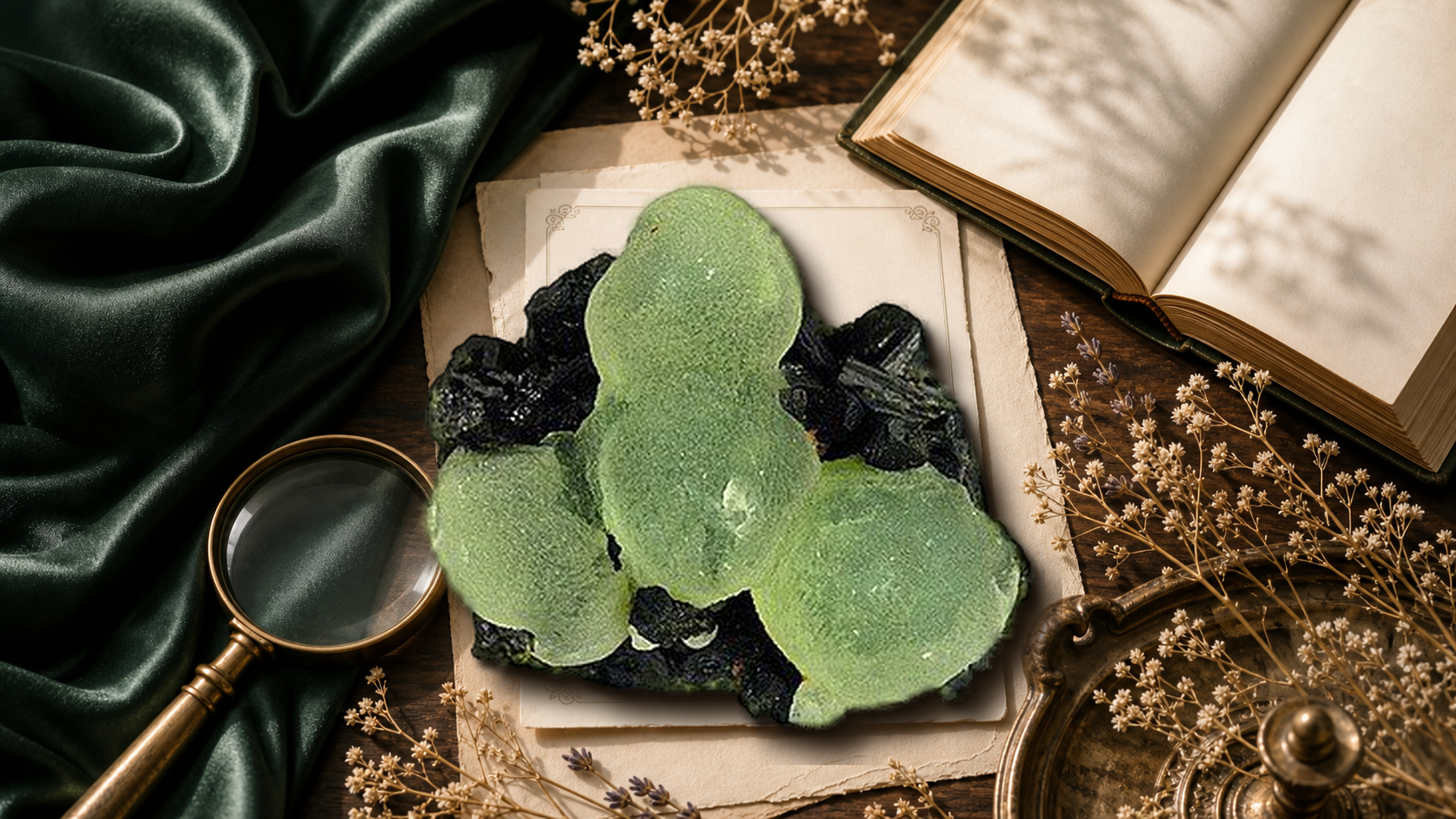
Prehnite with epidote lets the strain show. The green soft body remains open and translucent, but the darker epidote needles make the internal pressure legible instead of letting care pose as pure ease. Softness and effort are forced into the same image. This stone matters for boundaries because support becomes cleaner once the cost is no longer hidden inside it.
What Your Body Knows
sympathetic
The visual reality of prehnite with epidote; dark inclusions within light matrix; directly mirrors the nervous system experience of simultaneously holding shadow (dorsal, dark, contracted) and light (ventral, expansive, open) states. For nervous systems that oscillate between these poles rather than integrating them, this stone models coexistence. The epidote does not contaminate the prehnite. The prehnite does not bleach the epidote. They share space. State shift: shadow-light oscillation toward integrated co-presence.
sympathetic
Dorsal vagal (nature deprivation / disconnection from growing things):
dorsal vagal
Sympathetic activation (difficulty accepting help or receiving):
sympathetic
The geological relationship between prehnite and epidote is one of HOST and GUEST. Prehnite is the host matrix; epidote is the included guest. For nervous systems activated by the vulnerability of receiving (accepting help, gifts, compliments, support), prehnite-epidote models generous hosting. The prehnite does not collapse under the weight of the epidote inclusions. It holds them and remains translucent. Receiving does not diminish the receiver. State shift: receiving-avoidant sympathetic toward ventral vagal openness to support. 5. ; - Ventral vagal (deepening ecological awareness): For regulated nervous systems seeking deeper connection to ecological and systemic thinking, prehnite-epidote provides a meditative object that embodies relationship. Two distinct mineral species, different crystal systems, different chemistries, coexisting in a single stone because the geological conditions allowed both. This is symbiosis in mineral form. State support: ventral vagal expansion into ecological consciousness.
Nervous system mapping based on polyvagal theory (Porges, 2011).
The Earth Made This
Prehnite with epidote is a composite mineral specimen combining two calcium-bearing silicates that commonly form together in low-grade metamorphic and hydrothermally altered basaltic rocks. Prehnite (Ca₂Al₂Si₃O₁₀(OH)₂) is a calcium aluminum phyllosilicate that forms botryoidal, stalactitic, or tabular crystal aggregates in cavities within basalt, gabbro, and other mafic igneous rocks. Epidote (Ca₂(Al,Fe³⁺)₃Si₃O₁₂(OH)) is a sorosilicate that forms prismatic crystals colored pistachio green by iron content.
Both minerals precipitate from calcium- and aluminum-rich hydrothermal fluids circulating through cooling volcanic rock at temperatures between 200°C and 400°C . the prehnite-pumpellyite metamorphic facies. The combination creates specimens where pale green to yellow prehnite hosts or is intergrown with darker green epidote needles and prisms.
Notable sources include the Kayes Region of Mali, where exceptional botryoidal prehnite with epidote sprays forms in basalt cavities.
Mineralogy
Chemical Formula
Prehnite: Ca2Al2Si3O10(OH)2 -- calcium aluminum phyllosilicate hydroxide; Epidote: Ca2(Al,Fe3+)3(SiO4)3(OH) -- calcium aluminum iron sorosilicate hydroxide
Crystal System
Mixed
Mohs Hardness
6.5
Specific Gravity
Prehnite: 2.80--2.95; Epidote: 3.30--3.50
Luster
Prehnite: Vitreous to waxy; Epidote: Vitreous to resinous
Color
Green
Traditional Knowledge
South African geological heritage (Karoo basalts): The Karoo Supergroup basalts of South Africa are a classic source for prehnite-epidote specimens. These Jurassic flood basalts, erupted during the breakup of Gondwana, host extensive vein and vesicle mineralization including world-class prehnite. The South African geological tradition, rooted in the mineral wealth of the subcontinent, has documented prehnite occurrences since the colonial period (Cairncross, B., "Field Guide to Rocks and Minerals of Southern Africa," 2004, Struik Publishers).
Dutch colonial mineralogy: Prehnite was first described in 1788 by Abraham Gottlob Werner and named after Colonel Hendrik Von Prehn, a Dutch military commander and mineral collector at the Cape of Good Hope, South Africa. It was one of the first minerals to be named after a person rather than a property or locality, establishing a naming convention that continues in mineralogy today (Deer, W. A., Howie, R. A., & Zussman, J., 2013).
Aboriginal Australian tradition (Northern Territory): Prehnite occurs at Wave Hill Station in the Northern Territory of Australia, within the country of the Gurindji people. The Gurindji are known for the historic Wave Hill Walk-Off of 1966, a landmark event in Aboriginal land rights. Green stones in many Aboriginal Australian traditions are associated with growth, renewal, and connection to Country; the deep spiritual relationship between people and land (Stanner, W. E. H., "White Man Got No Dreaming," 1979, ANU Press).
Malian gem trade (West Africa): Mali has emerged as the primary source for gem-quality prehnite-epidote in the global market. The Malian deposits produce the most visually dramatic specimens, with clearly defined dark epidote inclusions in translucent green prehnite. This material enters the international gem trade through Bamako and is cut primarily in India and China for the global market.
South African geological heritage (Karoo basalts)
The Karoo Supergroup basalts of South Africa are a classic source for prehnite-epidote specimens. These Jurassic flood basalts, erupted during the breakup of Gondwana, host extensive vein and vesicle mineralization including world-class prehnite. The South African geological tradition, rooted in the mineral wealth of the subcontinent, has documented prehnite occurrences since the colonial period (Cairncross, B., "Field Guide to Rocks and Minerals of Southern Africa," 2004, Struik Publishers). 2. Dutch colonial mineralogy: Prehnite was first described in 1788 by Abraham Gottlob Werner and named after Colonel Hendrik Von Prehn, a Dutch military commander and mineral collector at the Cape of Good Hope, South Africa. It was one of the first minerals to be named after a person rather than a pro
When This Stone Finds You
Somatic protocol
Orthorhombic prehnite hosts monoclinic epidote inclusions without collapsing -- a geological model for holding what is different without being diminished by it.
5 min protocol
Hold the prehnite-with-epidote specimen and look at the green-on-green. Prehnite (orthorhombic, Ca2Al2Si3O10(OH)2) is the host. Epidote (monoclinic, Ca2(Al,Fe3+)3(SiO4)3(OH)) is the guest. Two different crystal systems sharing space without conflict. The prehnite does not collapse under the epidote's weight. Breathe in for 5, out for 7.
1 minPlace the stone over your heart. Prehnite's specific gravity is 2.80-2.95. Epidote's is 3.30-3.50. The guest is denser -- heavier -- than the host. And the host holds it anyway. Ask: what heavier thing am I hosting right now? Can I hold it without being diminished? Breathe into the question for 60 seconds.
1 min 15 secMove the stone to your solar plexus. Epidote's iron content (Fe3+) gives it a deeper, sometimes pistachio-to-dark-green color within the paler translucent prehnite. Shadow inside light. Ask your gut: what shadow am I carrying that is not a problem to be solved but a guest to be hosted? Let the shadow have a seat without evicting it.
1 minHold the stone at arm's length. The translucence of prehnite lets you see the epidote inclusions -- the host does not hide the guest. It reveals it. Transparency is not weakness. Ask: where am I hiding what I carry because I think it makes me look weak? What would change if I held it visibly?
1 min 15 secSet the stone down. Place your hands on your belly, one over the other. You hosted something heavier than yourself for five minutes and you did not collapse. That is the prehnite lesson: hosting capacity is a kind of strength that never announces itself. Notice how your body feels. That is the data.
30 secCare and Maintenance
Prehnite with epidote is water-safe for brief rinses. Both minerals (Mohs 6-7 range) are chemically stable. Brief cool water rinse (30-60 seconds) is safe.
Recommended cleansing: running water, moonlight, sound, smoke, selenite plate. Store normally; both minerals are moderately durable.
In Practice
You have been carrying everyone else and forgot to notice what that costs. Prehnite's soft green translucence pairs with epidote's pistachio green in the same specimen. Hold during healer fatigue.
Place on your chest during rest. The two minerals formed together in the same hydrothermal cavity. Partnership that does not deplete is the geological model.
Verification
Prehnite with epidote: both minerals should be naturally intergrown. Prehnite (pale green, translucent, Mohs 6-6. 5) and epidote (pistachio green, Mohs 6-7).
The two greens should merge naturally in the specimen. If the colors appear painted or the minerals look glued together rather than naturally intergrown, question authenticity.
Natural Prehnite With Epidote should usually feel cooler than plastic or resin on first touch and warm more slowly in the hand.
Use 6.5 on the Mohs scale as the check, not internet myths. A real specimen should behave in line with the hardness listed above.
Look for a prehnite: vitreous to waxy; epidote: vitreous to resinous surface quality rather than a painted or plastic shine.
The listed specific gravity is Prehnite: 2.80--2.95; Epidote: 3.30--3.50. If a specimen feels unusually light for its size, it may deserve a second look.
Geographic Origins
Mali produces the most commercially available prehnite-epidote specimens from basaltic host rocks in the Kayes Region. Australia yields specimens from basaltic formations in Victoria and New South Wales. India produces prehnite-epidote from Deccan Traps basalt cavities.
Both minerals co-crystallize from hydrothermal fluids in low-grade metamorphic and volcanic settings.
FAQ
Prehnite With Epidote is classified as a Prehnite with epidote is a naturally occurring mineral combination, not a single mineral species. Prehnite forms the translucent green host matrix; epidote crystallizes as dark inclusions within or upon the prehnite. Both minerals commonly co-occur in low-grade metamorphic and hydrothermal environments, forming in the prehnite-pumpellyite metamorphic facies (approximately 200-350 degrees C, 2-7 km depth). Research confirms that both prehnite and epidote form through hydrothermal alteration of calcium-rich plagioclase feldspar, with oxygen potential (redox conditions) determining which phase predominates -- prehnite forms under more reducing conditions, epidote under more oxidizing conditions (Nozaka & Tateishi, 2023).. Chemical formula: Prehnite: Ca2Al2Si3O10(OH)2 -- calcium aluminum phyllosilicate hydroxide; Epidote: Ca2(Al,Fe3+)3(SiO4)3(OH) -- calcium aluminum iron sorosilicate hydroxide. Mohs hardness: Prehnite: 6--6.5; Epidote: 6--7. Crystal system: Prehnite: Orthorhombic (space group Pncm); Epidote: Monoclinic (space group P21/m).
Prehnite With Epidote has a Mohs hardness of Prehnite: 6--6.5; Epidote: 6--7.
Water Safety CONDITIONAL -- brief rinse acceptable. Prehnite is moderately water-safe (Mohs 6-6.5), but prolonged soaking may affect the interface between prehnite and epidote inclusions over time. Brief rinse for cleaning is fine. Do not soak for extended periods. For gem elixirs, use the indirect method (stone beside the vessel). Avoid ultrasonic cleaners, which may exploit the boundary between the two mineral phases.
Prehnite With Epidote crystallizes in the Prehnite: Orthorhombic (space group Pncm); Epidote: Monoclinic (space group P21/m).
The chemical formula of Prehnite With Epidote is Prehnite: Ca2Al2Si3O10(OH)2 -- calcium aluminum phyllosilicate hydroxide; Epidote: Ca2(Al,Fe3+)3(SiO4)3(OH) -- calcium aluminum iron sorosilicate hydroxide.
Formation Story Prehnite with epidote forms in the geological sweet spot between surface weathering and deep metamorphism -- a transitional zone where hot fluids alter existing rocks at moderate temperatures and pressures. This is the realm of the prehnite-pumpellyite facies, the lowest grade of metamorphism recognized by petrologists, occurring at approximately 200-350 degrees C and depths of 2-7 kilometers. In this environment, calcium-rich plagioclase feldspar in basaltic and gabbroic rocks b
References
. [SCI]
DOI: 10.1111/jmg.12713
. [SCI]
DOI: 10.1029/2021JB023136
. [SCI]
DOI: 10.1111/jmg.12078
Closing Notes
Two calcium silicates forming together in altered basalt. Green prehnite and pistachio epidote in the same specimen, both born from the same hydrothermal event. The science documents co-crystallization in low-grade metamorphic cavities.
The practice asks what partnership looks like when both minerals chose the same crack.
Bring it into practice
Move from reference to ritual. Search current inventory for Prehnite With Epidote, build a custom bracelet, or let Sacred Match choose the right supporting stones for you.
Community notes
Shared field notes tied to Prehnite With Epidote appear here, including notes saved from practice.
When members save a public field note for this stone, it will appear here.
The archive
Continue through stones that share intention, chakra focus, or tonal family with Prehnite With Epidote.
Shared intention: Boundaries & Protection
The Boundary Breaker

Shared intention: Anxiety Relief
The Gentle Calm

Shared intention: Self-Awareness
The Serpentine Thread of Knowing

Shared intention: Boundaries & Protection
The Cobalt Bloom

Shared intention: Self-Awareness
The Pink Warning

Shared intention: Anxiety Relief
The Four-Mineral Healer