Materia Medica
Rhodizite
The Tiny Amplifier
This page documents traditional and cultural uses of rhodizite alongside emerging research on tactile grounding objects. Crystalis does not claim that rhodizite treats, cures, or prevents any medical condition. For mental health concerns, consult a qualified professional.
Origins: Madagascar, Russia
Materia Medica
The Tiny Amplifier
Protocol
Generate what you need from what surrounds you
2 min
Hold the rhodizite crystal between your thumb and index finger. Despite its small size, note its glassy hardness — Mohs 8.5 in a crystal often smaller than a pea. The concentration of properties in this small form is the point. Consider where in your life maximum capacity exists in a compact space.
Warm the crystal by closing it in your fist for two full minutes. Rhodizite is pyroelectric — temperature change generates charge. While your body heat transfers to the stone, identify one area of your life where a slow build is occurring. Something that is accumulating gradually rather than arriving all at once.
Open your fist and place the crystal at the crown of your head (or hold it there). Ask yourself what charge you have been accumulating that has not yet discharged into action. Name the stored energy — is it a decision, a conversation, a project, a departure? Let the naming clarify the charge.
Place the crystal in front of you. Decide: is the charge ready to discharge, or does it need more accumulation time? If ready, identify the single next action. If not ready, identify what conditions need to change before discharge. Write your answer. Rhodizite teaches that generation precedes release.
tap to flip for protocol
Intermittent energy makes people mistrust their own scale. They still spark, just not continuously, and they begin to treat brief force as fake force.
Rhodizite keeps magnitude compressed. That is part of its usefulness.
Small signal. Real charge.
What Your Body Knows
sympathetic
Energy builds slowly without dissipating. You notice increased capacity for sustained attention, longer periods of focus without fatigue, and a sense that your reserves are growing rather than cycling between full and empty.
dorsal vagal
You become more responsive to subtle environmental shifts; not just temperature but the energetic tone of rooms, conversations, and transitions. Like the mineral's pyroelectric property, you convert ambient change into usable awareness.
ventral vagal
Decisions feel crisper. The usual fog between wanting something and committing to it thins. This is not urgency; it is reduced internal friction. What you intend and what you do move into closer alignment.
Nervous system mapping based on polyvagal theory (Porges, 2011).
Mineralogy
Chemical Formula
KAl4Be4(B11Be)O28
Crystal System
Cubic
Mohs Hardness
8
Specific Gravity
3.34-3.44
Luster
Vitreous to adamantine
Color
White-Yellow
Traditional Knowledge
Described 1834 by Gustav Rose; name from Greek rhodizein meaning to be rose-colored for borax bead test; rare borate from Madagascar and Russia
Pegmatite Crystal
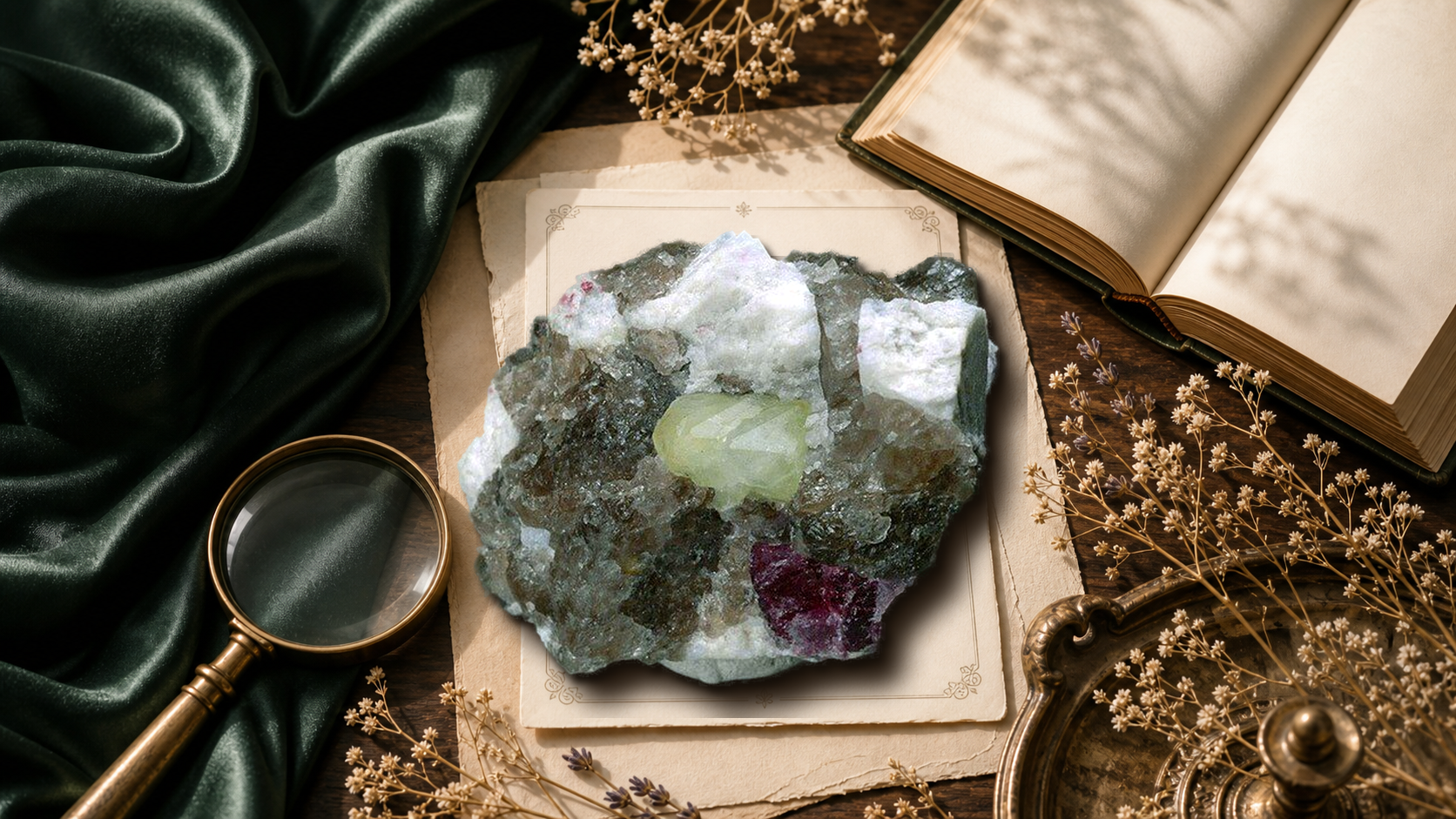
Artisanal miners in Madagascar extract rhodizite from lithium-bearing pegmatites, where it occurs alongside tourmaline and other rare minerals. The small, glassy crystals are recognized by experienced miners who know that their unusual hardness and brilliance distinguish them from quartz. Finding rhodizite signals a geochemically complex pegmatite worth careful exploration.
Pyroelectric Curiosity
19th-century mineralogists identified rhodizite's pyroelectric property — generating electrical charge when heated — and classified it alongside tourmaline as a polar crystal. Gustav Rose, who first described the mineral in 1834, noted its unusual density and hardness. The mineral became a study subject for understanding how crystal symmetry relates to electrical behavior.
Amplification Stone
Practitioners use rhodizite as an intensifier placed alongside other stones. The rationale draws from its measured physical properties — pyroelectricity, unusual hardness for its chemistry, high refractive index. These concentrated physical characteristics in a small crystal form the basis for its role as an amplifier in gridwork and personal practice.
Micro-Crystal Excellence
Among systematic mineral collectors, rhodizite is prized as a micro-mount specimen — small crystals that display extraordinary optical quality under magnification. The cubic system produces well-formed dodecahedral crystals that, despite their tiny size, demonstrate textbook geometry. Quality is measured in perfection of form, not size.
When This Stone Finds You
Somatic protocol
Generate what you need from what surrounds you
2 min protocol
Hold the rhodizite crystal between your thumb and index finger. Despite its small size, note its glassy hardness — Mohs 8.5 in a crystal often smaller than a pea. The concentration of properties in this small form is the point. Consider where in your life maximum capacity exists in a compact space.
Warm the crystal by closing it in your fist for two full minutes. Rhodizite is pyroelectric — temperature change generates charge. While your body heat transfers to the stone, identify one area of your life where a slow build is occurring. Something that is accumulating gradually rather than arriving all at once.
Open your fist and place the crystal at the crown of your head (or hold it there). Ask yourself what charge you have been accumulating that has not yet discharged into action. Name the stored energy — is it a decision, a conversation, a project, a departure? Let the naming clarify the charge.
Place the crystal in front of you. Decide: is the charge ready to discharge, or does it need more accumulation time? If ready, identify the single next action. If not ready, identify what conditions need to change before discharge. Write your answer. Rhodizite teaches that generation precedes release.
Care and Maintenance
Running Water Brief rinse under cool running water. Pat dry immediately. Safe for stones with adequate hardness.
30-60 seconds Yes . with conditions The Full Answer Rhodizite is generally water-safe for brief cleansing. Its 8-8.
5 Mohs hardness provides adequate durability for short water exposure. Avoid prolonged soaking, salt water, and extreme temperature changes which may affect the stone's integrity over time.
In Practice
You feel underestimated by your own size. Rhodizite is tiny and ferociously hard for a borate. Hold this small crystal during periods when the volume of your contribution does not match the scale of your impact.
Place on your desk when you need a reminder that potency is not proportional to mass.
Verification
Rhodizite: tiny, extremely hard borate (Mohs 8. 5). Specific gravity 3.
34-3. 44. Vitreous to adamantine luster.
Cubic system. One of the hardest boron minerals. The combination of extreme hardness and small crystal size is distinctive.
If a claimed rhodizite is larger than 1 cm, verify; large crystals are extremely rare.
Natural Rhodizite should usually feel cooler than plastic or resin on first touch and warm more slowly in the hand.
Use 8 on the Mohs scale as the check, not internet myths. A real specimen should behave in line with the hardness listed above.
Look for a vitreous to adamantine surface quality rather than a painted or plastic shine.
The listed specific gravity is 3.34-3.44. If a specimen feels unusually light for its size, it may deserve a second look.
Geographic Origins
Rhodizite forms in granitic pegmatites . the final crystallization phase of cooling magma where rare elements concentrate. Its extreme rarity comes from the unusual combination of beryllium, aluminum, and boron required for formation. Most crystals are small, sharply formed, and remarkably brilliant for their size. Madagascar produces the finest specimens, often attached to tourmaline or pollucite.
Mineralogy: Chemical formula (BeAl)₂Al₆(BO₃)₆. Crystal system: Cubic. Mohs hardness: 8-8.5. Specific gravity: 3.0. Luster: Vitreous.
FAQ
It is one of the hardest boron-bearing minerals at Mohs 8-8.5, it is pyroelectric (generates charge when heated), and it is one of very few minerals with a density low enough to float on some heavy liquids used in mineral identification. That combination of properties is genuinely rare.
Madagascar is the primary source for gem-quality rhodizite crystals. It also occurs in the Ural Mountains of Russia and a few other localities, but Madagascan material dominates the market for specimens and faceted stones.
Mohs 8-8.5 places it harder than topaz and approaching corundum. For a mineral most people have never heard of, that is a remarkable hardness. It is durable enough for any jewelry application from a hardness standpoint.
When rhodizite is heated, it develops an electrical charge across its crystal faces — one end becomes positive, the other negative. This is a measurable physical property, not a metaphorical one. It results from the crystal's lack of a center of symmetry.
Small crystals are surprisingly affordable given the mineral's rarity. Faceted stones of any significant size are considerably more expensive and harder to find. The mineral's obscurity keeps demand lower than its rarity would otherwise dictate.
At its hardness and with its stable crystal structure, brief water contact is not a problem. It does not dissolve or degrade in water under normal conditions. However, as with most specimens, there is no reason to soak it routinely.
Look for its characteristic isometric (cubic system) crystal habit — often as small, bright, glassy dodecahedral or tetrahedral crystals. Its high hardness, low specific gravity, and strong pyroelectric response are diagnostic. It often occurs with tourmaline in pegmatite.
The mineral's pyroelectric property — generating charge through temperature change — corresponds in traditional systems to the solar plexus center, which is associated with personal energy regulation and response to environmental shifts.
References
Gatta, G.D. et al. (2017). High-pressure behavior of (Cs K)Al4Be5B11O28 londonite. Journal of the American Ceramic Society. [SCI]
DOI: 10.1111/jace.14936
Closing Notes
Potassium aluminum beryllium borate, cubic, Mohs 8. Rhodizite is harder than topaz and rarer than most gems people can name. It forms in lithium-bearing pegmatites in Madagascar and Russia's Ural Mountains.
A cubic crystal system gives it isotropic optical properties. It does not split light by direction. The same refractive index in every axis.
Rare consistency in a rare mineral.
Bring it into practice
Move from reference to ritual. Search current inventory for Rhodizite, build a custom bracelet, or let Sacred Match choose the right supporting stones for you.
Community notes
Shared field notes tied to Rhodizite appear here, including notes saved from practice.
When members save a public field note for this stone, it will appear here.
The archive
Continue through stones that share intention, chakra focus, or tonal family with Rhodizite.

Shared intention: Motivation & Energy
The Warrior's Endurance
Shared intention: Abundance & Prosperity
The Grounded Abundance

Shared intention: Abundance & Prosperity
The Merchant's Sun

Shared intention: Motivation & Energy
The Green Fire of the Heart

Shared intention: Motivation & Energy
The Ambition Sparkler

Shared intention: Motivation & Energy
The Solar Impact