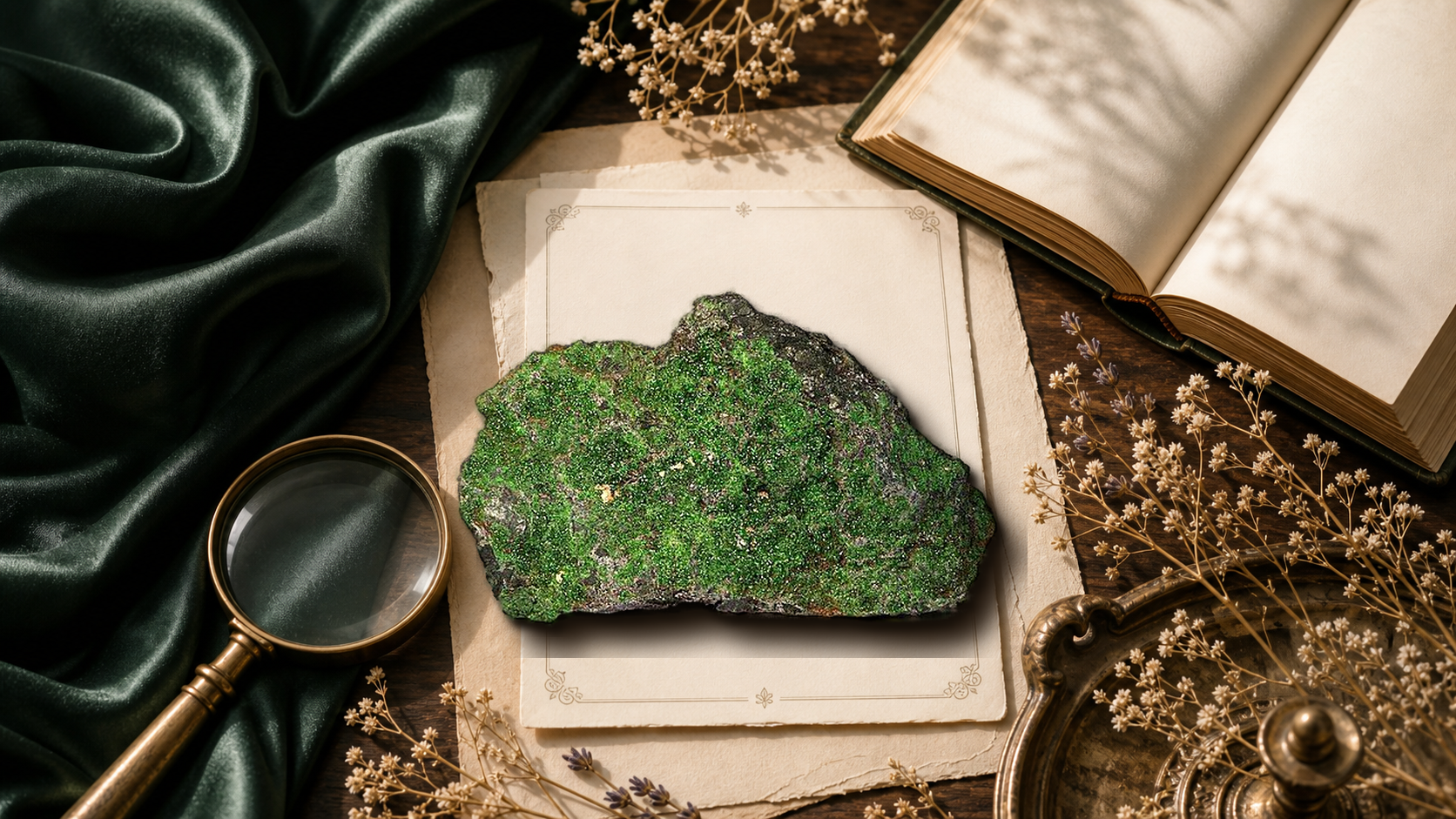
You need a green that comes in fierce small quantities. Uvarovite forms drusy emerald-green garnet crusts that rarely grow large but never fail to blaze. Scale is a poor measure of intensity.
Uvarovite works most clearly with states of concentrated vitality, especially when the body needs proof that intensity does not require scale. One presentation is...
The Meaning
Uvarovite Garnet 3 in the Crystalis dictionary
A lot of value gets mismeasured by size. The self starts apologizing for being subtle, partial, locally brilliant rather than expansively dominant, as if smallness automatically meant diminished force.
Uvarovite refuses that premise. It appears in drusy crusts and minute crystals, but the color is fierce enough to overrule any assumption that magnitude is the only index of power. Presence can come concentrated.
Uvarovite matters when confidence has been distorted by scale anxiety. Intensity does not owe anyone enlargement in order to count.
Stone Lore
Stories carried through time
Cultural notes are presented as tradition and historical context — stories carried through time.
Unknown
Russian Imperial mineralogy
Uvarovite was first described in 1832 by the German-Russian chemist Germain Henri Hess from specimens collected at the Saranovskii chromite mine in the Ural Mountains. He named it for Count Sergei Semionovich Uvarov, then president of the Russian Academy of Sciences and later the architect of Tsar Nicholas I's education policy of "Orthodoxy, Autocracy, and Nationality." The stone thus carries the imprint of Russian Imperial intellectual culture: the intersection of scientific discovery and state power.
The Urals themselves were considered Russia's "treasure chest" and the border between Europe and Asia. (Source: Hess, G. H. , 1832, original description in Poggendorff's Annalen der Physik und Chemie; Fersman, A. E. , 1946, "Gems of the Urals.")
Historical note
Named for Count Sergey Uvarov
Uvarovite was discovered in 1832 and named in honor of Count Sergey Semeonovich Uvarov (1786 to 1855), a Russian statesman, scholar, and President of the Russian Academy of Sciences. It is the rare calcium chromium end-member of the garnet...
Modern/Scientific · 1832 CE
Historical note
Emerald-Green Garnet from the Urals
The type locality for uvarovite is the Saranovskii Mine in the Middle Urals, Russia, which has produced the finest specimens for nearly two centuries. Unlike other garnet species, uvarovite rarely forms large individual crystals; instead,...
Modern/Scientific · 1832–present
Earth Record
Mineralogy and formation
Chromium has to dominate before uvarovite can exist, and that requirement makes its geological setting unusually strict. Most garnets tolerate broad compositional substitution and appear across many metamorphic and igneous environments. Uvarovite, by contrast, demands calcium plus abundant chromium in places where silica activity and host rock chemistry permit garnet growth. That usually means chromite-bearing ultramafic rocks, serpentinites, rodingites, or chromium-rich skarn systems developed where fluids react with carbonate country rock.
Its formula is the chromium end member of the calcium garnets, and the color follows directly from that chemistry. The emerald green is not produced by a minor trace impurity. Chromium is part of the species definition. That is why uvarovite remains reliably green in a way many other garnets do not remain reliably any one color. Cubic symmetry gives it isotropic optical behavior, but what collectors notice first is not optics under a microscope. It is size. Crystals are commonly tiny, often as drusy crusts of bright dodecahedra coating dark matrix.
The crystal habit reflects the environments where it grows. In chromitite seams and altered ultramafic rocks, open space is limited. Uvarovite forms as a sparkling veneer rather than a large free-standing crystal. Even in skarn settings, crystal size tends to stay small. This scarcity of larger crystals makes facetable material exceptional and keeps most specimens in the realm of matrix-mounted display pieces.
Classic localities in the Urals, Finland, Turkey, and South Africa all share chromium-rich protoliths or ore settings. The green crusts often sit on black chromite, creating one of mineral collecting's sharpest color contrasts. What emerges is a garnet defined as much by limitation as by brilliance. The chemistry must be exact. The room for growth is usually narrow. The crystals stay small, but their saturation makes smallness irrelevant.
Because of that, uvarovite is rarely about size competition with other garnets. Its identity rests in saturation, exact chemistry, and the visual shock of emerald color erupting from ultramafic darkness. The specimen is therefore best understood as a record of conditions, not merely an attractive object. Its structure, habit, and chemistry all preserve the environment that made it possible.
Crystal system diagram represents the general cubic classification. Diagram created by Crystalis for educational reference.
Russia's Ural Mountains (Sarany and Bissersk deposits) are the classic source for uvarovite on chromite matrix. Finland produces uvarovite from the Outokumpu mining district. South Africa yields specimens from Bushveld chromite deposits.
The calcium chromium garnet requires chromium-rich ultramafic environments (serpentinite, chromitite) found at all three localities.
Russia (Ural Mountains)FinlandSouth Africa
Telling it apart
Uvarovite gets mistaken for emerald druse, green grossular, and chrome-rich mica coatings because buyers see vivid green sparkle and fill in the rest. The mineralogy is tighter than that.
Uvarovite is the calcium chromium garnet. Green grossular is a different calcium garnet whose color can come from chromium or vanadium but whose species identity is not fixed by chromium dominance. Emerald is a beryl, not a garnet, and usually forms larger hexagonal prisms rather than tight drusy crusts. Chrome mica coatings can flash green on dark matrix, but they lack the tiny equant dodecahedral garnet geometry.
What separates them is habit first. Uvarovite usually appears as sparkling small crystals coating matrix, especially chromite. The confirming step is species-level testing when a seller claims large facetable uvarovite, because true stones of that size are rare. In green minerals, saturation is common. Correct species is where the rarity begins. Chromium garnet drusy specimens command collector premiums based on the vivid green color and small crystal size, and confirming the calcium chromium garnet composition separates it from green grossular.
Spotting the real thing
Uvarovite garnet: vivid emerald-green druzy crystals on dark chromite matrix. SG 3. 77-3.
81. Mohs 6. 5-7.
Cubic. The crystals are typically small (rarely over 3mm). If large faceted green stones are offered as uvarovite, they are almost certainly a different green garnet (tsavorite or demantoid).
The small druzy crystal size on dark matrix is diagnostic.
Ventral vagal with heart-wound (functional but guarded)
These associations come from tradition and reflective practice — a way of working with the stone, not a medical prescription.
Somatic Practice
Simple ways to work with Uvarovite Garnet 3
◇
Hold
Carry Uvarovite Garnet 3 in a pocket or place it over the heart center during a pause.
◌
Meditate
Let the stone become a quiet tactile anchor while the breath slows.
☽
Breathe
Breathe in softness. Breathe out tension. Keep the practice simple.
✎
Journal
Write with Uvarovite Garnet 3 nearby to name the feeling without forcing a conclusion.
✋
Bodywork
Rest the stone near the chest, hand, or bedside as a reminder to soften.
⌂
Environment
Place it where you want a visual cue for care, repair, or steadiness.
Field Instruction
The Chromium Heart
The only consistently green garnet, colored by chromium in a cubic lattice so symmetric it approaches perfection — its emerald druzy clusters grow in abundance but are almost never large enough to cut, teaching that enough is already present.
3 min protocol
1
Hold the uvarovite garnet cluster and notice the druzy — tiny emerald-green crystals coating a matrix, never large enough to facet. The chromium that makes them green is the same element that colors emeralds, but here it is locked in cubic garnet symmetry: every crystal identical, every crystal small, the abundance is in the collective.
2
Press the cluster gently against your heart center. Breathe in for five counts. The cubic crystal system is the most symmetric in nature — the same in every direction, no preferred axis, no hierarchy. Let that geometry enter your chest: abundance that does not rank, does not compete, does not need to be the biggest crystal to be the greenest.
3
Move the cluster to your solar plexus, where scarcity patterns live as tension. The calcium in this garnet's dodecahedral sites is the same calcium in your bones. The chromium is the same element that hardens steel. You are built from the same periodic table as this stone. Nothing you are made of is in short supply. Five breaths.
4
Hold the uvarovite at arm's length and look at the emerald surface. No single crystal stands out. None needs to. The beauty is in the druzy — the collective surface. Set the cluster down. Place both palms flat on your thighs. What you have is enough. It has always been enough. Three closing breaths.
Stone Intelligence
The fact that makes Uvarovite Garnet 3 memorable
The rarest common garnet. Calcium chromium silicate, emerald green, crystallizing in chromite-bearing serpentinites. Crystals too small for faceting but brilliant enough to stop you.
The science documents chromium garnet formation in ultramafic rock. The practice asks what impact means when the stone is too small to cut but too vivid to ignore.
SCI
Drainage of subduction interface fluids into the forearc mantle evidenced by a pristine jadeitite network (Polar Urals)
Platinum‐group mineral and silicate inclusions in the <scp>low‐Al</scp> chromitites of the Manipur ophiolite, northeast India: Implications on <scp>Cr‐PGE</scp> mineralization in nascent subduction zone settings
The use of Raman and infrared spectroscopy in determining the space symmetry group among the groups with the same rules of systematic absence in the diffraction patterns: Some basic principles and applications
You need abundance but the concept has been corrupted by marketing. Uvarovite is calcium chromium silicate garnet, Mohs 6. 5.
It is the rarest garnet species and almost never occurs in crystals large enough to cut. The emerald green comes from chromium. Most uvarovite is a druzy crust of tiny crystals on matrix.
Hold it during scarcity thinking. The stone redefines abundance: not large single gems but thousands of tiny crystals covering a surface completely. Abundance as coverage, not as size.
Sacred Match
Sacred Match reaches for Uvarovite when what you feel sounds like:
Feeling too small to have impact
Brightness constrained by tight circumstances
Need for concentrated rather than diffuse support
Comparison draining confidence
A strong signal trapped in a small container
Wanting proof that scale is not everything
Sacred Match listens to the body rather than to preference. It notices what you are feeling right now, the way you are protecting yourself, and the deeper need underneath both. When that points to minimized self-worth, constrained expression, or vitality compressed into too little room, uvarovite is the stone it offers.
Small -> size confused with value -> seeking intensity
Constrained -> brilliance limited by context -> seeking expression
Compressed -> signal crowded into narrow space -> seeking release
Dimmed -> impact underestimated -> seeking visible green fire It comes forward when the nervous system needs concentrated proof that impact can be vivid without becoming large, loud, or bloated. The prescription stays narrow on purpose, matching material logic to body state rather than treating every bright stone as interchangeable.
Stones and herbs that harmonize with Uvarovite Garnet 3
Pairings are treated like a recipe file: clear use, method, and safety.
Crystal Companion
Uvarovite Garnet 3 + Amethyst
Use when
You want to layer the primary intention with another supportive tone.
How to work with it
Place the stones together during meditation, journaling, or a short reset.
Safety
Use as a reflective practice tool, not as a medical substitute.
Crystal Companion
Uvarovite Garnet 3 + Rhodonite
Use when
You want to layer the primary intention with another supportive tone.
How to work with it
Place the stones together during meditation, journaling, or a short reset.
Safety
Use as a reflective practice tool, not as a medical substitute.
Crystal Companion
Uvarovite Garnet 3 + Clear Quartz
Use when
You want to layer the primary intention with another supportive tone.
How to work with it
Place the stones together during meditation, journaling, or a short reset.
Safety
Use as a reflective practice tool, not as a medical substitute.
Crystal Companion
Uvarovite Garnet 3 + Black Tourmaline
Use when
You want to layer the primary intention with another supportive tone.
How to work with it
Place the stones together during meditation, journaling, or a short reset.
Safety
Use as a reflective practice tool, not as a medical substitute.
Chromite
The Matrix and Blaze.
Uvarovite often grows directly on chromite, so pairing the garnet with its dark ore partner creates the most faithful geological presentation. Uvarovite is calcium chromium nesosilicate, cubic at Mohs 6.5, forming emerald-green drusy crusts. Chromite provides the black chromium-iron stage. Display chromite beneath or behind the drusy specimen.
Emerald
The Two Chromium Greens, Two Architectures.
Emerald offers transparent hexagonal prism energy where uvarovite offers tiny cubic garnet fire. Both owe their green to chromium but express it through completely different silicate frameworks: cyclosilicate beryl versus nesosilicate garnet. Best when someone wants to compare saturation expressed through abundance versus concentration. Wear emerald near the throat and keep uvarovite on the desk in view.
Black Tourmaline
The Small Intensity With Firm Boundary.
Uvarovite can read visually bright and high-contrast despite its tiny crystal size. Black tourmaline at Mohs 7 steadies the field without muting it. Tourmaline's trigonal boron silicate body provides linear containment for garnet's isometric intensity. Place uvarovite near a window where it can catch light and set tourmaline at the room entrance.
Clear Quartz
The Magnify the Microstructure.
Because uvarovite crystals are often tiny, quartz works well as an adjacent amplifier of attention. Both are common enough that their role here is service, not competition. Set both on a specimen tray at eye level. One gives the fine druse room to be noticed. The other invites slower looking.
Care & Cleansing
How to keep Uvarovite Garnet 3 in good condition
Water Safe?
Water safe
This stone is generally safe for short water contact, though polishing, fractures, and metal settings can still change how a specimen behaves.
Sunlight Safe?
Sunlight safe
Tolerates daylight; safe to charge or display in the sun.
Authenticity
What to check
Natural Uvarovite Garnet 3 should usually feel cooler than plastic or resin on first touch and warm more slowly in the hand.
Uvarovite garnet is water-safe. Calcium chromium garnet (Mohs 6. 5-7), no cleavage, chemically stable.
Brief to moderate water is safe. The vivid green from chromium is permanent. Recommended cleansing: running water, moonlight, sound, selenite plate.
Store carefully; uvarovite druzy crystals are small and can chip at matrix edges.
Temperature
Natural Uvarovite Garnet 3 should usually feel cooler than plastic or resin on first touch and warm more slowly in the hand.
Scratch logic
Use 6.5 on the Mohs scale as the check, not internet myths. A real specimen should behave in line with the hardness listed above.
Surface and luster
Look for a vitreous surface quality rather than a painted or plastic shine.
Weight and density
The listed specific gravity is 3.77-3.81. If a specimen feels unusually light for its size, it may deserve a second look.
My Field Guide
Your private record and next steps
Journal
Add this stone to your private collection, then log what happened when you worked with it.
Shared Notes
Read public practice logs and pattern notes from the Crystalis community.
When members save a public field note for this stone, it will appear here.
Frequently Asked
Questions people ask about Uvarovite Garnet 3
Why are uvarovite crystals always so small?
⌄
Uvarovite's crystal size is limited by chromium availability. Chromium is a geochemically scarce element, and uvarovite crystallization quickly depletes the local supply of dissolved Cr3+ in the fluid system. Once the chromium runs out, the crystal stops growing. This is why uvarovite typically forms as drusy coatings of thousands of micro-crystals (usually under 3mm) rather than the large, facetable crystals common in other garnets like almandine or pyrope.
Is uvarovite the same as "green garnet" sold in jewelry?
⌄
Usually not. Most "green garnet" in the jewelry trade is tsavorite (a green variety of grossular garnet, colored by vanadium and/or chromium) or demantoid (a green variety of andradite garnet, colored by chromium). Both form in larger, facetable crystals. True uvarovite is almost never faceted because the crystals are too small. If you see a faceted "uvarovite" in jewelry, it is very likely misidentified tsavorite or chrome diopside.
Can I make a uvarovite elixir by putting the stone in water?
⌄
Uvarovite is chemically safe in water; it will not dissolve or release toxic compounds. However, drusy specimens should not be submerged for prolonged periods, as the water can infiltrate micro-fractures in the rock matrix (not the garnet crystals themselves) and weaken the bond between the crystal coating and its host rock. If preparing a gem elixir, use the indirect method (stone in a separate glass container within the water vessel).
Is the chromium in uvarovite dangerous?
⌄
No. Uvarovite contains trivalent chromium (Cr3+), which is locked in a stable silicate crystal structure and is biologically inert through normal handling. Cr3+ is actually an essential trace nutrient in the human diet. The dangerous form of chromium is hexavalent chromium (Cr6+), found in industrial chemicals, not in any natural garnet.
Sources & Citations
Where this entry can be checked
Back Matter
Readable for people. Structured for AI search.
Sources stay visible in the page so readers, search engines, and answer systems can follow the evidence trail.
01
SCI
Drainage of subduction interface fluids into the forearc mantle evidenced by a pristine jadeitite network (Polar Urals)
Angiboust, Samuel, Glodny, Johannes, Cambeses, Aitor, Raimondo, Tom, Monié, Patrick et al. (2020). Drainage of subduction interface fluids into the forearc mantle evidenced by a pristine jadeitite network (Polar Urals). Journal of Metamorphic Geology. [SCI]DOI 10.1111/jmg.12570
02
SCI
Platinum‐group mineral and silicate inclusions in the <scp>low‐Al</scp> chromitites of the Manipur ophiolite, northeast India: Implications on <scp>Cr‐PGE</scp> mineralization in nascent subduction zone settings
Singh, Toijam Bapin, Maibam, Bidyananda, Kapsiotis, Argyrios. (2022). Platinum‐group mineral and silicate inclusions in the <scp>low‐Al</scp> chromitites of the Manipur ophiolite, northeast India: Implications on <scp>Cr‐PGE</scp> mineralization in nascent subduction zone settings. Geological Journal. [SCI]DOI 10.1002/gj.4668
03
SCI
The Availability of Limestone and Other Raw Materials for Ocean Alkalinity Enhancement
Caserini, Stefano, Storni, Niccolò, Grosso, Mario. (2022). The Availability of Limestone and Other Raw Materials for Ocean Alkalinity Enhancement. Global Biogeochemical Cycles. [SCI]DOI 10.1029/2021GB007246
04
SCI
The use of Raman and infrared spectroscopy in determining the space symmetry group among the groups with the same rules of systematic absence in the diffraction patterns: Some basic principles and applications
Moroz, Tatyana N., Edwards, Howell G. M. (2021). The use of Raman and infrared spectroscopy in determining the space symmetry group among the groups with the same rules of systematic absence in the diffraction patterns: Some basic principles and applications. Journal of Raman Spectroscopy. [SCI]DOI 10.1002/jrs.6220
Menzel, Manuel D., Garrido, Carlos J., López Sánchez‐Vizcaíno, Vicente, Hidas, Károly, Marchesi, Claudio. (2019). Subduction metamorphism of serpentinite‐hosted carbonates beyond antigorite‐serpentinite dehydration (Nevado‐Filábride Complex, Spain). Journal of Metamorphic Geology. [SCI]DOI 10.1111/jmg.12481
06
SCI
Minerals from Macedonia. XXVI. Characterization and spectra–structure correlations for grossular and uvarovite. Raman study supported by IR spectroscopy
Makreski, Petre, Runčevski, Tomče, Jovanovski, Gligor. (2011). Minerals from Macedonia. XXVI. Characterization and spectra–structure correlations for grossular and uvarovite. Raman study supported by IR spectroscopy. Journal of Raman Spectroscopy. [SCI]DOI 10.1002/jrs.2641