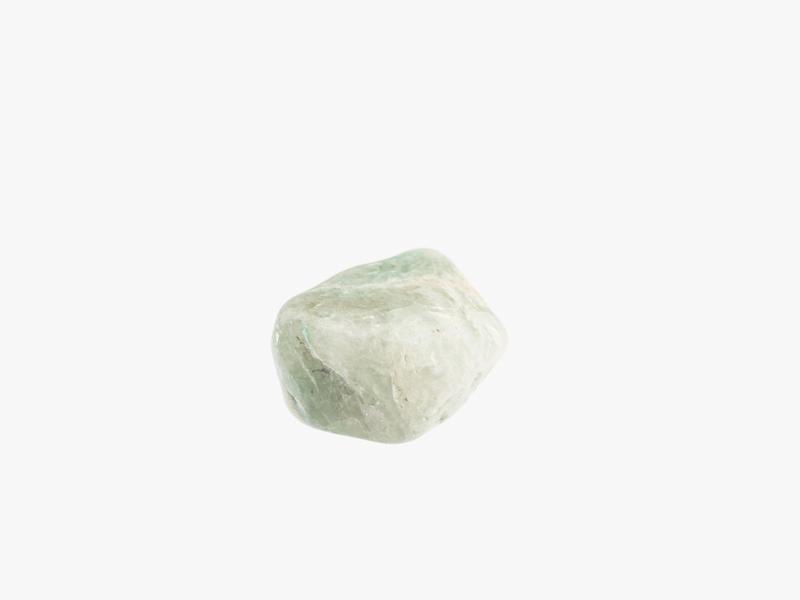
Vulnerability is asking for a tougher weave than appearance would suggest. Jadeite gains legendary toughness from tightly interlocking granular crystals, far harder to break than a simple hardness number implies. Strength can come from how closely the pieces hold.
At the hands, jaw, and lower abdomen, jadeite corresponds to cohesive resilience. It is useful when the body must withstand repeated contact or impact without...
The Meaning
Jadeite in the Crystalis dictionary
Some lives look more exposed than they are. The surface can seem soft, polished, almost tender to the eye, while the actual internal weave is so dense and interlocked that impact distributes instead of shattering the whole.
Jadeite is famous for exactly that kind of strength. Its toughness comes not merely from hardness, but from the fine granular interlocking of the crystal body. The pieces hold each other so closely that the material resists fracture far beyond what a simple number would suggest. That is what makes jadeite such an important image for boundaries and endurance. It reminds the psyche that resilience may come less from becoming harder and more from becoming more closely held together.
Stone Lore
Stories carried through time
Cultural notes are presented as tradition and historical context — stories carried through time.
Maya Civilization — Classic Period (250-900 CE)
The Breath Stone in Royal Burial
Maya royalty were buried with jadeite placed in the mouth of the deceased. The funerary mask of K'inich Janaab Pakal I, ruler of Palenque (603-683 CE), was constructed from over 200 pieces of fitted jadeite mosaic. In Mayan cosmology jade was associated with wind, breath, and the life force, the word for jade and the word for breath shared linguistic roots. The stone in the mouth marked the transition of breath from the living body to the next world. Jade did not represent wealth in death. It represented continuity of breath.
Ritual history
Pounamu as Living Ancestor
In Maori culture nephrite jade (pounamu) and in some contexts jadeite were carved into hei-tiki pendants and mere (short clubs) that carried the mana (spiritual authority) of their lineage. Each piece was named and its history recited...
Maori Tradition — New Zealand (pre-European contact to present)
Ritual history
The Jade Bi Disc and Heaven's Axis
Chinese jade culture spans over 7000 years, but Qing Dynasty emperors elevated Burmese jadeite (feicui) to imperial status above the nephrite traditionally favored. The jade bi disc, a flat circle with a central hole, was used in Chinese...
Chinese Imperial Tradition — Qing Dynasty (1644-1912)
Ritual history
Jade Celts and the First Mesoamerican Authority
The Olmec, considered the mother culture of Mesoamerica, established jade as the supreme prestige material of the Western Hemisphere. Jadeite celts (axe-shaped objects) were deposited in massive offerings at sites like La Venta around 800...
Jadeite forms where plate tectonics forces unusual chemistry into high pressure at relatively low temperature. Its formula is NaAlSi2O6, placing it in the pyroxene group, and it crystallizes in the monoclinic system. Unlike transparent prismatic pyroxenes familiar from handbooks, gem and carving jadeite usually occurs as dense interlocking granular aggregates. That texture is the source of its extraordinary toughness. A modest Mohs hardness around 6.5 to 7 understates how hard it is to break. The crystals lock together like a tightly woven fabric.
The geologic setting is subduction. Oceanic crust and related rocks descend, fluids move, sodium becomes available, and specific pressure-temperature windows allow jadeitite bodies to crystallize in veins and metasomatic zones. These are not casual environments. They are compressive, deep, and tectonically exact. Chromium can color the most valued imperial green material. Iron, manganese, and other elements can shift the stone toward lavender, white, yellow, or black.
Yet the real marvel is mechanical, not chromatic. Jadeite owes its cultural career to toughness born from intergrowth.
That is why jadeite historically excelled in tools, carvings, and ornaments that needed to resist impact. The stone does not merely sit there beautifully. It survives working. Mineralogically, it teaches that bulk behavior emerges from texture as much as from formula.
The somatic turn comes through woven strength. A body may look smooth on the outside while depending on countless tightly held internal contacts for resilience. Jadeite reads as communal toughness at the microscopic level, a dense fabric of support forged under convergent pressure.
Crystal system diagram represents the general monoclinic classification. Diagram created by Crystalis for educational reference.
Monoclinic structure
Chemical Formula
NaAlSi2O6
Crystal System
Monoclinic
Mohs Hardness
6.5
Specific Gravity
3.25-3.36
Luster
Vitreous to greasy
Color
Green
IMA Status
species
Type Locality
No type locality designated
IMA Number
Grandfathered (pre-1959)
01
Mineral conditions gather
02
Structure begins to crystallize
03
Jadeite records place and pressure
Myanmar (Burma) produces the most valued jadeite from the Kachin State, particularly the Hpakan jade mining district. Guatemalan jadeite from the Motagua Valley was carved by the Maya and Olmec civilizations. Japan produces jadeite from serpentinite-hosted deposits in Niigata Prefecture.
All three sources share the requirement: high-pressure, low-temperature subduction zone metamorphism.
Myanmar (Burma)GuatemalaJapan
Telling it apart
Jadeite is the pyroxene variety of jade, rarer and generally more valuable than nephrite, and the market confusion spans nephrite, serpentine, aventurine, dyed quartzite, glass, and synthetic material. The species confirmation depends on hardness, density, and crystal structure: jadeite is Mohs 6. 5 to 7, specific gravity 3. 24 to 3. 43, and forms in the monoclinic crystal system as interlocking granular pyroxene aggregates.
Nephrite is a tremolite actinolite amphibole, lighter at 2. 90 to 3. 03, and has fibrous rather than granular structure. Serpentine is much softer at 2. 5 to 5. 5 and lighter at 2. 5 to 2. 6. Dyed quartzite shows color pooling in grain boundaries. Glass lacks the granular aggregate structure and shows bubbles. If the green stone is heavy, hard, and shows granular pyroxene texture, jadeite is possible.
A gem lab report is essential for high value purchases because the price difference between jadeite and its substitutes is enormous.
Spotting the real thing
Jadeite: Mohs 6. 5-7 with exceptional toughness (interlocking crystal structure). Specific gravity 3.
25-3. 36. Vitreous to greasy luster.
The toughness test is key: jadeite does not break easily when struck. Imperial green jadeite (colored by chromium) is the most valuable. Dyed jadeite is common; check for dye concentration in fractures and grain boundaries using a Chelsea filter or UV light.
Your chest feels weighted and still; not heavy in a collapsing way, but dense like a stone that has settled into riverbed mud. Your jaw softens. Your shoulders stop climbing toward your ears. You are not relaxed exactly; you are grounded the way a post driven into earth is grounded. Your breathing drops into your belly without instruction. Your hands open. You are not reaching for anything and nothing is being taken from you.
Shut down & far away
Jade Fortress Lock
Your whole torso becomes a wall. Your breath goes shallow and high; trapped in the upper chest behind a ribcage that will not expand. Your hands close into loose fists without your permission. Someone said something. Or something shifted in the room. Your body decided to become impenetrable before you had time to choose. The density that felt grounding a moment ago is now a barricade. You are safe inside it and unreachable.
Settled & connected
Toughness Without Tension
Your body is firm but not rigid. There is structural integrity through your spine and legs; you feel upright, organized, present; without the muscular bracing that usually accompanies alertness. Your eyes are open and focused. Your hearing is sharp. But your stomach is soft. This is the state where you could absorb an impact without shattering. Your system has chosen resilience over resistance.
These associations come from tradition and reflective practice — a way of working with the stone, not a medical prescription.
Somatic Practice
Simple ways to work with Jadeite
◇
Hold
Carry Jadeite in a pocket or place it over the heart center during a pause.
◌
Meditate
Let the stone become a quiet tactile anchor while the breath slows.
☽
Breathe
Breathe in softness. Breathe out tension. Keep the practice simple.
✎
Journal
Write with Jadeite nearby to name the feeling without forcing a conclusion.
✋
Bodywork
Rest the stone near the chest, hand, or bedside as a reminder to soften.
⌂
Environment
Place it where you want a visual cue for care, repair, or steadiness.
Field Instruction
Crystalis Protocol: The Riverbed Anchor
Dense weight on the chest teaches breathing to descend without instruction.
1 min protocol
1
Lie on your back on a firm surface. Place a piece of jadeite directly on the center of your chest — on the sternum between the collarbones and the solar plexus. Let the weight register. Jadeite is heavier than most green stones. Do not adjust it. Let gravity decide where it settles. Close your eyes and notice where the weight pushes your awareness.
2
Breathe into the space beneath the stone. Let your inhale push the jadeite upward slightly with the rise of your chest. On the exhale let the stone press back down. You are not fighting the weight and you are not surrendering to it. You are including it in your breath cycle. Each exhale the stone settles one fraction deeper into your body's attention.
3
Shift your attention from the stone's weight to the temperature of the stone. Jadeite warms slowly — notice the point where the stone stops feeling cool and starts feeling like an extension of your own body heat. That thermal threshold is the moment when the foreign object becomes integrated. Your body accepted it. Register that acceptance without commentary.
4
Remove the stone and place it beside you. Keep your eyes closed. Notice the ghost impression — the memory of weight on your chest that lingers after the stone is gone. Breathe into that phantom pressure for five breaths. The absence teaches you what the presence did. Open your eyes when you are ready. You are not ending a practice. You are returning to a room.
Stone Intelligence
The fact that makes Jadeite memorable
High-pressure, low-temperature metamorphism in subduction zones. Oceanic crust pushed deep into the mantle, sodium-rich fluids producing a mineral that civilizations have carved for 7,000 years. The science documents how plate tectonics produces the toughest natural material known.
The practice asks what strength means when it is forged where continents collide.
SCI
Raman spectrum of NaAlSi2O6 jadeite: A quantum mechanical simulation
Somatic Protocol: "The Five Virtues Activation" (3 minutes)
3 Minutes
Preparation: Sit with spine straight. Hold jadeite in both hands at heart level. Minute 1 - Centering: Breathe deeply, feeling the cool, smooth energy of jadeite calming your entire system. Imagine ancient Chinese sages surrounding you with wisdom. Minute 2 - Virtue Integration: Silently affirm each Confucian virtue: "I embody wisdom.
I act with justice. I extend compassion. I practice modesty. I summon courage." Minute 3 - Heaven Connection: Raise the stone slightly above your head, then bring it back to your heart. Feel the connection between heaven's blessings and your earthly existence. Contraindications: None known. Safe for all. Dosage Framework
Condition
Application Method
Duration
Frequency
Heart Healing
Wear as pendant at heart
Continuous
Daily
Longevity
Carry as touchstone
All day
Prosperity
Place in wealth corner (SE)
Ongoing
Dream Work
Under pillow
Sleep cycle
Nightly
Harmony
Place in shared spaces
Sacred Match
Sacred Match reaches for Jadeite when what you feel sounds like:
lower body wanting cohesive strength under impact
jaw and hands bracing under pressure they expect to shatter them
need for woven resilience rather than rigid defense
many small loyalties trying to hold the self together
vulnerability asking for a tougher weave than appearance suggests
Sacred Match listens to the body rather than to preference. It senses whether the body needs hardness, mass, or the specific kind of toughness that comes from interlocking at the granular level. When that points to sympathetic bracing against shattering impact with preserved desire for cohesion, Jadeite is the stone it offers. The toughest behavior in jadeite comes not from hardness but from tightly interlocking granular crystals. Strength can come from how closely the pieces hold.
Lower body wanting cohesive strength -> structural demand for integrated support -> interlocking granular crystal habit in pyroxene monoclinic system produces toughness that exceeds what Mohs 6. 5-7 alone would predict
Jaw and hands bracing -> motor preparation for impact -> cleavage at ~87 and ~93 degrees (diagnostic pyroxene angle) provides two near-orthogonal planes of give that prevent catastrophic fracture
Woven resilience not rigid defense -> request for flexible cohesion -> specific gravity 3.
24-3. 43 is denser than nephrite, meaning the interlocking happens under more weight per unit volume
Many small loyalties -> distributed attachment pattern -> NaAlSi2O6 with sodium, aluminum, and silicon each contributing different structural roles demonstrates that cohesion requires diverse components
Vulnerability asking for tougher weave -> soft interior requesting stronger architecture -> imperial jade variety with vivid emerald green from chromium shows that extreme beauty can coexist with extreme toughness
Pairings are treated like a recipe file: clear use, method, and safety.
Crystal Companion
Jadeite + Amethyst
Use when
You want to layer the primary intention with another supportive tone.
How to work with it
Place the stones together during meditation, journaling, or a short reset.
Safety
Use as a reflective practice tool, not as a medical substitute.
Crystal Companion
Jadeite + Rhodonite
Use when
You want to layer the primary intention with another supportive tone.
How to work with it
Place the stones together during meditation, journaling, or a short reset.
Safety
Use as a reflective practice tool, not as a medical substitute.
Crystal Companion
Jadeite + Clear Quartz
Use when
You want to layer the primary intention with another supportive tone.
How to work with it
Place the stones together during meditation, journaling, or a short reset.
Safety
Use as a reflective practice tool, not as a medical substitute.
Crystal Companion
Jadeite + Black Tourmaline
Use when
You want to layer the primary intention with another supportive tone.
How to work with it
Place the stones together during meditation, journaling, or a short reset.
Safety
Use as a reflective practice tool, not as a medical substitute.
Nephrite
The classic comparison. Nephrite offers amphibole toughness, jadeite pyroxene toughness. Pairing them teaches that two stones can share a cultural name while keeping distinct geology. Place them side by side in a study tray or carry one at a time to feel the difference in density.
Black Tourmaline
Toughness with perimeter. Jadeite gives woven resilience, black tourmaline adds clear boundary. Best for public-facing pressure where endurance and protection are both required. Carry tourmaline in a pocket and wear jadeite at the wrist or neck.
Rhodonite
Stone for impact and repair. Rhodonite's black veining and jadeite's interlocking toughness make a useful pair for conflict recovery. Place rhodonite over the heart and jadeite low at the abdomen.
Smoky Quartz
High-pressure toughness with grounded release. Smoky quartz gives downward drainage to jadeite's compact resilience. Good for intense work cycles and long obligations. Put smoky quartz at the feet and jadeite near the pelvis or hand.
Clear Quartz
Reference and amplification. When a pairing needs one neutral witness, clear quartz does that job. It does not replace the main relationship. It clarifies it, making the dominant stone easier to read and easier to place with intention. Keep clear quartz beside the central specimen on a desk, shelf, or nightstand so the arrangement stays visually legible.
Care & Cleansing
How to keep Jadeite in good condition
Water Safe?
Water safe
This stone is generally safe for short water contact, though polishing, fractures, and metal settings can still change how a specimen behaves.
Sunlight Safe?
Sunlight safe
Tolerates daylight; safe to charge or display in the sun.
Authenticity
What to check
Natural Jadeite should usually feel cooler than plastic or resin on first touch and warm more slowly in the hand.
Can Jadeite Go in Water?
Yes. Water Safe.
Jadeite is a sodium aluminum silicate pyroxene (NaAlSi2O6) with Mohs hardness of 6.5 to 7. Jadeite is one of the toughest natural materials due to its interlocking granular structure. Water poses no threat. Running water rinses, soaking, and water-based cleansing are all safe. Jadeite has been submerged in water for centuries in Chinese and Mesoamerican traditions without degradation.
Salt water: brief exposure is safe. Extended soaking is unnecessary.
Gem elixirs: safe for indirect method. Jadeite is chemically inert in water.
One caution for treated jadeite: commercial jadeite is often treated. Type B jade has been acid-bleached and polymer-impregnated. Type C jade has been dyed. Prolonged water exposure can degrade polymer treatments and leach dyes. If your jadeite is Type A (natural, untreated), water is completely safe.
Cleansing Methods
Running water: Hold under cool running water for 30 to 60 seconds or longer. Pat dry. Jadeite's toughness makes this effortless.
Moonlight: Overnight on a windowsill. Safe for all jadeite types.
Earth contact: Place on soil for several hours. Jadeite forms in high-pressure subduction zones deep in the earth. Earth contact is appropriate.
Sunlight: 1 to 2 hours is safe for untreated jadeite. Limit sun exposure for dyed (Type C) jadeite, which can fade.
Storage and Handling
Jadeite is extremely durable. Its interlocking crystal structure makes it tougher than steel. It can share storage with virtually any practice stone without concern. Protect dyed or polymer-treated jadeite from prolonged heat, sunlight, and chemicals.
Temperature
Natural Jadeite should usually feel cooler than plastic or resin on first touch and warm more slowly in the hand.
Scratch logic
Use 6.5 on the Mohs scale as the check, not internet myths. A real specimen should behave in line with the hardness listed above.
Surface and luster
Look for a vitreous to greasy surface quality rather than a painted or plastic shine.
Weight and density
The listed specific gravity is 3.25-3.36. If a specimen feels unusually light for its size, it may deserve a second look.
My Field Guide
Your private record and next steps
Journal
Add this stone to your private collection, then log what happened when you worked with it.
Shared Notes
Read public practice logs and pattern notes from the Crystalis community.
When members save a public field note for this stone, it will appear here.
Frequently Asked
Questions people ask about Jadeite
What is jadeite?
⌄
Jadeite is a sodium aluminum pyroxene with the formula NaAlSi2O6. It is one of only two minerals classified as true jade, the other being nephrite. Jadeite registers 6.5 to 7 on the Mohs scale and crystallizes in the monoclinic system. It is the toughest naturally occurring material on Earth, tougher than steel, due to interlocking microscopic crystal fibers.
How does jadeite differ from nephrite?
⌄
Jadeite is a pyroxene mineral (single-chain silicate); nephrite is an amphibole (double-chain silicate). Jadeite is denser (specific gravity 3.3 versus nephrite's 2.95), takes a higher polish, and occurs in a wider color range including the prized imperial green. Nephrite is more common globally. Both share the name jade but are mineralogically distinct species identified as separate in 1863 by French mineralogist Alexis Damour.
Why is imperial green jadeite so valued?
⌄
Imperial green jadeite derives its saturated emerald color from trace chromium substituting for aluminum in the crystal lattice. The combination of high translucency, even color distribution, and fine grain texture creates what gemologists call "old mine" quality. Myanmar's Kachin State produces nearly all imperial-grade material. Carat-for-carat, top imperial jadeite has sold at auction for more than diamond.
Where is jadeite found?
⌄
Myanmar (Burma) produces the vast majority of gem-quality jadeite, specifically the Kachin State mines near Hpakan. Other sources include Guatemala, Japan (Itoigawa region, where it is the national stone), Kazakhstan, Russia, and California. Myanmar has dominated the global jadeite market for over two centuries.
What chakra is associated with jadeite?
⌄
Jadeite is associated with the heart chakra. When you place jadeite over the center of your chest, you may notice your breathing slow and your ribcage soften. The stone's density, heavier than most green minerals, creates a grounding pressure point. Your body registers the weight before your mind forms any narrative about it.
Why is jadeite considered the toughest natural material?
⌄
Toughness measures resistance to fracture, not scratch hardness. Jadeite's interlocking granular structure, microscopic crystals woven in random orientations, absorbs impact energy across the entire matrix rather than concentrating it along cleavage planes. This is why Mesoamerican and Neolithic toolmakers chose jade for axe heads. It chips before it shatters.
Can jadeite be artificially treated?
⌄
Yes. Commercial jadeite is graded by treatment level. Type A is untreated. Type B has been acid-bleached and polymer-impregnated to remove brown oxidation stains and improve translucency. Type C is dyed. Type B+C combines both treatments. Only Type A retains original mineral integrity. A qualified gemological lab can detect treatments through infrared spectroscopy.
How do you work with jadeite physically?
⌄
Hold a piece of jadeite in your non-dominant hand and notice the weight settle into your palm. The stone warms slowly; jadeite has moderate thermal conductivity. Press it against your sternum and take five slow breaths. You are not waiting for something to happen. You are registering what the weight does to your posture and breath pattern without editing the experience.
Sources & Citations
Where this entry can be checked
Back Matter
Readable for people. Structured for AI search.
Sources stay visible in the page so readers, search engines, and answer systems can follow the evidence trail.
01
SCI
Raman spectrum of NaAlSi2O6 jadeite: A quantum mechanical simulation
Prencipe, M. et al. (2014). Raman spectrum of NaAlSi2O6 jadeite: A quantum mechanical simulation. Journal of Raman Spectroscopy. [SCI]DOI 10.1002/jrs.4519
02
SCI
Discovery of pressure-induced monoclinic to monoclinic phase transition in NaAlSi2O6 jadeite
Fei, G. et al. (2020). Discovery of pressure-induced monoclinic to monoclinic phase transition in NaAlSi2O6 jadeite. Journal of Raman Spectroscopy. [SCI]DOI 10.1002/jrs.5837
03
SCI
The crystal structure of jadeite, NaAlSi2O6
Prewitt C.T., Burnham C.W. (1966). The crystal structure of jadeite, NaAlSi2O6. American Mineralogist. [SCI]DOI 10.2138/am.2010.3371
04
LORE
Demystifying jadeite: an underwater Maya discovery at Ek Way Nal, Belize
Sievert, A., Smith, C.W., Harlow, G., McKillop, H., Wiemann, M. (2019). Demystifying jadeite: an underwater Maya discovery at Ek Way Nal, Belize. [LORE]DOI 10.15184/aqy.2019.35