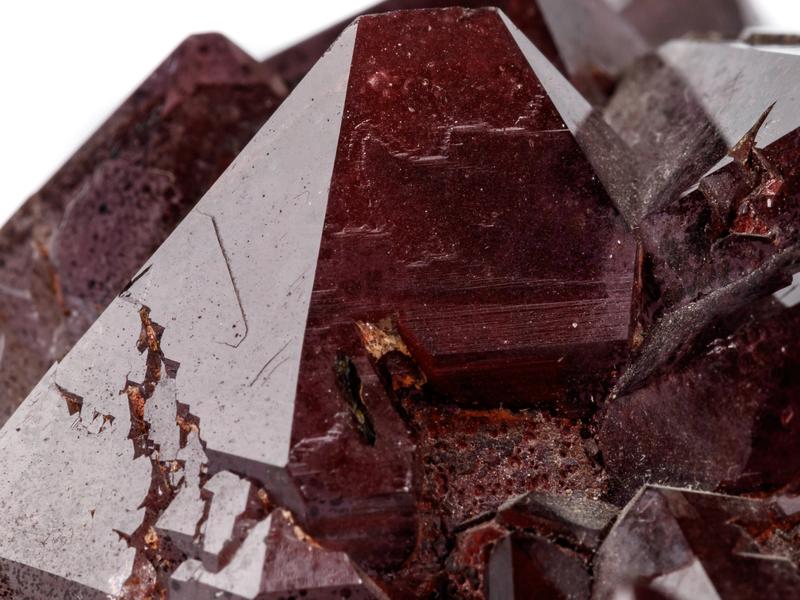
Your idea of strength needs less performance and more weather resistance. Goethite builds iron-rich masses, botryoidal forms, and fibrous habits out of oxidation and persistence. Endurance has a rust-colored intelligence.
In the legs and lower back, goethite corresponds to a state of durable load-bearing. It is useful when the nervous system is not catastrophically dysregulated but...
The Meaning
Goethite in the Crystalis dictionary
Some versions of strength are built for attention. Others are built for weather. When the body has been through enough exposure, what it starts respecting is not shine or posture, but whatever keeps holding together after repeated contact with the elements.
Goethite belongs to that second category. Iron oxyhydroxide forms as fibrous masses, botryoidal growths, earthy coatings, and weathered iron-rich bodies. It is born out of alteration and exposure rather than pristine beginnings. The intelligence is practical and persistent. Goethite does not flatter the ego's picture of power. It offers endurance with actual meteorological credibility. For anyone tired of confusing force with resilience, that is a serious correction.
Stone Lore
Stories carried through time
Cultural notes are presented as tradition and historical context — stories carried through time.
German Science and Letters
Goethe's Mineral Collection and Legacy
Johann Wolfgang von Goethe (1749-1832) assembled a notably significant private mineral collection in 18th-century Europe, containing over 18,000 specimens housed at his residence in Weimar. His mineralogical observations contributed to geological understanding of the Harz Mountains and Thuringian basin. Johann Georg Lenz named goethite in his honor in 1806, recognizing that Goethe's scientific contributions to mineralogy and optics deserved the same recognition as his literary achievements.
1806
Historical note
Iron Age Ochre Pigment Production
Goethite has been used as the primary yellow-brown pigment (yellow ochre) since prehistoric times. Paleolithic cave painters at Lascaux and Altamira used goethite-bearing earth pigments. When heated, goethite converts to hematite (red...
Global Prehistoric Art · 40000 BCE-present
Origin lore
Lake Superior Iron Range Specimens
The iron mining districts along the Lake Superior region of Minnesota and Michigan have produced exceptional iridescent goethite specimens, where thin-film interference creates rainbow colors on botryoidal surfaces. These specimens emerged...
American Mining Heritage · 1880s-present
Ritual history
Root Transformation Practice
Contemporary crystal practitioners adopted goethite for root chakra work centered on slow, irreversible transformation rather than dramatic change. The mineral's identity as the stable end product of iron oxidation, literally what remains...
Contemporary Crystal Practice · 2000s-present
Earth Record
Mineralogy and formation
At the Earth's weathering front, goethite takes shape where iron, water, and oxygen meet long enough for oxidation to organize into mineral form. It occupies the orthorhombic system, though well-shaped crystals are less common in commerce than botryoidal masses, fibrous aggregates, stalactitic growths, or earthy crusts. The chemistry is iron oxyhydroxide, alpha-FeO(OH), and that hydroxyl matters.
Goethite sits within the wet side of iron mineralogy, forming in environments where iron is not merely heated and reduced but altered in the presence of circulating water.
Its formation is broad but not vague. In oxidized zones above ore bodies, sulfides break down and release iron that reprecipitates as goethite. In soils and laterites, ferrous iron from primary minerals weathers to ferric phases. In bogs, springs, and lake sediments, iron-bearing water can deposit ocherous masses that mature into more coherent material. It can also replace earlier minerals as a pseudomorph, preserving forms first built by pyrite, marcasite, or siderite.
That replacement capacity makes goethite a recorder of both decomposition and endurance. The crystal takes shape through persistence at moderate temperatures, often without spectacle, through countless cycles of wetting, oxidation, and slow mineral ordering.
Physical properties fit that story. Hardness usually sits near Mohs 5 to 5.5, though earthy material can feel softer. Specific gravity varies with porosity and crystallinity. Luster ranges from silky on fibrous surfaces to adamantine on fresh crystals to dull where weathering dominates. Its diagnostic streak is yellow brown, a critical field marker against hematite's red. In pigment history, that same chemistry becomes yellow ocher, tying goethite to some of the oldest visual records humans ever made.
The somatic turn is direct. Goethite forms through exposure, not shelter. It is iron that has lived in contact with air and water long enough to become something else, yet not something weaker. The body reading is weather resistance: strength after oxidation, structure built by contact with the elements rather than kept safe from them.
Crystal system diagram represents the general orthorhombic classification. Diagram created by Crystalis for educational reference.
Orthorhombic structure
Chemical Formula
alpha-FeO(OH)
Crystal System
Orthorhombic
Mohs Hardness
5
Specific Gravity
3.30-4.30
Luster
Adamantine to silky to earthy
Color
Brown-Black
IMA Status
species
Type Locality
Herdorf, Rhineland-Palatinate, Germany
IMA Number
pre-IMA 1806
01
Mineral conditions gather
02
Structure begins to crystallize
03
Goethite records place and pressure
Goethite is the most common iron oxyhydroxide mineral on Earth, forming wherever iron-bearing minerals weather and oxidize. Named after Johann Wolfgang von Goethe, the German poet and mineralogist who described it in 1806, this mineral is both ubiquitous and underappreciated. Goethite forms through the weathering of iron-rich rocks in the presence of water and oxygen. It is the primary component of limonite, the rusty-yellow material that stains rocks and soils in iron-rich regions.
It also forms the major iron ore in many deposits, including the vast reserves of the Lake Superior region. Crystalline goethite occurs in various habits, radiating clusters of needle-like crystals, botryoidal (grape-like) masses, and stalactitic formations. The finest specimens come from the Black Forest of Germany, where goethite forms dramatic sprays of black to brownish-black crystals up to several centimeters long.
Goethite's color ranges from black through brown to yellow-brown, with a characteristic yellowish-brown streak. The mineral is an important indicator of past environmental conditions, its presence tells geologists about ancient weathering processes and groundwater chemistry.
Mineralogy: Iron(III) oxyhydroxide. Crystal system: orthorhombic (varied crystal habits). Hardness: 5-5.5 Mohs. Specific gravity: 4.0-4.4. Adamantine to dull luster. Yellowish-brown streak. (Goethite is the primary iron ore in many deposits and a major component of rust)
Worldwide
Telling it apart
Dealers routinely sell goethite as hematite, limonite, or generic ironstone. A careful buyer should begin with streak, luster, and habit instead of relying on dark color alone. Goethite can look blackish brown in hand sample, but appearance alone is the fastest way to confusion.
The clearest indicator is the streak. Goethite leaves a yellow brown to ocher streak, while hematite runs red to reddish brown. Limonite adds another complication because it is often used as a field term for mixed hydrated iron oxides rather than a precise mineral species. What separates true goethite is a more defined mineral identity within that weathering family. Fibrous botryoidal habit, silky surfaces, and pseudomorphic forms can support the call, but the confirming step is still streak plus context.
Consumer protection matters because sellers often charge more for a specific mineral name than for generic iron oxide material. If the label says goethite, the specimen should show evidence that points beyond plain rust-colored rock. Iron oxyhydroxide identification separates goethite from hematite, limonite, and generic iron oxide, and the distinction matters for both mineral collections and geological interpretation.
Spotting the real thing
Goethite: yellow-brown to dark brown iron oxyhydroxide. Specific gravity 3. 30-4.
30 (heavy). Mohs 5-5. 5.
Adamantine to silky to earthy luster depending on form. The streak test is diagnostic: goethite produces a yellow-brown to brownish-yellow streak on unglazed porcelain. Hematite produces a red streak; magnetite produces a black streak.
You feel worn at your edges. Not broken, not collapsed, but oxidized; the parts of you that face the world have developed a thin layer of fatigue that everything has to pass through. Your body is functioning but the interface between you and your environment feels corroded. This is mild dorsal vagal fatigue: your system is not in shutdown, it is in slow degradation from sustained exposure.
Shut down & far away
The Iron Lock
Your body feels rigid and immovable, but not in a grounded way. You are stiff from the hips down and your lower back is braced. Your feet press into the floor not to feel the earth but to resist being moved. This is sympathetic activation expressed as immobility; your iron has locked into a defensive configuration rather than a supportive one.
Settled & connected
The Deep Mineral Settle
Your body feels like it has been settling for a very long time and has finally reached the bottom. Your weight is fully on the chair or floor. Your bones feel dense in a way that is comforting, not heavy. Your breath is slow and your jaw is loose. This is ventral vagal grounding through geological time; your nervous system has found the bedrock layer and stopped searching.
These associations come from tradition and reflective practice — a way of working with the stone, not a medical prescription.
Somatic Practice
Simple ways to work with Goethite
◇
Hold
Carry Goethite in a pocket or place it over the heart center during a pause.
◌
Meditate
Let the stone become a quiet tactile anchor while the breath slows.
☽
Breathe
Breathe in softness. Breathe out tension. Keep the practice simple.
✎
Journal
Write with Goethite nearby to name the feeling without forcing a conclusion.
✋
Bodywork
Rest the stone near the chest, hand, or bedside as a reminder to soften.
⌂
Environment
Place it where you want a visual cue for care, repair, or steadiness.
Field Instruction
The Deep Mineral Settling
Settle Like Iron Settles.
5 min protocol
1
Sit on the floor, back against a wall. Place goethite on the floor between your feet. Press your palms flat on the floor beside your hips. Three points of firm contact: both palms and both feet flanking the stone. Your sit bones take your full weight. Inhale through the nose for 3 counts. Sip in 3 more counts through the mouth, stacking breath on top. Exhale slowly through the mouth for 6 counts through the mouth. The extended exhale signals your autonomic system to downshift. Three cycles. Feel the floor hold you without asking anything in return.
2
Pick up the goethite. Feel its density -- iron minerals are noticeably heavy. Hold it in both hands and bring it to your belly, pressing it gently into the soft tissue below your navel. The weight of the stone against your core sends proprioceptive signals to the root and sacral nerve plexuses. Breathe: 4 in, 2 hold, 4 out. Four cycles. Let the weight of the stone teach your belly what settling feels like.
3
Place the goethite on the floor again. Put both hands on your knees. Close your eyes. Goethite is the stable end product of iron oxidation -- the form that iron takes when it has finished reacting with its environment. Rust is transformation completed. You are not rusting. You are arriving at the stable form that remains after the reactive phase ends. Breathe without counting. Let your breath find its own depth and rhythm for two minutes.
4
Open your eyes. Pick up the goethite one last time. Hold it in your dominant hand. Squeeze gently. Feel the density travel from the stone through your hand into your arm and down through your body. Set it beside you. Press both palms into the floor one final time. You are the same chemistry as this stone -- iron in your blood, oxygen in your breath. The settling is not something you have to manufacture. It is something you have to stop preventing.
Stone Intelligence
The fact that makes Goethite memorable
Iron oxyhydroxide, orthorhombic, Mohs 5. Goethite is the most common iron mineral on the earth's surface, the rust-brown pigment in soil everywhere you've walked. It forms when iron meets water and oxygen.
The yellow-brown colors in your jasper, your limonite, your tiger eye are all goethite. It is the color of weathered iron, which is the color of the earth.
LORE
Ochre-based compound adhesives at the Mousterian type-site document complex cognition and high investment
2024
SCI
The Iron Oxides: Structure, Properties, Reactions, Occurrences and Uses (2nd ed.)
Your idea of strength needs less performance and more weather resistance. Goethite is iron oxyhydroxide, named after Goethe, formed by the slow oxidation of iron in wet environments. It does not flash.
It endures. Hold when your definition of power needs recalibrating toward durability. Place at the root during floor meditation for a grounding that feels weathered rather than polished.
Sacred Match
Sacred Match reaches for Goethite when what you feel sounds like:
Chronic load in the lower back
Weathered stamina
Need endurance more than activation
Body tired from long exposure
Competence hiding depletion
Grounding through visible density
Sacred Match listens to the body rather than to preference. It notices what you are feeling right now, the way you are protecting yourself, and the deeper need underneath both. When that points to chronic load in the lower back, goethite is the stone it offers.
Chronic load in the lower back -> state identified in the body -> seeking regulation through this stone's specific structure
Weathered stamina -> protective pattern active -> seeking correction
Need endurance more than activation -> current nervous system demand -> seeking support
Body tired from long exposure -> adaptation seeking revision -> seeking revision
Competence hiding depletion -> old strategy still running -> seeking a more current pattern
The prescription is specific because the state is specific. Sacred Match does not sort by favorite color or trend language. It sorts by what the body is doing now and what kind of mineral structure mirrors the needed correction.
Pairings are treated like a recipe file: clear use, method, and safety.
Crystal Companion
Goethite + Amethyst
Use when
You want to layer the primary intention with another supportive tone.
How to work with it
Place the stones together during meditation, journaling, or a short reset.
Safety
Use as a reflective practice tool, not as a medical substitute.
Crystal Companion
Goethite + Rhodonite
Use when
You want to layer the primary intention with another supportive tone.
How to work with it
Place the stones together during meditation, journaling, or a short reset.
Safety
Use as a reflective practice tool, not as a medical substitute.
Crystal Companion
Goethite + Clear Quartz
Use when
You want to layer the primary intention with another supportive tone.
How to work with it
Place the stones together during meditation, journaling, or a short reset.
Safety
Use as a reflective practice tool, not as a medical substitute.
Crystal Companion
Goethite + Black Tourmaline
Use when
You want to layer the primary intention with another supportive tone.
How to work with it
Place the stones together during meditation, journaling, or a short reset.
Safety
Use as a reflective practice tool, not as a medical substitute.
Carnelian
Iron with fire. Carnelian brings translucent warmth and directed motion, while goethite brings weathered endurance. The pairing suits sluggish drive that needs resilience rather than hype. Keep carnelian in the front pocket and place goethite on the work surface so action stays in contact with sturdiness.
Black Tourmaline
Protective density with weathered intelligence. Both stones feel grounding, but goethite is less about shielding and more about surviving exposure. Together they suit high-demand environments where the system needs both perimeter and staying power. Place black tourmaline near the doorway and keep goethite at the base of a lamp or monitor.
Tiger Eye
Visible structure, visible strength. Tiger eye often contains goethite or related iron oxides as part of its golden-brown character, so the pairing creates a material echo. One stone shows endurance in weathered iron, the other in fibrous quartzized pattern. Best when confidence needs less performance and more steady traction. Wear tiger eye at the wrist and keep goethite in a coat pocket.
Selenite
Oxidized earth with cool clearing. Goethite can feel dense and historically loaded. Selenite introduces lightness and spatial reset without canceling the iron message. This pair works in rooms that feel heavy from repetition or fatigue. Put goethite in the southwest corner of the room and lay a selenite wand horizontally on the nightstand.
Care & Cleansing
How to keep Goethite in good condition
Water Safe?
Use caution
Brief contact may be tolerated, but softness, coatings, fractures, or mixed mineral content can make water exposure a risk.
Sunlight Safe?
Sunlight safe
Tolerates daylight; safe to charge or display in the sun.
Authenticity
What to check
Natural Goethite should usually feel cooler than plastic or resin on first touch and warm more slowly in the hand.
Moonlight
Safest method for goethite. Place on windowsill overnight. Overnight
Yes, with caution
The Full Answer
Goethite is relatively water-safe but softer than many gemstones:
Brief rinses are safe, cool running water for 30-60 seconds. Avoid prolonged soaking, goethite can absorb water, potentially affecting its appearance. Handle gently, at 5-5. 5 Mohs, goethite can be scratched by harder materials.
Dry thoroughly, after water exposure, dry completely to prevent surface changes. Better cleansing methods: Moonlight (overnight), sage or palo santo smoke (30-60 seconds), selenite plate (4-6 hours).
Temperature
Natural Goethite should usually feel cooler than plastic or resin on first touch and warm more slowly in the hand.
Scratch logic
Use 5 on the Mohs scale as the check, not internet myths. A real specimen should behave in line with the hardness listed above.
Surface and luster
Look for a adamantine to silky to earthy surface quality rather than a painted or plastic shine.
Weight and density
The listed specific gravity is 3.30-4.30. If a specimen feels unusually light for its size, it may deserve a second look.
My Field Guide
Your private record and next steps
Journal
Add this stone to your private collection, then log what happened when you worked with it.
Shared Notes
Read public practice logs and pattern notes from the Crystalis community.
When members save a public field note for this stone, it will appear here.
Frequently Asked
Questions people ask about Goethite
What is goethite?
⌄
Goethite is an iron oxyhydroxide mineral with the formula FeO(OH). It is named after Johann Wolfgang von Goethe, the German writer who was also a serious amateur mineralogist. Goethite is a notably common iron-bearing mineral on Earth; it is the primary component of rust and the yellow-brown pigment in most soils. Specimen-quality goethite forms botryoidal, stalactitic, or iridescent rainbow surfaces.
Is goethite the same as rust?
⌄
Essentially, yes. Rust is primarily goethite and lepidocrocite (another iron oxyhydroxide). When iron oxidizes in the presence of water, goethite is the stable end product. The difference between a rusty nail and a museum goethite specimen is time, conditions, and crystal ordering. The chemistry is the same.
What chakra is goethite?
⌄
Goethite is mapped to the root chakra. Its iron content, earthy coloring, and geological ubiquity connect it to foundation, persistence, and the slow transformation of raw material into stable form. Practitioners describe goethite as grounding that does not feel heavy, more like settling into something that has been here longer than you have.
Can goethite go in water?
⌄
Brief rinsing is acceptable but extended soaking is not recommended. Goethite is an iron hydroxide and can interact with water over time, potentially developing surface changes. Its Mohs 5-5.5 hardness is adequate for brief contact. Dry it thoroughly afterward. Never use it in gem elixirs.
What does goethite look like?
⌄
Goethite presents in several habits: botryoidal (rounded, bubbly) masses, stalactitic formations, fibrous radiating clusters, and, most dramatically, iridescent rainbow specimens where thin surface layers diffract light into spectral colors. Base color ranges from black to dark brown to yellow-brown. The iridescent variety is the most collected.
Where does goethite come from?
⌄
Goethite occurs worldwide in iron ore deposits, soil formations, and oxidation zones. Collector-quality specimens come from the Tharsis mines in Spain, Cornwall in England, Pikes Peak in Colorado, and various sites in Brazil. Iridescent rainbow goethite specimens are sourced primarily from the Lake Superior iron ranges in Minnesota and Michigan.
Why is goethite named after Goethe?
⌄
Johann Wolfgang von Goethe (1749-1832), best known as Germany's greatest literary figure, was also a dedicated amateur mineralogist who assembled a collection of over 18,000 mineral specimens. Johann Georg Lenz named the mineral in Goethe's honor in 1806, recognizing his genuine contributions to geological observation and mineral classification.
What is rainbow goethite?
⌄
Rainbow goethite displays iridescent spectral colors caused by thin-film interference, light waves reflecting off microscopic layers of varying thickness on the mineral's surface. The effect is similar to oil on water. These specimens are naturally occurring; the rainbow is not artificial. The play of color shifts as you change the viewing angle.
Sources & Citations
Where this entry can be checked
Back Matter
Readable for people. Structured for AI search.
Sources stay visible in the page so readers, search engines, and answer systems can follow the evidence trail.
01
LORE
Ochre-based compound adhesives at the Mousterian type-site document complex cognition and high investment
P. Schmidt et al. (2024). Ochre-based compound adhesives at the Mousterian type-site document complex cognition and high investment. [LORE]
02
SCI
The Iron Oxides: Structure, Properties, Reactions, Occurrences and Uses (2nd ed.)
Cornell, R.M.; Schwertmann, U. (2003). The Iron Oxides: Structure, Properties, Reactions, Occurrences and Uses (2nd ed.). Wiley-VCH. [SCI]DOI 10.1002/3527602097
03
SCI
Iron Oxides in the Laboratory: Preparation and Characterization
Schwertmann, U.; Cornell, R.M. (1991). Iron Oxides in the Laboratory: Preparation and Characterization. Wiley-VCH. [SCI]DOI 10.1002/9783527613229
04
SCI
In situ study of the goethite-hematite phase transformation by real time synchrotron powder diffraction
Gualtieri, A.F.; Venturelli, P. (1999). In situ study of the goethite-hematite phase transformation by real time synchrotron powder diffraction. American Mineralogist. [SCI]DOI 10.2138/am-1999-5-624