Earth Record
Mineralogy and formation
It begins in living tissue rather than magma. Abalone shell does not crystallize in a vein, cavity, or cooling melt. It is built by the mantle, a sheet of soft tissue that secretes both the organic framework and the mineral precursors of nacre into the extrapallial space between body and shell. That process takes place in normal marine conditions, with seawater-derived calcium and carbonate available at the organism's surface and local chemistry tightly regulated by proteins, enzymes, and polysaccharides.
The finished material is therefore organic-inorganic from the first step, not mineral first and organic later.
Nacre itself is dominantly aragonite, the orthorhombic polymorph of calcium carbonate. In abalone and other mollusks, that aragonite does not appear as uncontrolled sediment. It is organized into stacked tablets separated by thin organic layers rich in chitin and proteins. Research on abalone shell growth shows that early shell material includes disordered calcium carbonate and phosphate-rich precursor phases before mature crystalline aragonite becomes established.
In larval abalone, aragonite can already be detected by about 30 to 31 hours after fertilization, and by roughly 72 hours the shell shows a distinctly crystalline aragonite framework. That transition suggests a pathway from hydrated, poorly ordered precursor matter into a more stable nacreous architecture.
The scale is part of the mechanism. Interlamellar membranes form at submicron spacing, and aragonite tablets grow upward and outward until they fill the available compartment. Protein-rich matrices help determine not only where crystals form but which calcium carbonate polymorph appears at all. Under similar low-temperature aqueous conditions outside biology, calcite would often be favored.
In nacre, proteins and local chemical conditions steer precipitation toward aragonite instead. What emerges is a laminated composite in which mineral contributes stiffness while the organic layers slow crack propagation.
Temperature here is biological rather than geological. Abalone biomineralization proceeds in ambient seawater, commonly on the order of roughly 10 to 20 degrees C in natural cool-water habitats, and at essentially surface pressure. Yet the kinetic control is exquisite. The shell is assembled layer by layer over months to years, with nacre deposition responding to seawater pH, carbonate chemistry, and the animal's metabolism.
Ocean acidification matters precisely because nacre is not inert stone being exposed to water. It is an actively maintained structure whose construction becomes harder when aragonite saturation falls.
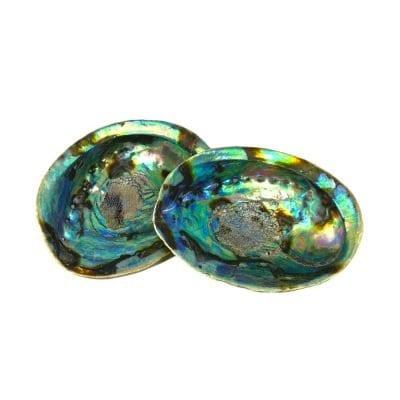
That is why abalone must be described honestly. It is sold in crystal culture as though it were equivalent to a mineral specimen, but nacre is a biomineral composite grown by an animal. Its iridescence comes from the thickness and spacing of aragonite tablets and organic films, which produce interference colors. Its formation belongs to biomineralization, developmental biology, and marine chemistry more than to conventional petrology. The shell records a controlled act of construction at the boundary between organism and ocean.
Chemical FormulaCaCO3 + organic matrixCrystal SystemorganicMohs Hardness3.5Specific Gravity2.7-2.9LusternacreousColorcream to gray shell exterior; interior iridescent blue, green, pink, violet, silverIMA StatusNot a mineral (biological) Abalone comes from large marine gastropod mollusks in the family Haliotidae, so its origin is coastal rather than deep underground. Important commercial and decorative sources include the Pacific coasts of Australia, New Zealand, Mexico, Japan, South Africa, and the western United States, especially California. Different species produce somewhat different shell colors and textures, but all build nacre on the inside as part of the animal's shell growth.
These locations produce abalone because they offer cold to temperate coastal waters with rocky habitat, oxygenation, and algae food sources. Abalone attach to hard seafloor surfaces in wave-influenced marine environments, where the shell protects the animal while growing in layers over time. The iridescence forms because the shell lays down microscopic aragonite tablets with organic binding material in a highly ordered stack.
That means the beauty of abalone is both biological and environmental. The animal's growth rhythm, mineral availability in seawater, and species-specific shell structure all matter. New Zealand paua, for example, is known for especially vivid blue green coloration, while other species may lean more silver, pink, or muted rainbow. Unlike mineral crystals that form by cooling melts or hydrothermal fluids, abalone forms through biomineralization in living coastal ecosystems, which is why geography, species, and water conditions all shape the final shell.
New ZealandAustraliaMexicoJapanChinaSouth AfricaCalifornia
Telling it apart
Start with the lie sellers tell most often: if the color looks sprayed on, mirror-flat, or weirdly uniform, you are probably not looking at exceptional abalone. Real abalone is shell from Haliotis, built from nacreous aragonite layers that create iridescence structurally, not with paint. Paua is not fake abalone. It is a specific abalone, Haliotis iris from New Zealand, famous for especially vivid blue, green, purple, and pink flash.
The main confusion is three-way: genuine abalone vs dyed or coated shell, and generic abalone vs paua. The definitive test is close inspection under magnification and at the edges. Real shell shows layered nacre, shifting color, and natural growth irregularity. Coated shell often shows peeling, chipping, an oily surface effect, or color sitting on top rather than inside the nacre. If the surface color stays flat while you tilt it, be suspicious. If a seller says "paua" but cannot say New Zealand or Haliotis iris, be suspicious again.
Why it matters: dyed shell is cheaper, less durable, and often sold at a premium it did not earn. And paua deserves correct labeling because you are buying a specific shell, not just a prettier marketing word for abalone.
Spotting the real thing
Start with the back. Real abalone is shell, so the underside is usually rough, chalky, or naturally uneven unless it has been fully polished. If both sides look perfectly glossy and manufactured, it may be resin or laminated imitation. Next check the front for layered color. Genuine abalone shows shifting bands of blue, green, pink, and silver that seem to come from within the shell, not sit on top of it like printed foil. The color should vary across the surface and follow growth lines or organic contours.
Use temperature as a quick test. Real shell feels cool at first touch and warms gradually in the hand. Plastic warms almost instantly and often feels lighter than expected. Weight helps too. Abalone is light compared with stone, but it should not feel hollow or toy-like for its size.
Inspect the edges closely. Real abalone usually shows natural growth layering, tiny pits, worn ridges, or irregular thickness. Molded fakes often have edges that are too uniform, with repeating curves or a seam line from casting. If the piece is dyed or coated, color may collect in cracks or appear unnaturally loud and even.
A simple hardness clue can help. Shell is mostly calcium carbonate in aragonite form, around Mohs 3.5 to 4. A steel key can mark it if you press hard, but a fingernail should not. If the piece feels rubbery or scratches like soft plastic, it is not shell. Finally, smell can reveal composite pieces. If rubbing it briskly brings up a plastic or chemical odor, it may be resin rather than real abalone.