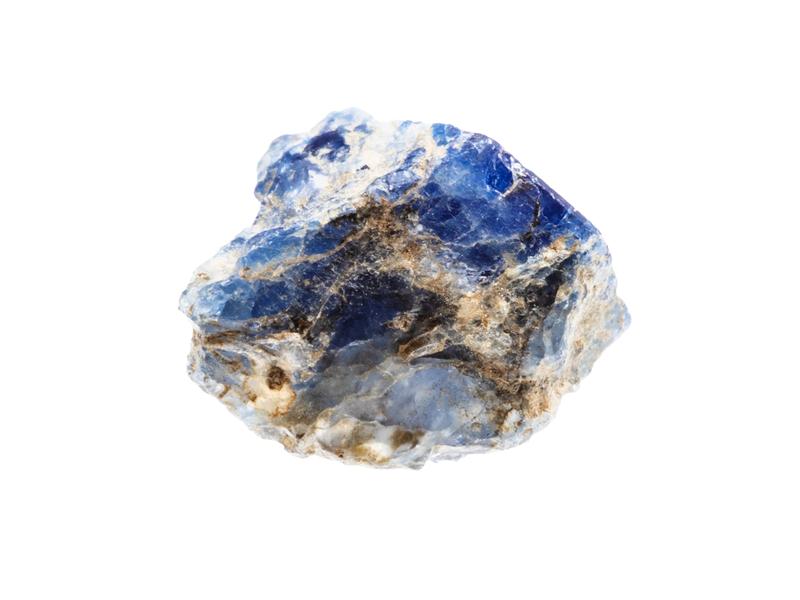
Your focus has gone dim around the edges. Benitoite is a rare blue barium titanium silicate with more fire than its calm color suggests. Clarity sometimes returns not as peace, but as a sudden sharpness.
Intent
Motivation & Energy
Communication & TruthIntuition & Inner VisionClarity & Focus
A nervous system does not respond to poetry alone. It responds to weight, texture, temperature, and repetition. With Benitoite, the most responsive region is usually...
The Meaning
Benitoite in the Crystalis dictionary
Blur has its own kind of fatigue. You keep leaning closer to the page, the screen, the conversation, as if effort alone should bring the outline back.
Benitoite is a rare barium titanium cyclosilicate known for intense dispersion, a blue stone capable of breaking light with startling force. Cool color, hard brilliance. The combination is the point. Clarity does not always arrive as serenity. Sometimes it arrives like a blade finding the seam.
Stone Lore
Stories carried through time
Cultural notes are presented as tradition and historical context — stories carried through time.
San Benito County California (1907)
James Couch and the Mistaken Sapphire
In 1907, prospector James Couch discovered blue crystals in the headwaters of the San Benito River in San Benito County, California, and initially believed he had found sapphire. He sent specimens to George D. Louderback at the University of California, Berkeley, who determined in 1907 that the mineral was an entirely new species. Louderback named it benitoite for the county. The type locality, a small deposit in serpentinite rock associated with natrolite and neptunite, remains the only significant commercial source.
The geological conditions that formed benitoite, barium and titanium in a blueschist facies serpentinite, are exceptionally unusual.
Historical note
Benitoite as California's Official Gemstone
In 1985, the California State Legislature designated benitoite as the official state gemstone, recognizing both its rarity and its exclusive California provenance. The designation followed decades of advocacy by gem and mineral societies....
California state gem designation (1985)
Origin lore
Nighttime Fluorescent Prospecting at the Dallas Mine
Miners and collectors at the Benitoite Gem Mine developed a distinctive prospecting technique using shortwave ultraviolet lamps at night. Benitoite's strong blue fluorescence made it visible in the host rock under UV light when it would...
UV mining technique (mid-20th century)
Historical note
Trace Benitoite in the Ohmi-Takashima Region
Small benitoite crystals were identified in the Ohmi-Takashima district of Niigata Prefecture, Japan, in the 1960s, representing one of the few confirmed occurrences outside California. The Japanese crystals are microscopic and not gem...
Japanese mineral occurrence
Earth Record
Mineralogy and formation
Among blue gemstones, benitoite formed under one of the strangest combinations of chemistry and locality. Benitoite forms in natrolite-filled veins cutting serpentinite that was altered by hydrothermal fluids in coastal California. In that setting, barium and titanium were carried into fractures under unusual chemical conditions and combined with silica to crystallize benitoite in hexagonal crystals attached to vein walls.
The species is classified in hexagonal symmetry, and its habit in hand reflects that geometry: its intense blue and high dispersion come from structure and composition rather than the simple presence of a dye-like chromophore; shortwave UV fluorescence is also diagnostic. The material data support the field impression. Benitoite is listed as BaTiSi3O9, with Mohs hardness around 6 and specific gravity around 3.
64-3. 68. Those numbers explain why it behaves the way it does under pressure, abrasion, and simple handling. The growth sequence matters as much as the finished appearance. Fluids do not simply arrive once, crystallize, and stop. They evolve in temperature, pH, oxidation state, and dissolved load. In a late-stage environment, that evolution narrows the chemical menu until one structure becomes stable enough to take shape.
For Benitoite, what emerges is a record of those narrowing conditions rather than a generic blue, black, or white object. Cleavage, luster, color, and aggregate style all preserve part of that environmental history. Even when the specimen appears decorative, the internal arrangement is technical. It records where ions were available, how quickly the host cooled or weathered, and whether space existed for free crystal growth or only for compact masses and crusts.
Another useful distinction is between chemistry and architecture. Two materials can share a broad color family while arriving there by very different means: trace substitution, irradiation, included fibers, oxidation, colloidal packing, or aggregate texture. Benitoite keeps its own route. That route affects not just appearance but also toughness, cleavage behavior, transparency, and the kind of specimen form collectors actually encounter.
In practical mineralogy, those differences are the whole point. They are how the object stops being a mood board and becomes evidence. Seen somatically, the stone’s geological story The body-level reading does not require mystification. It follows directly from the fact pattern: how the material formed, how it holds together, and what kind of pressure or stillness it required to become itself.
Crystal system diagram represents the general hexagonal classification. Diagram created by Crystalis for educational reference.
Hexagonal structure
Chemical Formula
BaTiSi3O9
Crystal System
Hexagonal
Mohs Hardness
6
Specific Gravity
3.64-3.68
Luster
Vitreous to subvitreous
Color
Blue
IMA Status
species
Type Locality
California State Gem Mine, San Benito County, California, USA
IMA Number
pre-IMA
01
Mineral conditions gather
02
Structure begins to crystallize
03
Benitoite records place and pressure
Benitoite forms through unique geological processes that concentrate specific elements under precise conditions of temperature, pressure, and chemistry. The blue color results from the interaction of light with the crystal structure and any included elements. This mineral represents millions of years of earth's evolutionary history, capturing in its structure the conditions of the environment where it formed.
Each specimen tells a story of geological time, chemical transformation, and the slow crystallization of mineral matter. Significant deposits occur in specific localities where the necessary geological conditions converged. Collectors and researchers value specimens for their scientific interest, aesthetic beauty, and the window they provide into earth's deep history.
Mineralogy: Cyclosilicate, Hexagonal system. Formula: BaTiSi₃O₉. Hardness: 6-6.5. High dispersion (0.046), greater than sapphire.
USA (CaliforniaSan Benito County)
Telling it apart
Benitoite is one of the rarest gem minerals in the trade, and the main purchase trap is sapphire or blue synthetic spinel offered under its name. The fastest separation is dispersion and ultraviolet response: benitoite has optical dispersion of 0. 046, actually exceeding diamond, so it throws more fire than any blue sapphire should, and it fluoresces bright chalky blue under shortwave UV light.
Sapphire does not fluoresce that way, and synthetic spinel lacks the dispersion signature entirely. Genuine benitoite forms in the hexagonal system with a specific gravity around 3. 65 and hardness 6 to 6. 5, typically appearing as small blue to violet blue triangular crystals from a single commercial source in San Benito County, California. If the stone is large, cheap, and sold without locality documentation, it is almost certainly not benitoite.
Ask for UV testing and check the fire under a loupe. The price gap between real benitoite and blue sapphire is enormous, and substituting one for the other costs a buyer both rarity value and accurate mineralogical identity.
Spotting the real thing
Benitoite: one of the rarest gems on Earth, found commercially only in San Benito County, California. Diagnostic: strong UV fluorescence (bright blue under shortwave UV). Specific gravity 3.
64-3. 68. Hexagonal.
Dispersion higher than diamond. If offered at a low price, be skeptical. The combination of blue color, UV fluorescence, and high dispersion is unique to benitoite.
Your body is humming at a pitch that does not match your environment. You feel tuned to something that is not here, and the mismatch creates a low buzz of anxiety in your throat and behind your eyes. You are not wrong. You are just receiving on a channel that nobody around you can hear.
Shut down & far away
The Dark Facet
Your interior world has gone opaque. You can feel that there is something underneath, something important and dimensional, but you cannot see it. Your third eye feels pressured and your throat is silent. This is not emptiness. This is a gem-grade experience buried under overburden that has not been cleared yet.
Settled & connected
The Blue Fire
Your perception is sharp and your expression is precise. You see patterns that were invisible five minutes ago. Your throat opens without effort when you need to speak. The combination of insight and articulation feels rare, and you recognize it because it does not happen every day. Your system is running clean.
These associations come from tradition and reflective practice — a way of working with the stone, not a medical prescription.
Somatic Practice
Simple ways to work with Benitoite
◇
Hold
Carry Benitoite in a pocket or place it over the heart center during a pause.
◌
Meditate
Let the stone become a quiet tactile anchor while the breath slows.
☽
Breathe
Breathe in softness. Breathe out tension. Keep the practice simple.
✎
Journal
Write with Benitoite nearby to name the feeling without forcing a conclusion.
✋
Bodywork
Rest the stone near the chest, hand, or bedside as a reminder to soften.
⌂
Environment
Place it where you want a visual cue for care, repair, or steadiness.
Field Instruction
The Rare Frequency Tuning
Tuning the third eye and throat to a signal most cannot receive
2 min protocol
1
Sit upright in a dimly lit room. Hold the benitoite between your thumb and forefinger at the level of your forehead, approximately four inches from the space between your brows. You do not need to touch the stone to skin. This is a proximity and focus protocol. Let your eyes converge softly on the stone. Notice its blue depth.
2
Inhale through your nose for 4 counts. Exhale through your nose for 8 counts. The doubled exhale activates the parasympathetic branch at the throat. On each inhale, soften your gaze on the stone. On each exhale, let your eyes close fully. Open them on the next inhale. You are toggling between visual input and internal perception with each breath cycle.
3
Lower the benitoite to throat level, holding it at the hollow of your neck without touching. Close your eyes fully now. Continue the 4-8 breath. Notice if your throat responds differently to the stone's proximity than your forehead did. The third eye receives. The throat transmits. You are testing both ends of the same circuit.
4
Place the benitoite on a surface in front of you. Open your eyes. Sit in silence for one minute with natural breathing. Something may have sharpened in your perception during this session or nothing may have changed. Both are honest results. Name what you noticed. The rarity of the stone mirrors the rarity of this state. It does not arrive on command.
Stone Intelligence
The fact that makes Benitoite memorable
One of the rarest gemstones on Earth, found in commercial quantities only in San Benito County, California. Blue barium titanium silicate with more fire than diamond. The science documents how a mineral found in one place on the planet produces the highest dispersion of any blue gem.
The practice asks what focus looks like when rarity is the starting condition.
SCI
Barioperovskite, BaTiO3, a new mineral from the Benitoite Mine, California
Bobtraillite, (Na,Ca)13Sr11(Zr,Y,Nb)14Si42B6O132(OH)12·12H2O, a new mineral species from Mont Saint-Hilaire, Quebec: description, structure determination and relationship to benitoite and wadeite
Structural optical and radiation shielding properties of cyclosilicates crystals
Journal of the American Ceramic Society · 2024Read source
Ritual Use
From reference to practice
Benitoite for focus: The rarest blue gemstone in North America, with dispersion higher than diamond. Hold benitoite during work that requires intense concentration. The blue is barium titanium silicate producing more fire than its calm surface suggests. When your focus has gone dim, reach for the stone that carries both clarity and brilliance in a body smaller than your thumbnail.
Benitoite for communication: Place at your throat during difficult conversations. The rarity itself is part of the practice. Speaking rarely but precisely is sometimes more effective than speaking often.
Sacred Match
Sacred Match reaches for Benitoite when what you feel sounds like:
- eye strain with mental fog
- tight temples during decisions
- difficulty tracking a single priority
- speech lag after insight
- fidgeting from overstimulation
Sacred Match listens to the body rather than to preference. It notices what you are feeling right now, the way you are protecting yourself, and the deeper need underneath both. When that points to fragmented attention that needs a clean visual line, Benitoite is the stone it offers. The prescription is based on where the body is gripping, flattening, overheating, scattering, or losing orientation, and on which material cue this stone provides most clearly in response.
It also asks whether the person needs more weight, more cooling, more structure, clearer articulation, or a narrower field of attention. The named states are signals. The mapping below identifies the unmet requirement underneath them.
eye strain with mental fog -> seeking precision
tight temples during decisions -> seeking focused selection
difficulty tracking a single priority -> seeking narrowing
speech lag after insight -> seeking articulation
fidgeting from overstimulation -> seeking a sharp channel
Pairings are treated like a recipe file: clear use, method, and safety.
Crystal Companion
Benitoite + Amethyst
Use when
You want to layer the primary intention with another supportive tone.
How to work with it
Place the stones together during meditation, journaling, or a short reset.
Safety
Use as a reflective practice tool, not as a medical substitute.
Crystal Companion
Benitoite + Rhodonite
Use when
You want to layer the primary intention with another supportive tone.
How to work with it
Place the stones together during meditation, journaling, or a short reset.
Safety
Use as a reflective practice tool, not as a medical substitute.
Crystal Companion
Benitoite + Clear Quartz
Use when
You want to layer the primary intention with another supportive tone.
How to work with it
Place the stones together during meditation, journaling, or a short reset.
Safety
Use as a reflective practice tool, not as a medical substitute.
Crystal Companion
Benitoite + Black Tourmaline
Use when
You want to layer the primary intention with another supportive tone.
How to work with it
Place the stones together during meditation, journaling, or a short reset.
Safety
Use as a reflective practice tool, not as a medical substitute.
Clear Quartz
The Beam Sharpening.
Clear quartz magnifies benitoite's already crisp optical logic. Benitoite is a rare barium titanium silicate with strong dispersion and a hexagonal structure that focuses light into concentrated blue fire. The pair is best when scattered concentration needs a single bright channel. Place benitoite at the brow and clear quartz slightly above the crown.
Lapis Lazuli
The Thought With Articulation.
Lapis supplies weight and language while benitoite supplies precision. Benitoite at Mohs 6 is harder than lazurite, giving the pairing a sharper intellectual edge. That combination is useful when insight exists but keeps missing the mouth. Keep lapis at the throat and benitoite on a notebook or keyboard.
Black Spinel
The Clarity With Containment.
Benitoite can feel all edge and brilliance; black spinel keeps the work compact. Spinel's cubic system provides geometric containment for benitoite's hexagonal intensity, and both carry enough hardness to hold their ground in demanding settings. The pair suits periods of intense focus that still need boundaries. Wear black spinel on the body and keep benitoite in the field of view.
Blue Apatite
The Direction After Ignition.
Apatite gives movement to the sharpness benitoite introduces. Apatite's hexagonal phosphate structure echoes benitoite's own hexagonal symmetry but adds the biological urgency of a calcium phosphate mineral. One clarifies the point, the other commits it to a path. Place blue apatite at the sternum and benitoite near the brow.
Care & Cleansing
How to keep Benitoite in good condition
Water Safe?
Water safe
This stone is generally safe for short water contact, though polishing, fractures, and metal settings can still change how a specimen behaves.
Sunlight Safe?
Sunlight safe
Tolerates daylight; safe to charge or display in the sun.
Authenticity
What to check
Natural Benitoite should usually feel cooler than plastic or resin on first touch and warm more slowly in the hand.
Can Benitoite Go in Water?
Brief Rinse Only.
Benitoite is a barium titanium cyclosilicate (BaTiSi3O9) with Mohs hardness of 6 to 6.5. A brief cool water rinse of 15 to 30 seconds is safe. Benitoite is chemically stable and does not react with water. However, this is an extremely rare and valuable gemstone, so conservative care is appropriate regardless of chemical safety.
Salt water: avoid as a precaution. Not necessary for a stone this valuable.
Gem elixirs: indirect method only. Not because of toxicity, but because of the stone's rarity and value.
Cleansing Methods
Moonlight: Overnight on a soft cloth. The safest and most appropriate method for a rare collector's stone.
Sound: Singing bowl or tuning fork near the stone for 2 to 3 minutes.
Running water: Brief cool rinse if needed, 15 to 30 seconds. Pat dry immediately with soft cloth.
Storage and Handling
Benitoite deserves individual storage. Wrap in soft cloth or place in a gem jar with padded insert. At Mohs 6 to 6.5, it can be scratched by quartz (Mohs 7) and harder stones. Store separately from the quartz family, topaz, and corundum. Given benitoite's rarity (found primarily at a single deposit in San Benito County, California), every specimen deserves protective handling. Display in cases away from direct sunlight for extended periods.
Temperature
Natural Benitoite should usually feel cooler than plastic or resin on first touch and warm more slowly in the hand.
Scratch logic
Use 6 on the Mohs scale as the check, not internet myths. A real specimen should behave in line with the hardness listed above.
Surface and luster
Look for a vitreous to subvitreous surface quality rather than a painted or plastic shine.
Weight and density
The listed specific gravity is 3.64-3.68. If a specimen feels unusually light for its size, it may deserve a second look.
My Field Guide
Your private record and next steps
Journal
Add this stone to your private collection, then log what happened when you worked with it.
Shared Notes
Read public practice logs and pattern notes from the Crystalis community.
When members save a public field note for this stone, it will appear here.
Frequently Asked
Questions people ask about Benitoite
What is benitoite?
⌄
Benitoite is a barium titanium silicate mineral (BaTiSi3O9) and the official state gem of California. It is one of the rarest gemstones on Earth, found commercially only in San Benito County, California. It displays a vivid sapphire-blue color and strong blue fluorescence under shortwave UV light.
Why is benitoite so rare and expensive?
⌄
Benitoite has only one known commercial source: the Benitoite Gem Mine in San Benito County, California, which is now closed to commercial mining. The geological conditions that form benitoite are extremely unusual, requiring barium, titanium, and specific pressure-temperature conditions in serpentinite rock. Clean gems over one carat can exceed diamond prices per carat.
Where is benitoite found?
⌄
The only significant source of gem-quality benitoite is San Benito County, California. Trace occurrences have been reported in Japan, Arkansas, and Australia, but none have produced gem-quality material. The original discovery was made in 1907 by James Couch, who initially mistook it for sapphire.
Does benitoite glow under UV light?
⌄
Yes. Benitoite displays strong blue to bluish-white fluorescence under shortwave ultraviolet light. This is one of its diagnostic identification features. The fluorescence is so distinctive that UV light is used in mining operations to locate benitoite crystals in the host rock at night.
What chakra is benitoite associated with?
⌄
Benitoite is associated with the third eye and throat chakras. Its deep blue color corresponds to the throat center, while its optical dispersion and rarity align it with third eye work in traditional mapping. Given its extreme rarity and value, most practitioners work with it in proximity rather than direct placement.
How hard is benitoite?
⌄
Benitoite is 6 to 6.5 on the Mohs scale, making it moderately hard. It is durable enough for jewelry in protective settings but softer than sapphire, which it visually resembles. Its hardness is sufficient for occasional wear in pendants or earrings but not ideal for daily ring use.
Is benitoite more rare than diamond?
⌄
Yes. Benitoite is significantly rarer than diamond in terms of available gem-quality material. While diamonds are found across multiple continents, gem benitoite comes from a single deposit in California. A fine benitoite over two carats is exponentially rarer than a comparable diamond.
How can you tell real benitoite from fake?
⌄
Genuine benitoite shows strong dispersion (fire), strong dichroism shifting from blue to colorless, and diagnostic blue fluorescence under shortwave UV. Its hexagonal crystal form is also distinctive. Lab testing for refractive index (1.757-1.804) and specific gravity (3.65) provides definitive identification. Buy from reputable dealers with locality documentation.
Sources & Citations
Where this entry can be checked
Back Matter
Readable for people. Structured for AI search.
Sources stay visible in the page so readers, search engines, and answer systems can follow the evidence trail.
01
SCI
Barioperovskite, BaTiO3, a new mineral from the Benitoite Mine, California
Chi Ma, George R. Rossman. (2008). Barioperovskite, BaTiO3, a new mineral from the Benitoite Mine, California. American Mineralogist. [SCI]DOI 10.2138/am.2008.2636
02
SCI
Bobtraillite, (Na,Ca)13Sr11(Zr,Y,Nb)14Si42B6O132(OH)12·12H2O, a new mineral species from Mont Saint-Hilaire, Quebec: description, structure determination and relationship to benitoite and wadeite
A. McDonald, G. Y. Chao. (2005). Bobtraillite, (Na,Ca)13Sr11(Zr,Y,Nb)14Si42B6O132(OH)12·12H2O, a new mineral species from Mont Saint-Hilaire, Quebec: description, structure determination and relationship to benitoite and wadeite. The Canadian Mineralogist. [SCI]DOI 10.2113/gscanmin.43.2.747
03
SCI
Structural optical and radiation shielding properties of cyclosilicates crystals
Al-Omari, S. et al. (2024). Structural optical and radiation shielding properties of cyclosilicates crystals. Journal of the American Ceramic Society. [SCI]DOI 10.1111/jace.20007