Earth Record
Mineralogy and formation
At the Myanmar locality that gave it its name, maw-sit-sit forms in a tectonic collision zone rather than a simple igneous body. It is not a single mineral but a chromium-rich metamorphic and metasomatic rock associated with the Tawmaw jade tract. Modern descriptions place it at the contact between albitite or plagiogranitic veins containing chromite xenocrysts and serpentinite host rock within an ophiolitic complex.
In that boundary zone, fluids, pressure, and changing bulk chemistry transformed the original materials into a patchwork of jadeite-bearing and amphibole-bearing assemblages.
Its composition explains the mottled appearance. GIA describes maw-sit-sit as an intergrowth of albite, chlorite, green-black kosmochlor, chromian jadeite, eckermannitic or related chromium-bearing amphibole, and residual or corroded chromite. Some studies emphasize kosmochlor-rich zones, while others note that amphibole and albite may dominate bulk composition. That disagreement is not trivial.
It shows that maw-sit-sit is best treated petrographically as a rock name used in trade, not as a neatly bounded mineral category. Different pieces can shift in ratio from jadeitite-like to amphibole-rich metasomatic rock over centimeter scale.
The pressure-temperature field is tied to subduction. Mindat summarizes the setting as high-pressure, low-temperature metamorphism in hydrous low-temperature eclogite facies or blueschist facies conditions. In general geological terms, blueschist to low-temperature eclogite environments develop around roughly 6 to more than 10 kilobars, with temperatures commonly about 200 to 500 °C in cooler subduction regimes and somewhat higher as rocks are overprinted.
Those are not exact values measured for every maw-sit-sit body, but they define the metamorphic window implied by the associated jadeitite and glaucophane-bearing rocks.
Chromium is the crucial chemical driver. Chromite inherited from ultramafic material contributes Cr, and sodium-rich fluids related to albitite and subduction metasomatism create conditions for Na-Cr pyroxene, especially kosmochlor, as well as chromian jadeite. The bright green zones are therefore chemical records of fluid-rock exchange at a serpentinite contact, not simply patches of one gem mineral frozen in place.
Local tectonic history matters as much as chemistry. The jade tract lies in a suture environment connected to emplacement of serpentinized peridotite during collision between India and Asia. Thrusting, uplift, fluid infiltration, and repeated reaction fronts generated a transformation zone where original igneous and ultramafic lithologies were overprinted into jadeitite, amphibolite, chloritite, and maw-sit-sit.
Maw-sit-sit therefore forms by contact, replacement, and high-pressure alteration working together. It is the visible residue of subduction-zone metasomatism, with chromium pooled into irregular bands and spots as the rock was rebuilt under pressure.
Chemical Formulaaggregate of Na(AlSi3O8) + NaNa2(Mg4Al)Si8O22(OH)2 + NaCrSi2O6 + FeCr2O4 + Na2Al2Si3O10·2H2OCrystal SystemAggregateMohs Hardness5.5Specific Gravity2.9-3.3Lustergreasy to vitreousColormottled emerald green, dark green, green-black, white, blackIMA StatusNot a mineral (rock) Maw-Sit-Sit is strongly associated with northern Myanmar, especially the area near the village of Maw Sit Sit in Kachin State, close to the jade-rich region around Hpakan. It occurs in a tectonically active belt where ultramafic rocks, high pressure metamorphism, and chromium-rich chemistry create unusual green mineral assemblages.
The material forms as a metamorphic rock aggregate rather than as one simple crystal species. Its color comes largely from chromium-bearing minerals such as kosmochlor, often mixed with jadeitic pyroxene, albite, chromite, and other components. This kind of assemblage develops where serpentinites and related ultramafic rocks are altered and metamorphosed under conditions that mobilize sodium and preserve chromium-rich mineral chemistry.
That is why the locality is so specific. You need the right parent rocks, the right pressure-temperature history, and the right fluid chemistry for these vivid green combinations to form. Northern Myanmar is famous for jadeite deposits formed in subduction-related metamorphic settings, and Maw-Sit-Sit belongs to that same broad geological story. The rock's striking appearance reflects that complexity. It is not simply "green stone" from one mine, but the visible result of converging tectonic and chemical conditions that only a few regions can provide.
Hpakant-Tawmaw jade tractKachin StateMyanmar
Telling it apart
This one fools buyers because the color is doing all the talking. Bright green with black mottling gets called jade, chrome chalcedony, chrysoprase, or whatever sounds expensive that day. But maw-sit-sit is not just "green jade." It is a polymineralic rock, not a single mineral, typically an intergrowth of albite, clinochlore, kosmochlor, chromian jadeite, amphibole, and often chromite.
The confusion is maw-sit-sit vs chrome chalcedony, chrysoprase, and jadeite. The definitive test is texture and composition. Chalcedonies are microcrystalline quartz with a more uniform waxy body color. Chrysoprase gets its green from nickel. Chrome chalcedony gets its green from chromium but is still chalcedony. Jadeite is dominated by jadeitic pyroxene. Maw-sit-sit looks mottled, mixed, and busy because it is mixed and busy. Under magnification, it should not read like a uniform silica material.
Why it matters: these are not interchangeable names. Value, durability, and collector accuracy all change depending on whether you have a jade-related rock, a nickel-colored chalcedony, or a chromium-colored chalcedony. If a seller calls maw-sit-sit simply "jadeite" or "chrysoprase," they are flattening a complicated material into an easier sale. That should make you cautious immediately.
Spotting the real thing
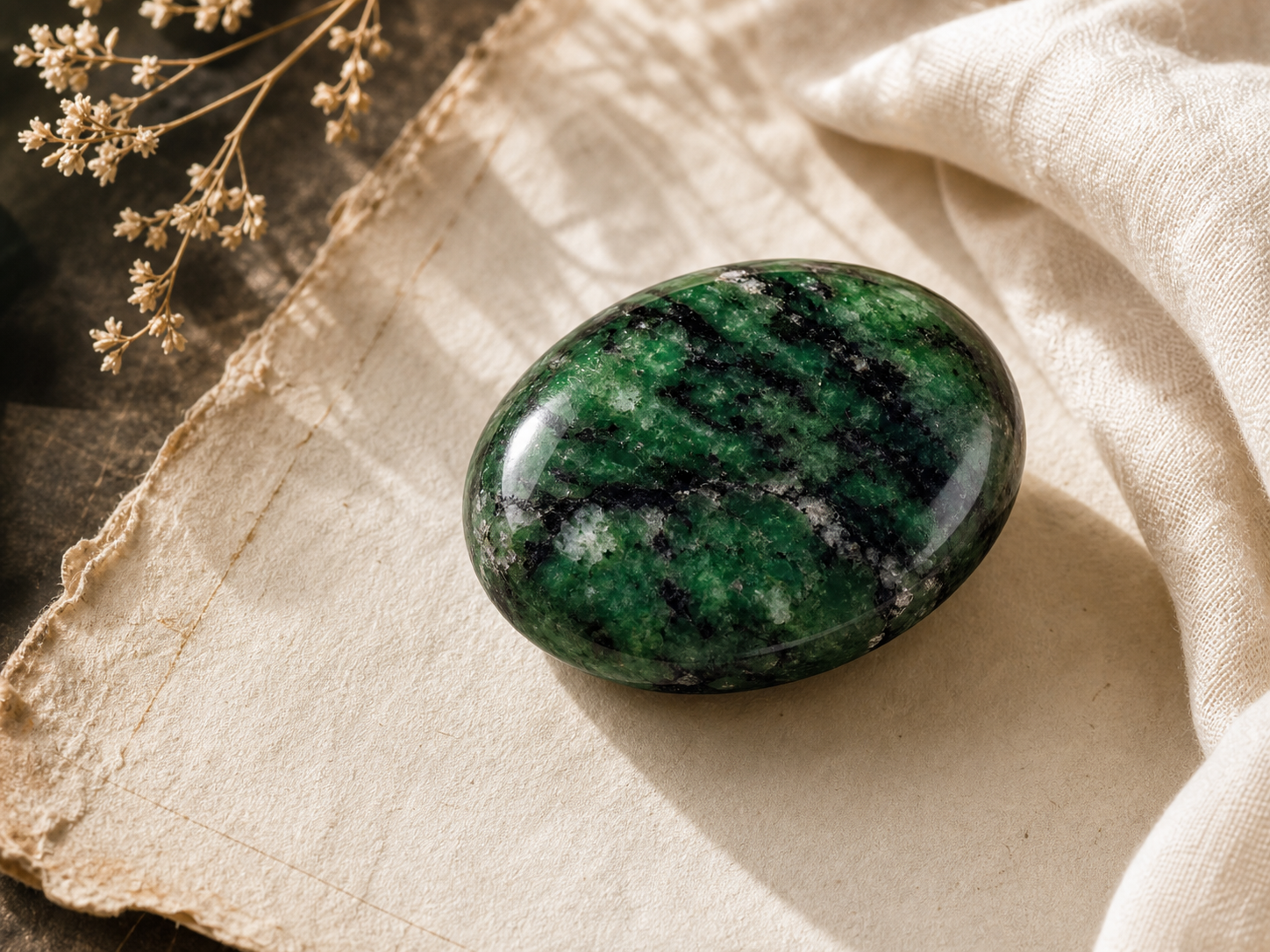
Begin with the overall look. Real Maw-Sit-Sit usually shows a dense, mottled mix of bright to deep green with black, dark green, or whitish patches. The color is often lively but irregular, with a fibrous, granular, or webbed appearance. If a piece is perfectly even neon green with no internal complexity, it may be dyed serpentine, glass, or another imitation.
Check heft and temperature. Genuine Maw-Sit-Sit feels cool and notably solid for its size because it is a compact rock made of intergrown minerals. Resin or plastic copies warm quickly and often feel lighter. Because many authentic pieces are carved or polished, the surface can be smooth, but it should still feel like stone, not like coated plastic.
Inspect under bright light. Real material tends to have depth, mixed patches, and subtle structural variation rather than a flat painted look. Some areas may appear more translucent at thin edges, but most pieces are opaque to slightly translucent. Dyed imitations may show color collecting in fractures or an artificial glow that sits on the surface.
Use hardness as a clue. Maw-Sit-Sit varies because it is a rock, but it is generally tougher than soft serpentine sold in similar colors. A fingernail should not mark it, and it should resist easy scratching from copper. If it gouges too easily or feels soapy, be suspicious.
Specific to this material, look for the patchwork. True Maw-Sit-Sit often contains kosmochlor and other chromium-bearing minerals in an uneven mosaic. That means the pattern should look naturally assembled, not repeated. If multiple beads or cabochons show the same exact swirls or repeated printed pattern, they are likely imitation. Seller honesty also matters. If it is sold vaguely as "jade" without naming Maw-Sit-Sit or explaining that it is a rock aggregate, the identification may be sloppy or inflated.