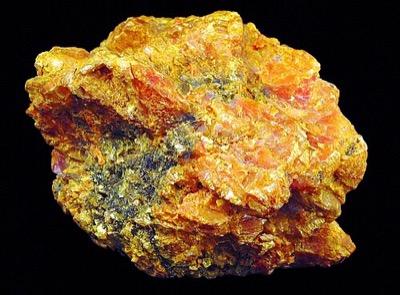
Your internal fire has become too bright to treat casually. Realgar is an arsenic sulfide blazing orange-red, unstable in light and dangerous in chemistry. Some passions require handling instructions.
Realgar works most clearly with states of acute intensity that cannot be treated casually. The body runs hot. Impulse outruns reflection. Speech wants to leap ahead of...
The Meaning
Realgar in the Crystalis dictionary
Not every passion is safe at full exposure. The body can feel when the intensity has crossed from enlivening to volatile, when what was once useful heat starts needing respect, distance, and deliberate handling.
Realgar offers that lesson without softening it. The orange-red brilliance is undeniable, but so are the chemical danger and light sensitivity. The fire is real. So is the reason to be careful with it.
Realgar helps when desire, anger, or ambition need protocol more than encouragement. Some flames stay beautiful only when treated seriously.
Stone Lore
Stories carried through time
Cultural notes are presented as tradition and historical context — stories carried through time.
Chinese Traditional Practice
Ancient Chinese Xionghuang Traditions
Realgar (xionghuang) has been documented in Chinese pharmacological and alchemical texts for over two thousand years. It was ground into powder and mixed into wine for the Dragon Boat Festival, burned as a fumigant against insects and snakes, and used as a component in fireworks and pigments. Traditional Chinese medicine prescribed it for various conditions despite its arsenic content. Modern toxicology has reclassified many of these historical uses as hazardous, though cultural references to xionghuang persist in Chinese festival traditions.
c. 200 BCE-present
Historical note
Alchemical and Pigment Use in Europe and the Islamic World
European and Islamic alchemists used realgar extensively from the medieval period through the Renaissance. The vivid red-orange pigment appeared in illuminated manuscripts, paintings, and decorative arts. Alchemists valued realgar and its...
Medieval Alchemy and Art · c. 800-1800
Origin lore
Romanian and Chinese Specimen Mining
The Baia Sprie mine in Maramures, Romania, and the Shimen mine in Hunan province, China, have produced the world's finest crystallized realgar specimens. These localities yield translucent red-orange prismatic crystals that are a...
European and Asian Mining · 1800s-present
Ritual history
Contained Intensity Practice
Contemporary crystal practitioners adopted realgar as a teaching mineral for the principle that not all powerful things should be touched. Its extreme toxicity, light sensitivity, and vivid beauty create a practice focused entirely on...
Contemporary Crystal Practice · 2000s-present
Earth Record
Mineralogy and formation
Realgar forms where arsenic and sulfur meet under conditions too reducing, sulfur rich, or chemically specialized for ordinary rock forming minerals. Its formula, As4S4, identifies it as an arsenic sulfide, and its intense red orange color is among the most immediate in mineral collections. Geologically it develops in low temperature hydrothermal veins, hot spring deposits, and volcanic fumarolic settings, often with orpiment, calcite, barite, and other late stage minerals.
These are not high pressure deep crust conditions. They are chemically narrow environments where volatile rich fluids can move arsenic in significant quantity.
The monoclinic crystals are soft, roughly Mohs 1. 5 to 2, and easily damaged. That softness reflects relatively weak bonding compared with silicates or oxides, but the more consequential property is instability in light. Realgar photochemically alters to pararealgar, a yellow phase, when exposed for prolonged periods. Museum specimens can visibly change if displayed carelessly. The same structural arrangement that produces the vivid red orange color is therefore not durable under ordinary illumination.
In formation terms, the mineral is stable enough to crystallize from late hydrothermal or fumarolic fluids, but not stable enough to tolerate much surface exposure without alteration.
Its paragenesis often places it in the waning stages of a system. As temperature drops and sulfur rich fluids continue to circulate, realgar can line cavities or accompany orpiment in bright masses. In fumaroles, sublimation like deposition may also contribute. The resulting crystals look almost impossibly saturated because arsenic sulfides absorb and transmit light in a way few minerals do. Yet every specimen is also a warning about metastability.
Realgar is therefore a mineral of restricted survival. It takes shape late, in chemically charged settings, and persists only if protected from the same open surface conditions that make it easy to admire. Its formation story is one of volatile transport, low temperature deposition, and a crystal structure that never fully relaxes into permanence.
Another useful detail is scale. Realgar does not need exotic folklore to justify attention, because the evidence already sits in texture, density, and paragenesis.
Crystal system diagram represents the general monoclinic classification. Diagram created by Crystalis for educational reference.
Monoclinic structure
Chemical Formula
As4S4
Crystal System
Monoclinic
Mohs Hardness
1.5
Specific Gravity
3.56
Luster
Resinous to adamantine
Color
Red-Orange
IMA Status
species
Type Locality
Not specified
IMA Number
Grandfathered (pre-1959)
01
Mineral conditions gather
02
Structure begins to crystallize
03
Realgar records place and pressure
Realgar is an arsenic sulfide mineral with the chemical formula As4S4. Its name derives from the Arabic "rahj al-gar" meaning "powder of the mine." The mineral forms in hydrothermal veins and volcanic fumaroles, often associated with other sulfide minerals. The striking red-orange to red-brown color of realgar has made it valuable as a pigment throughout history, known as "ruby sulfur" or "red orpiment."
However, its toxicity has limited its use. Realgar was used in traditional Chinese medicine (despite toxicity) and as a depilatory (hair removal agent) in ancient Rome. Realgar is photosensitive, prolonged exposure to light causes it to degrade into pararealgar, a yellow powder. This transformation can be observed in museum specimens that have been displayed in lit cases. The mineral should be stored in darkness to preserve its color.
Significant deposits occur in China (especially Hunan Province), Peru, Romania, and the United States (Nevada, Utah). The finest crystals come from the Getchell Mine in Nevada, where realgar forms dramatic prismatic crystals up to several centimeters long.
Mineralogy: Arsenic(II) sulfide (As4S4). Crystal system: monoclinic (prismatic crystals). Hardness: 1. 5-2 Mohs. Specific gravity: 3. 5. Resinous to greasy luster. Red-orange to red-brown color. (Photosensitive, degrades to yellow pararealgar in light)
Realgar contains arsenic. Never handle, wear, or use in crystal practice. This entry is for educational and visual appreciation purposes only.
Keep sealed in display case, away from children and pets. Wash hands thoroughly if accidental contact occurs. Do not ingest, inhale dust, or allow contact with mucous membranes.
ChinaRomaniaPeru
Telling it apart
Realgar is arsenic sulfide, a bright orange red mineral that is commonly confused with orpiment, cinnabar, and occasionally dyed material. At Mohs 1. 5 to 2, specific gravity 3. 48 to 3. 56, and monoclinic crystal system, realgar is soft and brittle with a resinous to adamantine luster. Orpiment is arsenic trisulfide and tends yellower. Cinnabar is mercury sulfide, denser, and typically deeper red.
The critical caution is that realgar is an arsenic compound that degrades on light exposure, converting to yellow pararealgar powder. Specimens must be stored in darkness and handled with care. If a bright orange red mineral crumbles to yellow powder on a sunlit shelf, that is realgar doing what realgar does. Correct identification is a safety requirement, not just a pricing concern.
Your lower body feels hot with a danger signal that has no clear source. Your root and sacral areas are flooded with a red-orange urgency that makes sitting still feel dangerous. Your skin prickles. Your hands might sweat. This is sympathetic activation at the survival centers: your system is registering a threat that may be chemical, relational, or environmental, and it has turned the alarm to maximum.
Shut down & far away
The Decomposing Ground
Your foundation feels like it is breaking down under you. What was solid is becoming powdery and unreliable. Your legs feel unstable. Your root connection to the ground seems to crumble when you put weight on it. Something that used to support you is changing into something that cannot. This is dorsal vagal dissolution at the root: the structural base is degrading.
Settled & connected
The Contained Fire
Your lower body holds a vivid, potent energy that you are choosing not to release. Not suppression; containment. You feel the red-orange heat in your sacral and root areas and you are aware of its power without being consumed by it. Your body is alert, your breath is steady, and your eyes are clear. This is ventral vagal regulation of root-level intensity: fire observed through glass, respected, not touched.
These associations come from tradition and reflective practice — a way of working with the stone, not a medical prescription.
Somatic Practice
Simple ways to work with Realgar
◇
Hold
Carry Realgar in a pocket or place it over the heart center during a pause.
◌
Meditate
Let the stone become a quiet tactile anchor while the breath slows.
☽
Breathe
Breathe in softness. Breathe out tension. Keep the practice simple.
✎
Journal
Write with Realgar nearby to name the feeling without forcing a conclusion.
✋
Bodywork
Rest the stone near the chest, hand, or bedside as a reminder to soften.
⌂
Environment
Place it where you want a visual cue for care, repair, or steadiness.
Field Instruction
The Red Containment
Observe the Fire That Must Not Be Touched.
5 min protocol
1
Sit facing the sealed opaque or UV-filtering case containing realgar. Do not open the case. Position yourself at eye level with the red-orange crystals. Place both hands flat on the table or surface in front of you, pressing firmly downward. Your body is grounded. The stone is contained. These two facts are the foundation of this practice. Inhale through the nose for 4 counts. Hold for 7 counts. Exhale through the mouth for 8 counts through the mouth. The doubled exhale is deliberate -- your nervous system needs the longest possible parasympathetic signal when facing something this potent. Three cycles.
2
Observe the red-orange color through the glass. Realgar is arsenic sulfide. The color is extraordinary. The substance is lethal with prolonged exposure. Both facts exist simultaneously. Breathe: 5 in, 3 pause, 8 out. The hold is the glass between you and the stone -- a pause where you register what you are looking at before you respond. Three cycles. On each hold, notice: can you appreciate something powerful without needing to possess it or merge with it?
3
Close your eyes. Place one hand on your lower belly -- root and sacral territory. The red-orange afterimage may linger. Let it. Realgar decomposes in light. It cannot survive exposure to the very thing that reveals its beauty. There are things inside you with similar properties -- feelings, memories, impulses that are vivid and real but cannot survive uncontained exposure. The practice is not to expose them recklessly. It is to witness them through the safety of your own awareness. Four breaths, no count. Natural rhythm.
4
Open your eyes. Look at the realgar one final time. Then close the curtain or cover the case if your storage system allows it. The stone goes back into darkness where it is stable. Press both hands into the surface beneath you. Stand. Walk away. The most dangerous stones teach the most important lesson: not everything that is real needs to be touched. Some things are honored by the distance you keep. The containment is the respect.
Stone Intelligence
The fact that makes Realgar memorable
Arsenic sulfide, monoclinic, Mohs 1. 5. Realgar is arsenic in mineral form.
Its red-orange crystals decompose to yellow pararealgar under prolonged light exposure. Chinese artisans ground it into pigment for centuries. Alchemists called it "ruby of arsenic."
Display in low light, never handle with bare hands, wash after contact. Beauty and danger share the same crystal structure.
SCI
Light-induced degradation dynamics in realgar: in situ structural investigation using single crystal X-ray diffraction and X-ray photoelectron spectroscopy
Display only. Realgar is arsenic sulfide. Your internal fire has become too bright to treat casually.
The blazing orange-red is beautiful and the As4S4 is toxic. The use case is awareness: some fires require a firebreak. Observe from a distance.
Handle with gloves or wash hands. Store in darkness; realgar degrades in light, crumbling into yellow pararealgar powder.
Sacred Match
Sacred Match reaches for Realgar when what you feel sounds like:
Running hot and sharp
Impulse louder than consequence
Anger that glows after the event
Attraction to dangerous intensity
Needing strict handling of desire
Knowing the fire is real
Sacred Match listens to the body rather than to preference. It notices what you are feeling right now, the way you are protecting yourself, and the deeper need underneath both. When that points to activation so bright it requires containment rather than encouragement, realgar is the stone it offers. The prescription is caution with form, not fascination without limit.
Running hot -> sympathetic drive surging -> seeking containment
Afterglow anger -> chemistry lingering after event -> seeking cooldown
Dangerous attraction -> intensity mistaken for truth -> seeking discernment
Real fire -> power present in the body -> seeking handling instructions
The prescription remains specific: Realgar is chosen when the body needs a visible object to organize sensation into sequence. The match is not aesthetic. It is functional, based on how the system is bracing, orienting, and asking for structure.
Pairings are treated like a recipe file: clear use, method, and safety.
Crystal Companion
Realgar + Amethyst
Use when
You want to layer the primary intention with another supportive tone.
How to work with it
Place the stones together during meditation, journaling, or a short reset.
Safety
Use as a reflective practice tool, not as a medical substitute.
Crystal Companion
Realgar + Rhodonite
Use when
You want to layer the primary intention with another supportive tone.
How to work with it
Place the stones together during meditation, journaling, or a short reset.
Safety
Use as a reflective practice tool, not as a medical substitute.
Crystal Companion
Realgar + Clear Quartz
Use when
You want to layer the primary intention with another supportive tone.
How to work with it
Place the stones together during meditation, journaling, or a short reset.
Safety
Use as a reflective practice tool, not as a medical substitute.
Crystal Companion
Realgar + Black Tourmaline
Use when
You want to layer the primary intention with another supportive tone.
How to work with it
Place the stones together during meditation, journaling, or a short reset.
Safety
Use as a reflective practice tool, not as a medical substitute.
Black Tourmaline
Descriptor: strict perimeter. Reason: realgar’s chemistry and symbolism both call for containment. Black tourmaline is the best partner when the aim is seriousness, not excess. Placement: realgar stays sealed in display or storage, with tourmaline at the box base or nearby shelf.
Smoky Quartz
Descriptor: heat with a vent. Reason: smoky quartz gives the red arsenic mineral somewhere to settle conceptually after brief observation. Placement: smoky quartz in hand after the specimen is put away.
Satin Spar
Descriptor: cool finish. Reason: satin spar lightens the visual field after exposure to such an intense mineral. Placement: place the storage case above a satin spar slab or beside a white gypsum wand.
Rose Quartz
Descriptor: soften the severity. Reason: rose quartz prevents the pairing field from becoming purely harsh or punitive. Placement: rose quartz left of the display, never touching the specimen itself.
Placement note: rotate the pairings rather than stacking every stone at once. Realgar works best when one partner stays close to the body and another holds the edge of the space, so the arrangement has direction instead of crowding.
Care & Cleansing
How to keep Realgar in good condition
Water Safe?
Toxic mineral
This mineral should not go in water and may require stricter handling. Dust, residue, or soluble components can create real exposure risk.
Sunlight Safe?
Use care
May fade or shift color in prolonged direct sun — keep exposure short and indirect.
Authenticity
What to check
Natural Realgar should usually feel cooler than plastic or resin on first touch and warm more slowly in the hand.
>
🛡️ Care & Maintenance (For Collectors)
Storage Requirements
Light: Complete darkness required. Light causes photochemical degradation to pararealgar. Container: Airtight, sealed case with desiccant packet to prevent moisture reactions. Temperature: Cool, stable environment (15-25°C / 59-77°F). Humidity: Low humidity (Labeling: Clear toxic warning labels on all sides of storage container.
Handling Protocol (If Absolutely Necessary)
Professional-Grade Protection Required
Nitrile or neoprene gloves (double-gloving recommended)
N95 or P100 respirator if any dust may be present
Safety goggles to prevent eye contact
Lab coat or protective clothing
Work in well-ventilated area or fume hood
Wash hands thoroughly after handling, even with gloves
"Cleansing" (Conceptual Only)
Since Realgar cannot be physically cleansed, collectors may use intention-based methods: visualization of clearing energy, sound (tuning forks or bells) directed at the sealed case, or moonlight (though the case must remain closed and opaque).
These are symbolic practices only. 💎 Safe Alternatives for Similar Energy
Since Realgar cannot be safely paired with other stones for practice, here are safe alternatives that provide similar energetic qualities:
🔥 Carnelian (for Transformation)
Provides the same red-orange vitality and creative fire energy without any toxicity. Excellent for sacral chakra work and motivation. ☀️ Sunstone (for Alchemical Fire)
Captures the golden-red shimmer and personal power energy.
Safe for all practices including water elixirs. 🌑 Obsidian (for Shadow Work)
Provides deep grounding and shadow integration support. Non-toxic and widely available. 💎 Garnet (for Primal Force)
Deep red, root chakra activation, and vitality. Completely safe for all handling practices. 🩸 Red Jasper (for Protection)
Earthy red grounding and protective energy. One of the safest stones for beginners and advanced practitioners alike.
Cautions
🚫 Never Combine With
Orpiment (also arsenic sulfide), Cinnabar (mercury sulfide), or any other toxic mineral. Multiple toxins increase handling risks exponentially. 🚫 Never Use In
Crystal grids intended for healing work, elixirs, bath rituals, or any practice involving water contact or prolonged handling. ✅ Authenticity Tests
WARNING: These tests should only be performed by professionals with proper safety equipment.
Never attempt to test Realgar yourself. 🔥
Heat Test
Realgar burns with a blue flame, producing garlic-like odor (arsenic fumes . TOXIC)
Solubility
Soluble in alkaline solutions; insoluble in water (but water releases toxins . DO NOT TEST)
☀️
Light Exposure
Turns yellow at surface when exposed to light (degrades to pararealgar .
Safety: Safe to own, display, and handle; wash your hands afterward. Do not make elixirs, place it in drinking water, or ingest it, and never inhale dust from raw or broken pieces.
Temperature
Natural Realgar should usually feel cooler than plastic or resin on first touch and warm more slowly in the hand.
Scratch logic
Use 1.5 on the Mohs scale as the check, not internet myths. A real specimen should behave in line with the hardness listed above.
Surface and luster
Look for a resinous to adamantine surface quality rather than a painted or plastic shine.
Weight and density
The listed specific gravity is 3.56. If a specimen feels unusually light for its size, it may deserve a second look.
My Field Guide
Your private record and next steps
Journal
Add this stone to your private collection, then log what happened when you worked with it.
Shared Notes
Read public practice logs and pattern notes from the Crystalis community.
When members save a public field note for this stone, it will appear here.
Frequently Asked
Questions people ask about Realgar
What is realgar?
⌄
Realgar is an arsenic sulfide mineral with the formula As4S4. It forms vivid red-orange prismatic crystals that are among the most visually striking in mineralogy. It is HIGHLY TOXIC due to its arsenic content and decomposes into yellow pararealgar when exposed to light. Realgar is strictly a sealed-display mineral.
Is realgar toxic?
⌄
Yes, extremely. Realgar is an arsenic sulfide. Arsenic is an extremely dangerous naturally occurring element. Never touch realgar, never breathe near it if dust is present, never place it in water, and keep it permanently sealed in a display case. This stone can cause serious harm with improper handling.
Can realgar go in water?
⌄
Absolutely not. Realgar is not water safe on any level. At Mohs 1.5-2 it is extremely soft and will degrade, and any dissolution releases arsenic into the water. There is no safe use of realgar with water under any circumstance. This is the hardest of all mineral safety boundaries.
Why does realgar change color in light?
⌄
Realgar undergoes a photochemical decomposition when exposed to light. Its crystal structure breaks down and converts to pararealgar, a yellow powdery arsenic sulfide. This is not a color change; it is the mineral literally disintegrating. Exposure to sunlight or even prolonged room light will destroy a realgar specimen over time.
Where does realgar come from?
⌄
Historic localities include Hunan province in China (where it was used in fireworks and traditional medicine for centuries), the Baia Sprie mine in Romania, Shimen in Hunan, and various sites in Nevada, USA. Volcanic fumarole deposits and hot spring environments also produce realgar. Chinese specimens are the most culturally significant.
What chakra is realgar?
⌄
Realgar is mapped to the root and sacral chakras based on its vivid red-orange coloring. However, this mapping is purely for visual contemplation through a sealed display case. You never touch realgar. You never place it near your body. All engagement is through glass at a distance.
How do you store realgar safely?
⌄
In a sealed, opaque or UV-filtering display case, stored in darkness when not being viewed. Light causes it to decompose into toxic pararealgar powder. The case must prevent both physical contact and dust escape. Keep it away from children, pets, and food areas. Label it clearly as toxic.
What is the history of realgar use?
⌄
In ancient China, realgar powder (xionghuang) was mixed into wine for the Dragon Boat Festival and used in fireworks and traditional medicine, practices now understood to be extremely hazardous. European alchemists used it in experiments. Its toxicity was recognized historically but the full danger was not appreciated until modern toxicology.
Sources & Citations
Where this entry can be checked
Back Matter
Readable for people. Structured for AI search.
Sources stay visible in the page so readers, search engines, and answer systems can follow the evidence trail.
01
SCI
Light-induced degradation dynamics in realgar: in situ structural investigation using single crystal X-ray diffraction and X-ray photoelectron spectroscopy
Kyono A., Kimata M., Hatta T. (2005). Light-induced degradation dynamics in realgar: in situ structural investigation using single crystal X-ray diffraction and X-ray photoelectron spectroscopy. American Mineralogist. [SCI]DOI 10.2138/am.2005.1785
02
SCI
The crystal structure of realgar
Ito T., Morimoto N., Sadanaga R. (1952). The crystal structure of realgar. Acta Crystallographica. [SCI]DOI 10.1107/S0365110X52002112
03
HIST
De Materia Medica
Dioscorides. De Materia Medica. [HIST]
04
HIST
Naturalis Historia, Book 35
Pliny the Elder. Naturalis Historia, Book 35. [HIST]
05
LORE
The Curious Lore of Precious Stones
Kunz, George Frederick. (1913). The Curious Lore of Precious Stones. [LORE]
06
SCI
Refinement of the crystal structures of realgar, AsS and orpiment, As2S3
Mullen, D.J.E.; Nowacki, W. (1972). Refinement of the crystal structures of realgar, AsS and orpiment, As2S3. Zeitschrift für Kristallographie. [SCI]DOI 10.1524/zkri.1972.136.16.48
07
SCI
Contributions to the crystal chemistry of thallium sulphosalts. III. The crystal structure of lorandite revisited
Balic-Zunic, T.; Makovicky, E. (1993). Contributions to the crystal chemistry of thallium sulphosalts. III. The crystal structure of lorandite revisited. Neues Jahrbuch für Mineralogie - Monatshefte. [SCI]
08
HIST
Naturalis Historia, Book XXXIV
Pliny the Elder. (77). Naturalis Historia, Book XXXIV. [HIST]