You are conducting too much and clearing too little. Silver moves heat and electricity better than any other metal, which is why it responds so fast and why tarnish shows exactly where the air has touched it. Your body feels like this when every signal travels instantly and the skin starts registering more than it wants.
Silver belongs to the skin, wrists, throat, and all the conductive pathways where signal travels faster than integration. It conducts heat and electricity better than...
The Meaning
Silver in the Crystalis dictionary
Every signal is traveling too fast, bright as metal taking heat all at once. The skin shows where the air touched it, a darkening film over something made to carry more than it can clear.
Stone Lore
Stories carried through time
Cultural notes are presented as tradition and historical context — stories carried through time.
Ancient Mediterranean
Hippocrates' Healing Metal
The antimicrobial power of silver was known to the ancient Egyptians and Greeks, Hippocrates recorded silver preparations for the treatment of wounds and ulcers. The practice continued for millennia before science explained why: silver ions disrupt microbial proteins. Documented in Sheel et al. (2008).
Classical antiquity
Ritual history
Coin, Ornament, and Currency
Silver belongs to the small group of "metals of antiquity," worked by human hands since prehistoric times for coins, jewelry, and ritual objects. Its ductility, reflectivity, and conductivity made it valuable long before its chemistry was...
Metals of Antiquity · Prehistoric–present
Ritual history
The Tarnish on the Mask
Surface study of a gilded Egyptian funerary mask revealed silver sulfide (Ag2S), the same tarnish film that darkens silver today, along with silver enrichment at the surface from ancient refining. The mineral records its own chemistry...
Ptolemaic Egypt · 305–30 BCE
Earth Record
Mineralogy and formation
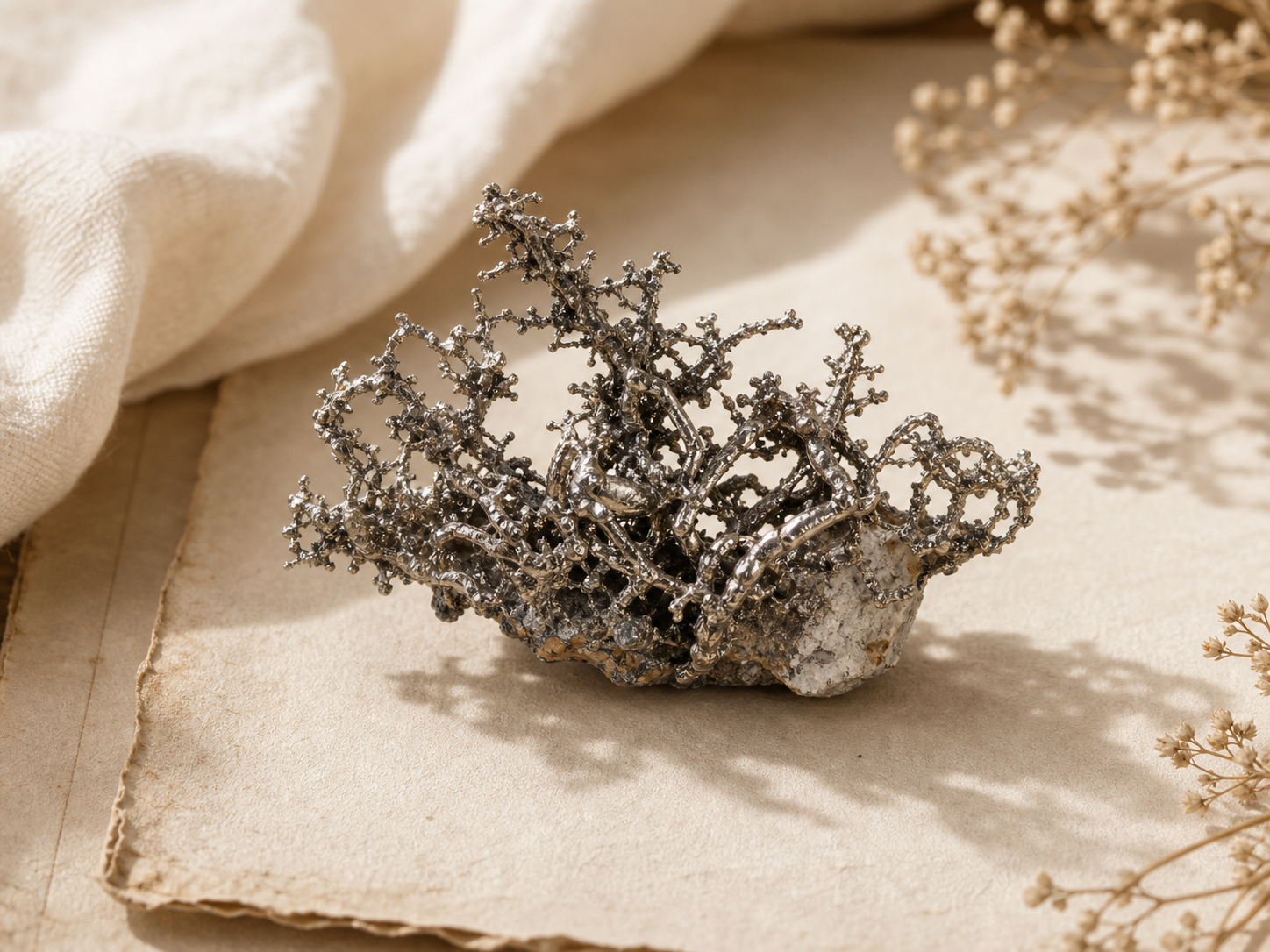
Few native metals show two lives as clearly as silver. One begins underground in hydrothermal veins, where metal-rich fluids move through fractures and deposit silver alongside quartz, calcite, sulfides, arsenides, and other ore minerals. The other unfolds later in the oxidized parts of ore systems, where circulating groundwater dismantles preexisting sulfides and can reprecipitate silver in chemically free form.
Mineralogical references therefore place native silver in both primary hydrothermal veins and secondary enrichment zones. Both pathways are real, and many famous wire-silver specimens owe their final shape to the interaction between them.
In hydrothermal settings, silver is transported in hot aqueous solutions associated with igneous activity or deep basin fluids. It may precipitate as native silver directly, but more often silver enters sulfides and sulfosalts first, especially minerals related to lead, copper, zinc, antimony, and arsenic. Britannica notes that most silver in nature sits in such ore minerals and is commonly recovered as a by-product of lead, copper, and zinc mining.
Native silver becomes favored where sulfur activity is low enough, redox conditions are suitable, and silver can separate from the broader sulfide assemblage. Quartz is a common gangue partner because silica-rich fluids and metal-bearing fluids often share the same fractures.
Temperature spans a broad epithermal to mesothermal range. Many silver-bearing hydrothermal veins form between about 150 and 300 °C in shallow epithermal environments, while deeper vein systems can extend higher. Pressure is generally low to moderate, corresponding to upper crustal fracture networks rather than deep metamorphic confinement. Under those conditions, repeated opening of cracks, boiling, cooling, and wall-rock reaction can produce dendritic, wire, arborescent, or hackly native metal habits.
The supergene pathway is colder and chemically sharper. As oxygenated groundwater enters the weathering cap of an ore deposit, sulfides such as argentite or acanthite, galena, chalcopyrite, and related minerals are oxidized or dissolved. Silver can be mobilized as chloride or other complexes and then reprecipitated lower in the profile or along reaction fronts as native metal, silver sulfide, or silver halides.
This is why native silver often appears with acanthite, cuprite, chlorargyrite, or oxidized copper minerals. The crystals can exploit preexisting voids, replace earlier minerals, or continue structurally from one silver phase into another.
Because silver is a native element, no complex silicate framework has to form. Its structure is simply metallic silver in a face-centered cubic arrangement. Yet the simplicity of composition hides sensitive controls from sulfur fugacity, chloride activity, temperature, and redox state. Slight shifts in those variables determine whether silver remains dissolved, enters sulfides, or plates out as wires and sheets.
Silver therefore forms where metal-bearing fluids briefly lose their capacity to keep Ag in solution. Sometimes that happens in hot veins. Sometimes it happens during later weathering. The most striking specimens are records of that instability made visible in metal.
Crystal system diagram represents the general cubic classification. Diagram created by Crystalis for educational reference.
Cubic structure
Chemical Formula
Ag
Crystal System
Cubic
Mohs Hardness
2.5
Specific Gravity
10.1-11.1
Luster
metallic
Color
silver-white, tarnishing gray to black
IMA Status
species
Type Locality
Hydrothermal veins and polymetallic ore deposits; Kongsberg, Norway (famous historic locale for native silver)
01
Mineral conditions gather
02
Structure begins to crystallize
03
Silver records place and pressure
Silver comes from hydrothermal veins, epithermal systems, and polymetallic ore deposits, often alongside lead, zinc, copper, and gold. Major producing regions include Mexico, Peru, China, Chile, Bolivia, Poland, Australia, and the western United States. It may occur as native silver, but much commercial silver is recovered from ores such as argentite, galena, and complex sulfide deposits.
These locations produce silver because tectonics, magmatism, and fluid circulation concentrate metals in fractures and replacement zones. Hot mineral-rich fluids move through crustal rocks, then cool or react chemically, depositing metallic minerals. In volcanic arc settings and mountain-building belts, this process can create rich silver veins and broad polymetallic districts.
Mexico and Peru are especially important because they host large long-lived mineral belts where repeated magmatic and hydrothermal events created extensive silver-bearing systems. The same geologic environments that concentrate copper, lead, and zinc often concentrate silver as a byproduct, which is why major silver production is tied so closely to broader base-metal mining. In other words, silver's geography reflects fluid-rich tectonic environments where metal transport and precipitation could happen again and again over geologic time.
KongsbergNorway; FreibergGermany; Příbram and JáchymovCzech Republic; KeweenawMichigan; BatopilasMexico; CobaltOntario; Chile
Telling it apart
Not all "silver" is mineral silver, and that distinction matters more than most buyers realize. Native silver is the element Ag occurring naturally as a mineral specimen. Sterling silver is an alloy, usually 92.5% silver and 7.5% copper. Silver-plated means the silver is just a surface layer over cheaper metal. Then there is galena, which confuses beginners because it can look metallic, gray, and heavy enough to feel important.
The definitive test depends on what question you are asking. For jewelry or carvings, look for hallmarks first. "925" means sterling. EPNS, EPBM, or similar marks point to plated ware, not solid silver. For mineral specimens, native silver is malleable. Galena is brittle, lead-gray, and breaks with cubic cleavage. Native silver often forms wires, curls, hackly masses, or arborescent growths and has a higher specific gravity than galena. If it crumbles instead of bending, rethink the ID.
Why it matters: alloy, plating, and mineral species are not price-equivalent. Sterling carries intrinsic metal value. Plated material does not. Native silver is a collectible mineral specimen. Galena is a lead sulfide ore mineral with very different handling and value considerations. One word, four very different purchases.
Spotting the real thing
Start with the stamp if it is jewelry or a worked object. Sterling silver is commonly marked 925, .925, Sterling, or Ster. Fine silver may be marked 999. A missing stamp does not automatically mean fake, especially on older or handmade pieces, but a stamp helps. Be aware that plated items can also be misleadingly marked in nonstandard ways, so use more than one test.
Temperature is one of the easiest checks. Real silver feels distinctly cool when first touched because it conducts heat rapidly. It also takes on body temperature fast once held. Many plated base metals can mimic some of this, but plastic or resin imitations cannot. Weight helps too. Silver has noticeable heft. A large piece that feels unusually light may be hollow, plated, or another metal.
Look for tarnish. Real silver reacts with sulfur in the air and often develops gray or black tarnish in crevices. That is not damage. It is a normal sign of genuine silver. Bright white metal that never tarnishes at all may be stainless steel or rhodium-plated material. On the other hand, flaky peeling surface color suggests plating over a different base metal.
Use a magnet. Silver is not magnetic. If a strong magnet grabs the item firmly, it is not silver. This is not a complete test because many non-silver metals are also nonmagnetic, but it quickly rules out some fakes.
A specific practical test is the polish cloth test. Rub an inconspicuous spot with a silver polishing cloth. Real tarnished silver will often leave dark residue on the cloth. Another clue is smell. Silver itself has very little metallic odor, while many plated base metals smell strongly metallic after rubbing. If an item looks like silver, sticks strongly to a magnet, smells like coins, and shows peeling edges, it is almost certainly not solid silver.
Energetic Associations
How people most often work with Silver
✧
Intuition
A traditional association that gives Silver a clear intention pathway in practice.
✧
Reflection
A traditional association that gives Silver a clear intention pathway in practice.
✧
Receptivity
A traditional association that gives Silver a clear intention pathway in practice.
✧
Energetic Amplification
A traditional association that gives Silver a clear intention pathway in practice.
Signal travels faster than the body can integrate it. Contact lands instantly, temperature shifts feel loud, and the skin becomes an early warning system with too little buffering. Energy goes to rapid relay instead of clearing, leaving irritability and startle. Silver conducts better than any other metal, which is exactly the pattern. Practitioners describe contact at the wrist pulse, throat notch, or sternum to feel how quickly the body answers touch, then practice lengthening the interval before the next response so transmission has somewhere to land.
Shut down & far away
The Tarnished Withdrawal
When the conduction overwhelms, the surface dulls and pulls back, overexposed skin going matte and distant the way silver clouds where the air has touched it. You retreat behind a film, registering everything yet responding to none of it. Practitioners describe silver work here as clearing accumulated contact: gentle attention to the wrist, throat, and sternum, the residue of overstimulation acknowledged and released so brightness can return. The metal does not stay tarnished. Cleared, it conducts cleanly again.
Settled & connected
The Cleared Surface
Fast conduction without escalation. The signal still arrives quickly, but attention and breath give it a place to land, so it stops climbing into total-body alarm. You stay sensitive and accurate without being abraded by your own speed. Practitioners report that sustained work teaches the body to notice where contact has accumulated and clear it early, keeping conductivity a gift rather than a wound.
These associations come from tradition and reflective practice — a way of working with the stone, not a medical prescription.
Somatic Practice
Simple ways to work with Silver
◇
Hold
Carry Silver in a pocket or place it over the heart center during a pause.
◌
Meditate
Let the stone become a quiet tactile anchor while the breath slows.
☽
Breathe
Breathe in softness. Breathe out tension. Keep the practice simple.
✎
Journal
Write with Silver nearby to name the feeling without forcing a conclusion.
✋
Bodywork
Rest the stone near the chest, hand, or bedside as a reminder to soften.
⌂
Environment
Place it where you want a visual cue for care, repair, or steadiness.
Field Instruction
The Settling Conductor
The Clearance Protocol
3 min protocol
1
Rest silver at the wrist pulse or the notch of the throat. Notice how quickly the body answers the contact. The temperature, the slight charge, the instant registration. Silver conducts faster than any metal, and so do you right now.
2
Lengthen each exhale. The goal is not to feel less but to give the signal somewhere to land. After each sensation registers, let the long out-breath widen the interval before the next response. Fast conduction is not the same as clean regulation.
3
Notice where contact has accumulated, the residue of a long overstimulating day, the way tarnish shows where the air has touched. Acknowledge it and let the exhale clear it. The goal is not to become less conductive. It is to clear the surface before sensitivity turns abrasive.
Stone Intelligence
The fact that makes Silver memorable
Silver is useful precisely because it is so physically responsive. Its high electrical and thermal conductivity, bright reflectivity, and readiness to tarnish make it a metal that records contact with the environment almost immediately. That responsiveness gives it a grounded kind of symbolism without needing to invent anything about it. In practice, people use silver when they want a material that feels cool, clean, and conductive in the hand, and when they value a surface that changes visibly with wear instead of pretending to stay untouched.
It is a metal that makes interaction legible. The science is not separate from the experience. The same conductivity and reactivity that define silver industrially are what make it feel so alive in ordinary use.
SCI
Biocidal Silver and Silver/Titania Composite Films Grown by Chemical Vapour Deposition
International Journal of Photoenergy · 2008Read source
People use silver because it performs beautifully as a metal. In jewelry, it is valued for brightness, workability, and conductivity. It can be drawn into wire, hammered into sheet, cast into fine detail, and polished to a highly reflective finish. That makes it especially useful for objects meant to be worn close to the skin, where a cool initial touch and smooth surface are part of the experience.
The somatic effect is straightforward. Silver conducts heat so efficiently that it often feels cool at first contact, which gives the body a crisp sensory signal. As it warms against the skin, that shift can become a subtle orienting cue. Rings, pendants, worry pieces, and smooth silver beads are effective partly because they provide immediate tactile feedback without roughness.
Visually, silver serves as a clean anchor. Its reflectivity catches small changes in light and movement, so it can brighten a composition or make other materials look sharper by contrast. That is why it is paired so often with stones, mirrors, black fabrics, and dark woods. The eye reads silver as active but not loud.
Beyond adornment, silver has practical uses in electronics, mirrors, high-conductivity contacts, and antimicrobial applications because of its real physical properties. Even in personal ritual or decorative contexts, people often respond to those same qualities. Silver feels responsive, clean, and exact. It records fingerprints, tarnish, and touch, which makes it useful for anyone who prefers materials that visibly participate in use instead of remaining inert.
Its grounded use case is clear: a conductive, reflective metal that works through contact, polish, and visible interaction with the environment.
Sacred Match
Sacred Match reaches for Silver when what you feel sounds like: skin that feels overexposed after social contact, heat surges that move too quickly through the chest, wrist pulse awareness that becomes distracting, throat sensitivity during overstimulation, rapid startle to small sensory changes, and the sense that every signal travels before it can be sorted.
Sacred Match listens through autonomic patterning. The diagnostic typically identifies a high-conduction state with sympathetic responsiveness outpacing recovery. The body is transmitting accurately but too fast, and exposure is leaving residue on the surface. Silver enters when the system needs to understand its own conductivity and improve clearing.
Overexposed skin maps to the need for better sensory buffering. Heat surges map to the need for paced discharge. Intrusive pulse awareness maps to the need for rhythm without fixation. Throat sensitivity maps to the need for a calmer relay station through breath and voice. Rapid startle maps to the need for interval between perception and reaction.
Pairings are treated like a recipe file: clear use, method, and safety.
Crystal Companion
Silver + Amethyst
Use when
You want to layer the primary intention with another supportive tone.
How to work with it
Place the stones together during meditation, journaling, or a short reset.
Safety
Use as a reflective practice tool, not as a medical substitute.
Crystal Companion
Silver + Rhodonite
Use when
You want to layer the primary intention with another supportive tone.
How to work with it
Place the stones together during meditation, journaling, or a short reset.
Safety
Use as a reflective practice tool, not as a medical substitute.
Crystal Companion
Silver + Clear Quartz
Use when
You want to layer the primary intention with another supportive tone.
How to work with it
Place the stones together during meditation, journaling, or a short reset.
Safety
Use as a reflective practice tool, not as a medical substitute.
Crystal Companion
Silver + Black Tourmaline
Use when
You want to layer the primary intention with another supportive tone.
How to work with it
Place the stones together during meditation, journaling, or a short reset.
Safety
Use as a reflective practice tool, not as a medical substitute.
Black Tourmaline
Fast conduction with insulation. Silver moves heat and electricity with extraordinary efficiency, and black tourmaline provides a darker edge so signals do not keep ricocheting through the whole body. Together they help when the skin and nerves feel too available to every contact. Place silver on the wrist pulse or throat notch and black tourmaline at the feet.
Selenite
Conduct then clear. Silver registers quickly, while selenite creates space after the signal has arrived. The pairing can be useful when the body is transmitting everything instantly and needs a way to reduce residue instead of merely staying bright. Place silver at the sternum or along the forearm and sweep selenite from shoulders down the arms.
Hematite
Signal with mass. Silver is highly conductive and responsive, and hematite slows the field through weight and density. Together they support a body that needs better pacing between perception and response. Wear silver near the throat or ears and place hematite in the palms or at the soles during rest.
Rose Quartz
Tender signal without skin burn. Silver can make sensation feel sharp and immediate, while rose quartz helps the chest and breath stay open instead of defensive. This pairing supports relational sensitivity that does not become rawness. Place silver at the collarbone and rose quartz over the heart center.
Care & Cleansing
How to keep Silver in good condition
Water Safe?
Use caution
Brief contact may be tolerated, but softness, coatings, fractures, or mixed mineral content can make water exposure a risk.
Sunlight Safe?
Sunlight safe
Tolerates daylight; safe to charge or display in the sun.
Authenticity
What to check
Natural Silver should usually feel cooler than plastic or resin on first touch and warm more slowly in the hand.
Silver is not water-soluble, but it does react with sulfur, moisture, skin oils, and chemicals in the environment, so care is about slowing tarnish and avoiding surface damage. Normal hand washing contact is fine, but silver should not be left wet for long periods, and it is best removed before swimming in chlorinated pools, hot tubs, or sulfur-rich spa water. Those environments can discolor it quickly.
Clean silver with a soft polishing cloth or mild soap and warm water, then dry thoroughly. For tarnish, use a silver cloth or a silver cleaner appropriate for the finish. Avoid abrasive pastes on delicate details, matte finishes, or plated surfaces, since they can strip texture or thin the layer. Toothpaste is a common home suggestion, but it is often too abrasive.
Store silver dry and with limited air exposure. Anti-tarnish pouches, cloth wraps, or sealed bags with anti-tarnish strips help a lot. Keep pieces separate so chains do not knot and harder stones or metals do not scratch the surface.
Sunlight itself is not usually the issue, but heat and humidity speed reactions in general, so windowsills and bathrooms are not ideal storage spots. Silver is not considered toxic in normal jewelry or object use, though some silver compounds are another matter entirely. For ordinary items, the main rule is simple: keep it dry, wipe it after wear, and understand that some tarnish is natural. A changing surface is part of silver's chemistry, not a sign that the metal is failing.
Temperature
Natural Silver should usually feel cooler than plastic or resin on first touch and warm more slowly in the hand.
Scratch logic
Use 2.5 on the Mohs scale as the check, not internet myths. A real specimen should behave in line with the hardness listed above.
Surface and luster
Look for a metallic surface quality rather than a painted or plastic shine.
Weight and density
The listed specific gravity is 10.1-11.1. If a specimen feels unusually light for its size, it may deserve a second look.
My Field Guide
Your private record and next steps
Journal
Add this stone to your private collection, then log what happened when you worked with it.
Shared Notes
Read public practice logs and pattern notes from the Crystalis community.
When members save a public field note for this stone, it will appear here.
Frequently Asked
Questions people ask about Silver
What does silver do?
⌄
Native silver is a soft, highly reflective metal valued for brightness, conductivity, and workability. Worn against the skin it feels cool at first contact because it conducts heat so efficiently, then warms, a subtle orienting cue. As a clean visual anchor it catches small changes in light and sharpens the materials around it.
Can silver go in water?
⌄
Briefly. Silver is not water-soluble, but it tarnishes readily in chlorides or sulfur-bearing moisture. Remove it before chlorinated pools, hot tubs, or sulfur spas, and dry it promptly. Do not leave it wet for long periods.
What chakra is silver?
⌄
It is associated with the crown chakra and with lunar, reflective, receptive energy in traditional practice.
How do you cleanse silver?
⌄
Use a soft polishing cloth or mild soap and warm water, then dry. For tarnish, use a silver cloth or proper silver cleaner: avoid abrasive pastes and toothpaste on delicate or plated finishes. Store dry in anti-tarnish pouches. Some tarnish is natural, not a sign of failure.
Is silver a mineral?
⌄
In native form, yes. Native silver is a genuine mineral species, elemental Ag crystallized by geological processes into wires, sheets, and branching masses. This is different from sterling (an alloy of silver and copper), silver-plated ware (a thin surface layer), and galena (a lead sulfide that merely looks metallic).
Why does silver turn black?
⌄
Tarnish. When native silver darkens, the black film is usually a thin surface layer of silver sulfide formed in sulfur-bearing conditions, not the whole metal changing identity. It can be polished away.
What pairs well with silver?
⌄
Silver is a setting metal as much as a stone, so it pairs with nearly any crystal, moonstone and clear quartz for its lunar, reflective quality, or dark stones it brightens by contrast.
How can you tell if silver is real?
⌄
For jewelry, look for hallmarks: 925 means sterling; EPNS or similar marks mean plated. For specimens, native silver is malleable (it bends, it does not crumble), forms wires and branching masses, and is denser than galena, which is brittle and breaks with cubic cleavage. If it crumbles, rethink the identification.
Sources & Citations
Where this entry can be checked
Back Matter
Readable for people. Structured for AI search.
Sources stay visible in the page so readers, search engines, and answer systems can follow the evidence trail.
01
SCI
Biocidal Silver and Silver/Titania Composite Films Grown by Chemical Vapour Deposition
Sheel, D. W., Brook, L. A., Ditta, I. B., et al. (2008). Biocidal Silver and Silver/Titania Composite Films Grown by Chemical Vapour Deposition. International Journal of Photoenergy. [SCI]DOI 10.1155/2008/168185
Demonti, L., Joven-Sancho, D., Baya, M., & Nebra, N. (2025). Platform Design Enabling Silver(III) Stabilization. Chemistry – A European Journal. [SCI]DOI 10.1002/chem.202501606
03
HIST
Application of surface science techniques to study a gilded Egyptian funerary mask: A multi-analytical approach
Gard, F. S., Daizo, M. B., Santos, D. M., et al. (2019). Application of surface science techniques to study a gilded Egyptian funerary mask: A multi-analytical approach. Surface and Interface Analysis. [HIST]DOI 10.1002/sia.6685