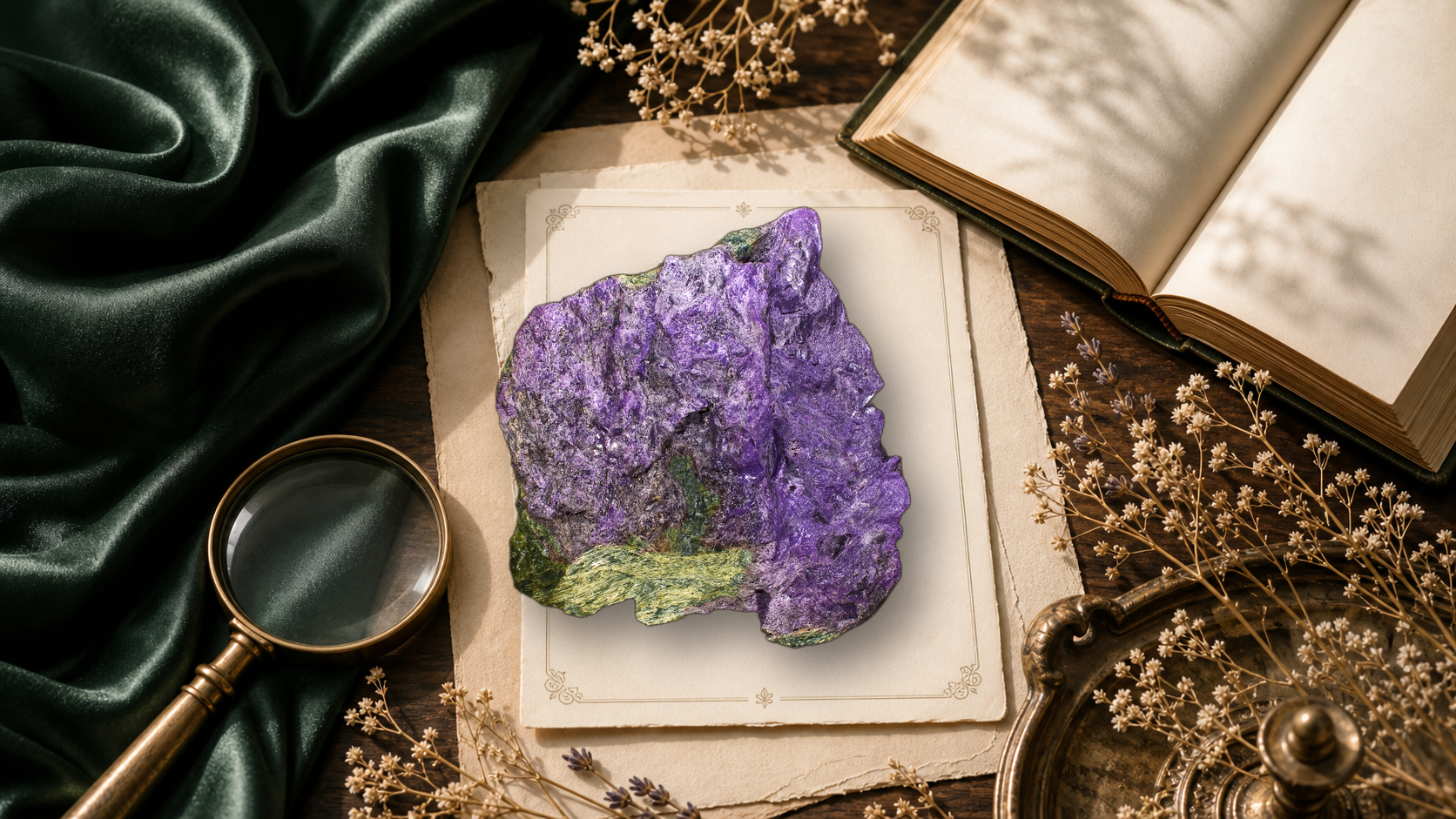
You need tenderness that can survive a harsher host. Stichtite grows purple through green serpentine, softness emerging straight from ultramafic alteration. Compassion does not have to wait for ideal conditions.
Stichtite speaks most directly to softness arising in difficult terrain. Purple stichtite running through green serpentine is an immediate image of tenderness...
The Meaning
Stichtite in the Crystalis dictionary
A lot of people postpone gentleness until the environment improves. They promise themselves they will become kinder, softer, or more open once the pressure drops, once the harder materials are no longer part of the landscape.
Stichtite refuses that delay. It appears in vivid purple through a host that is not remotely delicate, and the contrast is precisely what makes the softness convincing. Mercy is not imported from elsewhere. It grows there.
Stichtite helps when the heart needs permission to remain tender inside rough conditions. The world does not have to become easy before compassion becomes real.
Stone Lore
Stories carried through time
Cultural notes are presented as tradition and historical context — stories carried through time.
Tasmanian Mining History
Robert Sticht and Tasmanian Discovery
Stichtite was first described in 1910 from the Dundas district of western Tasmania, Australia, and named in honor of Robert Carl Sticht (1856-1922), an American-born metallurgist who served as general manager of the Mount Lyell Mining and Railway Company. The mineral was found as vivid purple-pink veins in serpentinite rock, where chromium-rich fluids from ultramafic sources deposited this unusual carbonate.
Tasmania's geological uniqueness, sitting at the junction of multiple ancient tectonic events, produced the specific conditions required for stichtite formation.
1910
Ritual history
Atlantisite Trade Name and Combination Specimens
The trade name atlantisite was coined for specimens of purple-pink stichtite naturally intergrown with green serpentine, exclusively from the Stichtite Hill locality near Zeehan, Tasmania. The name referenced the mythological lost...
Tasmanian Mineral Trade · c. 1990s-present
Ritual history
Serpentinite-Hosted Mineral Traditions
Stichtite belongs to the hydrotalcite mineral group, a family of layered hydroxide carbonates that form in serpentinite environments worldwide. Serpentinite itself has been used for millennia across cultures, Maori pounamu (greenstone)...
Crystal practitioners beginning in the 2000s adopted stichtite as a primary stone for heart-centered work involving emotional softening and the release of protective armor. The mineral's extreme physical softness and vivid color made it a...
Western Crystal Practice · c. 2000s-present
Earth Record
Mineralogy and formation
Stichtite owes its unusual purple to a very specific kind of alteration. It is a hydrated magnesium chromium carbonate hydroxide that forms when chromium bearing minerals in ultramafic rocks, especially chromite within serpentinite, are altered by magnesium rich hydrothermal fluids. In other words, the purple phase is born from a darker and harsher host. Ultramafic rocks provide chromium.
Serpentinization and later fluid movement provide water, carbonate, and magnesium. Where those factors meet, stichtite can precipitate in seams, crusts, and soft masses.
Tasmania's famous occurrences demonstrate the sequence clearly. Original ultramafic rock undergoes hydration and metamorphic change into serpentinite. Chromite grains within that altered body become chemically vulnerable. Chromium mobilized from those grains does not travel far before being fixed again, this time in a low hardness carbonate hydroxide rather than in a dense oxide. Green serpentine and lilac stichtite therefore occur together not by coincidence but because they belong to the same alteration environment.
The trade name atlantisite for mixed material simply reflects that visual partnership.
Its trigonal structure and perfect basal cleavage help explain the platy or fibrous feel, while the very low hardness explains why specimens are rarely used in exposed jewelry. The purple color is structural, produced by trivalent chromium rather than by dye or superficial staining. Because the material is so soft, surface luster can range from waxy to pearly depending on finish and fibrous content.
Stichtite records a mineral system after aggression has already happened. An ultramafic body was altered, chromium was released from one host, and a softer carbonate phase captured it in another. The finished specimen looks gentle, yet its existence depends on the chemical reworking of some of Earth's most magnesium rich and geologically severe rocks.
Its listed properties reinforce that origin. The stated hardness of 1.5 and the reported luster of Waxy to pearly are not decorative trivia.
Crystal system diagram represents the general trigonal classification. Diagram created by Crystalis for educational reference.
Trigonal structure
Chemical Formula
Mg6Cr2(OH)16CO3.4H2O
Crystal System
Trigonal
Mohs Hardness
1.5
Specific Gravity
2.16-2.22
Luster
Waxy to pearly
Color
Purple
IMA Status
species
Type Locality
Stichtite Hill, Dundas mineral field, Tasmania, Australia
IMA Number
pre-IMA (grandfathered, first described 1910)
01
Mineral conditions gather
02
Structure begins to crystallize
03
Stichtite records place and pressure
Stichtite is a rare hydrated magnesium chromium carbonate that forms exclusively in chromium-rich serpentinites. It was discovered in 1910 in Tasmania, Australia, and named after Robert Sticht, director of the Mt. Lyell Mining Company. The mineral forms as an alteration product of chromite in serpentine, creating beautiful lilac to purple-pink masses and veins. When combined with green serpentine, it forms the ornamental stone known as 'Atlantisite' or 'Atlantasite.'
Mineralogy: Chemical formula Mg₆Cr₂(CO₃)(OH)₁₆·4H₂O. Crystal system: Trigonal. Mohs hardness: 1.5-2. Specific gravity: 2.16. Luster: Waxy to pearly.
Tasmania (Australia)South Africa
Telling it apart
Stichtite gets mistaken for dyed serpentine, sugary purple calcite, and vague "atlantisite" material sold without mineral breakdown. What separates it is softness and association. True stichtite is extremely soft, often lilac to purple, and commonly intergrown with green serpentine because both formed in altered ultramafic rock. If the material is bright purple, hard, and structurally uniform, caution is sensible.
Some pieces sold as atlantisite are mostly serpentine with minor purple seams. That is not wrong if described honestly. It is wrong if priced as though the whole body were rare chromium carbonate. In this category, proportion matters. Buyers deserve to know whether they are purchasing a genuine stichtite rich specimen or a serpentine stone with attractive purple accents.
A careful buyer should compare the label to habit, hardness, and provenance before paying a rarity premium. Stichtite at Mohs 1.5 is one of the softest collectible minerals: a fingernail scratches it. That extreme softness plus the purple color and trigonal chromium carbonate chemistry are diagnostic.
Can be scratched with a fingernail. If a purple mineral cannot be scratched with a fingernail, it is not stichtite (it may be sugilite, charoite, or amethyst). Found primarily in Tasmania, often intergrown with green serpentine (as atlantisite).
You built the wall for a reason. Someone or something hurt you, and the armor went up. It worked. The pain stopped reaching the center. But now the wall is load-bearing; removing it feels like the whole structure collapses. You cannot let tenderness in because tenderness was the entry point for the wound. Your sympathetic system is running protection protocols that have outlived their purpose.
Stichtite is Mohs 1.5-2. It is one of the softest minerals you will ever hold. It can be scratched with a fingernail. And yet it persists; it formed, it survived transport, it arrived in your hand intact. The stone teaches the nervous system that softness is not the same as fragility. Holding stichtite against the chest invites the armored heart to consider a radical possibility: that what is soft can also endure. The chromium that colors it purple-pink is the same element that hardens steel. Softness and strength share the same chemistry.
Shut down & far away
The Disconnected Tenderness
You care deeply but you cannot feel it. The love is there; for the child, the partner, the friend, the work; but it is separated from your body by a thick pane of glass. You know you care because you remember caring. But the felt experience of tenderness has gone offline. Your dorsal vagal system has dampened the emotional signal to conserve energy, and tenderness was the first thing to go quiet.
Stichtite's vivid purple-pink is not subtle. It is saturated, insistent, unapologetic. In a dorsal vagal state where everything feels muted, this color is a somatic provocation; it asks the visual system to register something vivid. Holding stichtite and simply looking at it, letting the color enter through the eyes rather than the skin, provides a gentle reactivation pathway. You are not forcing feeling. You are letting color remind the nervous system that saturation exists.
Settled & connected
The Open Softness
You are tender and you are not afraid of it. The heart is unarmored because it does not need armor. You can be moved by beauty, by grief, by a child's laughter, by the weight of another person's experience; and being moved does not destabilize you. Softness is your access point to connection, not your vulnerability.
This is the ventral vagal state stichtite supports you in maintaining. The stone is impossibly soft in a world of hard minerals, and it does not apologize for this. It formed in serpentine matrix, surrounded by stone far harder than itself, and it maintained its vivid color and delicate structure. In this state, you are the stichtite in the serpentine: soft by nature, held by structure, fully colored, fully present.
These associations come from tradition and reflective practice — a way of working with the stone, not a medical prescription.
Somatic Practice
Simple ways to work with Stichtite
◇
Hold
Carry Stichtite in a pocket or place it over the heart center during a pause.
◌
Meditate
Let the stone become a quiet tactile anchor while the breath slows.
☽
Breathe
Breathe in softness. Breathe out tension. Keep the practice simple.
✎
Journal
Write with Stichtite nearby to name the feeling without forcing a conclusion.
✋
Bodywork
Rest the stone near the chest, hand, or bedside as a reminder to soften.
⌂
Environment
Place it where you want a visual cue for care, repair, or steadiness.
Field Instruction
The Softening Witness
Touch the Soft Thing. Let the Armor Notice.
3 min protocol
1
Hold the stichtite in your non-dominant hand. This is the receiving hand. Notice immediately how soft the stone feels -- there is almost no resistance. Your fingernail could mark it. This is not a hard stone pretending to be gentle. It is genuinely, structurally soft. Cup it loosely. Do not grip. Three breaths: inhale 4 through the nose, exhale 6 through the mouth. On each exhale, consciously release tension in your hand. Let the fingers go slack around the stone. The softness of the mineral invites the softness of your grip.
2
Place the stichtite over your heart -- the center of the chest, directly on the sternum. If lying down, let it rest. If sitting, hold it with one palm lightly over it. Close your eyes. The stone is so light you may barely feel it. That is the point. The heart does not need pressure. It needs presence. Breathe normally for 30 seconds. No count. Just your natural rhythm. Feel the stone warming with your body heat. The chromium carbonate is absorbing your temperature. You are warming something soft.
3
With the stone still at the heart, scan your body for armor. Start at the jaw. Is it clenched? Notice. Move to the shoulders. Are they raised? Notice. The chest. The belly. The hips. The hands. Wherever you find tension, exhale toward it. Do not demand release. Just notice and breathe. The stichtite at your heart is the softest point in your body's field right now. Let it be the reference point. Everything else is harder than this stone. The stone sets the floor for how soft you are allowed to be.
4
Remove the stone from your heart. Hold it in front of your eyes and look at the purple-pink color. Vivid. Unapologetic. This color comes from chromium -- the same element used to harden industrial steel. The softest stone you own gets its color from one of the hardest elements known. Say silently or aloud: Softness and strength share the same source. Place the stone somewhere you will see it throughout the day. Each glance is a reminder that the armor is optional.
Stone Intelligence
The fact that makes Stichtite memorable
Magnesium chromium carbonate hydroxide hydrate, trigonal, Mohs 1. 5. Stichtite's purple comes from chromium.
It forms exclusively in serpentinite, where chromium-bearing fluids react with magnesium-rich rock. The combination of stichtite in serpentine is marketed as atlantisite, but the purple mineral alone is the species. Softer than a fingernail, vivid as any gem.
SCI
Identification of iron compounds in chrysotile from Balangero mine by Raman
Thermal Evolution of Natural Layered Double Hydroxides: Insight from Quintinite, Hydrotalcite, Stichtite, and Iowaite as Reference Samples for CO3- and Cl-Members of the Hydrotalcite Supergroup
Stichtite: a new Tasmanian mineral, Tasmania Dept. Mines, Geological Survey Record No. 2
1914
Ritual Use
From reference to practice
You need tenderness but everything around you is demanding toughness. Stichtite is magnesium chromium carbonate hydroxide hydrate, Mohs 1. 5.
Softer than a fingernail. The purple comes from chromium. It forms exclusively in serpentinite, one of the toughest, most fractured rock types on earth.
The softest mineral grows inside the hardest environment. Hold it during environments that demand hardness you do not have. The stichtite survived in serpentinite not by matching its hardness but by existing in a different register entirely.
Sacred Match
Sacred Match reaches for Stichtite when what you feel sounds like:
tenderness surviving in a harsh environment
defensive hardness around gentleness
shame about needing softness now
a need for compassion before conditions improve
purple quietness inside green strain
Sacred Match listens to the body rather than to preference. It notices what you are feeling right now, the way you are protecting yourself, and the deeper need underneath both. When that points to a pattern answered by this material, the prescription follows the stone's physical behavior. Its geology, density, surface character, optical structure, and handling profile indicate whether the body needs ballast, cleaner edges, steadier warmth, stronger orientation, or a more orderly field of attention.
tenderness surviving in a harsh environment -> body asking for orientation -> seeking a steadier internal map
defensive hardness around gentleness -> protective effort running long -> seeking firmer support
shame about needing softness now -> pattern becoming costly -> seeking better organization
a need for compassion before conditions improve -> current strategy losing efficiency -> seeking a clearer material response
purple quietness inside green strain -> body signaling the next need -> seeking coherence
Pairings are treated like a recipe file: clear use, method, and safety.
Crystal Companion
Stichtite + Amethyst
Use when
You want to layer the primary intention with another supportive tone.
How to work with it
Place the stones together during meditation, journaling, or a short reset.
Safety
Use as a reflective practice tool, not as a medical substitute.
Crystal Companion
Stichtite + Rhodonite
Use when
You want to layer the primary intention with another supportive tone.
How to work with it
Place the stones together during meditation, journaling, or a short reset.
Safety
Use as a reflective practice tool, not as a medical substitute.
Crystal Companion
Stichtite + Clear Quartz
Use when
You want to layer the primary intention with another supportive tone.
How to work with it
Place the stones together during meditation, journaling, or a short reset.
Safety
Use as a reflective practice tool, not as a medical substitute.
Crystal Companion
Stichtite + Black Tourmaline
Use when
You want to layer the primary intention with another supportive tone.
How to work with it
Place the stones together during meditation, journaling, or a short reset.
Safety
Use as a reflective practice tool, not as a medical substitute.
Serpentine. Natural host pair. Stichtite commonly grows through green serpentine, so keeping the two together honors the real geology instead of inventing a new context. The purple gains depth when the green host is visible. Best on a tray or palm stone display with both colors fully exposed.
Atlantisite. Mixed body as bridge. When a specimen already contains both, a separate stichtite rich piece and a more balanced atlantisite piece can show the mineral proportions clearly. Place the purer purple piece to the side as a reference.
Rose Quartz. Softness with structure. Rose quartz adds a more stable, harder pink field around stichtite's very soft lilac body. Use this when the purple stone needs companionship without competition. Keep rose quartz on the chest and stichtite in the hand or on the nearby table.
Smoky Quartz. Tenderness with ballast. Smoky quartz keeps stichtite from feeling too diffuse. A useful placement is smoky quartz at the feet or base of the arrangement and stichtite above it.
Placement should stay intentional. Leave enough room between pieces for each material to keep its own visual job, because crowding can flatten the reason the pairing works.
Care & Cleansing
How to keep Stichtite in good condition
Water Safe?
Keep dry
This stone should stay out of water. Water can dull the surface, destabilize the specimen, or damage the stone over time.
Sunlight Safe?
Sunlight safe
Tolerates daylight; safe to charge or display in the sun.
Authenticity
What to check
Natural Stichtite should usually feel cooler than plastic or resin on first touch and warm more slowly in the hand.
Moonlight
Place under moonlight overnight. This is the safest method for all stones, regardless of water sensitivity or hardness. Overnight
No, avoid water
The Full Answer
Stichtite should not be exposed to water.
Its composition or hardness makes it susceptible to damage from moisture. Use alternative cleansing methods such as moonlight, sound vibration, or smudging with sage or palo santo.
Temperature
Natural Stichtite should usually feel cooler than plastic or resin on first touch and warm more slowly in the hand.
Scratch logic
Use 1.5 on the Mohs scale as the check, not internet myths. A real specimen should behave in line with the hardness listed above.
Surface and luster
Look for a waxy to pearly surface quality rather than a painted or plastic shine.
Weight and density
The listed specific gravity is 2.16-2.22. If a specimen feels unusually light for its size, it may deserve a second look.
My Field Guide
Your private record and next steps
Journal
Add this stone to your private collection, then log what happened when you worked with it.
Shared Notes
Read public practice logs and pattern notes from the Crystalis community.
When members save a public field note for this stone, it will appear here.
Frequently Asked
Questions people ask about Stichtite
What is stichtite used for in crystal practice?
⌄
Stichtite is held over the heart or placed in contact with the chest during rest to support emotional softening when you have hardened around a wound. Its extremely soft texture (Mohs 1.5-2) and vivid purple-pink color create a tactile and visual experience of gentleness. You use it when the protective shell you built is now preventing connection.
Is stichtite safe in water?
⌄
No. Stichtite is absolutely not water safe. At Mohs 1.5-2 it is one of the softest minerals in practice, softer than a fingernail. It is also a hydrated carbonate that will degrade with water exposure. Even brief rinsing can damage the surface. Use only dry cleansing methods.
Where does stichtite come from?
⌄
The type locality is Dundas, Tasmania, Australia, where it was first described in 1910 and named after Robert Carl Sticht, manager of the Mount Lyell Mining and Railway Company. Tasmania remains the primary source. Stichtite found intergrown with green serpentine from this locality is sold under the trade name atlantisite.
How soft is stichtite?
⌄
Mohs 1.5 to 2. For reference, your fingernail is Mohs 2.5, which means you can scratch stichtite with your nail. This extreme softness means it must be handled gently, stored in padded containers, and never placed in pockets or bags with other stones. It is a display and gentle meditation mineral.
What chakra is stichtite associated with?
⌄
Stichtite is most commonly mapped to the heart and crown chakras. Its vivid purple-pink color bridges the heart's green-pink spectrum with the crown's violet range. Practitioners describe its felt effect as softening the barrier between emotional experience and spiritual perspective, feeling your feelings without losing the larger view.
What is atlantisite?
⌄
Atlantisite is a trade name for stichtite naturally intergrown with green serpentine, found in Tasmania. The purple-pink stichtite veins through the darker green serpentine create a striking color contrast. The combination is considered by practitioners to blend the heart-softening quality of stichtite with the grounding stability of serpentine.
Can stichtite go in the sun?
⌄
Brief sun exposure is acceptable, but prolonged direct sunlight should be avoided. Stichtite's extremely soft, layered structure can become brittle with extended heat and UV exposure. A few minutes of sunlight for charging is fine. Do not leave it on a windowsill long term.
What is stichtite's chemical formula?
⌄
Stichtite is Mg6Cr2(OH)16CO3 with 4 water molecules, a magnesium chromium hydroxide carbonate. The chromium is what produces its distinctive purple-pink color, the same element responsible for the red in ruby and the green in emerald. Different crystal environments produce dramatically different colors from the same element.
Sources & Citations
Where this entry can be checked
Back Matter
Readable for people. Structured for AI search.
Sources stay visible in the page so readers, search engines, and answer systems can follow the evidence trail.
01
SCI
Identification of iron compounds in chrysotile from Balangero mine by Raman
Fornasini, L. et al. (2022). Identification of iron compounds in chrysotile from Balangero mine by Raman. Journal of Raman Spectroscopy. [SCI]DOI 10.1002/jrs.6434
02
SCI
Thermal Evolution of Natural Layered Double Hydroxides: Insight from Quintinite, Hydrotalcite, Stichtite, and Iowaite as Reference Samples for CO3- and Cl-Members of the Hydrotalcite Supergroup
Zhitova L.M., Greenwell H.C., Krzhizhanovskaya M.G., Apperley D.C., Pekov I.V., Yakovenchuk V.N. (2020). Thermal Evolution of Natural Layered Double Hydroxides: Insight from Quintinite, Hydrotalcite, Stichtite, and Iowaite as Reference Samples for CO3- and Cl-Members of the Hydrotalcite Supergroup. Minerals. [SCI]DOI 10.3390/min10110961
03
SCI
Insights on Structure and Threshold Detection Limits of Stichtite (Magnesium-Chromium Carbonate-Hydroxide) by Fourier Transform Infrared Analysis
Melchiorre E.B., Garcia A., Brounce M.F. (2020). Insights on Structure and Threshold Detection Limits of Stichtite (Magnesium-Chromium Carbonate-Hydroxide) by Fourier Transform Infrared Analysis. Minerals. [SCI]DOI 10.3390/min10030215
04
HIST
Stichtite: a new Tasmanian mineral, Tasmania Dept. Mines, Geological Survey Record No. 2
W.H. Twelvetrees (ed.). (1914). Stichtite: a new Tasmanian mineral, Tasmania Dept. Mines, Geological Survey Record No. 2. [HIST]
05
HIST
Catalogue of the Minerals of Tasmania
W.F. Petterd. (1910). Catalogue of the Minerals of Tasmania. [HIST]
06
SCI
Micro-Raman mapping of the polymorphs of serpentine
Petriglieri, J.R. et al. (2015). Micro-Raman mapping of the polymorphs of serpentine. Journal of Raman Spectroscopy. [SCI]DOI 10.1002/jrs.4695