Materia Medica
Stromatolite
The Oldest Living Record

This page documents traditional and cultural uses of stromatolite alongside emerging research on tactile grounding objects. Crystalis does not claim that stromatolite treats, cures, or prevents any medical condition. For mental health concerns, consult a qualified professional.
Origins: Australia (Western Australia), Bolivia
Materia Medica
The Oldest Living Record

Protocol
Fossilized cyanobacterial mats that created Earth's oxygen atmosphere 3.5 billion years ago — not a crystal but the oldest evidence that life breathes, stacks, and persists.
5 min
Hold the stromatolite and understand what you are holding: this is not a crystal. This is a fossil of layered cyanobacterial mats — the organisms that invented photosynthesis and created Earth's oxygen atmosphere 3.5 billion years ago. Every breath you take exists because of what this stone records. Hold it at your belly and breathe.
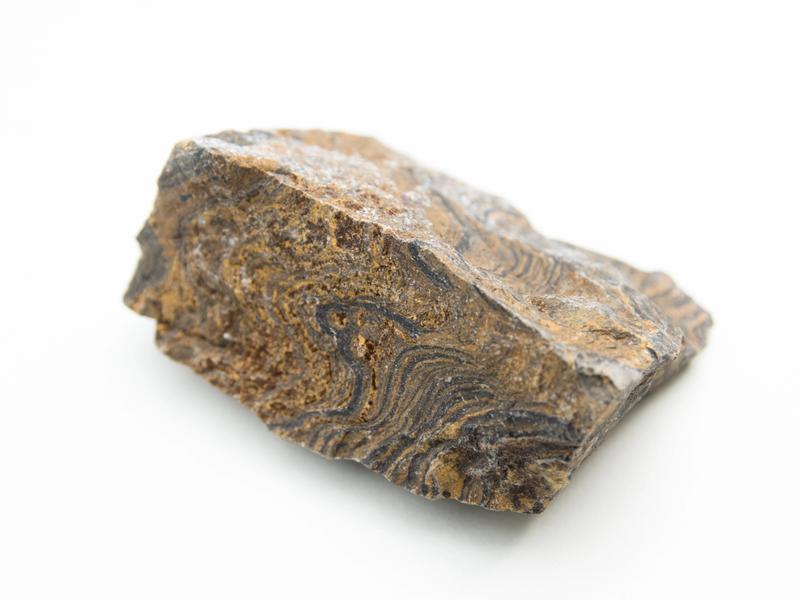
Look at the laminated layers visible in the stone. Each layer represents a mat of living organisms that grew, died, and were cemented by sediment — then the next generation grew on top. Layer after layer for billions of years. Place the stone on your chest and inhale for six counts. You are the latest layer. You are built on everything that came before you.
Close your eyes with the stone still on your chest. Breathe naturally and count backward from ten to one. Each number is a layer. Each layer is a generation. By the time you reach one, you are at the oldest part of the story — the first organism that figured out how to eat light. Rest there for thirty seconds.
Move the stone to your forehead. The cyanobacteria did not know they were changing the world. They were just breathing. Your daily acts of persistence may be changing things you cannot yet see. Let that possibility sit on your forehead without needing proof.
Continue in the full protocol below.
tap to flip for protocol
Isolation distorts time as much as feeling. The self begins to imagine its struggle as uniquely contemporary, uniquely private, and uniquely impossible to share. The body gets lonelier not just from pain, but from smallness of frame.
Stromatolite widens that frame almost brutally. These layered structures record ancient microbial communities whose work changed planetary conditions over time scales the individual mind can barely metabolize. The point is not insignificance. It is lineage.
Stromatolite matters when endurance needs a larger ancestry behind it. Life has survived by collaboration before, and some part of the body recognizes the relief in that fact.
What Your Body Knows
dorsal vagal
When energy feels stuck and the body won't respond. Stromatolite is placed on the body as an anchor point. Your shoulders drop. Your breath becomes shallow and barely audible. A heaviness settles in your limbs. This is dorsal vagal shutdown; your oldest survival circuit pulling you toward stillness, collapse, disconnection from sensation.
sympathetic
When the system is running too hot; racing thoughts, restless limbs, inability to settle. Your chest tightens. Your jaw clenches. Your breath moves higher, shallower, faster. This is sympathetic activation; your body mobilizing for fight or flight, muscles tensing, heart rate rising.
ventral vagal
When the body finds its resting rhythm. Stromatolite held or placed becomes a touchpoint for presence. Your chest opens. Your jaw unclenches. Your breath deepens into your belly. This is ventral vagal regulation; your body finding safety, social connection, steady presence.
Nervous system mapping based on polyvagal theory (Porges, 2011).
Mineralogy
Chemical Formula
Variable (SiO2 if silicified; CaCO3 if carbonate-dominated; biogenic sedimentary structure)
Crystal System
N/A
Mohs Hardness
5
Specific Gravity
2.4-2.8 (varies with composition)
Luster
Varies -- waxy (chert), vitreous (quartz), dull to earthy (carbonate)
Color
Brown-Green
Traditional Knowledge
3.48-3.8 Ga (billion years ago): The earliest stromatolites formed during the Paleoarchean era. They represent the oldest macroscopic evidence of life on Earth. ~2.4-2.0 Ga (Great Oxidation Event): Cyanobacterial stromatolites are credited with transforming Earth's atmosphere from anoxic to oxic through photosynthetic oxygen production; one of the most significant events in Earth history. ~850 Ma (Late Riphean): Stromatolites reach their greatest morphological diversity. ~540 Ma (Cambrian explosion): Stromatolite diversity and abundance decline dramatically, likely due to grazing by newly evolved metazoan organisms. 1825: Karl von Sternberg first describes fossilized stromatolites, though their biological origin is not yet recognized. 1908: Ernst Kalkowsky coins the term "stromatolite" from the Greek "stroma" (bed/layer) and "lithos" (stone). 1956-1961: Discovery of living stromatolites at Shark Bay, Western Australia, by Philip Playford and colleagues, providing the critical modern analog for understanding ancient forms. 2000s-present: Stromatolites become widely available in the lapidary and crystal market, valued for their banded appearance and connection to deep geological time. The concept of holding "the oldest evidence of life on Earth" gives them a unique narrative power. Astrobiology significance: Stromatolites are a primary target in the search for biosignatures on Mars. NASA rovers have searched for stromatolite-like structures in ancient Martian lake beds.
3.48-3.8 Ga (billion years ago)
The earliest stromatolites formed during the Paleoarchean era. They represent the oldest macroscopic evidence of life on Earth. - ~2.4-2.0 Ga (Great Oxidation Event): Cyanobacterial stromatolites are credited with transforming Earth's atmosphere from anoxic to oxic through photosynthetic oxygen production -- one of the most significant events in Earth history. - ~850 Ma (Late Riphean): Stromatolites reach their greatest morphological diversity. - ~540 Ma (Cambrian explosion): Stromatolite diversity and abundance decline dramatically, likely due to grazing by newly evolved metazoan organisms. - 1825: Karl von Sternberg first describes fossilized stromatolites, though their biological origin is not yet recognized. - 1908: Ernst Kalkowsky coins the term "stromatolite" from the Greek "stroma"
When This Stone Finds You
Somatic protocol
Fossilized cyanobacterial mats that created Earth's oxygen atmosphere 3.5 billion years ago — not a crystal but the oldest evidence that life breathes, stacks, and persists.
5 min protocol
Hold the stromatolite and understand what you are holding: this is not a crystal. This is a fossil of layered cyanobacterial mats — the organisms that invented photosynthesis and created Earth's oxygen atmosphere 3.5 billion years ago. Every breath you take exists because of what this stone records. Hold it at your belly and breathe.
1 minLook at the laminated layers visible in the stone. Each layer represents a mat of living organisms that grew, died, and were cemented by sediment — then the next generation grew on top. Layer after layer for billions of years. Place the stone on your chest and inhale for six counts. You are the latest layer. You are built on everything that came before you.
1 minClose your eyes with the stone still on your chest. Breathe naturally and count backward from ten to one. Each number is a layer. Each layer is a generation. By the time you reach one, you are at the oldest part of the story — the first organism that figured out how to eat light. Rest there for thirty seconds.
1 minMove the stone to your forehead. The cyanobacteria did not know they were changing the world. They were just breathing. Your daily acts of persistence may be changing things you cannot yet see. Let that possibility sit on your forehead without needing proof.
1 minSit up and hold the stromatolite in both hands. It survived 3.5 billion years of tectonic upheaval, erosion, and entropy. It is still here. You are still here. That is not coincidence — it is the same stubbornness wearing different forms. Set the stone down. The ancient breath acknowledges your current one.
1 minMineral Distinction
- Stromatolite is NOT a mineral. It is a biogenic sedimentary structure (a type of fossil). It has no fixed chemical formula, crystal system, or mineral classification.
Listing it alongside minerals is a category error common in the crystal trade. - Common misconception: "All stromatolites are billions of years old." Stromatolites span the entire geological record from ~3.
48 Ga to the present. Modern living stromatolites exist today. The age of a specific specimen depends on the geological formation it comes from.
Most lapidary-market stromatolites are Proterozoic (0. 5-2. 5 Ga) from Montana or Western Australia.
- Biogenicity debates: The oldest putative stromatolites (~3. 7-3. 8 Ga, Isua, Greenland; ~3.
48 Ga, Dresser Formation) are still debated. Some researchers argue certain ancient structures could be abiotic (formed by non-biological chemical precipitation). The 3.
43 Ga Strelley Pool Formation stromatolites are more widely accepted. - "Kambaba jasper" confusion: "Kambaba jasper" (also "crocodile jasper") is sometimes marketed as fossilized stromatolite from Madagascar. Some specimens may indeed contain stromatolitic structures, but much of what is sold under this name is orbicular rhyolite or other volcanic rock with no biological origin.
Care and Maintenance
- Water safe: GENERALLY YES. Most stromatolite specimens are silicified (quartz-rich) and extremely stable in water. Carbonate-dominated specimens are slightly soluble in acidic water but pose no toxicity concern.
- Sun safe: YES. The mineral pigments (iron oxides, organic carbon) are photostable. - Toxic elements: VERY LOW CONCERN.
The primary minerals in most commercial stromatolite specimens are quartz, calcite, and dolomite. all essentially non-toxic. - Exception: Pyritic stromatolites (containing iron sulfide) can oxidize in moist air, producing sulfuric acid and releasing iron.
This is more of a specimen preservation issue than a health concern. - Dust caution: Cutting silicified stromatolites produces silica dust. standard lapidary precautions apply.
- Overall: Stromatolite is among the SAFEST geological specimens commonly available. Safe for handling, display, and educational use.
In Practice
You feel disconnected from the scale of life itself. Stromatolite records the layered labor of ancient cyanobacteria that produced the oxygen you are breathing. 3.
5 billion years of microbial life, recorded in stone. Hold during periods of meaninglessness. Place in your environment as a visual reminder that patience on a planetary scale built an atmosphere.
The organisms are extinct. The air they made is what keeps you alive.
Verification
Stromatolite: layered sedimentary structure built by ancient cyanobacteria. The diagnostic feature is wavy, dome-shaped laminations visible in cross-section. These biological layering patterns are distinct from non-biological banded rock.
If the layers are perfectly parallel and uniform (like agate banding), it may be banded chert, not a biological stromatolite.
Natural Stromatolite should usually feel cooler than plastic or resin on first touch and warm more slowly in the hand.
Use 5 on the Mohs scale as the check, not internet myths. A real specimen should behave in line with the hardness listed above.
Look for a varies -- waxy (chert), vitreous (quartz), dull to earthy (carbonate) surface quality rather than a painted or plastic shine.
The listed specific gravity is 2.4-2.8 (varies with composition). If a specimen feels unusually light for its size, it may deserve a second look.
Geographic Origins
Pilbara Craton, Western Australia: Home to the oldest widely accepted stromatolites . the ~3.48 Ga (billion-year-old) Dresser Formation at North Pole Dome and the ~3.43 Ga Strelley Pool Formation. These are among the oldest macroscopic evidence of life on Earth. Shark Bay, Western Australia: Living stromatolites at Hamelin Pool . a UNESCO World Heritage site. These modern analogs provide insight into ancient stromatolite-forming processes. Barberton Greenstone Belt, South Africa: Contains some of the oldest putative biological structures (~3.4-3.5 Ga), though their biogenicity is debated. Isua Group, Greenland: Disputed stromatolite-like structures in ~3.7-3.8 Ga rocks . if biogenic, these would be the oldest evidence of life on Earth. Bahamas (Highborne Cay and Exuma Cays): Modern marine stromatolites forming in open ocean conditions. Brazil (Lagoa Salgada): Modern stromatolites in a seasonally brackish lagoon, producing unusually 13C-enriched carbonates linked to methanogenesis. Cape Recife, South Africa: Living phosphatic stromatolites . the first described modern analogs of fossil phosphatic stromatolites. Montana/Wyoming, USA (Precambrian Belt Supergroup): Excellent Proterozoic stromatolite fossils commonly available in the lapidary market. Bolivia/Peru (Lake Titicaca region): Modern stromatolites in high-altitude alkaline lakes.
Modern living stromatolites are found in hypersaline environments (Shark Bay, Western Australia), alkaline lakes, and some marine settings (Bahamas, Brazil) where competition from grazing organisms is reduced.
FAQ
Mohs hardness: 5 - 7 (depending on predominant mineral; chert-dominated stromatolites ~7, carbonate-dominated ~3-4, silicified specimens ~6-7). Crystal system: N/A (biogenic sedimentary structure, not a crystalline mineral).
Stromatolite has a Mohs hardness of 5 - 7 (depending on predominant mineral; chert-dominated stromatolites ~7, carbonate-dominated ~3-4, silicified specimens ~6-7).
GENERALLY YES. Most stromatolite specimens are silicified (quartz-rich) and extremely stable in water. Carbonate-dominated specimens are slightly soluble in acidic water but pose no toxicity concern.
YES. The mineral pigments (iron oxides, organic carbon) are photostable.
Stromatolite crystallizes in the N/A (biogenic sedimentary structure, not a crystalline mineral).
VERY LOW CONCERN. The primary minerals in most commercial stromatolite specimens are quartz, calcite, and dolomite -- all essentially non-toxic.
References
. [SCI]
DOI: 10.1111/gbi.12610
. [SCI]
. [SCI]
DOI: 10.1111/gbi.12184
. [SCI]
DOI: 10.1111/gbi.12029
. [SCI]
. [SCI]
DOI: 10.1111/gbi.12415
. [SCI]
DOI: 10.1111/gbi.12399
. [SCI]
DOI: 10.1111/gto.12321
. [SCI]
DOI: 10.1111/gbi.12506
. [SCI]
. [SCI]
DOI: 10.1111/gbi.12130
. [SCI]
Closing Notes
Among the oldest evidence of life on Earth. Layered structures built by cyanobacteria 3. 5 billion years ago.
The organisms that eventually produced the oxygen you are breathing right now. The science documents biological sedimentary structures. The practice asks what legacy means when the builders are extinct but the atmosphere they created is the one you are using.
Bring it into practice
Move from reference to ritual. Search current inventory for Stromatolite, build a custom bracelet, or let Sacred Match choose the right supporting stones for you.
Community notes
Shared field notes tied to Stromatolite appear here, including notes saved from practice.
When members save a public field note for this stone, it will appear here.
The archive
Continue through stones that share intention, chakra focus, or tonal family with Stromatolite.
Shared intention: Protection & Grounding
The Megalithic Anchor

Shared intention: Protection & Grounding
The Fossil Memory

Shared intention: Protection & Grounding
The Keeper of Deep Time

Shared intention: Protection & Grounding
The Black Foundation Stone
Shared intention: Protection & Grounding
The Iron That Fell From Space

Shared intention: Protection & Grounding
The Heavy Anchor of Abundance