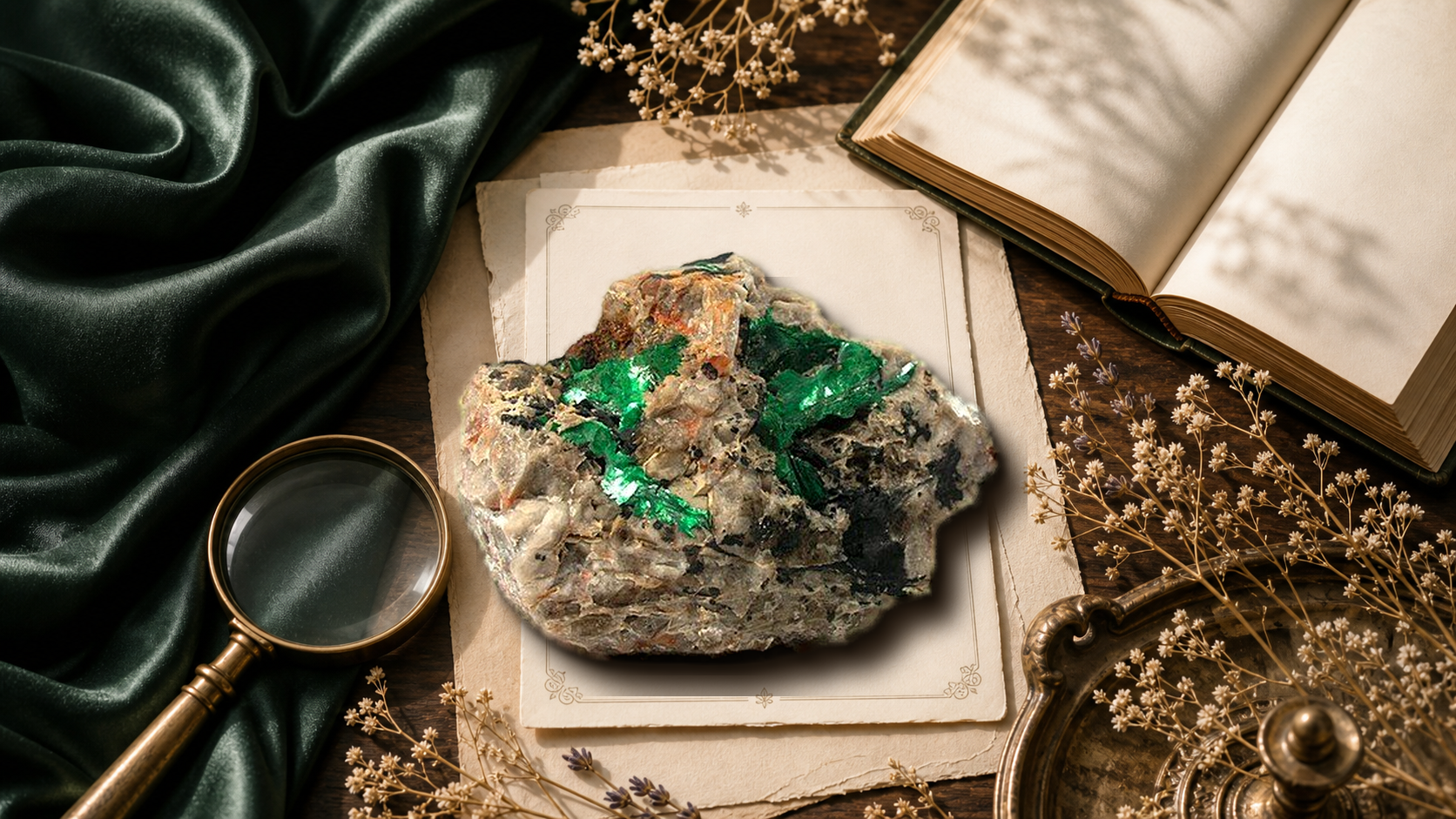
You are wary of the parts of you that glow too dangerously to ignore. Torbernite forms vivid green uranium phosphate plates with an elegance sharpened by real toxicity. Some beauty belongs behind glass.
Torbernite works most clearly with themes of hazardous attraction, but it is not a handling stone and should remain a specimen. Its narrative value comes from...
The Meaning
Torbernite 2 2 8 12H2O in the Crystalis dictionary
Not every attractive quality is safe in direct handling. There are talents, passions, and intensities that draw the eye immediately and still require protocol if they are going to remain survivable.
Torbernite teaches that lesson without losing any beauty in the process. Its tabular green crystals look almost too refined for the chemistry they carry, and that tension is the whole point. The allure is real. So is the need for distance.
Torbernite helps when discernment must become sharper around what dazzles you.
Attraction is not always permission.
Stone Lore
Stories carried through time
Cultural notes are presented as tradition and historical context — stories carried through time.
Unknown
Shinkolobwe and the Manhattan Project (1940s)
The Shinkolobwe mine in the Belgian Congo (now DRC) produced the uranium that fueled the Manhattan Project. Union Miniere du Haut Katanga, the Belgian mining company, had stockpiled Shinkolobwe ore in a New York warehouse, and this high-grade uranium became the feedstock for the first nuclear weapons. Torbernite, abundant in Shinkolobwe's oxidation zone, was one of the visual markers used by geologists to identify uranium-rich zones.
The mine's role in the development of nuclear weapons makes Congolese torbernite one of the most historically consequential minerals on Earth (Helmreich, S. , "Uranium Mining and Nuclear Legacies in the Congo," 2020; Zoellner, T. , "Uranium: War, Energy, and the Rock That Shaped the World," 2009, Viking Penguin).
Origin lore
Green Uranium Mineral from Joachimsthal
The type locality for torbernite is Jáchymov (St. Joachimsthal) in the Czech Republic, a historic mining district that also gave its name to the joachimsthaler coin, the ancestor of the word "dollar." Torbernite contains approximately 48%...
Modern/Scientific · 1793–present
Historical note
Werner's Tribute to Bergman
Named by Abraham Gottlob Werner in 1792 in honor of Torbern Olof Bergman (1735 to 1784), the Swedish chemist who introduced a classification of minerals based on chemical composition rather than appearance. The mineral was first mentioned...
Modern/Scientific · 1792 CE
Earth Record
Mineralogy and formation
Few minerals announce oxidation-zone chemistry as vividly as torbernite. Its square green plates form after primary uranium minerals have already broken down. Groundwater enters fractures, mobilizes uranium under oxidizing conditions as the uranyl ion, and transports phosphate through the same system. If copper is available, often from nearby sulfides, these components combine at shallow depth and precipitate as hydrated copper uranyl phosphate.
That late-stage origin explains torbernite's association with altered uranium veins and weathered ore bodies rather than deep primary crystallization.
The crystal structure is sheet-like and strongly hydrated. Water molecules occupy interlayer positions, giving torbernite both its delicate habit and its instability. In humid conditions it can remain bright and well formed, but in dry air it tends to lose part of that water load and convert to metatorbernite, the 8-water phase. Collectors often see the evidence directly: surfaces dull, edges craze, and once-glassy plates look tired. That dehydration is not a cosmetic issue alone. It is a structural change.
Its color comes from a chemically dramatic partnership. Uranyl groups contribute their characteristic yellow-green influence, while copper deepens the hue toward emerald and grass green. The result is elegant enough to tempt close handling, but the mineral remains radioactive and should be treated as a display specimen, not a pocket stone. Historically, torbernite mattered as an indicator of uranium mineralization because its appearance often signaled the oxidative redistribution of uranium in ore districts.
Classic localities in Cornwall, the Erzgebirge, Katanga, and South Australia all share the same broad narrative: preexisting uranium sources, oxidative groundwater, phosphate availability, and time for delicate secondary growth in open fractures. Tetragonal symmetry gives many crystals their neat square outline, making torbernite one of the easiest uranium minerals to recognize by habit.
What emerges is a mineral of beautiful instability, a green plate that exists only because a far older ore system has been chemically taken apart and reassembled in the weathering cap. In specimen terms, torbernite is less a durable endpoint than a moment caught in oxidation chemistry. Its beauty depends on conditions remaining just wet enough, just cool enough, and just undisturbed enough for the hydrate to persist.
Crystal system diagram represents the general tetragonal classification. Diagram created by Crystalis for educational reference.
3.2--3.6 (higher than autunite due to copper content)
Luster
Vitreous to subadamantine on crystal faces; pearly on cleavage surfaces
Color
Green
IMA Status
species
Type Locality
Georg Wagsfort Mine, Johanngeorgenstadt, Saxony, Germany
IMA Number
pre-IMA 1793
01
Mineral conditions gather
02
Structure begins to crystallize
03
Torbernite 2 2 8 12H2O records place and pressure
DR Congo's Shinkolobwe Mine (Katanga) produced historically significant torbernite specimens from the same deposit that supplied uranium for the Manhattan Project. UK's Cornwall produces specimens from historic mining districts. Australia yields torbernite from uranium-bearing deposits in South Australia.
All localities share uranium-bearing geological environments with phosphate-rich groundwater.
DR CongoUKAustralia
Telling it apart
The fraud risk is highest with torbernite, autunite, and green mica-like minerals because many buyers see bright uranium green and stop there. That is not enough.
Torbernite is the copper uranyl phosphate. Autunite is the calcium uranyl phosphate. Both can form tabular yellow-green to green plates in oxidized uranium deposits, and both are radioactive. The color can overlap, but torbernite is usually the richer emerald green because copper sits in the structure. Autunite often trends more yellow. Green micas and chlorites may imitate the look from a distance, but they lack radioactivity, the same square-tabular habit, and the uranium chemistry.
The clearest indicator is dehydration behavior and context. Torbernite often alters to metatorbernite in dry storage, leaving a duller cracked surface. Autunite responds differently and is generally more fluorescent. A radiation meter is the confirming step for safety, not just identification.
Safety is the issue here. Any seller treating torbernite as ordinary decorative green crystal material is omitting the single fact a buyer most needs.
Spotting the real thing
Torbernite: RADIOACTIVE. Vivid green tabular crystals. SG 3.
2-3. 6 (heavier than autunite due to copper). Mohs 2-2.
5 (very soft). Fluoresces under UV light. Contains uranium and copper.
A Geiger counter will register above background. If a green tabular mineral is not radioactive, it is not torbernite. Handle with care; store sealed.
Torbernite's vivid green is the most intense green in the mineral kingdom; a color that simultaneously signals "life" (chlorophyll, vegetation, safety) and "poison" (warning coloration in nature; green mambas, poison dart frogs, toxic algae blooms). For a nervous system already in sympathetic activation, observing torbernite through glass provides an opportunity to practice what Deb Dana calls "glimmers within triggers"; recognizing beauty within danger without either denying the danger or being consumed by it.
State shift: undifferentiated sympathetic toward nuanced sympathetic-ventral co-activation (discerning awareness).
Shut down & far away
Dorsal vagal collapse (nihilism/meaninglessness):
Torbernite's extreme beauty challenges nihilistic collapse directly. The dorsal vagal state says "nothing matters." Torbernite answers: "This matters enough to kill you." The mineral reasserts that reality has consequences; that the physical world is not neutral or indifferent but actively potent. For some nervous systems in dorsal shutdown, this confrontation with undeniable potency can initiate the first stirrings of re-engagement. State shift: nihilistic dorsal toward acknowledgment that the world is consequential, which is a precondition for caring.
Charged & on alert
the sublime
The ventral vagal system is engaged and it is oriented toward responsibility: not obligation, not guilt, but the genuine awareness that capacity creates duty. The person in this state has enough regulation and enough resources to recognize that their surplus can serve others, and this recognition does not deplete them but organizes their energy toward purpose. Responsibility awareness is the autonomic foundation of leadership, parenthood, and service.
Torbernite's role: Torbernite is hydrated copper uranyl phosphate in vivid green tabular crystals. It is radioactive and must be handled with awareness and stored with care. The mineral is beautiful but carries genuine consequence for careless contact. Placed in a sealed display case in the workspace, torbernite provides the visual model for responsible power: something vivid and potent that requires awareness of its effects on others.
The stone does not punish carelessness. It simply is what it is, and the responsibility for safe handling belongs to the person who chose to keep it. That is what leadership feels like from the inside.
Settled & connected
When already regulated, observing torbernite supports reflection on power, stewa...
When already regulated, observing torbernite supports reflection on power, stewardship, and the ethics of knowledge. The uranium in this mineral built bombs that ended one war and threatened to end civilization. The same element powers medical imaging and cancer treatment. Torbernite confronts the regulated nervous system with the question of what we do with dangerous knowledge. State support: ventral vagal engagement with ethical complexity and responsibility.
5.
; -
Sympathetic depletion with moral injury: For individuals whose burnout includes a moral dimension; healthcare workers, educators, social workers, veterans who have witnessed systemic failures; torbernite provides a geological mirror. Here is a substance of extraordinary beauty that has been simultaneously used for destruction and healing. The mineral does not resolve the moral injury.
It witnesses it. Sometimes what a depleted nervous system needs is not resolution but recognition that the paradox is real and has always been real. State shift: morally injured depletion toward companioned complexity.
These associations come from tradition and reflective practice — a way of working with the stone, not a medical prescription.
Somatic Practice
Simple ways to work with Torbernite 2 2 8 12H2O
◇
Hold
Carry Torbernite 2 2 8 12H2O in a pocket or place it over the heart center during a pause.
◌
Meditate
Let the stone become a quiet tactile anchor while the breath slows.
☽
Breathe
Breathe in softness. Breathe out tension. Keep the practice simple.
✎
Journal
Write with Torbernite 2 2 8 12H2O nearby to name the feeling without forcing a conclusion.
✋
Bodywork
Rest the stone near the chest, hand, or bedside as a reminder to soften.
⌂
Environment
Place it where you want a visual cue for care, repair, or steadiness.
Field Instruction
The Emerald Warning Witness
Honor the emerald warning you cannot touch.
3 min protocol
1
Place Torbernite in a sealed glass display case or behind glass. Do NOT handle with bare hands — this mineral contains both uranium and arsenic, and is radioactive. Keep at least 3 feet away. Settle your posture. Let your breath slow.
2
Observe the striking emerald-green tabular crystals. Notice the square, flat plates and vitreous luster. Let your eyes soften. Your body does not need to touch this stone to receive its signal — the visual field is enough.
3
With each exhale, release one thing — a thought, a tension, a worry. The stone holds its own boundaries. You hold yours. Continue breathing. Notice where the body softens first.
4
After 3 minutes: check in. Has the breath changed? Has the jaw released? That shift — however small — is the protocol complete. The emerald witnessed. The body responded. No contact required.
Stone Intelligence
The fact that makes Torbernite 2 2 8 12H2O memorable
Copper uranyl phosphate. Radioactive. Emerald green tabular crystals that fluoresce vivid green under UV.
Beautiful and dangerous. The science documents uranium mineralization in oxidation zones. The practice is sealed observation only.
Distance is the lesson.
SCI
Crystal structures and synthesis of the copper-dominant members of the autunite and meta-autunite groups: torbernite, zeunerite, metatorbernite and metazeunerite
Cu-Fe-U phosphate mineralization of the Hagendorf-Pleystein pegmatite province, Germany: with special reference to laser-ablation inductively-coupled plasma mass spectrometry (LA-ICP-MS) of limonite-cored torbernite
Locating hydrogen positions in the autunite mineral metatorbernite [Cu(UO2)2(PO4)2·8H2O]: a combined approach using neutron powder diffraction and computational modelling
Uranium brannerite with Tb(III)/Dy(III) ions: Phase formation, structures, and crystallizations in glass
Journal of the American Ceramic Society · 2019Read source
Ritual Use
From reference to practice
Display only. Torbernite is radioactive. Copper uranyl phosphate with vivid green tabular crystals that fluoresce under UV.
The use case is awareness at a distance: recognizing that the most vivid glow in the mineral kingdom comes from uranium chemistry. Do not handle frequently. Do not carry.
The boundary IS the practice.
Sacred Match
Sacred Match reaches for Torbernite when what you feel sounds like:
Drawn to what is clearly risky
Poor boundary respect around powerful things
Compulsive checking or fixation
Need for stricter handling protocols
Difficulty admiring without grasping
Learning distance as discipline
Sacred Match listens to the body rather than to preference. It notices what you are feeling right now, the way you are protecting yourself, and the deeper need underneath both. When that points to hazardous attraction, protocol failure, or a system that needs limits made visible, torbernite is the stone it offers as a specimen only.
Fixated -> attention locked on danger -> seeking distance
Boundary-poor -> power approached too casually -> seeking protocol
Grasping -> admiration confused with access -> seeking containment
Undisciplined -> curiosity without structure -> seeking procedure The prescription is about disciplined distance. It favors observation, limits, and the nervous-system skill of not touching everything that fascinates it. The prescription stays narrow on purpose, matching material logic to body state rather than treating every bright stone as interchangeable.
Stones and herbs that harmonize with Torbernite 2 2 8 12H2O
Pairings are treated like a recipe file: clear use, method, and safety.
Crystal Companion
Torbernite 2 2 8 12H2O + Amethyst
Use when
You want to layer the primary intention with another supportive tone.
How to work with it
Place the stones together during meditation, journaling, or a short reset.
Safety
Use as a reflective practice tool, not as a medical substitute.
Crystal Companion
Torbernite 2 2 8 12H2O + Rhodonite
Use when
You want to layer the primary intention with another supportive tone.
How to work with it
Place the stones together during meditation, journaling, or a short reset.
Safety
Use as a reflective practice tool, not as a medical substitute.
Crystal Companion
Torbernite 2 2 8 12H2O + Clear Quartz
Use when
You want to layer the primary intention with another supportive tone.
How to work with it
Place the stones together during meditation, journaling, or a short reset.
Safety
Use as a reflective practice tool, not as a medical substitute.
Crystal Companion
Torbernite 2 2 8 12H2O + Black Tourmaline
Use when
You want to layer the primary intention with another supportive tone.
How to work with it
Place the stones together during meditation, journaling, or a short reset.
Safety
Use as a reflective practice tool, not as a medical substitute.
Display Obsidian
The Beauty With a Warning Label.
Torbernite is hydrated copper uranyl phosphate, tetragonal at Mohs 2, a mineral that should not be handled casually due to its uranium content. Any pairing remains conceptual and display-based rather than body-based. Obsidian is useful beside it because both materials carry a hard edge of truth. Place torbernite in a closed cabinet and set obsidian directly in front of the case.
Malachite
The Copper Kin, Different Risk.
Malachite and torbernite share green copper-associated visual appeal, but only one carries uranium. Malachite is copper carbonate hydroxide; torbernite is copper uranyl phosphate. Pairing them in a collection teaches discernment about what beauty costs. Arrange malachite on a lower shelf and torbernite above it in sealed storage.
Fluorite
The Structured Inspection.
Fluorite's cubic order and color zoning make it a strong companion for specimen observation. Fluorite at Mohs 4 is handleable where torbernite is not. Best when the goal is mineral study rather than metaphysical use. Keep fluorite on the desk as the handling stone and torbernite inside a case across the room.
Black Tourmaline
The Perimeter Awareness.
Used not as a cure or shield against radiation, but as a symbolic reminder that some materials require non-negotiable boundaries. Black tourmaline's Mohs 7 boron silicate body provides firm boundary language beside a mineral that demands genuine physical respect. Place black tourmaline near the cabinet latch and torbernite inside the sealed display.
Pairing Caution
Torbernite is radioactive and contains uranium. Display only, sealed storage, never use in elixirs, never handle without precaution.
Care & Cleansing
How to keep Torbernite 2 2 8 12H2O in good condition
Water Safe?
Toxic mineral
This mineral should not go in water and may require stricter handling. Dust, residue, or soluble components can create real exposure risk.
Sunlight Safe?
Sunlight safe
Tolerates daylight; safe to charge or display in the sun.
Authenticity
What to check
Natural Torbernite 2 2 8 12H2O should usually feel cooler than plastic or resin on first touch and warm more slowly in the hand.
WARNING: Torbernite is RADIOACTIVE. Copper uranyl phosphate containing uranium. NEVER handle without washing hands afterward. NEVER place in water or gem elixirs. Display only in a sealed case, preferably with a radiation label. Do not store near living spaces or sleeping areas. Can dehydrate and crumble into toxic radioactive dust. Recommended cleansing: visual observation only. Store in a sealed container in a well-ventilated area.
Safety: Safe to own, display, and handle; wash your hands afterward. Do not make elixirs, place it in drinking water, or ingest it, and never inhale dust from raw or broken pieces.
Temperature
Natural Torbernite 2 2 8 12H2O should usually feel cooler than plastic or resin on first touch and warm more slowly in the hand.
Scratch logic
Use 2 on the Mohs scale as the check, not internet myths. A real specimen should behave in line with the hardness listed above.
Surface and luster
Look for a vitreous to subadamantine on crystal faces; pearly on cleavage surfaces surface quality rather than a painted or plastic shine.
Weight and density
The listed specific gravity is 3.2--3.6 (higher than autunite due to copper content). If a specimen feels unusually light for its size, it may deserve a second look.
My Field Guide
Your private record and next steps
Journal
Add this stone to your private collection, then log what happened when you worked with it.
Shared Notes
Read public practice logs and pattern notes from the Crystalis community.
When members save a public field note for this stone, it will appear here.
Frequently Asked
Questions people ask about Torbernite 2 2 8 12H2O
What is Torbernite?
⌄
Torbernite is a hydrated copper uranyl phosphate, Cu(UO2)2(PO4)2 . 8-12H2O, tetragonal (space group I4/mmm), extremely soft and fragile at Mohs 2 to 2. 5, belonging to the autunite group of hydrated uranyl phosphate minerals; it is the copper analogue of autunite, which contains calcium instead of copper. Like autunite, torbernite dehydrates readily to meta-torbernite (Cu(UO2)2(PO4)2 .
4-8H2O), losing structural water and becoming more opaque and brittle. The vivid green color is produced by the combination of the uranyl ion (UO22+) and copper (Cu2+), with copper dominating the visible color while uranyl contributes fluorescence under UV light; torbernite's fluorescence is weaker than autunite's due to copper's quenching effect (Nakata et al. , 2013).
What is the Mohs hardness of Torbernite?
⌄
Torbernite has a Mohs hardness of 2 to 2.5 (extremely soft and fragile).
Can Torbernite go in water?
⌄
Water Safety ABSOLUTELY NOT, RADIOACTIVE AND TOXIC. Torbernite is moderately soluble in water, releasing both uranium and copper ions into solution. Uranium causes renal toxicity; copper causes gastrointestinal and hepatic toxicity. The dual contamination from a single mineral makes water exposure doubly hazardous. Never place torbernite in water, near water, or anywhere water vapor, condensation, or humidity could create runoff.
Never use for elixirs, gem water, or any indirect method. This mineral has zero safe water applications. Even cleaning requires extreme caution, see Safety Warnings.
What crystal system is Torbernite?
⌄
Torbernite crystallizes in the Tetragonal, space group I4/mmm.
What is the chemical formula of Torbernite?
⌄
The chemical formula of Torbernite is Cu(UO2)2(PO4)2. 8 to 12H2O, hydrated copper uranyl phosphate.
Is Torbernite toxic?
⌄
Copper compounds cause nausea, vomiting, hepatic damage, and contact dermatitis through ingestion, inhalation, or prolonged skin contact (Park et al., 2018). Uranium compounds cause renal toxicity and potential carcinogenicity (Wang et al., 2024).
How does Torbernite form?
⌄
Formation Story Torbernite shares its origin story with autunite, both form in the supergene oxidation zones of uranium deposits, but torbernite's formation requires the additional presence of dissolved copper. Where autunite needs only calcium (ubiquitous in most geological environments), torbernite needs copper, making it rarer and more geochemically specific.
Sources & Citations
Where this entry can be checked
Back Matter
Readable for people. Structured for AI search.
Sources stay visible in the page so readers, search engines, and answer systems can follow the evidence trail.
01
SCI
Crystal structures and synthesis of the copper-dominant members of the autunite and meta-autunite groups: torbernite, zeunerite, metatorbernite and metazeunerite
Locock A.J., Burns P.C. (2003). Crystal structures and synthesis of the copper-dominant members of the autunite and meta-autunite groups: torbernite, zeunerite, metatorbernite and metazeunerite. Canadian Mineralogist. [SCI]DOI 10.2113/gscanmin.41.2.489
02
SCI
Cu-Fe-U phosphate mineralization of the Hagendorf-Pleystein pegmatite province, Germany: with special reference to laser-ablation inductively-coupled plasma mass spectrometry (LA-ICP-MS) of limonite-cored torbernite
Dill H.G., Gerdes A., Weber B. (2007). Cu-Fe-U phosphate mineralization of the Hagendorf-Pleystein pegmatite province, Germany: with special reference to laser-ablation inductively-coupled plasma mass spectrometry (LA-ICP-MS) of limonite-cored torbernite. Mineralogical Magazine. [SCI]DOI 10.1180/minmag.2007.071.4.371
03
SCI
Locating hydrogen positions in the autunite mineral metatorbernite [Cu(UO2)2(PO4)2·8H2O]: a combined approach using neutron powder diffraction and computational modelling
Kirk C.A., MacIver-Jones F.M., Sutcliffe P., Graham M.C., Morrison C.A. (2021). Locating hydrogen positions in the autunite mineral metatorbernite [Cu(UO2)2(PO4)2·8H2O]: a combined approach using neutron powder diffraction and computational modelling. IUCrJ. [SCI]DOI 10.1107/S205225252100837X
04
SCI
Uranium brannerite with Tb(III)/Dy(III) ions: Phase formation, structures, and crystallizations in glass
Zhang, Yingjie, Wei, Tao, Zhang, Zhaoming, Kong, Linggen, Dayal, Pranesh et al. (2019). Uranium brannerite with Tb(III)/Dy(III) ions: Phase formation, structures, and crystallizations in glass. Journal of the American Ceramic Society. [SCI]DOI 10.1111/jace.16657