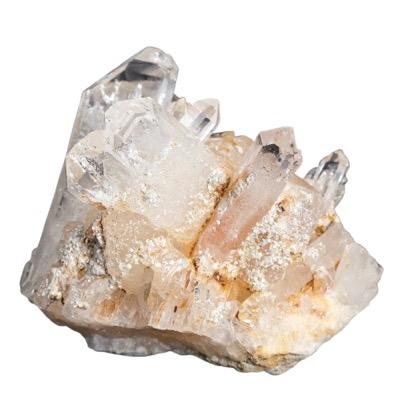
You need softness that is sheeted, not collapsed. Cookeite is a lithium aluminum phyllosilicate in thin layered structure, soft enough to mark at Mohs 2.5 to 3.5 and commonly formed as an alteration mineral in pegmatites. The body knows this as tension finally separating into manageable layers instead of one hard block.
Cookeite belongs to the diaphragm, lower ribs, shoulders, and the wrapped places where tension has fused into one hard block. It is a lithium aluminum phyllosilicate...
The Meaning
Cookeite in the Crystalis dictionary
Tension is no longer one hard block but a pile of soft sheets lifting apart under the fingers. The body feels powdery at the edges, marked easily, as if pressure could leave a trace without having to break anything open.
Stone Lore
Stories carried through time
Cultural notes are presented as tradition and historical context — stories carried through time.
Modern/Scientific
Named for Harvard's Josiah Cooke
Cookeite was named in honor of Josiah Parsons Cooke Jr. (1827 to 1894), an American mineralogist and chemist at Harvard University. It is a rare lithium-rich member of the chlorite group, typically occurring as a late-stage alteration product of spodumene, lepidolite, and other lithium minerals in granite pegmatites. The type locality is Paris, Oxford County, Maine. Documented in Dana (1868).
1866 CE
Origin lore
Lithium Chlorite from Pegmatites
Cookeite is the only lithium-rich member of the chlorite group and occurs exclusively in lithium-bearing granite pegmatites as an alteration product of spodumene, lepidolite, and tourmaline. Notable localities include the Bennett and...
Modern/Scientific · 1866–present
Earth Record
Mineralogy and formation
Late in the life of a lithium pegmatite, after the coarse framework minerals have largely crystallized, cookeite can appear as an alteration product rather than a primary architectural phase. This lithium aluminum phyllosilicate typically forms when earlier lithium-bearing minerals such as lepidolite, spodumene, petalite, or lithian tourmaline are attacked by hydrothermal fluids.
Mineralogical references consistently place it in late-stage pegmatitic and hydrothermal settings, and specifically describe it as a hydrothermal alteration product of lithium minerals in pegmatites, with a secondary role as a primary mineral in some hydrothermal veins.
Its structure reflects those conditions. Cookeite occupies a position within the chlorite group structurally, with layered tetrahedral and octahedral sheets that accommodate lithium and aluminum in a hydrous framework. That is a texture of re-equilibration. Pegmatites begin as extremely evolved silicate melts enriched in water, boron, fluorine, phosphorus, and incompatible elements.
As the system cools, residual fluids become chemically concentrated and highly reactive. Once those fluids begin moving through fractures, cavities, and grain boundaries, unstable earlier lithium phases can be partly dissolved and replaced by micas, clays, and chlorite-group minerals. Cookeite belongs to that final hydrous overprint.
Exact formation temperatures are not standardized for every occurrence, but the geological position is clear. Pegmatitic cookeite marks the low-temperature tail of pegmatite evolution, after the main magmatic stage and during hydrothermal alteration. In granitic pegmatites, that commonly places it below the temperatures of primary feldspar and quartz crystallization and often in the broad neighborhood of roughly 200 to 400 °C, where late fluids can still reorganize lithium and aluminum efficiently without remelting the rock.
Pressure is shallow crustal, corresponding to emplacement depths typical of granite pegmatites rather than deep metamorphic terranes.
Associations confirm the setting. Cookeite commonly occurs with quartz, albite, microcline, lepidolite, spodumene, petalite, and tourmaline. Those are classic pegmatite companions. It may line cavities, coat replaced crystals, or develop in worm-like, botryoidal, or platy aggregates, all signs of growth in open space or during replacement. In some specimens it forms pseudomorphic shells after earlier minerals, preserving an earlier external shape while completely changing internal mineralogy.
There is also a broader lesson in its paragenesis. Lithium pegmatites do not end with the crystallization of gem phases. They continue chemically as residual fluids strip, redistribute, and reassemble components. Cookeite records that late conversation between rock and fluid. Lithium that once sat in a mica, pyroxene, or borosilicate is reincorporated into a softer, hydrous layered silicate more stable under altered conditions.
Cookeite therefore is not the triumphant first crystal of a melt. It is a late adjustment. It forms when evolved pegmatitic systems cool into hydrothermal regimes and earlier lithium minerals begin to yield to replacement, hydration, and structural simplification.
Crystal system diagram represents the general monoclinic classification. Diagram created by Crystalis for educational reference.
Cookeite is found in lithium-rich pegmatites, hydrothermal veins, and metamorphically altered settings associated with aluminous rocks. Important occurrences include parts of the United States such as Maine, California, and North Carolina, as well as France, Zimbabwe, Brazil, and Madagascar. It is commonly linked to pegmatite environments that also host lepidolite, spodumene, tourmaline, quartz, and feldspar.
These places produce Cookeite because pegmatites represent the late stage fluids of granitic systems, enriched in lithium, aluminum, silica, and volatiles. As the chemistry evolves and earlier minerals alter, sheet silicates such as Cookeite can form as secondary or replacement minerals. It may line cavities, replace spodumene or feldspar, or occur in fine masses with other lithium minerals.
The geological context matters because Cookeite is often a sign of change rather than primary crystallization alone. Pegmatites cool slowly and concentrate unusual elements, creating ideal conditions for both large crystals and later alteration products. That is why Cookeite often appears in mineral suites that show multiple stages of growth and replacement. In practical terms, the same places famous for lithium pegmatites tend to be the places where Cookeite is most likely to appear, because the rock chemistry already contains the ingredients its layered structure requires.
Maine and MassachusettsUSA; Western Australia; Brazil; Madagascar; Afghanistan; China
Telling it apart
If every pale green flaky mineral got sold honestly, cookeite would be labeled a lot less often. The confusion here is straightforward: cookeite gets mixed up with chlorite, muscovite, and other sheet silicates because they can all look soft, platy, and vaguely pearly. But cookeite is a lithium-rich chlorite-group mineral, not just any green mica-like coating.
The definitive field test is the sheet behavior first, then the context. Thin muscovite lamellae are elastic. They spring back. Chlorite-group lamellae, including cookeite, are flexible but not elastic. Cookeite also commonly forms botryoidal, wormy, radial plate aggregates rather than neat mica "books." If the material occurs as a soft greenish coating in pegmatite cavities with quartz, lepidolite, or tourmaline, cookeite becomes more plausible. If you need certainty, you move to XRD, because visual separation from other phyllosilicates can be shaky.
Why it matters: sellers use obscure names to inflate ordinary-looking material. Real cookeite has a specific mineral identity and geological setting. Mislabeling muscovite or generic chlorite as cookeite is not a harmless mix-up. It changes the specimen's accuracy, collectibility, and price. If the seller cannot explain why it is cookeite specifically, assume they are guessing.
Spotting the real thing
Cookeite can be tricky because it is less familiar than quartz or calcite and is often mixed with other minerals. Start by expecting a soft, layered, mica-like or clay-like appearance rather than a sharply faceted crystal. It may appear pale green, whitish, gray, lilac, or pinkish depending on locality and associations. If a seller presents it as a glassy transparent crystal with perfect terminations, be skeptical.
Touch is informative. Real Cookeite often has a soft feel and may show tiny platy or foliated textures. It should still feel mineral, not waxy plastic. Because hardness is only around Mohs 2.5 to 3.5, a copper coin or steel point may scratch it, while a fingernail might mark the softer end of the range. That softness is a specific and important clue.
Check the structure at the edges. Authentic Cookeite may show fine layering, cleavage, or a stacked texture, especially in aggregates. A fake resin piece will not show true mineral parting or lamellar surfaces. If associated with quartz or lepidolite, Cookeite may appear as pale coatings or masses around harder host minerals.
Use temperature and weight. It should feel cool when first picked up and have a natural mineral density, though not especially heavy. Resin imitations warm too fast and often look too smooth or too perfect.
A material-specific clue is association. Cookeite commonly forms as an alteration mineral in pegmatites and lithium-rich environments. If the specimen is labeled Cookeite but shows no plausible matrix, no layered habit, and no relation to lithium minerals or quartz, the identification deserves scrutiny. Since it is a niche mineral, authenticity often depends on whether the specimen looks geologically believable, not just whether the color matches a photo online.
Energetic Associations
How people most often work with Cookeite
✧
Calm
Chosen as a tactile cue for slowing down, breathing steadily, and returning to the present.
✧
Nervous System Support
A traditional association that gives Cookeite a clear intention pathway in practice.
✧
Rest
A traditional association that gives Cookeite a clear intention pathway in practice.
✧
Gentle Change
A traditional association that gives Cookeite a clear intention pathway in practice.
The body has bundled many kinds of tension into one defended mass and braces against all of it at once. The diaphragm hardens, the shoulders rise toward the ears, and breathing becomes an argument with a wall. There is no edge to grip because nothing is differentiated. Cookeite is a layered mineral that softens by reworking, not breakage. Practitioners describe placement over the ribs or solar plexus as interoceptive layering: surface muscle first, then deeper breath restriction, then the emotion beneath, each felt as its own stratum.
Shut down & far away
The Numb Slab
When the bracing outlasts its usefulness, the block goes quiet and heavy. You stop feeling the tension and start feeling nothing, a flattened weight where sensation used to be. Practitioners describe cookeite work here as the patient return of one layer at a time: a thin sheet of feeling lifting away from the slab, then another, soft enough to mark but still load-bearing. The mineral models change through gradual reworking. The body does not have to shatter to come back online.
Settled & connected
The Sheeted Softness
Softness that still has form. The tension separates into layers you can feel and let go in sequence, and breath returns without a fight. This is not collapse. It is organized release. Practitioners report that sustained cookeite work teaches the body that it can soften without losing structure, that load can be carried in thin sheets instead of one fused mass.
These associations come from tradition and reflective practice — a way of working with the stone, not a medical prescription.
Somatic Practice
Simple ways to work with Cookeite
◇
Hold
Carry Cookeite in a pocket or place it over the heart center during a pause.
◌
Meditate
Let the stone become a quiet tactile anchor while the breath slows.
☽
Breathe
Breathe in softness. Breathe out tension. Keep the practice simple.
✎
Journal
Write with Cookeite nearby to name the feeling without forcing a conclusion.
✋
Bodywork
Rest the stone near the chest, hand, or bedside as a reminder to soften.
⌂
Environment
Place it where you want a visual cue for care, repair, or steadiness.
Field Instruction
The Layered Unbinding
The Differentiation Protocol
3 min protocol
1
Rest cookeite over the lower ribs or the solar plexus. Notice the single word the body keeps offering: tight. Do not try to release it yet. Just acknowledge the block.
2
Now name it from the outside in. First the surface muscle. Then, underneath, the place where the breath is restricted. Then, underneath that, the feeling. Three strata, not one mass. Let each become distinct the way thin sheets separate without breaking.
3
Let each layer soften before reaching for the next. Once the load is differentiated, the nervous system no longer has to defend against an undivided wall. Notice breath returning. This is softness with form, not collapse.
Stone Intelligence
The fact that makes Cookeite memorable
Cookeite is subtle until you pay attention to its structure. As a lithium aluminum phyllosilicate, it belongs to the sheet silicates, so its softness and layered feel are part of the mineral's actual architecture. That makes it useful for people who respond to materials that signal gentleness through touch rather than through shine or bright color. In practice, Cookeite often works best as a quiet specimen, one that reminds the body that separation into layers can be stabilizing and that not every useful mineral needs to arrive with hardness or spectacle.
Its restraint is part of what makes the material effective.
SCI
Empirical Raman calibration of trioctahedral ferromagnesium chlorite minerals
Cookeite is usually used by collectors and practitioners who want a soft-textured mineral rather than a flashy one. Its main appeal is tactile and structural. The layered phyllosilicate architecture can produce a gentle platy feel or a soft matte presence that reads as quiet even before it is touched. That makes it useful in collections built around texture contrast, especially alongside harder polished stones that can otherwise dominate the hand and the eye.
As a specimen, Cookeite works well in close viewing contexts. It rewards attention to small differences in layering, sheen, and softness. For people who regulate through subtle sensory input instead of high visual drama, that matters. A piece that invites gentle handling can slow the pace of touch and encourage lighter contact, which changes the tone of the whole interaction.
Cookeite also appears with quartz, lepidolite, tourmaline, or other pegmatite minerals, so it is sometimes used as a companion specimen that reveals alteration and geological process. In that role, people value it because it shows transformation physically. A harder earlier mineral can be present beside a softer later one, and the relationship is visible.
It is less suited to everyday pocket carry, rings, or heavy bead wear because of its softness. Where it shines is in palm-sized specimens, study collections, tray displays, and quiet handling during reading or rest. The grounded use case is simple: Cookeite gives a soft mineral surface that can be felt as layered, light, and non-abrasive, which is often exactly why people keep returning to it.
Sacred Match
Sacred Match reaches for Cookeite when what you feel sounds like: a hard band around the diaphragm, shoulders that feel fused into one block, breath snagging under the ribs, stress that seems soft emotionally but hard physically, layered fatigue under muscular tension, and relief that only comes in thin strips instead of all at once.
Sacred Match listens through somatic diagnosis. The assessment often finds a compression pattern with low differentiation, where the body has bundled many kinds of tension into one defended mass. Cookeite enters when the system needs sheeted softening: layered release that preserves structure while letting rigidity separate.
A diaphragmatic band maps to the need for breath layers rather than one dramatic opening. Fused shoulders map to the need to separate effort from protection. Snagged breath maps to the need for gentle sliding between tissues. Soft emotion with hard musculature maps to the need to uncouple feeling from armor. Layered fatigue maps to the need to distinguish depletion from tension so each can be addressed accurately.
Pairings are treated like a recipe file: clear use, method, and safety.
Crystal Companion
Cookeite + Amethyst
Use when
You want to layer the primary intention with another supportive tone.
How to work with it
Place the stones together during meditation, journaling, or a short reset.
Safety
Use as a reflective practice tool, not as a medical substitute.
Crystal Companion
Cookeite + Rhodonite
Use when
You want to layer the primary intention with another supportive tone.
How to work with it
Place the stones together during meditation, journaling, or a short reset.
Safety
Use as a reflective practice tool, not as a medical substitute.
Crystal Companion
Cookeite + Clear Quartz
Use when
You want to layer the primary intention with another supportive tone.
How to work with it
Place the stones together during meditation, journaling, or a short reset.
Safety
Use as a reflective practice tool, not as a medical substitute.
Crystal Companion
Cookeite + Black Tourmaline
Use when
You want to layer the primary intention with another supportive tone.
How to work with it
Place the stones together during meditation, journaling, or a short reset.
Safety
Use as a reflective practice tool, not as a medical substitute.
Rose Quartz
Soft sheet with heart softness. Cookeite's layered phyllosilicate structure helps tension separate into workable strata, while rose quartz keeps the upper chest from hardening around what is revealed. Together they support gentle emotional unwinding that does not collapse into sentimentality. Place cookeite over the diaphragm and rose quartz over the sternum.
Lepidolite
Layer meeting layer. Both minerals carry lithium, but cookeite brings a softer, alteration-born sheet structure and lepidolite adds a flakier, more obviously micaceous release. The pair helps when one hard block of tension needs to become many thin layers the body can actually feel and sort. Place cookeite on the solar plexus and lepidolite at the temples or under the pillow.
Smoky Quartz
Layered softening with grounding. Cookeite loosens the stacked tensions inside the torso, while smoky quartz keeps the process from staying in the chest and head. This pairing is useful when unwinding begins but needs a route into the legs. Place cookeite across the lower ribs and smoky quartz between the feet.
Selenite
Softness with clear separation. Cookeite differentiates layers, and selenite gives those layers visual and energetic space so the body does not mash them back into one hard mass. Used together, they support the sense that tension can be organized and lightened at the same time. Sweep selenite down the front body, then rest cookeite over the navel.
Care & Cleansing
How to keep Cookeite in good condition
Water Safe?
Use caution
Brief contact may be tolerated, but softness, coatings, fractures, or mixed mineral content can make water exposure a risk.
Sunlight Safe?
Sunlight safe
Tolerates daylight; safe to charge or display in the sun.
Authenticity
What to check
Natural Cookeite should usually feel cooler than plastic or resin on first touch and warm more slowly in the hand.
Cookeite needs gentle care because it is soft and often occurs in delicate aggregates. Water is not usually dangerous in the way it is for halite, but soaking is still a poor idea. Moisture can enter cleavage surfaces, loosen friable material, and make associated clays or alteration textures more fragile. A quick rinse only if truly needed is safer than repeated washing.
For routine cleaning, use a dry soft brush, a bulb blower, or a microfiber cloth. If dust is trapped, a barely damp cotton swab can help, followed by immediate drying. Avoid ultrasonic cleaners, steam, abrasive cloths, and chemical cleaners. These can lift layered surfaces or dull soft areas quickly.
Cookeite should be stored away from harder minerals. Quartz, feldspar, and even ordinary handling in a mixed box can scratch or crush it. Wrap it in tissue or keep it in an individual padded compartment. Pieces with visible foliation should be handled from below rather than pinched at the edges.
Direct sun and heat are not ideal, mainly because they can dry and stress delicate aggregate pieces and any associated alteration products. Cookeite is not known as a toxic handling hazard in solid specimen form, but as with any silicate mineral, do not inhale dust from cutting or breakage.
The safest approach is to treat Cookeite like a soft mica-family specimen: keep it mostly dry, clean it lightly, protect it from abrasion, and do not expect it to tolerate the same wear as quartz or jasper.
Temperature
Natural Cookeite should usually feel cooler than plastic or resin on first touch and warm more slowly in the hand.
Scratch logic
Use 2.5 on the Mohs scale as the check, not internet myths. A real specimen should behave in line with the hardness listed above.
Surface and luster
Look for a pearly to silky surface quality rather than a painted or plastic shine.
Weight and density
The listed specific gravity is 2.58-2.69. If a specimen feels unusually light for its size, it may deserve a second look.
My Field Guide
Your private record and next steps
Journal
Add this stone to your private collection, then log what happened when you worked with it.
Shared Notes
Read public practice logs and pattern notes from the Crystalis community.
When members save a public field note for this stone, it will appear here.
Frequently Asked
Questions people ask about Cookeite
What does cookeite do?
⌄
Cookeite is a soft lithium-bearing sheet silicate valued for its quiet, layered texture rather than flash. It is used as a study specimen and a gentle tactile object, often favored by people who regulate through subtle sensory input instead of high visual drama.
Can cookeite go in water?
⌄
Use caution. Cookeite is soft (Mohs 2.5) with perfect cleavage. Water is not chemically dangerous, but soaking can enter the cleavage surfaces and loosen friable material. A quick rinse only if truly needed, then dry immediately.
What chakra is cookeite?
⌄
It is associated with the crown chakra, consistent with lithium-bearing minerals often linked to calm and mental quieting.
How do you cleanse cookeite?
⌄
Keep it dry. Use a soft dry brush, a bulb blower, or a microfiber cloth. Smoke and moonlight are safe. Avoid water soaking, ultrasonic cleaners, steam, abrasives, and chemicals; all can lift the layered surface.
Is cookeite the same as mica or chlorite?
⌄
No, though it is related and often confused. Cookeite is a lithium-rich member of the chlorite group, not muscovite mica or generic chlorite. Its lamellae are flexible but not elastic (muscovite springs back; cookeite does not), and it tends to form wormy, radial plate aggregates rather than neat mica books.
Can you wear cookeite?
⌄
It is not suited to rings, bracelets, or daily carry because of its softness (Mohs 2.5). It is best kept as a palm-sized specimen, study piece, or tray display where it is handled gently.
What pairs well with cookeite?
⌄
It naturally occurs with lepidolite, tourmaline, and quartz in lithium pegmatites, so it pairs well with those as a companion specimen that shows geological alteration.
How can you tell if cookeite is real?
⌄
Check the sheet behavior first: flexible but not elastic, soft enough to mark easily. Context matters, real cookeite occurs as soft greenish coatings in pegmatite cavities with quartz, lepidolite, or tourmaline. Certainty often requires XRD. If a seller cannot say why it is cookeite specifically, assume they are guessing.
Sources & Citations
Where this entry can be checked
Back Matter
Readable for people. Structured for AI search.
Sources stay visible in the page so readers, search engines, and answer systems can follow the evidence trail.
01
SCI
Empirical Raman calibration of trioctahedral ferromagnesium chlorite minerals
Lamm, S. N., Lacroix, B., Marshall, C. P., et al. (2023). Empirical Raman calibration of trioctahedral ferromagnesium chlorite minerals. Journal of Raman Spectroscopy. [SCI]DOI 10.1002/jrs.6596