Crystal Encyclopedia
40+YEARS

Marble

CaCO3 · Mohs 3 · aggregate · root Chakra

The stone of marble: meaning, mineralogy, and somatic practice.

StabilityComposureDisciplineTransformation

This page documents traditional and cultural uses of marble alongside emerging research on tactile grounding objects. Crystalis does not claim that marble treats, cures, or prevents any medical condition. For mental health concerns, consult a qualified professional.

Crystalis Editorial · 40+ Years · Herndon, VA

Origins: Italy, Greece, Turkey, India, Spain, Portugal, Vermont and Georgia in the USA

Quick actions

Move from reference into practice

Crystalis

Materia Medica

Marble

The Inner Sculptor

Marble crystal
StabilityComposureDiscipline
Crystalis

Protocol

3-minute reset

Protocol steps have not been loaded for this entry yet.

tap to flip for protocol

The body has gone fine-grained under pressure, not fragile, just tightly locked. Heat has already passed through here, leaving a firmness that would take a chisel cleanly.

What Your Body Knows

Nervous system states

Marble belongs to the sternum, jaw, thighs, and the large load-bearing planes of the body that have learned firmness under pressure. It begins as limestone, then metamorphism recrystallizes the calcite into an interlocking granoblastic mass. The original sedimentary softness is not erased so much as reorganized into tighter grain.

The nervous system pattern is pressurized competence. The person can hold form, take instruction, and carry weight, but the body often stays subtly compressed even when the demand has ended. Chest and jaw hold their shape. Thighs grip. Breath remains efficient rather than full. This is not theatrical armor. It is matured compression, useful and costly at the same time.

Marble offers a physical analogy that honors what pressure already built. Interlocking grains explain why the body can feel solid without being fake. In practice, weight placed on the sternum or thighs invites recognition of support rather than endless self-bracing. The somatic mechanism is load redistribution. Once the body senses that structure is already present, local muscles can stop performing firmness on top of firmness. Heat and pressure created the grain; present contact teaches the nervous system it no longer has to manufacture the entire edifice in real time. Regulation returns through dignified softening, not collapse. The person remains coherent while effort drops from the places that have been chiseling themselves too hard.

Nervous system mapping has not been added for this crystal yet.

Nervous system mapping based on polyvagal theory (Porges, S.W. The Polyvagal Theory. Norton, 2011).

The Earth Made This

Formation: How Marble Becomes Marble

What most people get wrong about marble is that they treat it as a mineral. It is a rock. Specifically, marble is a metamorphic rock produced when limestone or dolostone recrystallizes under heat and pressure. In the common white carving and architectural varieties, the dominant mineral is calcite. That is why marble is softer than many people expect, reacts with acid, and cannot be understood correctly if it is spoken of as though it were quartz or feldspar.

The defining change is recrystallization. In limestone, carbonate material may begin as sediment, shell debris, or chemically precipitated calcite. During metamorphism, those original textures are largely erased and replaced by an interlocking mosaic of carbonate grains. This granoblastic texture is what gives marble its workable mass, ability to take polish, and visual continuity across sculpture and architecture. Veining, color bands, and clouding reflect impurities, deformation, or later fluid movement, not a separate species identity.

Because many marbles are calcitic, the correct mineral reference for their dominant phase is calcite, CaCO3, trigonal, hardness 3. Dolomitic marble exists too, but the classic statuary material is calcitic. That distinction matters in practical handling. Marble scratches readily, effervesces in dilute acid, and is vulnerable to etching from household acids, skin products, and polluted water. Historically it became one of the world's great building and carving stones not because it is indestructible, but because recrystallized carbonate can be quarried in large masses, carved cleanly, and polished to a luminous surface. The proper account, then, is not "marble crystal." It is metamorphosed carbonate rock, usually calcite-dominant, with a geological identity rooted in recrystallization.

Material facts

What the stone is made of

Marble is an aggregate metamorphic rock usually dominated by calcite, CaCO3, though some varieties are dolomitic. For classic calcitic marble, the dominant mineral phase is trigonal calcite with Mohs hardness 3 and specific gravity around 2.71. As a rock, marble is best classified as aggregate because grain size, accessory minerals, and proportions vary. Luster on fresh broken grains is vitreous to pearly, while polished surfaces can appear waxy to glassy. Color ranges from white and gray to pink, green, black, yellow, and variegated patterns caused by impurities and veining. Notable properties include acid reactivity, interlocking granoblastic texture, relative softness, and suitability for carving and polishing. Major source regions include Italy, Greece, Turkey, India, Spain, and the United States.

Deeper geology

Where limestone is buried deeply enough to recrystallize, marble takes shape as a new texture rather than a new chemistry. The starting rock is usually limestone or dolostone composed mainly of calcite or dolomite, often with fossils, mud, clay, quartz, iron oxides, or organic matter still visible. During metamorphism those original sedimentary structures are progressively erased as carbonate grains grow into an interlocking mosaic. Marble is therefore the product of recrystallization under heat, pressure, and commonly the presence of aqueous fluids.

The essential transformation is textural. In unmetamorphosed limestone, carbonate may occur as shell fragments, micrite, skeletal debris, or fine cement. Under metamorphic conditions, those components become unstable as separate textures and reorganize into larger calcite or dolomite crystals that interlock across old boundaries. That is why fossils blur or disappear and why fresh marble often shows a sugary sparkle of cleavage faces. The rock becomes massive rather than bedded, even when faint banding from impurities survives.

The pressure-temperature field is broad because marble can form in both regional and contact metamorphic environments. General metamorphic references place the onset of metamorphism around roughly 150 to 200 °C, with the full metamorphic range extending far higher depending on composition. In regional metamorphism at convergent margins, limestones may be buried through several kilometers of crust and recrystallize under pressures of multiple kilobars as mountain belts thicken. In contact aureoles around igneous intrusions, carbonate rock can be thermally recrystallized at comparatively lower differential stress but elevated temperature as magma heats adjacent beds. Many common marbles likely formed in the approximate range of 300 to 700 °C, though exact conditions vary with depth, fluid pressure, and whether the setting is regional or contact.

Impurities control the colors and accessory minerals. Pure limestone yields white marble dominated by calcite. Clay introduces aluminum and silica that can react to form micas and calc-silicates. Iron-bearing impurities may generate yellow, brown, red, or green minerals. Magnesium-rich compositions can lead toward dolomitic marble, and silica-rich fluids near intrusions may push the system further into skarn-forming reactions. Even so, the central act remains carbonate recrystallization.

Deformation can complicate the picture. Under strong tectonic stress, calcite grains may elongate, twin, or develop curved cleavage traces, and later fracturing can open veins later filled by coarse calcite. This is how some marbles acquire dramatic veining and brecciation long after the first recrystallization event.

Marble thus forms when sedimentary carbonate rock crosses into the metamorphic field and loses its original fabric. Heat provides mobility, pressure drives recrystallization and burial, fluids assist chemical exchange, and calcite grains lock into a crystalline mosaic. The stone keeps the chemistry of limestone close at hand while abandoning its sedimentary past.

Mineralogy

Mineral specs

Chemical Formula

CaCO3

Crystal System

aggregate

Mohs Hardness

3

Specific Gravity

2.7-2.8

Luster

vitreous to pearly

Color

white, gray, pink, green, black, yellow, variegated

Sacred Match Notes

When this stone becomes the right door

Sacred Match prescribes Marble when you report: sternum pressure from holding it together, jaw firmness that feels dignified but exhausting, thigh gripping while standing still, a polished outer composure over internal compression, breath that stays efficient instead of spacious, and the sense of being shaped by pressure into something functional but too tightly grained.

Sacred Match prescribes through structural diagnosis. The evaluation often finds pressurized competence: an organized nervous system that built strength through repeated demand and now keeps bracing after the demand is gone. Marble enters when the body needs support for interlocking firmness without additional hardening.

Sternum pressure maps to the need for support beneath composure. Jaw firmness maps to the need to release maintained dignity into genuine ease. Thigh gripping maps to the need for load redistribution through the whole frame. Polished outer control maps to the need to let inner grain breathe. Efficient breath maps to the need for more volume, not more discipline.

3-Minute Reset

3-Minute Reset

Protocol duration pending

3-Minute Reset steps have not been loaded for this crystal yet.

Mineral Distinction

What sets Marble apart

A lot of material sold as marble is really just "stone with a soft luxury vibe." True marble is metamorphosed limestone or dolostone. Heat and pressure recrystallize the original carbonate into interlocking calcite crystals. That is the real definition. Without metamorphism, you still have limestone.

The confusion set is common and expensive: marble vs quartzite, alabaster, and unmetamorphosed limestone. The definitive test is three-part. First, acid: marble and limestone both fizz because they are carbonate-rich. Quartzite does not. Second, hardness: marble is soft enough to scratch far more easily than quartzite, which is quartz-rich and much harder. Third, texture and identity: alabaster is gypsum, much softer than marble, often carvable with absurd ease. Limestone may still show fossils or sedimentary structure, while marble tends to lose those details in recrystallization and develops a sugary interlocking texture.

Why it matters: these stones behave very differently in wear, carving, cleaning, and valuation. Call quartzite marble and you misstate durability. Call limestone marble and you exaggerate metamorphic status. Call alabaster marble and you set someone up for damage. In stone buying, correct naming is not pedantry. It is consumer protection.

Care and Maintenance

How to care for Marble

Marble is safe with water in everyday use, but it is acid-sensitive and relatively soft, so care is more about chemistry than solubility. Do not soak decorative marble unnecessarily, and never clean it with vinegar, lemon, bathroom descalers, or acidic stone cleaners. Calcite-rich marble can etch quickly, losing polish and developing dull spots.

Use a soft cloth with warm water and a small amount of pH-neutral soap, then dry it thoroughly. For polished objects, wipe rather than scrub. Abrasive powders and rough pads can scratch the surface. If the piece is carved or porous, avoid letting moisture sit in crevices for long periods.

Sun exposure usually does not damage marble the way it damages dyed minerals, but outdoor weathering, acid rain, and freeze-thaw cycles can break it down over time. Indoor display is safest for polished or decorative pieces. Store marble separately from harder stones like quartz or topaz that can scratch it, and away from rough iron minerals that may stain it.

Marble is not toxic to handle, but dust from cutting or polishing should not be inhaled. If a piece contains metallic veining or has been sealed, follow the product-specific finish care as well.

In daily life, marble does best with simple respect: neutral soap only, no acids, no abrasives, and no assumption that a stone surface is automatically tough. It is durable in bulk, but the polish and chemistry are more vulnerable than many people expect.

Crystal companions

What pairs well with Marble

Hematite

Firmness with weight. Marble is calcite recrystallized into an interlocking mass under heat and pressure, and hematite adds denser grounding when the body feels shaped by demand. Together they support steadiness that comes from compression without tipping into brittleness. Place marble on the sternum or thighs and hematite at the feet.

Rose Quartz

Compressed structure with tenderness. Marble brings the lesson of grains locked together into coherence, and rose quartz keeps that coherence from becoming emotional stonewalling. The pairing supports people whose strength developed under pressure and now needs warmth reintroduced. Place marble over the solar plexus and rose quartz over the heart.

Smoky Quartz

Metamorphic firmness with downward release. Marble holds the body quality of having already been through heat and compression, while smoky quartz helps excess effort travel out of the upper body. This pairing is useful when posture is proud but overworked. Place marble on the chest or abdomen and smoky quartz between the ankles.

Selenite

Interlocking structure with light. Marble can feel dense and load-bearing, and selenite helps the system remember that firmness does not have to become opaque. Together they support clarity inside strength. Rest marble on the sternum and hold selenite above the brow or throat.

In Practice

How Marble is used

Marble is widely used because it combines workable softness with visual calm. In sculpture, tile, vessels, tabletops, beads, and worry stones, it offers a smooth cool surface that feels substantial without the sharp glassiness of harder minerals. That tactile profile matters. When held in the hand, polished marble gives consistent coolness and moderate weight, which can be settling because the sensation is broad, even, and not overstimulating.

Visually, marble is used when people want pattern without glitter. Its veining and clouding create movement across the surface, but in a quieter register than iridescent shell or sparkling crystal. That makes it effective in interiors, desk objects, trays, and palm stones where the eye benefits from a gentle anchor rather than a highly activating one.

Because marble is softer than quartz, it can be carved into forms that feel rounded and intimate. Hearts, eggs, spheres, and small figurines are common. The material takes detail well enough for shaping, but still reads as soft-edged because the luster is usually satiny to polished rather than glass-bright.

Marble is also a good teaching material. It shows metamorphism clearly: sedimentary carbonate reorganized by heat and pressure into an interlocking crystalline rock. People often respond to that story physically even if they do not name it. The stone feels compressed, settled, and coherent. Its grounded use case is simple: a cool, smooth, visually quiet material suited to handling, carving, and spaces where calm structure matters more than sparkle.

Verification

Authenticity

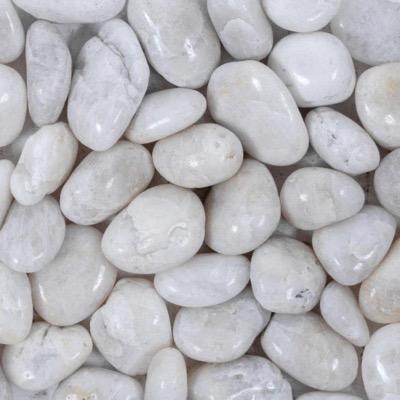
The first thing to know is that real marble is metamorphosed calcite or dolomite rock, so it should look like crystalline stone, not printed pattern. Examine the veining and color transitions closely. Natural marble usually has irregular movement, soft mineral blending, and depth inside the stone. Faux marble made from resin, ceramic print, or vinyl often has surface-level pattern that repeats or looks too graphic.

Temperature is a reliable home clue. Real marble feels cool to the touch and stays cool longer than plastic or resin. It also has a substantial weight for its size. Composite imitations may look convincing from a distance but often feel lighter and warmer.

Use the acid sensitivity test only with care on an unseen spot. Because marble is made mostly of calcite or dolomite, a drop of vinegar or lemon juice can etch it and may fizz slightly on calcite-rich pieces. That confirms carbonate stone, but it also damages the finish, so it should be avoided unless authenticity truly matters. A safer clue is that marble scratches more easily than granite. A steel blade or quartz piece may mark it, while glass can sometimes resist it.

Inspect the broken or unpolished underside if available. Real marble often shows a sugary crystalline texture or interlocking calcite grains rather than a homogeneous manufactured body.

Specific to marble, check for translucency in lighter varieties at thin edges and for natural veins that cut through the stone rather than sitting on top. If the pattern stops abruptly at a chipped corner or seems printed under a glossy coat, it is likely imitation. Real marble should look geologic all the way through, because the pattern comes from mineral impurities and recrystallization inside the rock itself.
Temperature

Natural Marble should usually feel cooler than plastic or resin on first touch and warm more slowly in the hand.

Scratch logic

Use 3 on the Mohs scale as the check, not internet myths. A real specimen should behave in line with the hardness listed above.

Surface and luster

Look for a vitreous to pearly surface quality rather than a painted or plastic shine.

Weight and density

The listed specific gravity is 2.7-2.8. If a specimen feels unusually light for its size, it may deserve a second look.

Geographic Origins

Where Marble forms in the world

Marble forms where limestone or dolostone is subjected to metamorphism, so major sources occur in mountain belts and metamorphic terranes. Famous localities include Carrara in Italy, Paros and Naxos in Greece, Makrana in India, Vermont and Colorado in the United States, and quarries across Turkey, Spain, Portugal, and China. Each region produces distinct colors and veining based on the original carbonate rock and the impurities present during recrystallization.

These places produce marble because tectonic pressure and heat during burial or mountain building cause calcite or dolomite grains to recrystallize into an interlocking mosaic. Clay, iron oxides, graphite, serpentine, and other impurities become bands, swirls, or colored zones. The result is a rock that can be stronger and more coherent than the original limestone while still remaining relatively soft compared with silicate rocks.

Carrara marble became famous because its original carbonate was exceptionally pure and recrystallized into a fine, luminous white stone ideal for sculpture. Makrana is similarly valued for high-quality white marble. Other regions produce green, black, red, or dramatically veined material because the source rock contained more impurities or experienced different fluid histories during metamorphism. Marble's geography is therefore a map of altered carbonate platforms and tectonic pressure zones, where old seafloor limestone was transformed into something finer grained and more unified.

FAQ

Frequently asked

No FAQs are available for this crystal yet.

References

Sources and citations

Source rows are not available for this crystal yet.

Closing Notes

Marble

Marble is what pressure and heat do to limestone when they have enough time to reorganize it. Its calcite recrystallizes into an interlocking mass, which is why it can feel both softer than quartz and more cohesive than the sedimentary rock it came from. That combination makes marble useful as a touchstone for solidity without sharpness.

In practice, people tend to use it when they want a cool smooth surface, a quiet neutral appearance, and a material that shows how compression can become structure rather than just strain. It carries calm partly because the grain has already settled into agreement.

Field Notes

Field Notes on Marble

Open Field Notes

Personal practice logs and shared member observations. Community notes are separate from Crystalis editorial guidance.

No shared notes under Marble yet.

When members save a public field note for this stone, it will appear here.

Bring it into practice

What to do with Marble next

Move from reference to ritual. Shop Marble, follow the intention path, build a bracelet, or try a Power Vial tied to the same energy.

The archive

Related crystals

Read the Full Crystal Guide

Continue through stones that share intention, chakra focus, or tonal family with Marble.