Crystal Encyclopedia
40+YEARS

Shaman Stone

FeO(OH) + Fe2O3 + SiO2 · Mohs 4 · aggregate · root Chakra

The stone of shaman stone: meaning, mineralogy, and somatic practice.

GroundingAncestral ConnectionProtectionInner Journeying

This page documents traditional and cultural uses of shaman stone alongside emerging research on tactile grounding objects. Crystalis does not claim that shaman stone treats, cures, or prevents any medical condition. For mental health concerns, consult a qualified professional.

Crystalis Editorial · 40+ Years · Herndon, VA

Origins: Utah, especially Navajo Sandstone localities in the American Southwest

Quick actions

Move from reference into practice

Crystalis

Materia Medica

Shaman Stone

The Earth Oracle

Shaman Stone
GroundingAncestral ConnectionProtection
Crystalis

Protocol

3-minute reset

Protocol steps have not been loaded for this entry yet.

tap to flip for protocol

Around one old center, the body has been laying down ring after ring until the knot can be felt from the outside. What started as loose grit is now a hard palpable mass, pressure organized into a stone.

What Your Body Knows

Nervous system states

Shaman Stone belongs to the belly, sacrum, low back, and the palpable masses of sensation built around one old center. It is an iron oxide concretion formed in sandstone as minerals in groundwater precipitated outward in layers, cementing loose grains into a single body. The nervous system recognizes this exactly. One unresolved knot can gather years of guarding around it until the pressure becomes dense, rounded, and familiar.

The pattern is chronic protective organization, often a blend of sympathetic guarding and dorsal immobilization. There is an old point of pain, fear, or unfinished defense, and the body has built around it rather than through it. The abdomen hardens around one memory. The low back carries a historic brace. The person may describe a ball, stone, plug, or lodged pressure that has shape more than storyline.

Shaman Stone gives the body permission to work with accretion instead of pretending the center is gone. In practice, placing it directly over the knot helps define edges. Once the edges are felt, breath can move around the mass rather than slam into it. That circumferential breathing is the mechanism. The nervous system stops treating the knot as an infinite threat and starts sensing it as finite structure built in time. When the body can feel the layers around a center, it can begin to release them in sequence. The center no longer has to disappear all at once for regulation to return.

Nervous system mapping has not been added for this crystal yet.

Nervous system mapping based on polyvagal theory (Porges, S.W. The Polyvagal Theory. Norton, 2011).

The Earth Made This

Formation: How Shaman Stone Becomes Shaman Stone

What most people get wrong about shaman stone is that they assume it is a crystal species. It is not. The material sold under that name is usually the same thing Mindat classifies as Moqui marble: an iron oxide concretion formed in sandstone, especially the Navajo Sandstone of Utah. That means the object is geological cementation around a center, not free crystal growth. Its round or paired shape comes from concretionary growth in porous sediment, not from a crystal lattice expressing faces.

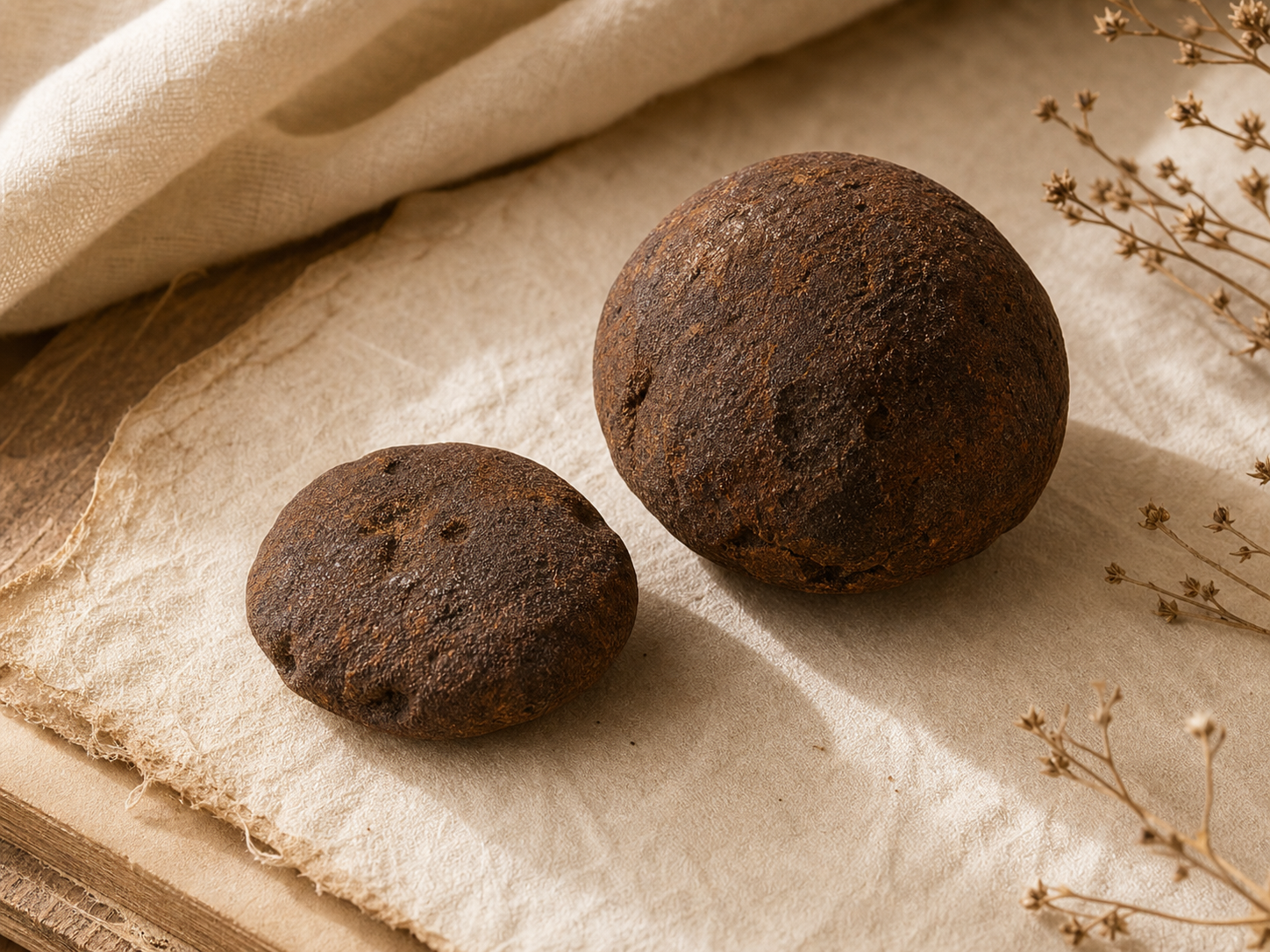
The standard composition is also routinely oversimplified. These concretions are not solid iron metal, and they are not marble in the metamorphic sense. They are sandstone bodies cemented chiefly by iron oxides and oxyhydroxides, commonly goethite with hematite and limonitic material, around or within a sand core. Some specimens show concentric internal shells that record repeated precipitation events as iron-bearing groundwater moved through the rock. The visual result is often a dark brown to black rind over a sandy interior, sometimes in naturally paired forms.

Calling them shaman stones is therefore a trade choice layered on top of a better geological description. The real identity is iron oxide concretion, often under the Moqui marble name. The word marble here is historical and misleading, because no metamorphic carbonate rock is involved. These are sedimentary concretions generated by groundwater chemistry, iron mobilization, and cementation in Jurassic sandstone. They matter as examples of concretionary growth, redox movement, and desert weathering, not as discrete mineral species. The record should state that clearly: shaman stone is an aggregate geological object made chiefly of goethite and hematite cementing sandstone.

Material facts

What the stone is made of

Shaman stone is best treated as an iron oxide concretion rather than a single mineral. Typical components are goethite, FeO(OH), and hematite, Fe2O3, cementing quartz sand, SiO2. Crystal system is therefore best listed as aggregate. Hardness varies with the balance of iron oxide cement and sandstone core, commonly around 4 to 6. Specific gravity ranges broadly from about 2.7 to 3.6. Luster is dull to earthy externally, locally submetallic on richer hematitic surfaces. Color is brown, reddish brown, dark brown, to black, with tan sandstone interiors where broken. Notable properties include concentric internal layering, spherical or discoidal concretionary form, natural paired growths, and formation in the Navajo Sandstone of Utah through groundwater-driven iron precipitation.

Deeper geology

Buried inside Jurassic dune sandstone, these concretions began with iron already dispersed at microscopic scale. The host rock is the Navajo Sandstone, an immense erg deposit laid down about 180 to 190 million years ago. Quartz sand grains in that sandstone were coated by thin hematite films during deposition and early burial, giving the rock its familiar red color. Later groundwater circulation rearranged that iron. The object sold as a Shaman Stone, Moqui marble, or Moqui ball is the hardened residue of that redistribution.

The first decisive stage was bleaching. While the sandstone remained deeply buried, reducing fluids carrying weak acids, hydrocarbons, hydrogen sulfide, or similar agents moved through its highly porous and permeable framework. Those fluids dissolved iron from the hematite coatings and turned sections of the sandstone from red to pink, yellow, or white. Utah Geological Survey summaries place much of that bleaching between about 65 and 25 million years ago, although some local episodes may have begun earlier. The iron did not disappear. It entered groundwater and traveled through the rock.

Then chemistry changed. When iron-rich reducing water mixed with more oxidizing groundwater, dissolved iron lost solubility and precipitated as iron oxide, chiefly hematite. The precipitate cemented nearby quartz grains into compact nodules and shells. Many concretions developed concentric layering, with a dark hematitic rind around more weakly cemented sandy interiors. Others merged into disks, buttons, pipes, or doublets depending on permeability pathways and local nucleation geometry. The precipitation itself likely occurred underground, hundreds of feet or more below the surface, and much of it appears to have taken place between about 25 and 6 million years ago.

Some studies also suggest that microorganisms may have assisted the conversion of dissolved iron to iron oxide after precipitation began, though the basic mechanism still depends on groundwater redox change rather than biology alone. The stone is therefore a geochemical artifact of fluid mixing in porous sandstone. It is not a meteorite, not a magmatic nodule, and not a primary iron mineral segregated directly from lava.

Pressure and temperature were modest. These concretions formed in shallow basin conditions during burial and later uplift, at near-surface geological temperatures and lithostatic loads far below metamorphic regimes. Time and fluid volume did the work that heat did not. Utah Geological Survey material emphasizes that a single concretion requires water volumes many times greater than its own size, because only small amounts of dissolved iron are available in any given parcel of fluid.

Exposure came last. As the Colorado Plateau uplifted and erosion stripped away overlying strata, the hardened concretions weathered free from softer bleached sandstone and accumulated on the ground. Their resistance to erosion is simply a consequence of iron oxide cement. The commercial name Shaman Stone is modern. The formation process is ancient groundwater mineralization written into desert sandstone.

Mineralogy

Mineral specs

Chemical Formula

FeO(OH) + Fe2O3 + SiO2

Crystal System

aggregate

Mohs Hardness

4

Specific Gravity

2.7-3.6

Luster

earthy to dull, locally submetallic

Color

brown, reddish brown, dark brown, black with tan sandstone interior

Sacred Match Notes

When this stone becomes the right door

Sacred Match prescribes Shaman Stone when you report: a palpable knot in the low belly, a hard round pressure in the low back or sacrum, tension that has organized around one old injury site, the sense of carrying a lodged mass during grief, breath that stalls when it reaches a specific spot, and longstanding bracing that feels older than the current situation.

Sacred Match prescribes through deep pattern recognition. The diagnostic often reveals chronic protective organization built by accretion around a core issue. Rather than diffuse stress, the body has formed a distinct center with layers of guarding around it. Shaman Stone enters when the system needs to name the concretion and work with its edges.

A belly knot maps to the need for circumferential breath around a center. Sacral pressure maps to the need for grounded support beneath an old load. Injury-centered tension maps to the need to separate present tissue from historical defense. Grief mass maps to the need for slow release around a core attachment. A stalled breath maps to the need for sequencing rather than force.

3-Minute Reset

3-Minute Reset

Protocol duration pending

3-Minute Reset steps have not been loaded for this crystal yet.

Mineral Distinction

What sets Shaman Stone apart

First, separate the brand from the object. "Boji Stone" is a trademarked marketing name. "Shaman Stone" is often used more loosely for similar-looking iron-rich concretions. That means two visually similar pairs of stones may not be the same thing in legal naming, mineral makeup, or source.

The confusion is Shaman Stone vs Boji Stone vs ordinary concretions. The definitive test starts with honesty about what can and cannot be proven from appearance alone. Many so-called Boji Stones are pyrite and marcasite concretions, often with limonite alteration. Ordinary iron concretions can look similar but be compositionally broader and less specific. If a seller promises every rough brown-black concretion is a Boji Stone, that is not mineral identification. That is branding. A proper answer needs provenance, and ideally mineral testing if the claim matters.

Why it matters: you may be paying for a trademark story rather than a distinct mineral species. If you want the branded item, ask for the source and paperwork. If you only want the general type, call it what it is: an iron sulfide or iron-rich concretion unless proven otherwise. That protects you from inflated pricing and from thinking a marketing label equals a geological classification. It does not.

Care and Maintenance

How to care for Shaman Stone

Shaman Stone is generally safe with brief water contact, but repeated soaking is not ideal. Although the concretion is cemented by iron oxides, the host texture is still sandstone-based, which means prolonged moisture can weaken friable edges, encourage flaking, or bring out clay residues. If it gets wet, dry it thoroughly before storing.

Clean it gently with a dry brush, soft cloth, or slightly damp wipe. Avoid aggressive scrubbing, detergents, acids, and oiling. Acids can react with iron-rich surfaces or any associated carbonate material, while oils can darken the piece artificially and trap dust. Ultrasonic cleaners are a bad choice because the object may contain natural internal weaknesses.

Sun exposure is usually not a major issue, but cycles of outdoor wetting, heating, and freezing can speed cracking, especially for porous or weathered specimens. Store indoors in a dry place. A padded shelf or box is useful because edges and protrusions can chip if knocked against harder stones.

The material itself is not considered toxic to handle, but iron-rich dust and sandstone dust should not be inhaled. Do not grind or cut it casually. If the piece sheds loose grit, keep it in its own pouch or tray so residue does not scratch polished objects nearby.

Best care is low intervention. Keep it dry most of the time, dust it rather than wash it, and let the natural roughness remain. This is a material whose authority comes partly from weathered texture, so over-cleaning usually removes character rather than improving it.

Crystal companions

What pairs well with Shaman Stone

Obsidian

Mass with a blade nearby. Shaman Stone is an iron oxide concretion grown outward in layers around a center, while obsidian helps define what the center actually is. Together they support work with old knots that have become palpable and organized over time. Place Shaman Stone on the densest point in the belly or back body and hold obsidian in the dominant hand.

Smoky Quartz

Concretion with drainage. Shaman Stone names the accumulated mass, and smoky quartz offers a route for what loosens to move downward. This pairing is useful when pressure has been organizing around one old issue and now needs gradual release without scattering. Place Shaman Stone over the lower abdomen and smoky quartz between the knees or at the feet.

Hematite

Iron with iron. Both materials bring heaviness and contact, but Shaman Stone adds the logic of accretion while hematite adds simple ballast. Together they support a body that needs to feel the boundary of an old knot without becoming swallowed by it. Place Shaman Stone on the sacrum or solar plexus and hematite in both palms.

Cookeite

Old core with layered softening. Shaman Stone holds the history of minerals precipitating outward around a center, and cookeite helps the surrounding tension separate into workable sheets. The pairing supports slow unpacking around long-held pressure. Place Shaman Stone on the most palpable knot and cookeite across the diaphragm.

In Practice

How Shaman Stone is used

People use Shaman Stone mainly as a holding object, desk object, or display piece because its strongest qualities are mass, roughness, and shape. Unlike polished stones that invite sliding touch, a concretion invites grip. The hand can wrap around ridges, pits, and lobed surfaces, which produces strong tactile feedback through the fingers and palm. That kind of coarse, irregular contact can be especially grounding for someone whose attention is scattered, because the body has more surface information to map.

Its weight also matters. A dense iron-rich concretion gives the hand and arm a small but noticeable load, which can create a sense of downward pull and containment. The mechanism is somatic, not symbolic. Heavier rough objects often help the body orient more effectively than light smooth ones because they provide clearer proprioceptive input.

Visually, Shaman Stone is used when people want something that looks geologic, old, and formed by process rather than polish. It works well in spaces built around natural textures such as wood, linen, clay, bone, or weathered metal. The rounded mass and rusty surface can anchor a display without drawing attention through sparkle.

Collectors also value these concretions as evidence of how groundwater can organize loose sediment into coherent forms. That makes them good teaching specimens. Even outside any spiritual framing, the use case is compelling: a naturally sculptural sandstone concretion that gives strong hand feel, visible density, and a clear sense of accretion over time.

Verification

Authenticity

Real Shaman Stone is usually an iron oxide concretion from sandstone, often brown, reddish brown, blackened, or rusty on the surface, sometimes in paired or oddly sculptural forms. Start with texture. Genuine pieces usually have a natural gritty, earthy, or pitted exterior, not the slick uniform finish of resin or dyed ceramic. If the object looks airbrushed or artificially antiqued, be cautious.

Weight is a strong clue. These concretions are denser than plain sandstone because iron oxides cement the grains together. They should feel solid and somewhat heavy for their size, though not metallic. Plastic or hollow fakes feel too light. Real pieces also feel cool initially, then warm gradually in the hand.

Inspect the surface closely. Natural concretions often show small pits, grainy inclusions, irregular weathering, and color variation from orange rust to dark brown or black. A fake may have repeated texture, mold seams, or identical paired shapes across multiple pieces. Nature makes odd forms, but not identical inventory.

A simple scratch clue helps. The surface should not gouge like clay or crumble like unfired ceramic if pressed with a fingernail. Some sandy grains may loosen from weathered areas, but the piece overall should feel cemented. If you rub it on unglazed ceramic and it leaves a reddish brown streak, that can support the presence of iron oxides, though this is better done only on an inconspicuous area.

A specific-to-material test is the broken-surface check on already chipped areas. Authentic concretions often show sandstone grains locked together by iron-rich cement and may reveal concentric growth or denser cores. They should look geological inside, not hollow, foamed, or homogeneous like cast resin. Real Shaman Stones usually look as though groundwater slowly built them, because that is exactly what happened.
Temperature

Natural Shaman Stone should usually feel cooler than plastic or resin on first touch and warm more slowly in the hand.

Scratch logic

Use 4 on the Mohs scale as the check, not internet myths. A real specimen should behave in line with the hardness listed above.

Surface and luster

Look for a earthy to dull, locally submetallic surface quality rather than a painted or plastic shine.

Weight and density

The listed specific gravity is 2.7-3.6. If a specimen feels unusually light for its size, it may deserve a second look.

Geographic Origins

Where Shaman Stone forms in the world

Shaman Stones are commonly sourced from the Navajo Sandstone of the American Southwest, especially Utah, where iron oxide concretions formed within porous Jurassic desert sandstone. Similar iron-rich concretions occur elsewhere, but the trade name is strongly tied to this region and to weathered forms collected from sandstone landscapes and dry washes.

These objects form when groundwater carrying dissolved iron moves through porous sandstone and begins precipitating iron oxides around a nucleus such as an organic fragment, mineral grain cluster, or chemical irregularity. Over time, the precipitated iron cements the surrounding sand grains into a harder nodule than the host rock. Later weathering erodes the softer sandstone away and leaves the concretion behind.

The Navajo Sandstone is especially suited to this process because it is thick, porous, and laterally extensive, with well-developed groundwater pathways and abundant iron available for mobilization and redeposition. The arid climate of the Colorado Plateau then helps expose the concretions once erosion frees them from the surrounding rock. That is why these forms are so characteristic of the region. Their shape reflects both internal mineral growth and external desert weathering, which together create the rounded, often paired masses that people recognize in the trade as Shaman Stones.

FAQ

Frequently asked

No FAQs are available for this crystal yet.

References

Sources and citations

Source rows are not available for this crystal yet.

Closing Notes

Shaman Stone

Shaman Stone has impact because its form is built, not carved by theory. As an iron oxide concretion in sandstone, it records slow mineral precipitation around a center, which gives it its rounded mass and layered authority. That makes it useful for people who respond to weight, roughness, and the sense of something having organized itself under pressure.

In practice, it often serves as a strong tactile anchor, a reminder that structure can grow gradually around what once felt loose and uncontained. Its force comes from accumulated density rather than polish. That is why the material tends to feel convincing in the hand.

Its geology and its practical use say the same thing at the same time.

Field Notes

Field Notes on Shaman Stone

Open Field Notes

Personal practice logs and shared member observations. Community notes are separate from Crystalis editorial guidance.

No shared notes under Shaman Stone yet.

When members save a public field note for this stone, it will appear here.

Bring it into practice

What to do with Shaman Stone next

Move from reference to ritual. Shop Shaman Stone, follow the intention path, build a bracelet, or try a Power Vial tied to the same energy.

The archive

Related crystals

Read the Full Crystal Guide

Continue through stones that share intention, chakra focus, or tonal family with Shaman Stone.